From Animal to Mineral

Judith Adelmann, Rachel Fäth, Sophia Mainka, Hannah Mitterwallner, Jonathan Penca, Maria VMier

15.12. 2023 – 18.02.2024

Lothringer Halle, Lothringer Str. 13, 81667 München
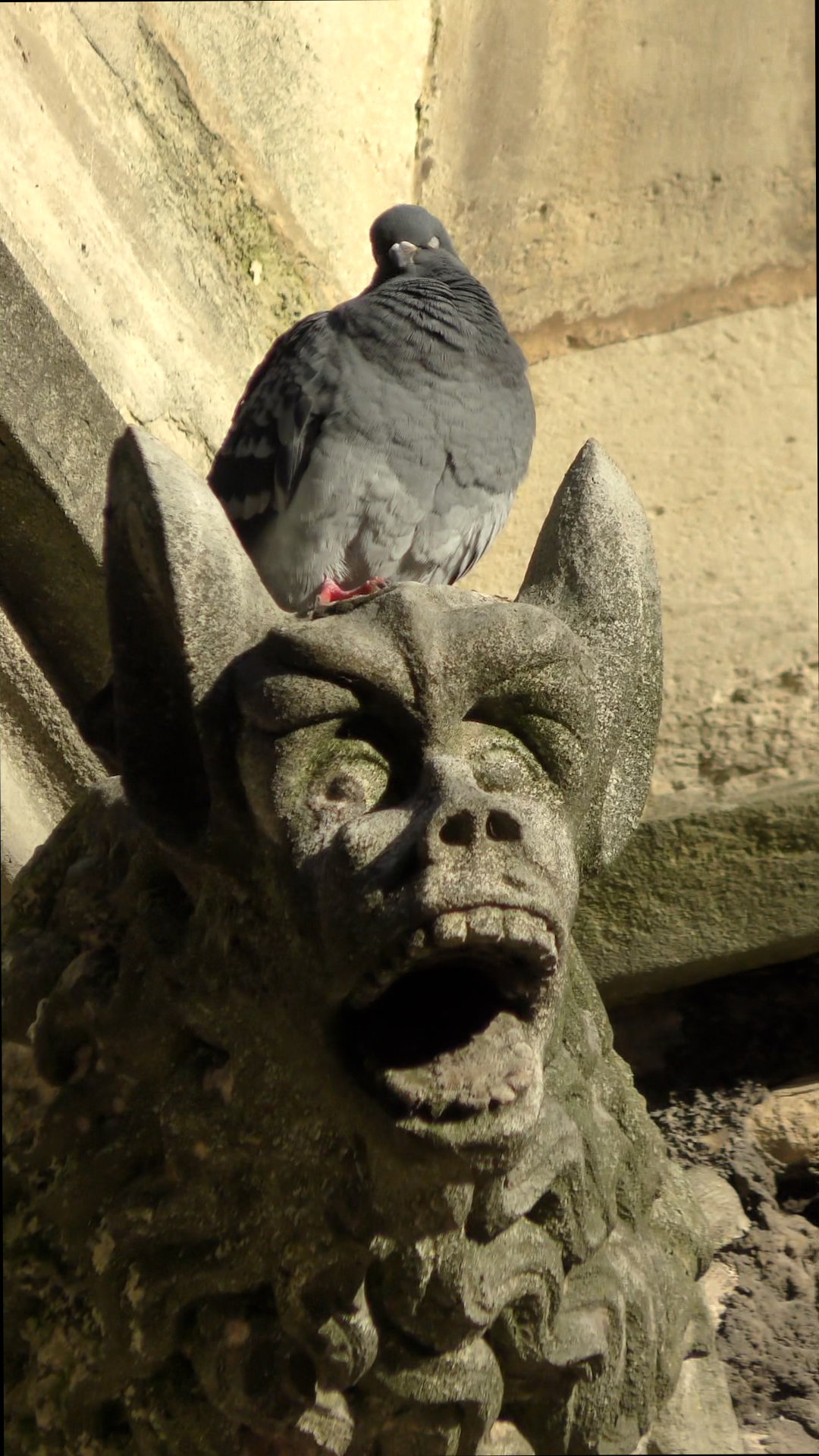
Filmstill_Mainka_HabitLoss(1)


“Animals” are wolves mainly, rats and the wasp. “Mineral” is everything imperceptible: elements, particles and molecules. To go from animal to mineral is to experience becoming, to step across a threshold and change. 

I began my reading of A Thousand Plateaus, specifically the chapter “1730: Becoming-Intense, Becoming-Animal, Becoming- Imperceptible …” 1 during the corona pandemic, when environmental concerns were at the forefront of almost every media discussion. Defining humanity’s role in nature seemed like an important task and Deleuze and Guattari’s work was useful in addressing the too easy distinction between nature and culture. I liked how Deleuze and Guattari saw the dominance of our species over others as a philosophical problem of autonomy where Man as a thinking being is subject only to the laws of his own construction. For them, the capacity for conscious thought conferred upon Man a dignity denied to other creatures, making their voices unheard. 

Whereas, in A Thousand Plateaus Deleuze and Guattari present nature as an endless variability, the “whole thousand-voiced multiple” of Difference and Repetition 2. Here, nature is a multi-voiced body, where the voices constituting this body resound in each other in a “clamor of Being.” In this din, my voice is one of many and many voices resonate in mine 3. For Deleuze and Guattari, to change the human collective relation, not just to animals, but to earth itself, would demand that we stop hearing just our own voice and become aware of the noise of others. This is the experience of becoming-animal, becoming-imperceptible. It is to shed Man’s mantle and learn how to listen, becoming the voice of many. 

Since 2021 I have realised a series of exhibitions at various locations in responses to different aspects of this chapter of A Thousand Plateaus, whether to its ideas of nature, technology or memory. This exhibition at Lothringer 13 Halle confronts the idea of becoming, specifically in our relation to nature, more directly. In different ways all the artists participating in this exhibition share these concerns, many acutely aware of working in the era of the Anthropocene, where the human impact on the planet can no longer be denied.

To their cluster of voices I add my own, belonging to the writer. The texts I have written over the past few years in response to Deleuze and Guattari’s chapter on becoming are on display throughout the room. The texts resonate with the artwork, and the art inhabits the text. The exhibition is an experiment in the construction of a multi-voiced population, a pack of wolves, a people of rats. 

Magdalena Wisniowska, November 2023

1) Deleuze, Gilles and Guattari, Félix, A Thousand Plateaus, trans. Brian Massumi, (Minneapolis, London: University of Minesota Press, 2005).
2) Deleuze, Gilles, Difference and Repetition, trans. Paul Patton (New York: Columbia University Press, 1994), 304.
3) Ibid.

Electric bodies shooting through space

Janna Jirkova

25.11 – 30.12.2022

Lothringer 13 Studio, Lothringer Str. 13, 81667 München

TALK: Stephen Zepke with Magdalena Wisniowska on Zoom, 29.12.2022

FINISSAGE: Friday, 30.12.2022, 5-8pm

GiG Munich is happy to be hosting Stephen Zepke on Zoom on the 29th of December at 7pm. Stephen Zepke is a philosopher and independent researcher, teaching Philosophy at the University of Vienna, Austria. He has published numerous essays on philosophy, art and cinema. He is the author of Art as Abstract Machine: Ontology and Aesthetics in Deleuze and Guattari (Routledge, 2005) and the co-editor of two books: Deleuze, Guattari and the Production of New (Continuum, 2008) and Deleuze and Contemporary Art (Edinburgh University Press, 2010). His research interests are: contemporary aesthetics and (bio)political theory.

During the meeting we will be discussing the current exhibition and the concepts of virtuality associated with it. The meeting is open to all: please contact me for the details.

Reading the Air

Kalas Liebfried

19.11.2021 – 21.01.2022

Kalas Liebfried, Reading the Air, 2021, installation view

Kalas Liebfried, Reading the Air, 2021, installation view

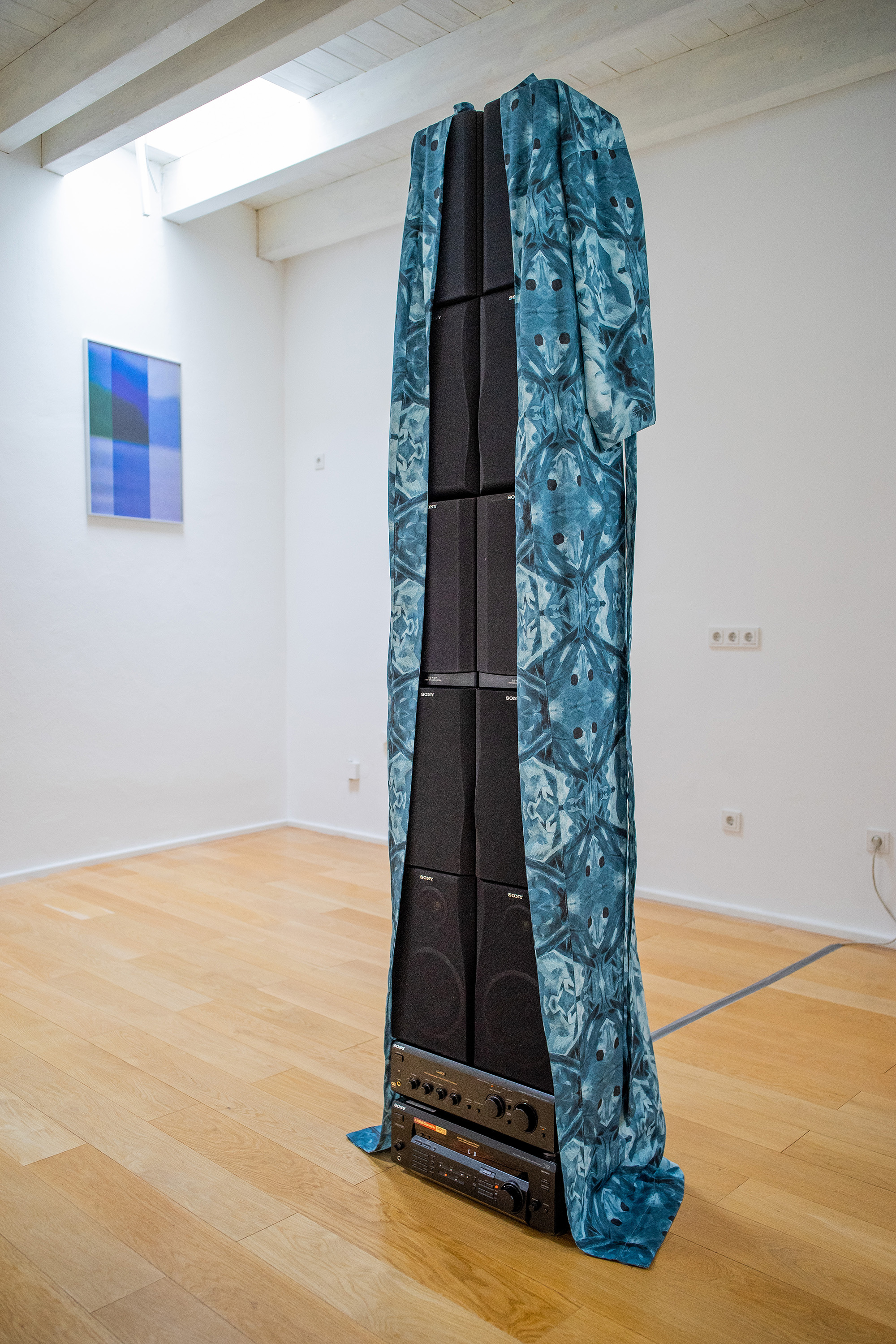
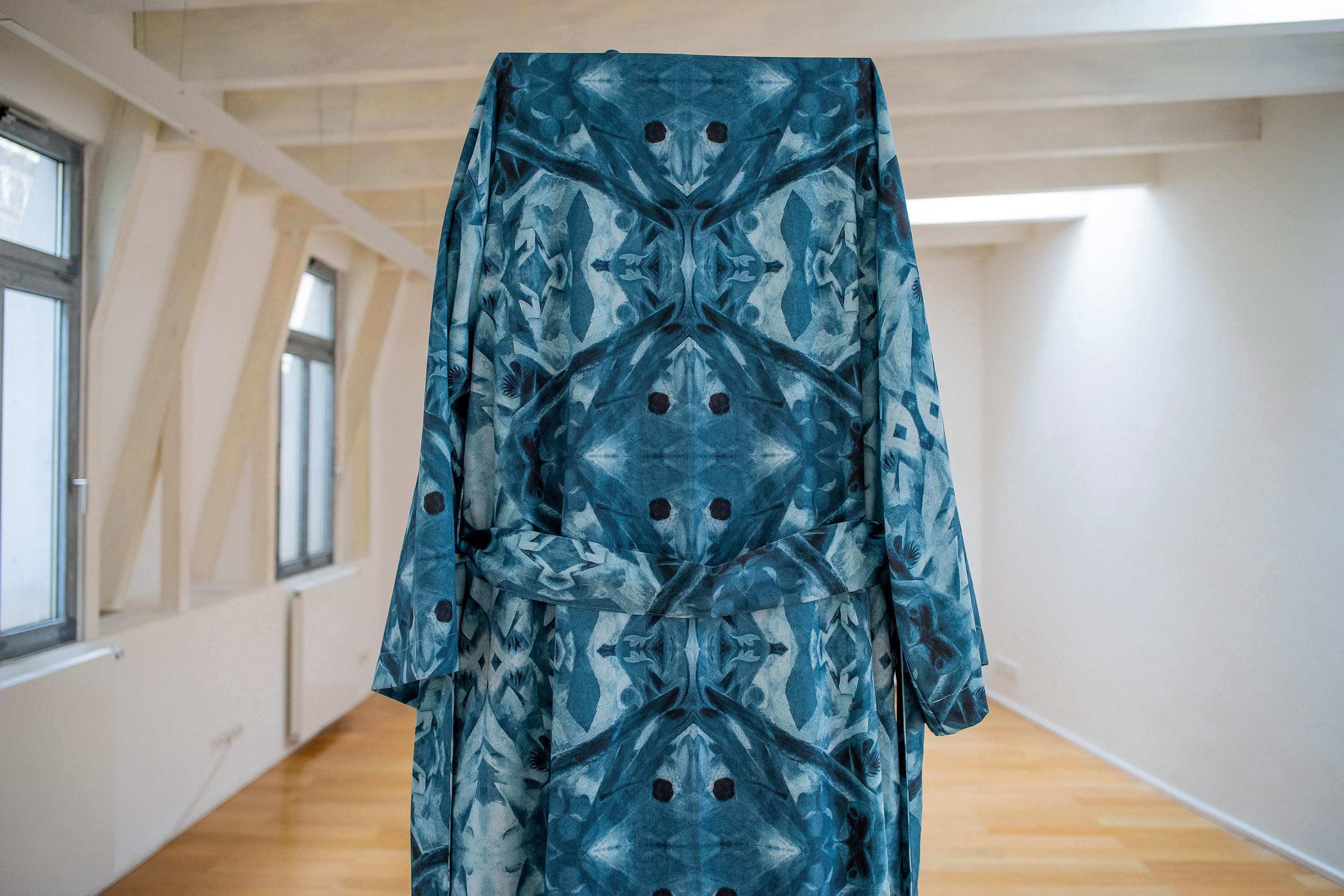
Kalas Liebfried, Sonic Ghost (Franz Marc In The Jungle, Breathing), 2021 custom made kimono, hi-fi system, speaker

Kalas Liebfried, Sonic Ghost (Franz Marc In The Jungle, Breathing), 2021 custom made kimono, hi-fi system, speaker

Kalas Liebfried, Sonic Ghost (Franz Marc In The Jungle, Breathing), 2021 custom made kimono, hi-fi system, speaker

Kalas Liebfried, Reading the Air, 2021, installation view

Kalas Liebfried, Death Mask (Choromatsu Listenining To ‘In the Air Tonight’), 2021 silicon, hair, headphones, mirrors, wooden box and stand 

Kalas Liebfried, Death Mask (Choromatsu Listenining To ‘In the Air Tonight’), 2021 silicon, hair, headphones, mirrors, wooden box and stand 


Kalas Liebfried, Death Mask (Choromatsu Listenining To ‘In the Air Tonight’), 2021 silicon, hair, headphones, mirrors, wooden box and stand 

Kalas Liebfried, Death Mask (Choromatsu Listenining To ‘In the Air Tonight’), 2021 silicon, hair, headphones, mirrors, wooden box and stand 

Kalas Liebfried, Death Mask (Choromatsu Listenining To ‘In the Air Tonight’), 2021 silicon, hair, headphones, mirrors, wooden box and stand 

Kalas Liebfried, Death Mask (Choromatsu Listenining To ‘In the Air Tonight’), 2021 silicon, hair, headphones, mirrors, wooden box and stand 

Kalas Liebfried, Death Mask (Choromatsu Listenining To ‘In the Air Tonight’), 2021 silicon, hair, headphones, mirrors, wooden box and stand 

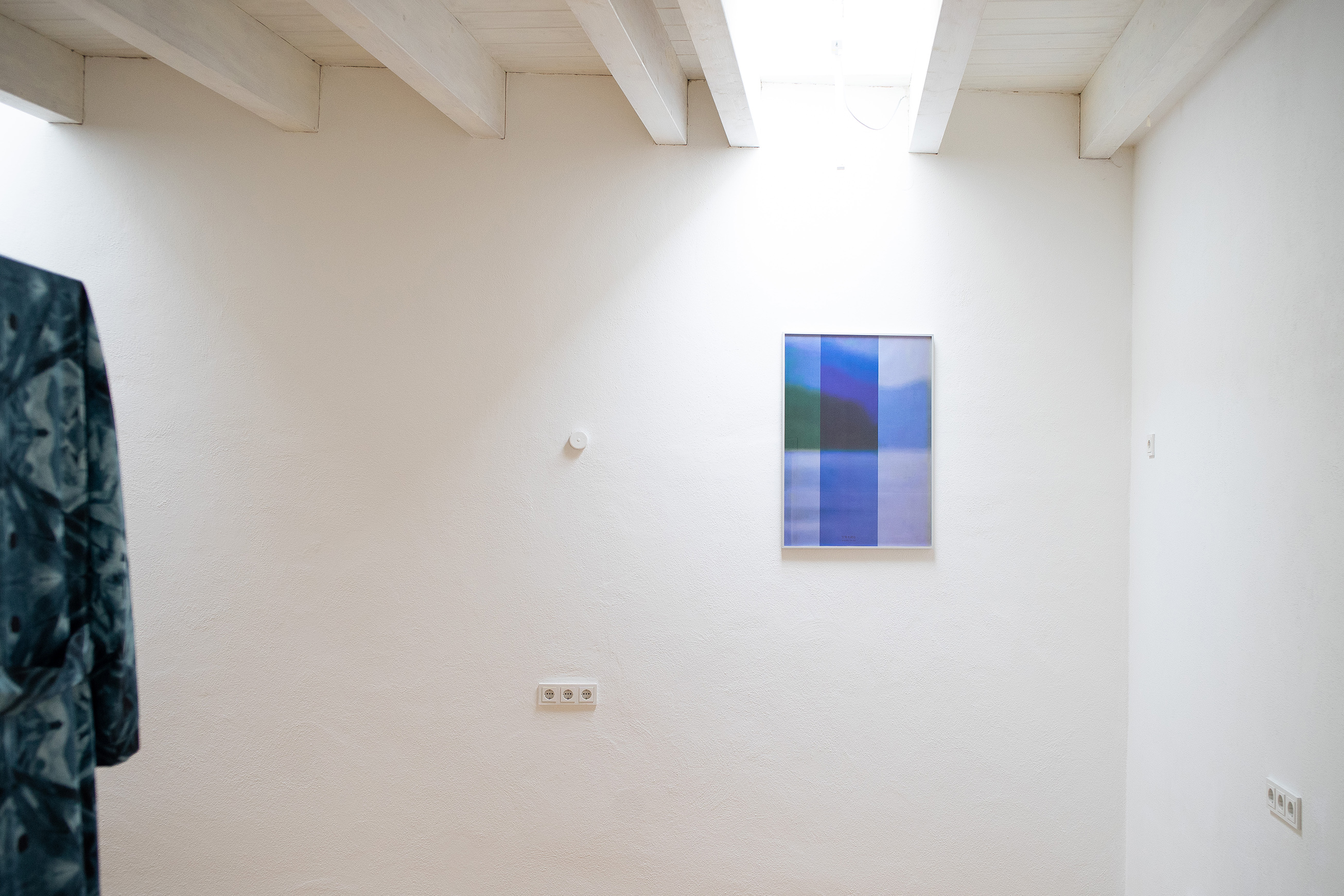
Kalas Liebfried, Japanese Landscape (Blue Screen Ambience), 2021 print on affiche paper, aluminium frame
Edition of 20 (+2AP)

Kalas Liebfried, Japanese Landscape (Blue Screen Ambience), 2021 print on affiche paper, aluminium frame
Edition of 20 (+2AP)

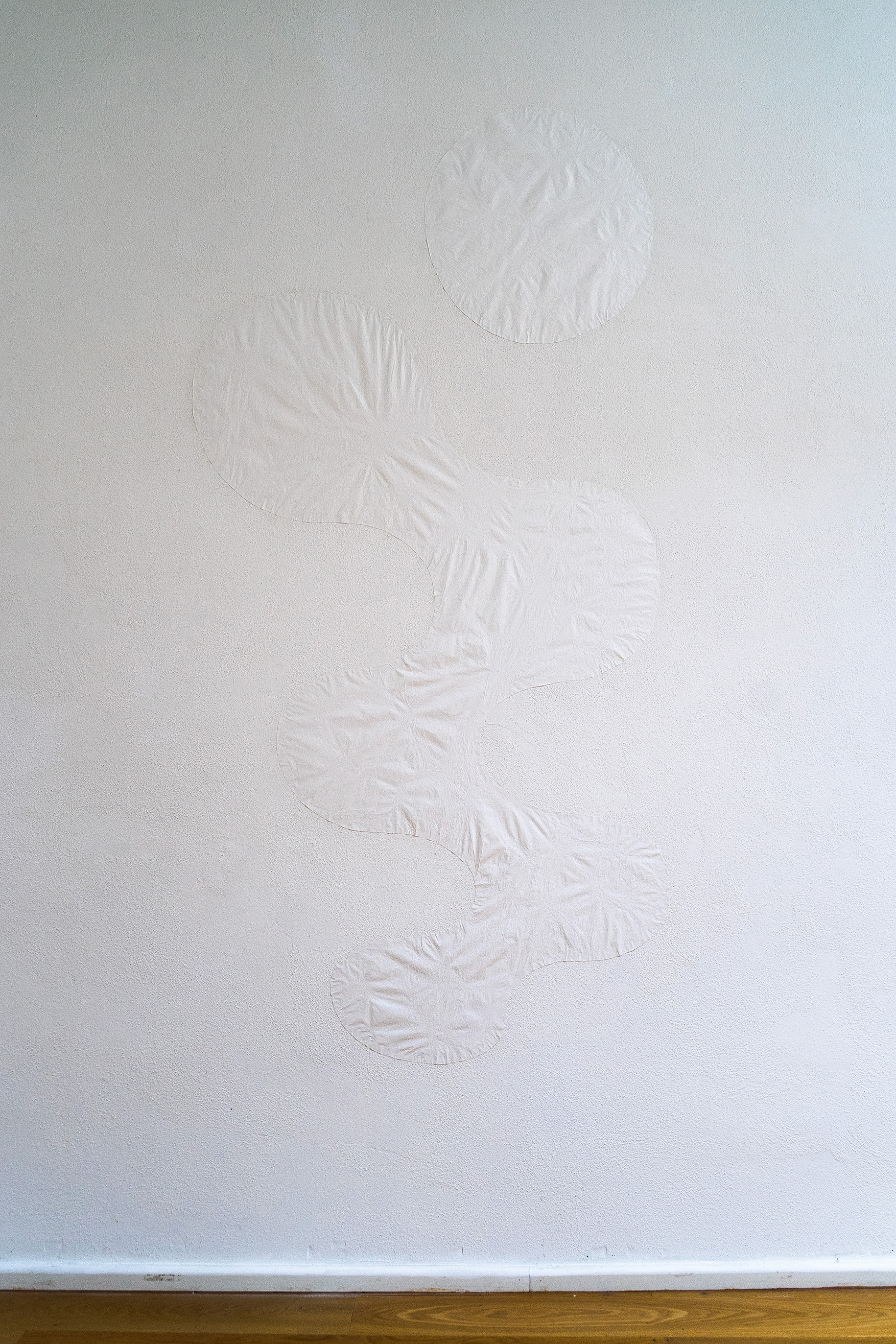
Kalas Liebfried, Skinning (Walkman Emblem), 2021 silk paper, varnish
Edition of 3 (+1AP)

Kalas Liebfried, Skinning (Walkman Emblem), 2021 silk paper, varnish
Edition of 3 (+1AP)

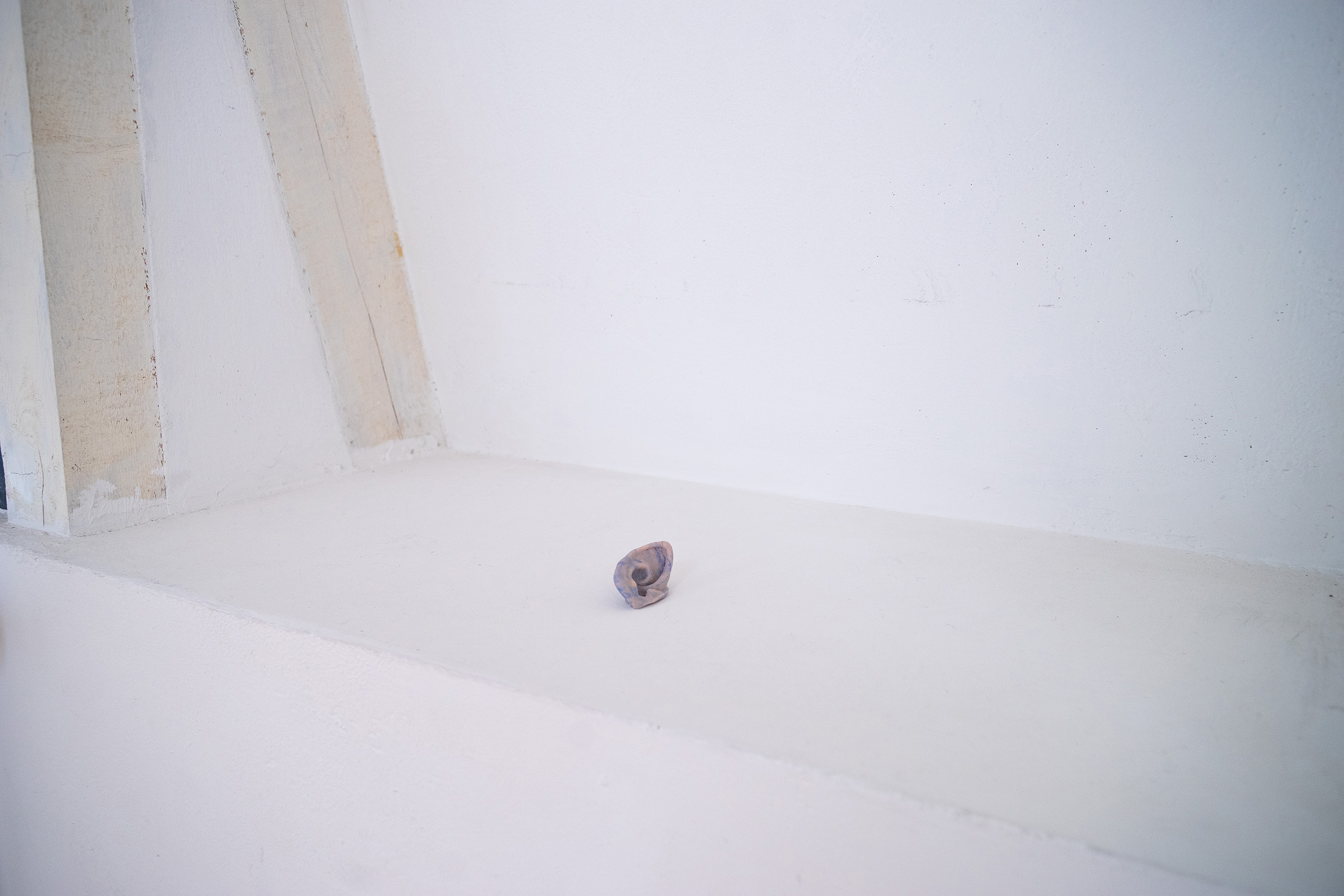
Kalas Liebfried, Marbled Evolution (Choromatsu‘s Ear), 2021 silicon, Edition of 10 (+2AP)


Photography: Mathias Reitz Zausinger

When we first see Choromatsu, the monkey starring in Sony’s groundbreaking commercial, he is standing still, eyes closed, listening to music on his walkman. He seems at peace, lost in his hidden inner world. He breathes deeply and slowly. We then read in subtitles below, ‘The progress in sound continues, but what about mankind?’ For music can now be everywhere. Not limited to the concert hall or the family piano, the radio or the hifi, it is now outside, with us, in nature.

For Kalas Liebfried, this is the point at which music becomes truly impressionist, catching up with the history of art. Impressionism in painting was in part a consequence of artists, who with the help of the then newly developed tubes of paint, taking their easels outside and painting en plein air. Impressionism for him is thus less about a technique or style of painting and more about bringing the outside in, or rather the inside out. 

This inside longing for the outside is what Adorno means when he writes after Kant, 

Authentic artworks, which hold fast to the idea of reconciliation with nature by making themselves completely a second nature, have consistently felt the urge, as if in need of a breath of fresh air, to step outside of themselves. Since identity is not to be their last word , they have sought consolation in first nature: Thus the last act of Figaro is played out of doors (…)

Art can be a copy of nature, in that something, anything, can be painted or drawn from life. But in the Kantian aesthetics Adorno is working with, art is like nature, because the aesthetic experience of art is based on and is the same as the aesthetic experience of natural beauty. Already when we experience nature as beautiful, we experience it as something more than it is, an image if you will. The nature that we see and feel is both the same nature as always and yet different, because it is beautiful for us. For art to share in the beauty of nature it must also have this ‘more’ and become in this way a ‘second nature’. Art that must be both itself and an excess, steps outside of itself, and this is why it seeks nature, even if, as Adorno mentions, it is only by staging Mozart’s Marriage of Figaro’s fourth act in the moonlit garden.  In nature, art can take a breath. It breathes. 

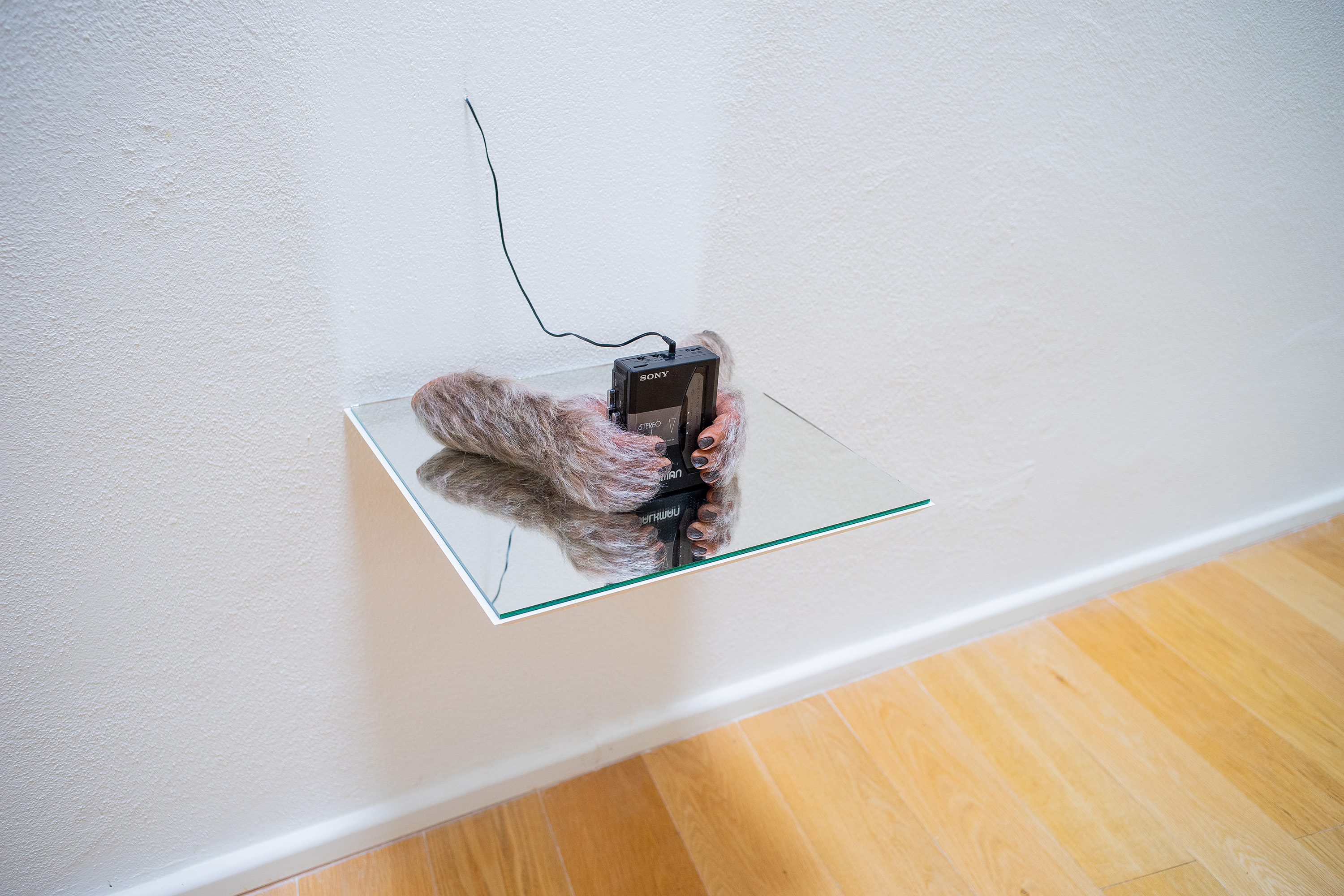
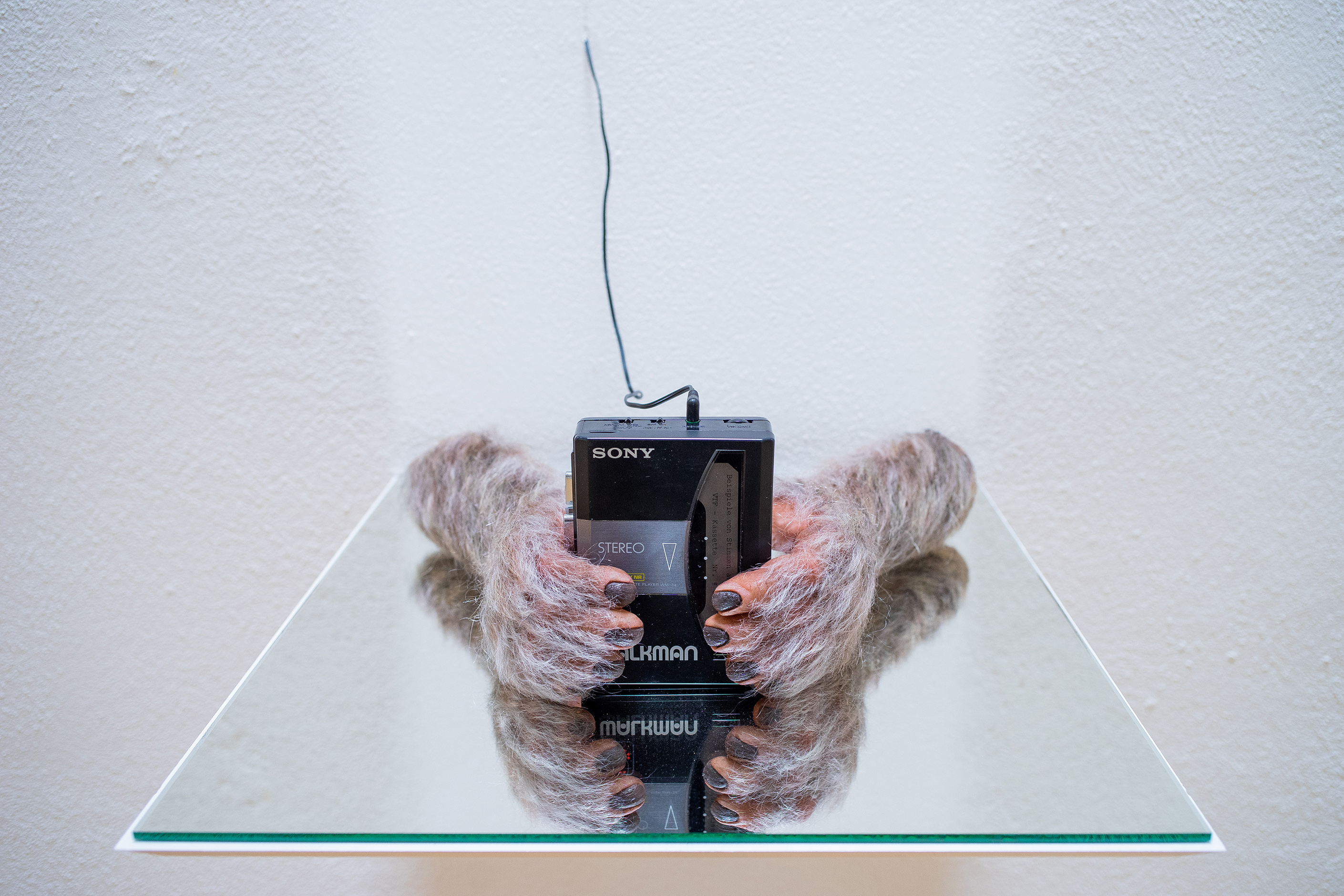
The advert for Sony’s walkman marks a moment in time in which the reconciliation between art and nature that Adorno had deemed impossible, seemed almost tangible: a rare moment of technological joy and optimism. Liebfried’s exhibition ‘Reading the Air’ is a reminder of the tangibility of this reconciliation. We see a hyperreal Choromatsu, listening with his headphones; we see his hands holding the walkman. And what we hear is the inside that always surrounds us – that we bring with us outside. This is the sound of our own breath, air rushing through the canal of our inner ear. 

SWAB Barcelona Art Fair

Jane Hayes Greenwood, Lukas_Hoffmann_

7.10 – 10.10.2021

From the 5.10.2021 GiG Munich will be away, doing the SWAB fair in Barcelona Spain with Lukas Hoffmann and Jane Hayes Greenwood. Come and visit us at our stand, Booth S4, or have a look online, on the website or on SWAB’s instagram profile. During this time the work will be also available to view on GiG Munich’s Artland page. 

Low Affinity

Johanna Strobel

CANCELLED

16.07. – 3.09.2021

Sadly, the exhibition will have to be postponed till further notice. The work was lost in the post. Hopefully we can make the exhibition happen later in the year, most likely in October. We apologise for the inconvenience caused.

GiG Munich is happy to present the next instalment of the series Thinking Nature, featuring new work by Johanna Strobel. For her solo exhibition low affinity, Johanna Strobel creates rhizomatic macramé-like structures from USB extension cords, using them to power her plexiglas and paraffin sculptures.

Entropy, the fact that once the USB 2.0 cable exceeds a certain length information gets lost while power still remains, forms the central component of this work. It ties together the ancient idea of ‘ether’ as a medium through which light travels, the fluid physics of translucency, and the decorative and practical craft of knot-making. Her practice is informed by her background in science, and explores such unwieldy concepts like time and space, information and entropy, language, the creation, attribution or suspension of meaning and the everyday perception and precipitation of these concepts in mundane life.

Johanna Strobel is an interdisciplinary artist from Germany, currently based in New York. She holds degrees in Information Science and Mathematics and graduated in painting and graphics from the Academy of Fine Arts Munich with Honors (Meisterschuelerin of Gregor Hildebrandt) in 2017. In 2020 she received her MFA from Hunter College New York (New Genres). Since then she has participated in numerous exhibitions in Germany, Italy, Taiwan and the US, with a solo exhibition at the Municipal Museum Cordonhaus Cham, 2019. In 2020 her work was included in The Immigrant Artist Biennial, New York, USA, Jahresgaben, Kunstverein Munich, Germany and featured online by Hauser & Wirth. Johanna was a fellowship artist in residence at NARS Foundation, Brooklyn in 2021.

The exhibition will include an online discussion event with Dr. Beth Lord, Professor of Philosophy, School of Divinity, History, Philosophy and Art History at the University of Aberdeen.

Maria VMier

Vier

12.10 – 23. 11. 2019


fullsizeoutput_12af


Opening: 12.10.2019, 7 – 9 pm

Reading by the artist: 8 pm


GiG Munich is excited to present the exhibition, ‘Vier’ by Maria VMier, artist and collaborator, known for her work with Ruine München and the Hammann von Mier Verlag. VMier’s multidisciplinary practice has two distinct aspects. On the one hand there is her performative work, with its postfeminist, social and political references, on the other, her formal, abstract drawings on paper. For her GiG Munich exhibition she shows both – performance and drawing – developed during her recent residency in Uckermark, near Berlin, as part of the Libken e.V. Kunst & Umwelt fellowship.

The work is made in response to her remote location in Uckermark and the concept of nature, as well as our relation to it, forms a large part of exhibition. With her performance VMier acknowledges the feminist approaches to ecological concerns, endorsing an ecofeminism that demonstrates the close ties between the structures of capitalism, patriarchy and the disenchantment of nature. With her drawings, she subverts the traditional place of nature in aesthetic discussions of art. Utilising an abstract language of expressive signs, she shows that to identify with nature in the work of art need not be the privilege of the male genius, but can be rather, a postfeminist critical gesture.

On Repeat. Cosmetic.wished.explorer

GiG Munich is pleased to present the new video work – Cosmetic.wished.explorer – by Jenny Dunseath, done specifically for the upcoming ‘On Repeat’ show.


Cosmetic.wished.explorer (2018)

Digital film embedded in GIG website for duration of the show.

Duration: 25 seconds

The film cosmetic.wished.explorer raises questions and discussion about the nature of authorship, appropriation, language and interpretation, exposing categories of truth and error. It is a palimpsest of presentations, and positions. Using the advances of current technology, perhaps this is a version of Spatium, the cosmic analogue of the Idea and the mechanism of abstract relations becoming actualised?

The film was made using Google Translate’s instant camera translation app. The app is designed to translate text from signs, handwritten notes, printed menus etc. by just pointing your camera. But what happens if it is used to ‘translate’ non-textual information?

When pointed at buildings (with no text to decipher) the app attempted to ‘translate’ the building in front of it and revealed a magical quality by virtue of its translation of nothing into a different time and place. The unpredictable effect of producing deciphered gibberish revealed a unique series of language constructs.

The title refers to the 3-word location of the filmed building. The 3 words generated from what3words is a new simple method used to describe global locations. In it, the world has been divided into a grid of 3m x 3m squares and each one assigned a unique 3-word address. It proposes that the system enables anyone can accurately find any location and share it more quickly, easily and with less ambiguity than any other system. It uses grid and language to reveal, classify and order.


Save the date: On Repeat!

21st September – 26th October

Alasdair Duncan, Jenny Dunseath, Jonah Gebka, Jane Harris, Melina Hennicker, Steffen Kern, Claudio Matthias Bertolini, Michael Schmidt, Amanda Ure, Magdalena Wisniowska

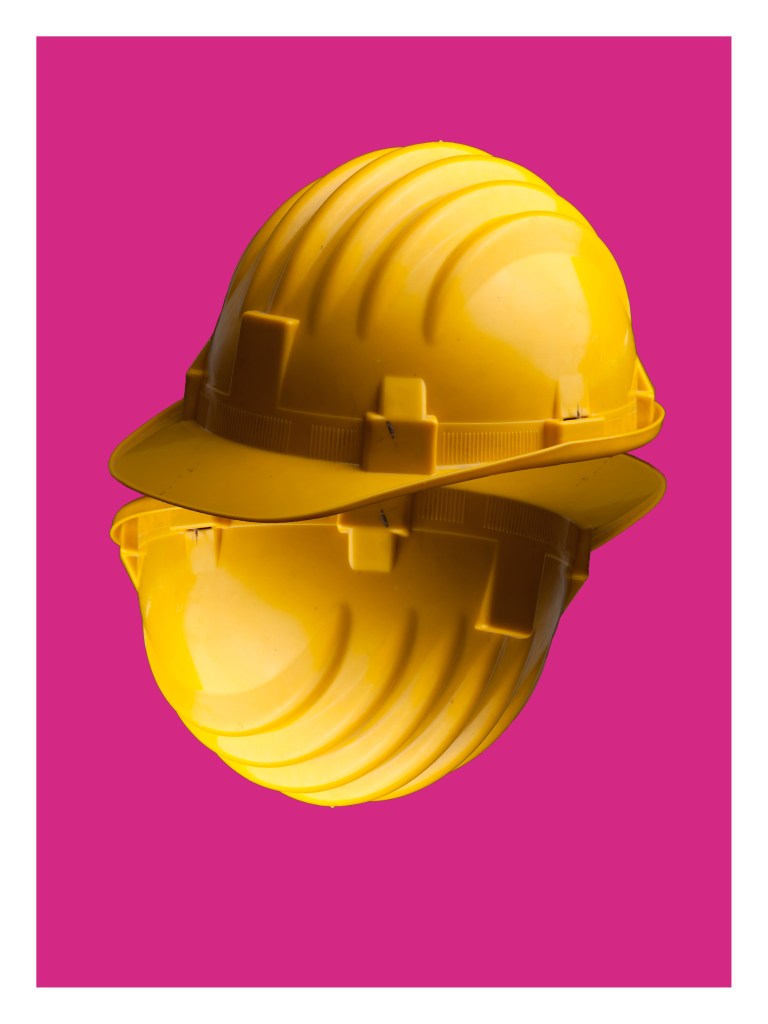
FINAL_hard_hard_hat_hat_PINK

Repetition. Not opposed to originality. Not the repetition of the same. But a call to productivity. To discovery and experimentation. To repeat is to start again, over and over. It is to affirm the unexpected and the new.