After Realism: Richard Moon

richard1

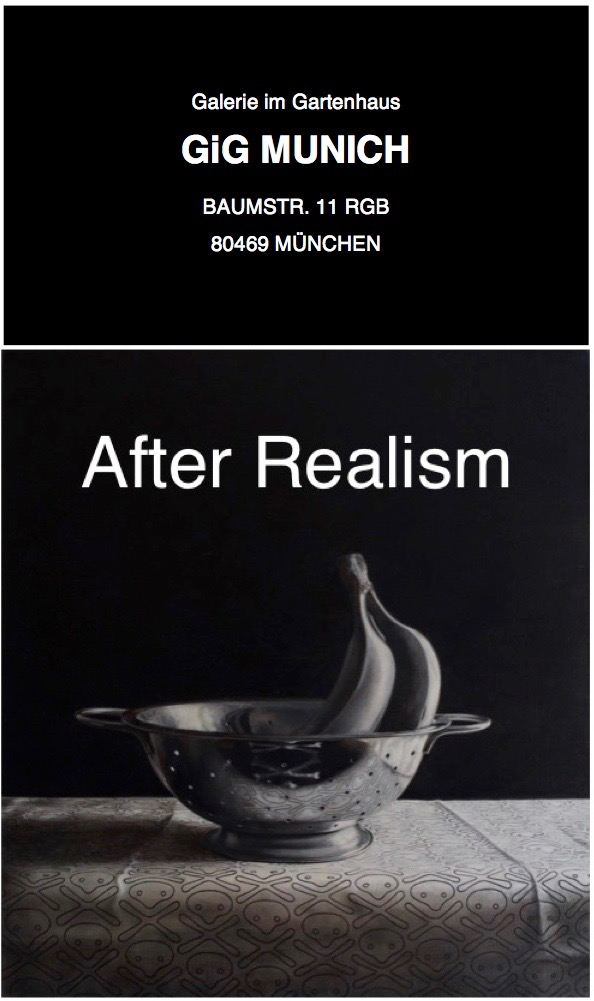
Richard Moon is a painter, who uses old-fashioned photographic tools to force grand gestures often denied to contemporary painting. Tackling such subject matter as death, madness and alienation, he exploits the medium’s history of failure and irrelevance in order to pursue his Romantic inclinations. For After Realism, he presents a black and white still life of some bananas in a colander, resting on a skull and bone tablecloth. 

Richard Moon ist ein Maler, der altmodische fotografische Mittel verwendet, um große Gesten zu erzeugen, die zeitgenössischen Gemälden oft verwehrt bleiben. Während er sich mit Themen wie Tod, Wahnsinn und Entfremdung beschäftigt, macht er sich die Geschichte des Scheiterns und der Belanglosigkeit dieses Mediums zunutze, um seinen romantischen Neigungen nachzugehen. Für After Realism präsentiert er ein Stilleben in Schwarz-Weiß: ein Büschel Bananen in einem Sieb, der auf einer mit Schädeln und Knochen bedruckter Tischdecke platziert ist.

After Realism: Maria Thurn und Taxis

untitled__37x46_5cm__2013__361_x_450_

Maria Thurn und Taxis is a recent graduate of the City and Guilds of London Art School, showing with Patrick Ebensperger in Berlin. Her recent paintings deal with the carnivalesque, finding in disguise and concealment a means of presenting the hidden aspects of reality. 

Maria Thurn und Taxis ist junge Absolventin der City and Guilds of London Art School, die von der Galerie Patrick Ebersperger in Berlin repräsentiert wird. Ihre jüngsten Gemälde beschäftigen sich mit dem Phänomen “Karneval”, in welchen sie in der Verkleidung und Tarnung ein Mittel entdeckt hat die verborgenen Aspekte der Realität aufzuzeigen.

After Realism: Gavin Tremlett

Amusement-2

Gavin Tremlett produces technically accomplished portraits, which despite their obvious pornographic vulgarity also exhibit the artist’s more abstract yearnings towards the sublime. The work is psychologically charged, simultaneously voyeuristic and self-aware. He is currently having a solo show, HYBRIS, with Charlie Smith, in London. 

Gavin Tremlett produziert technisch vollendete Porträts, welche trotz ihrer offensichtlichen pornografischen Vulgarität die eher abstrakten Sehnsüchte des Künstlers zum Erhabenen aufzeigen. Sein Werk ist psychologisch aufgeladen, gleichermaßen voyeuristisch und selbstkritisch. Er hat zurzeit eine Einzelausstellung, HYBRIS, in der Londoner Galerie Charlie Smith.

After Realism: Youjin Yi

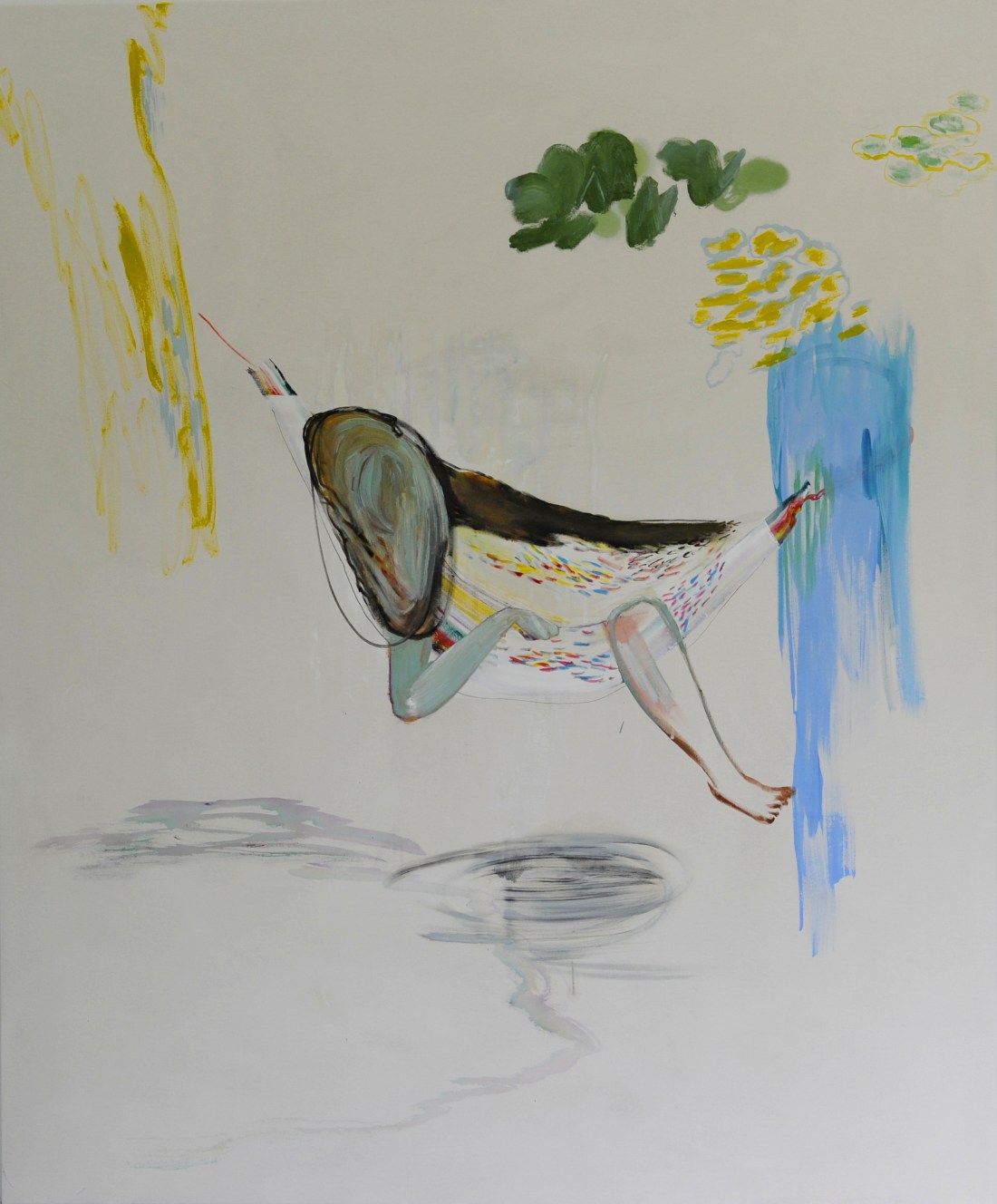
hängematte

Youjin Yi’s work is highly performative, her imaginary narratives painted directly on the canvas in a manner both spontaneous and precise. In response to a perceived over-intellectualised art world, she teases the viewer with materiality; yet her canvases are also minimal, celebrating the beauty found in emptiness. Originally from Korea, Youjin Yi lives and works in Munich, and shows with Tanja Pol.

Youjin Yi’s Arbeit ist in höchstem Maße performativ. Ihre fantastischen Erzählungen, die sie unmittelbar auf die Leinwand malt, sind in gewisser Hinsicht sowohl spontan als auch präzise. Als Reaktion auf eine überintellektualisierte Kunstwelt neckt sie den Betrachter mit Materialität; doch sind ihre Leinwände, welche die der Leere innewohnenden Schönheit feiern, ebenso minimalistisch. Ursprünglich aus Korea, lebt und arbeitet Youjin Yi in München, wo sie von Tanja Pol vertreten wird.

New Show: After Realism

12th March – 15th April 2016, Opening 12th March, 3 – 6 pm

af

After Realism brings together five artists, who in the face of contemporary challenges persist in making representational images. Liane  Lang, Richard Moon, Maria Thurn und Taxis, Gavin Tremlett and Youjin Yi work with the twofold difficulty of representing reality. First brought to the fore by a previous generation of artists, this consists of, on the one hand, an increasingly absent sense of what reality may be. Long mediated through the photographic and digital imagery, in its present commodified form reality retreats ever further behind a multitude of touch screens. On the other hand, art has since lost its privileged place in the task of representation.

In their work, Liane Lang, Richard Moon, Maria Thurn und Taxis, Gavin Tremlett and Youjin Yi reclaim some of the lost ground of representation, but in a manner that is alternately teasing, earnest, hostile, careful and funny.

After Realism führt fünf Künstler zusammen, die trotz heutiger Herausforderungen nicht davon abweichen gegenständliche Bilder zu schaffen. Liane Lang, Richard Moon, Maria Thurn und Taxis, Gavin Tremlett und Youjin Yi sind dabei einer doppelten Problematik ausgesetzt die Realität darzustellen. Bereits von einer vorangegangenen Generation von Künstlern beleuchtet, bedeutet dies zum einen ein zunehmend mangelndes Gefühl, was Realität sein könnte. Lange Zeit durch fotografische und digitale Bildsprache vermittelt, zieht sich die Realität nun in ihrer aktuellen kommerzialisierten Form noch weiter hinter einer Fülle von Touchscreens zurück. Zum anderen hat die Kunst ihre privilegierte Position in der Aufgabe der Repräsentation seitdem verloren.

In ihren Arbeiten gewinnen Liane Lang, Richard Moon, Maria Thurn und Taxis, Gavin Tremlett und Youjin Yi Bereiche des verlorengegangenen Terrains der Repräsentation auf eine Weise zurück, die abwechselnd scherzhaft, ernsthaft, feindselig, vorsichtig und humorvoll ist.

(trans. Nadja  Gebhardt)

USA participating artists: Magdalena Wisniowska

Magdalena Wisniowska

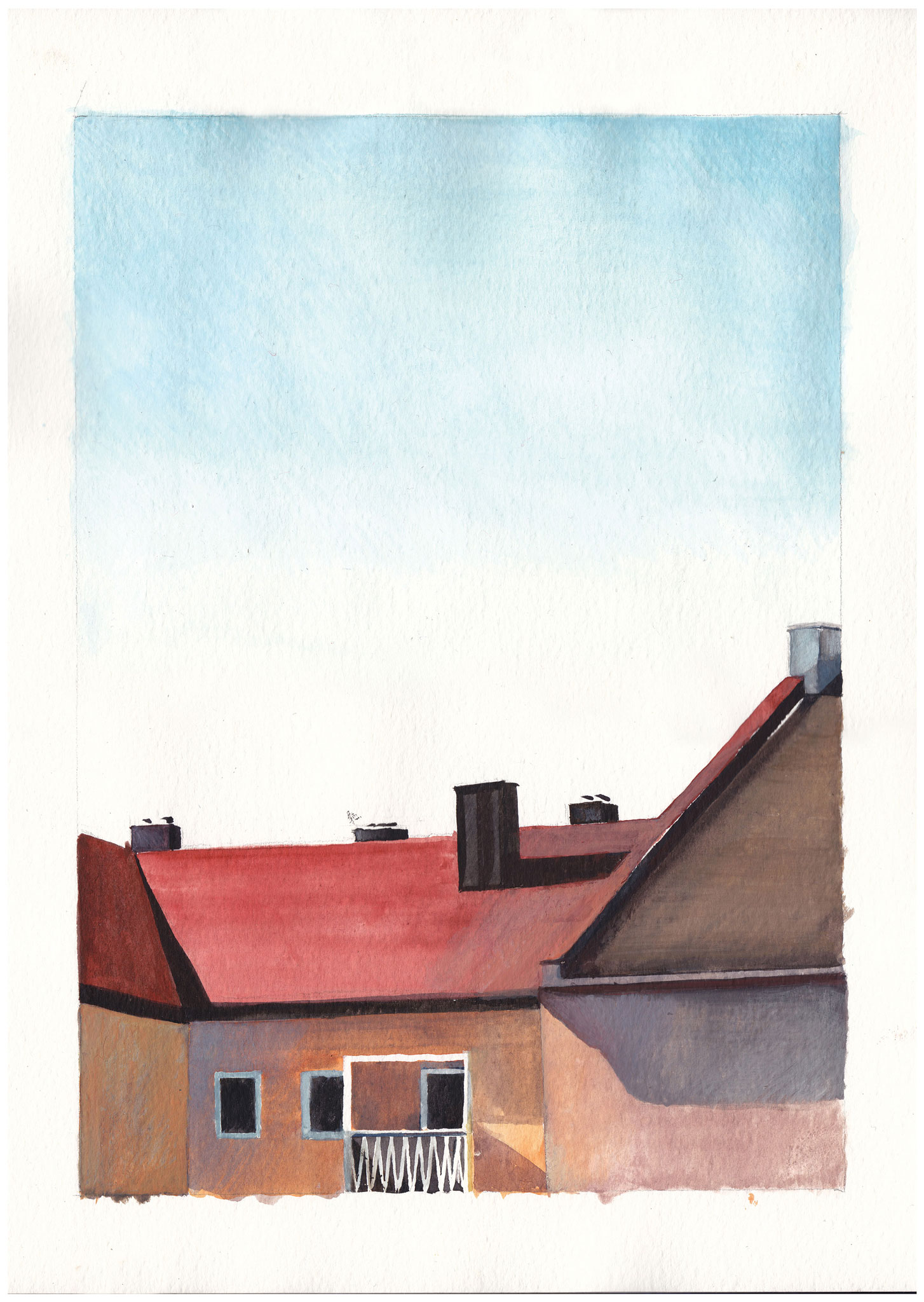
All of my recent work, no matter how abstract it might seem to an unsuspecting audience, has as its origin everyday life. By wiping away carefully built-up layers of paint, I have depicted many of my immediate surroundings: the trees outside my window, the buildings across the courtyard, the distant rooftops and their chimneys. Those more familiar with my painting would say it has an element of Edward Hopper’s work. Both the subject matter and the light quality are similar.

However, this aspect of my painting practice is not something that I have willingly acknowledged and actively pursued. To paint the way Edward Hopper did, uncritically and without self-consciousness, seemed to me an indulgence that I would not, could not, afford.

For me, ‘Amerika’ as a site of collective dreams, myths and fantasies offers a place for such indulgence. It is that imaginary space where I can look out of the window and paint simply what I see.  And in this particular arrangement of roofs, brickwork, shuttered windows and blue sky I do see a Hopper painting, with the lonely figure about to step out on the white-railed balcony.                     MW2013

USA participating artists: Will Tuck

GiG Munich is very happy to post a longer interview with Will Tuck, one of the artists participating in the USA show:

Will Tuck

How would you describe your recent practice?

I’ve been interested for a while in subjects that could broadly be described as ‘fantasy’, involving combinations of mythology, children’s toys and pin-ups. More recently I’ve begun combining images such as these with ‘motion illusions’ – abstract patterns that give the illusion of movement. I’m interested in the idea of over-saturation in painting.

What were the last couple of shows that you participated in?

The most recent one was “The Future Can Wait” in London, and before that was a show at Tallinn University of some animal paintings that I was involved in.

How would you describe your poster for the USA show?

It is one thousand smiles cut and pasted from digital images of Playboy models. The smiles have been left at their original resolution and have been arranged from top to bottom roughly according to size.

America has been described as a ‘property of the world’. We all have an idea of America that we feel quite strongly about. Have you ever visited the US and if so, what did you find striking?

I have been quite a few times, although just to the northeast. The first time I went I was 11 and what I remember finding most striking was how similar it was to home. I think after the long flight I was expecting a more ‘foreign’ culture! The friendliness of people and the air of positivity I also found striking. It’s something Europeans tend to be suspicious of.

Is there anything you particularly like or dislike about American culture?

I think one of the attractions of the US is that there are so many cultures, not just in different parts of the country but in many cases different parts of the same city, so I think it is hard to generalize. In my own experience seeing guns for sale in supermarkets is certainly odd, and coming from England, where flags and patriotism have been rather co-opted by the far right, the more overt patriotism you encounter can be unexpected.

Much of what I would say is ‘American’ culture has so thoroughly permeated the way we live here that it’s difficult to separate the two. Watching something like the Simpsons doesn’t feel like watching a ‘foreign’ cultural import, just part of a shared popular culture made elsewhere.

Politically, obviously things like the death penalty and the religious right are ones that I find hard to reconcile with my personal experiences of the country.

‘Identity’ – whether this is a thoroughly American identity or the idea of America that we as non-Americans identify with – is one of the themes explored in the show. Would you say ‘identity’ is one of the concerns of your practice?

Maybe ‘non-identity’ is more of an issue in my work! The fixed expressions of the toys are very similar to the fixed expressions of the glamour models, there is a kind of mass-produced sameness that runs through it. Even the tool itself (the airbrush) is a byword for fakeness and unreality of surface. In relation to this show, I would say the majority of influences in my work are from cultures and movements, both high and low, that have their roots in America.

Does your poster expand on some of these themes?

I wanted the poster to address the notion of the ‘Pan-American smile’, but also the European skepticism of it. The decision to use the smile of the Playboy model comes from the airhostess’s ‘perfect’ smile that gives it its name, but also the smile that is endemic in American advertising. Going back to the notion of fantasy, the Pan-American smile is the great signifier of the supposed happiness that consumerism can bring. The smile of the Playboy model, who takes this logic even further to become herself the object of consumption, is this fantasy’s nightmarish conclusion. However, having a thousand of these smiles together gives the work an additional quality – the industrial scale seems to offer something quite personal. When I started making the poster I expected the finished piece to look far more sinister and ‘fake’ than I think it has turned out to be. Instead, the poster seems to have a sort of jolliness, which I find surprising. Maybe the smiles are genuine after all.                  WT 2013