STEFAN LENHART, fruits of the dawn

noname

Eröffnung: Freitag 9. December 2016, 18:00-21:00 Uhr

Austellungdauer: 9 December 2016 – 13 Januar 2017

Finissage: Freitag 13. Januar 2017, 8:00-21:00 Uhr

GiG Munich is happy to present “fruits of the dawn,” the latest installation by Munich based artist and curator, Stefan Lenhart .

Stefan Lenhart, born 1969, graduated from the Academy of Fine Art, Munich in 2007. Since then, he has exhibited widely in Germany and abroad, most recently “Anthophobia” at the Artothek, Munich, 2016. The extensive catalogue “M.A.D.” of his work was published by Distanz in  2012. He is also founder of the project space, “Tanzschule projects” which ran from 2007-2012.

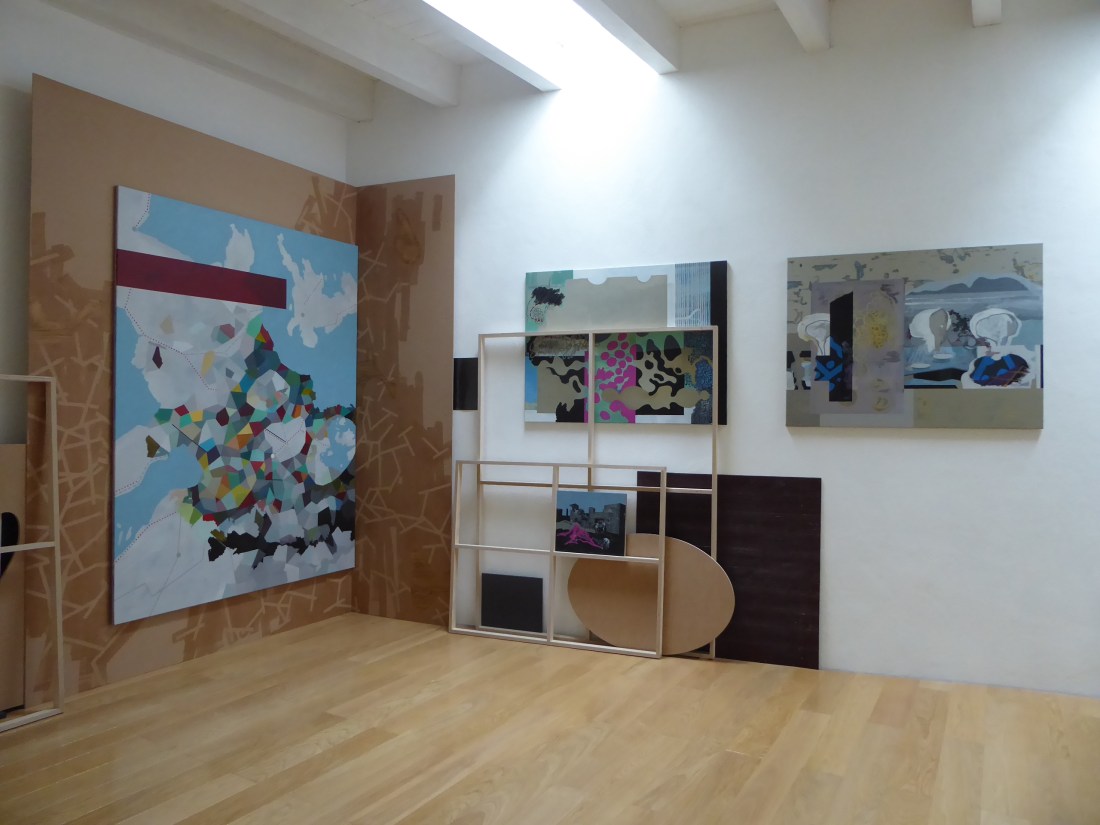
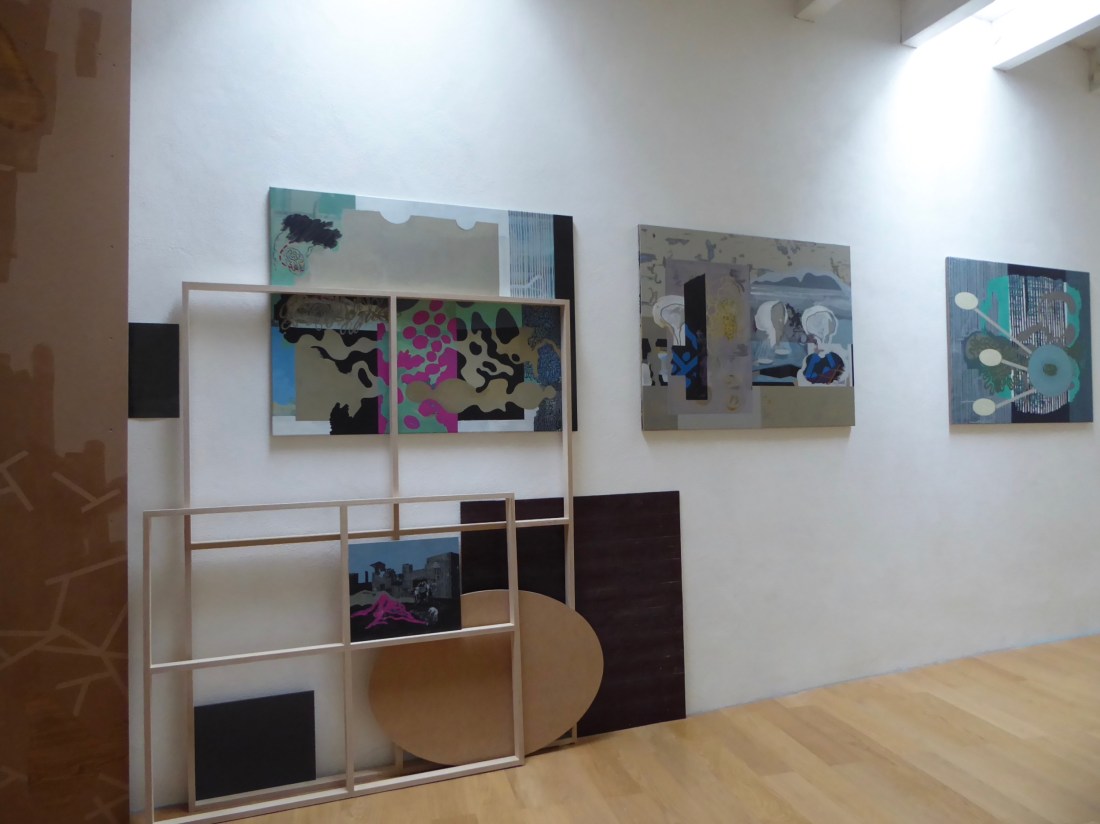
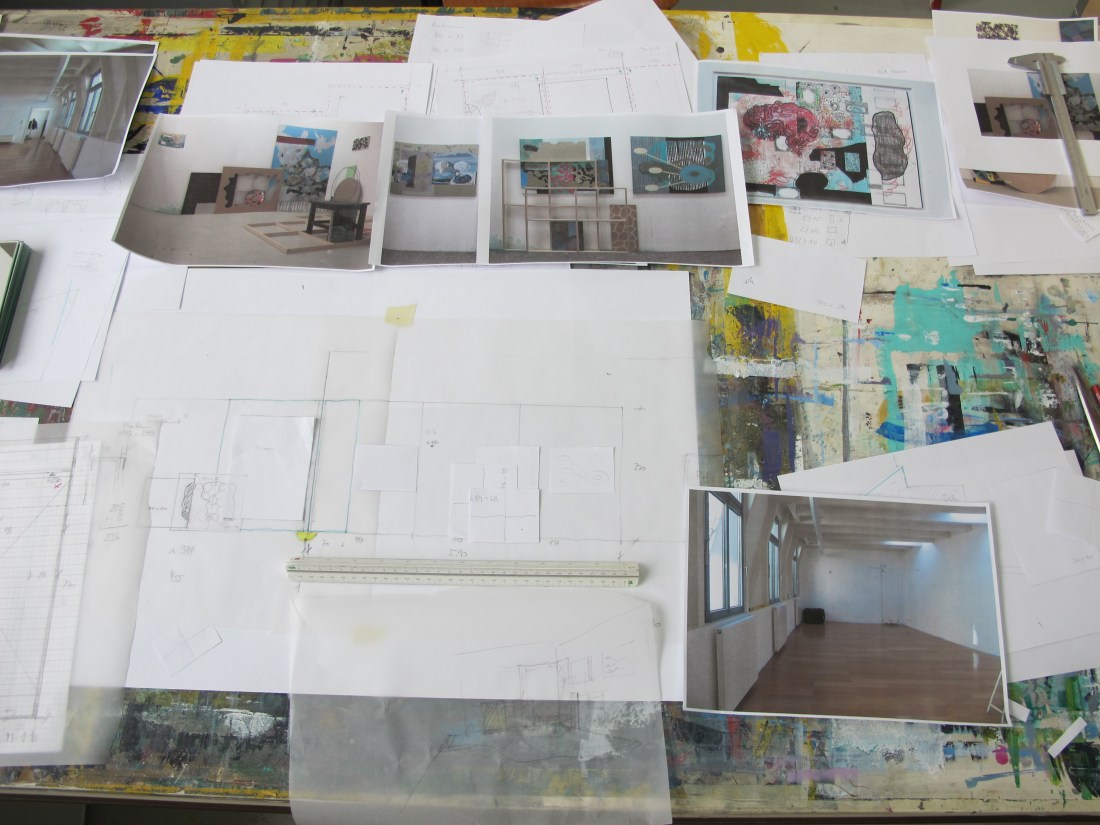
His work consists of large-scale installations that use references to the historical avant-garde – modernism and surrealism – to produce new meaning. Taking a holistic approach, he combines painting, sculpture and other modes of presentation in ways that are simultaneously theatrical and conceptual, unexpected and strange.

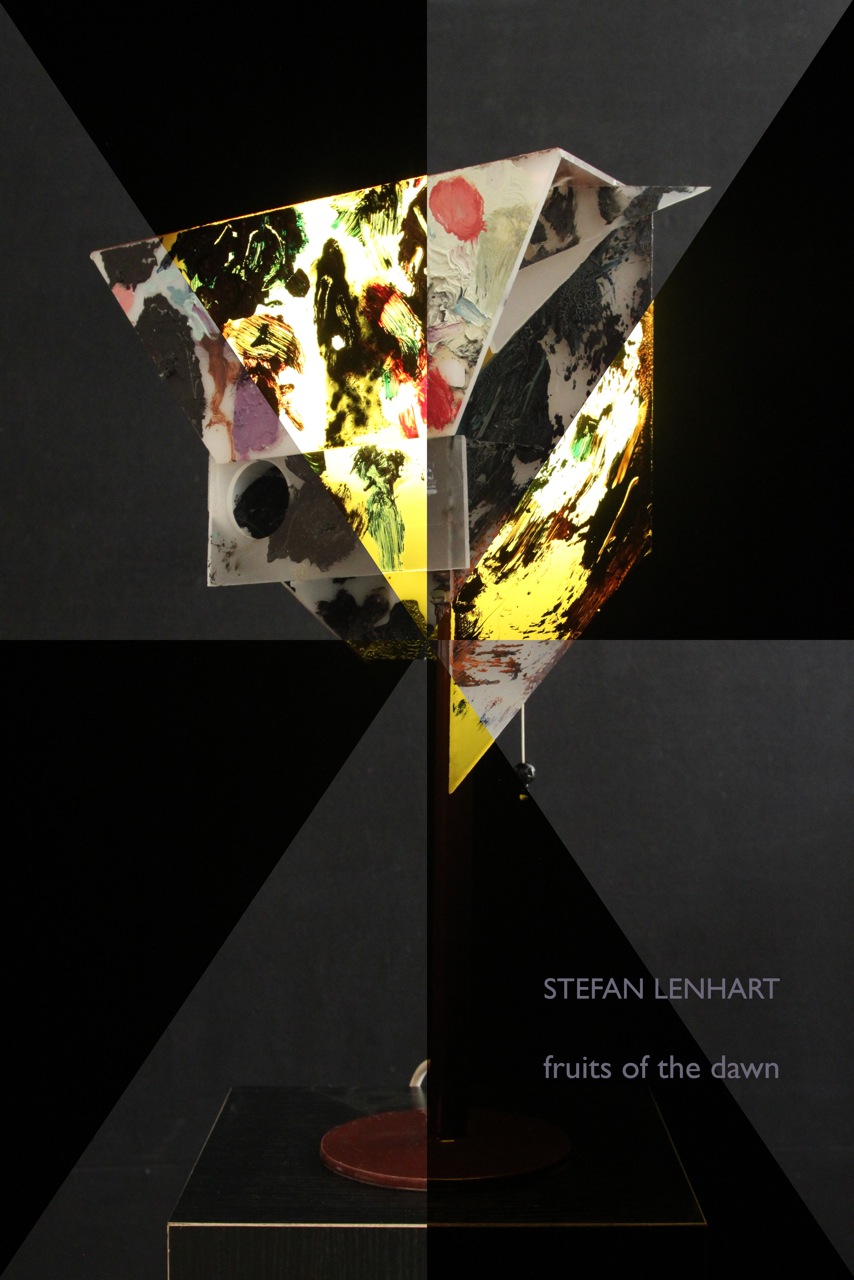
At GiG Munich, Stefan Lenhart presents a new series of light pieces. Constructed out of  used painter’s palettes, cut and arranged in the same asymmetric spiral shape, this new work plays with ideas of order, chance, destruction and creation.

Opening speech to Abstract Pleasures

Hello and welcome to GiG Munich’s autumn exhibition coinciding with the Open Art Weekend 2016, ‘Abstract Pleasures,’ featuring new site specific sculptural work by Kathrin Partelli and a selection from the photographic series, Sleeping Beauties, by Thomas Wieland. Those of you who have visited us before, may know that in my introductions I do not give a standard biography of the artist, whose work GiG Munich is showing. Instead, I would like to talk a little about the title, ‘Abstract Pleasures’ and my reasons for bringing these two very different artists, sculpture and photography together.

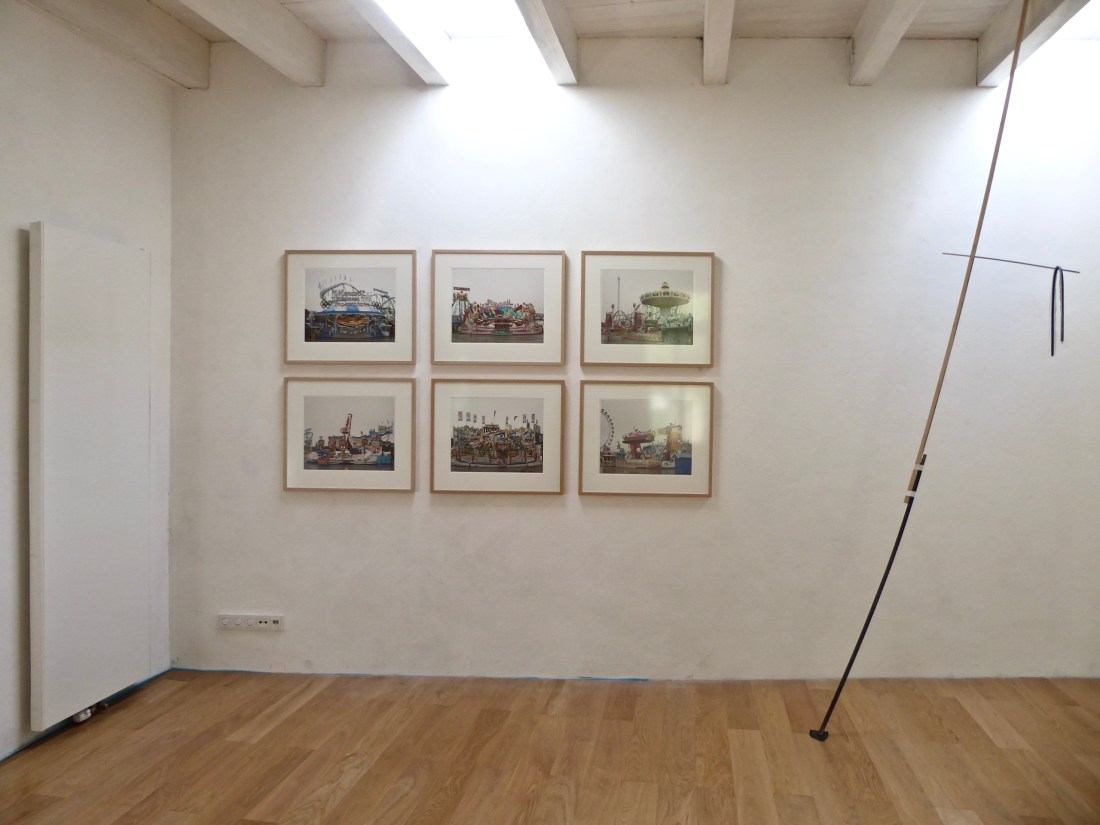
Let us turn to the second part of the title – pleasure – first. That the show has something to do with pleasure is immediately apparent from Thomas Wieland’s photos, which take the fairground rides of the annual Oktoberfest as a theme. Although the Oktoberfest marks the celebration of the marriage of Prince Ludwig and Therese of Saxe-Hildburghausen, the idea of the amusement park with fairground rides developed from the original pleasure gardens of the 18th century. Open to the public, these served as early venues of entertainment for the masses.

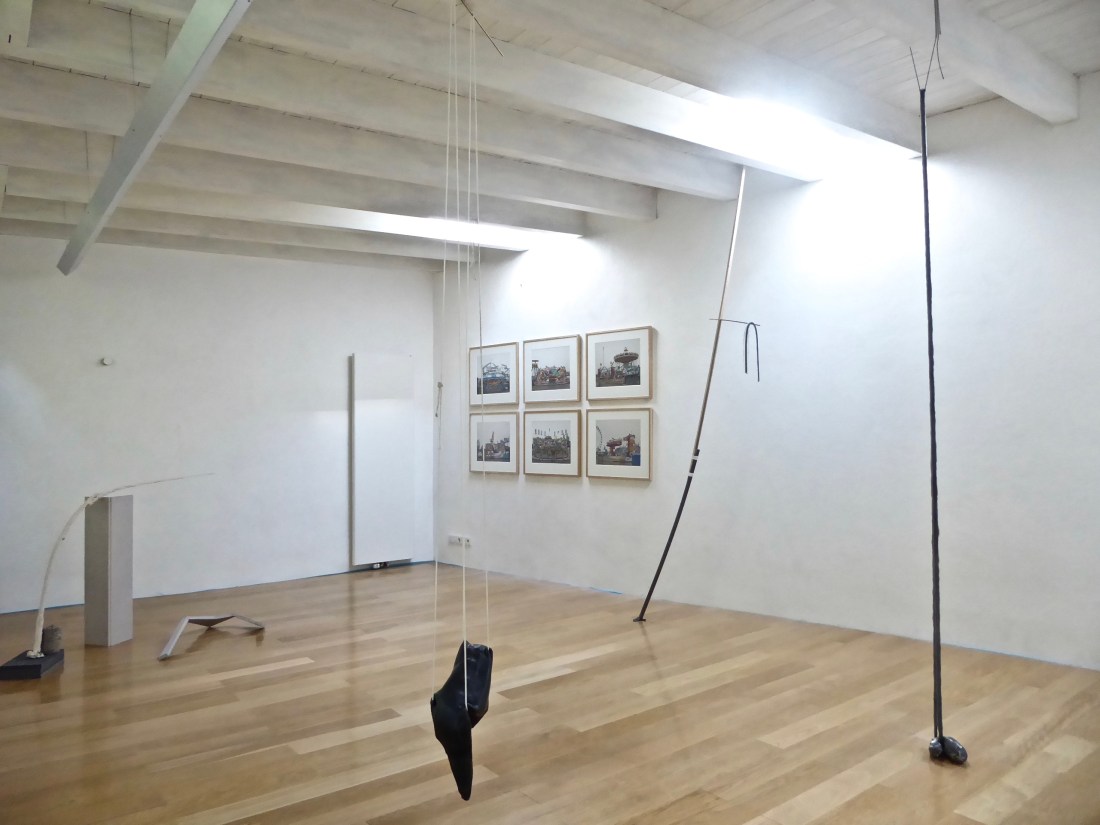
On the other hand, the first part of the title – abstract – seems to refer more to the work of Kathrin Partelli. Formal in quality, with a strong physical aspect her sculpture belongs to a minimalist tradition, rejecting composition and figuration for the disjunctive and the abstract. We can distinguish certain basic materials (metal, plaster and wood, wax and rubber) and certain basic mathematical shapes (lines, curves, quadrilaterals). Physical forces, such as stretching, pulling, and bending under gravity are at work. No element of construction is hidden; everything is laid out in a straightforward manner.

Yet equally, there is an abstract quality to Wieland’s photography. The very things which let us focus on the fairground rides – the fact that the images are unpopulated, that each ride is photographed separately from a standard distance, the neutral light, the depth of field and the cropping – also renders the image flat. The rides look more like a collage than a physical object, the various elements, bright colours, lights, slogans, placed next to each other without forming a coherent whole.

And similarly there is a pleasureable quality found in Kathrin Partelli’s work, a kind of humor, in common with the appropriation and the subversion of minimalist vocabulary by feminist and art povera artists. Her squares are wonky, the pieces of elastic might suddenly snap, the curved piece of plaster rests precariously on a gypsum board about to break.

Work that is about pleasure yet abstract, work that is abstract yet pleasureable – this is certainly one interpretation of the title. Nevertheless, ‘Abstract Pleasures’, refers to more. As mentioned in the brief text, which accompanied the invitation, it is also a matter of aesthetics. The pleasure of contemplation is associated with the appreciation of the beautiful object. First identified by the German philosopher, Immanuel Kant, this kind of pleasure has less to do with the object per se (indeed, Kant stresses that there can be no beautiful object), and more with the experience the human subject has when faced with beauty. Pleasure arises from the way our mind is engaged with the object of beauty. It is occupied with the object; it thinks about the object – and yet, despite all its efforts it cannot come to any conclusion other than, this object is beautiful.

If we now look at the work, we can see that, in both cases, it draws our attention. The photos rendered flat, allow our gaze to wonder, from slogan to paintwork, from light to colour. Similarly, the level of detail in Kathrin Partelli’s work belies its simple origins. There is a logic to her objects. No material is used more than once; the objects go from light to dark and from hard to soft; a curve in lead on the floor is repeated with a curve of rubber; what seems like a black stick is actually a drawing. We are occupied discerning these details, but as said, these objects allow no further conclusions to be drawn. Instead, they bring attention to the act of contemplation itself.

This is important, because historically speaking very few artworks engage with the pleasures of contemplation. Minimalism, art povera, or feminist art are more concerned with expanding the notion of the artwork. Indeed, it is rare that in everyday life we consider the joys of contemplation. Referring to Thomas Wieland’s photos: we are too busy spinning around half-drunk on the Oktoberfest rides to be thinking about their structures.

And all of this to what end? The pleasures of contemplation alert us to a basic relation, the fact we do have a relation to the outside world. That we can look at an object and recognize it as an object – that we think about the object and draw conclusions – this should be a source of wonder. I hope, that in a small way, this wonder is celebrated by the artwork featuring in this exhibition.

Magdalena Wisniowska, 2016
Abstract Pleasures

We are happy to announce GiG Munich’s latest exhibition, opening on the 10th of September, 3 pm. Hope to see many of you there!

Abstract pleasures web

“Abstract Pleasures” brings together a site-specific sculpture installation by Kathrin Partelli and Thomas Wieland’s series of photographs, Sleeping Beauties. The exhibition unites Partelli’s ephemeral, open-ended structures with Wieland’s images of empty Octoberfest rides to present the pleasures of contemplation: the enjoyment found in complex constructions.

Kathrin Partelli creates sculptures and large-scale installation pieces in the anti-monument tradition. Thomas Wieland is a photographer, who draws on his experience in the history of science. Already exhibiting on the online platforms, LandscapeStories and Humble Art Foundations, we are pleased to be the first gallery to present his work.


“Abstract Pleasures” bringt eine standortspezifische Skulptur von Kathrin Partelli und die Fotoserie “Sleeping Beauties” von Thomas Wieland zusammen. Sie vereint Partellis flüchtige, offene Strukturen mit Wielands Bildern der menschenleeren Fahrgeschäfte auf dem Oktoberfest, die das Vergnügen der Komtemplation präsentieren: die Freude, die in komplexen Konstruktionen zu finden ist.

Kathrin Partelli schafft Skulpturen und großangelegte Installationen in der Tradition der Anti-Monumente. Thomas Wieland ist ein Fotograf, der aus seiner Erfahrung in der Technikgeschichte schöpft. Nachdem er seine Arbeiten bereits auf den Onlineplatformen LandscapeStories und Humble Art Foundation ausgestellt hat, freuen wir uns diese nun als erste Galerie zu präsentieren.

trans. Nadja Gebhardt

MICHAEL LUKAS occupied corner, catalogue entry

Just as there are two ways of interpreting the aesthetic object, there are two ways in which the work of Michael Lukas can be approached. If we take the perspective prior to aesthetic experience, the work becomes the object of our study. We begin by situating the work and cataloguing its numerous themes. These include but are not limited to the fields of ontology, topology, geography, social science and history. From the perspective of aesthetic experience however, we need to examine the kind of experience the work engenders, which I would argue is unique. Perhaps the term aesthetic experience is misleading as Michael Lukas’s work involves much more than the traditional sense of the term, with the object to be viewed by the human subject, the individual artwork to be judged by the art expert, the connoisseur. Michael Lukas’s work presents a problem: in Deleuze’s words, it forces us to think.

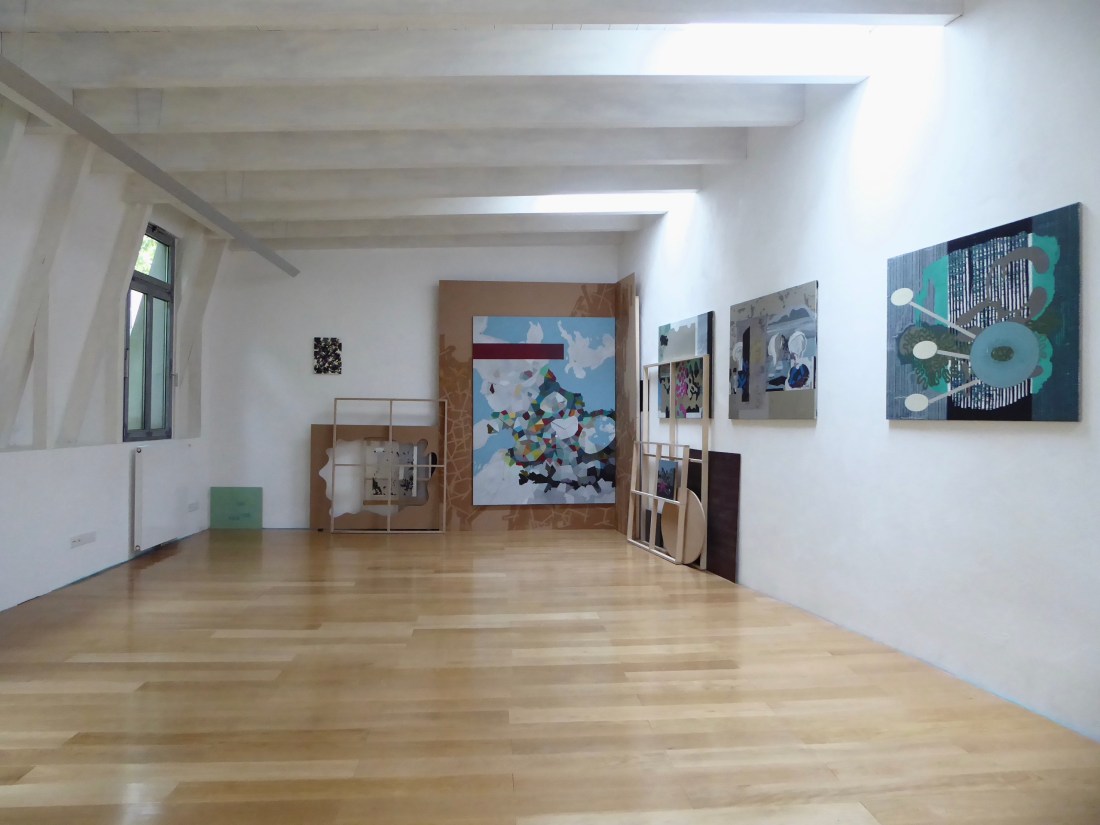
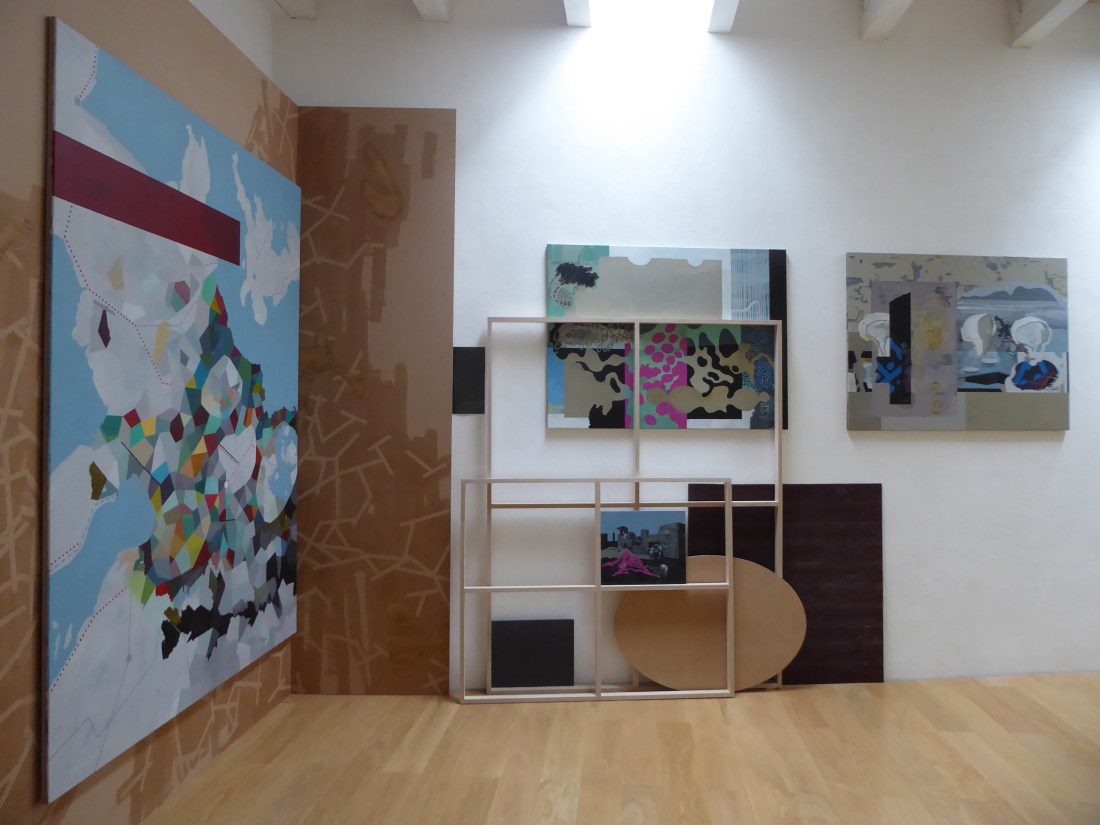
The site-specific work we see at GiG Munich does not exist as the one or even the group of paintings, what we know as compositions of brushstrokes on wood or canvas. It consists of the relations and connections these material elements make with each other, with other paintings, with the artist and with us, the viewer. The relations are physical but also abstract or intellectual, the connections between nebulous ideas just as important as those made by objects in Euclidean space. In other words the painting installation of Michael Lukas stages an encounter, an encounter always being the confrontation between a set of forces. The result of the encounter is an assemblage of affects.

For Spinoza, who is my main reference point here, the forces set up in the encounter have two possible outcomes. The encounter results either in the increase of the capacity for action, which is perceived as pleasurable, or in its decrease, which is felt as pain. The assemblage of affects is the consequence of the first kind of encounter, the pleasurable composition of relations, which ultimately is to bring us knowledge of God. Deleuze complicates matters by insisting that in the encounter, the position adopted by the body is one of combat. In combat, forces struggles against each other, going across and breaking up the organised body, as set within its boundaries. For combat to be considered by Deleuze as a positive encounter, this struggle cannot be resolved with the dominance of one force over the others. Any kind of resolution compromises combat’s inherent creative element. Something new is only produced when the struggles of the forces is maintained.

Michael Lukas’s work keeps up this tension, this struggle between various forces. He uses the frame, a repeated motif in his paintings and physically manifest as a sculptural relief hanging in the gallery corner, to demand from us the move out of an organised framework – to shift from one material aspect to another, to make those intellectual connections we would otherwise not make, all the time preventing us from ever settling on the one object, the one image, the one idea. When encountering Michael Lukas’s work, we are forced to think, in that we are forced into a position of creativity. It spurs us to action. But it never allows this activity to be resolved. We are continually intrigued, looking, making sense, thinking.