GiG air – Stefanie Ullmann

Another studio visit and resulting exhibition text:

I owe you the truth in painting and I will give it to you

Cézanne 

…d’un seul pas franchi…

Derrida

The small problem of truth has been occupying me recently: the truth in painting, as promised by another “sauvage raffiné,” Paul Cézanne. A long time ago, it took a painting by Vincent van Gogh, Old Shoes with Laces (1886), for the German philosopher Martin Heidegger to recognise what this truth might be and for him, the artwork became defined through its revelation of this truth. We now consider ourselves too sophisticated to think that a painting of some worn-out shoes reveals something so profound about the peasant woman’s being that there is no other way this can be grasped. And yet a little of this heideggerian desire remains. I find we still look for truth in painting despite thinking it unlikely. Or at least, I do.

At the height of the pandemic Stefanie Ullmann would walk and run in the rose gardens at the Isar, in May, when the magnolias are in bloom. These caught her attention – I remember how bright that spring was, and how vibrant the greens. But again it took a painting by van Gogh, this time, Blossoming Almond Branch in a Glass (1888) for her to begin painting from memory a series of small canvases with flowers.  A second series of watercolours followed. The oil paintings share van Goghs’ shimmering green-yellow palette as well as his strong horizontal and vertical lines. 
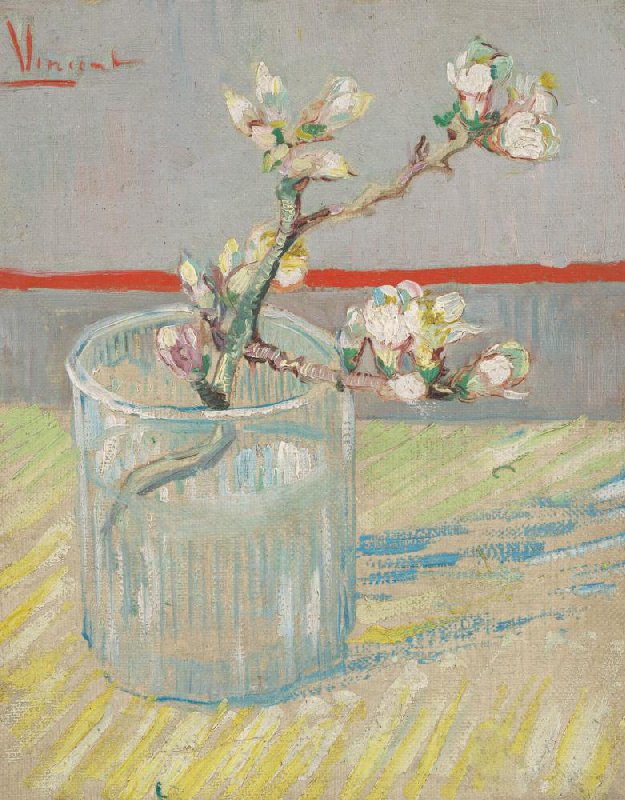
Vincent van Gogh, Sprig of flowering almond in a glass, 1888, oil on canvas, 24.5 cm x 19.5 cm
Credits: Van Gogh Museum, Amsterdam (Vincent van Gogh Foundation)

When I look at these paintings I find myself standing in Heidegger’s shoes. There is a truth in Stefanie Ullmann’s work that has to do with his schematic definition. On the one hand he claims, art has long been thought as formed matter, in other words as a “Zeug,” translated by Derrida as a “product,” more commonly in English translations of Heidegger’s essay as “equipment.” And these paintings here, especially the abstract ones, have this workman-like quality of being built, almost brick by brick, layer by layer. Occasionally Stefanie Ullmann even uses a spatula like a masonry trowel. And yet, as Derrida in his interpretation of Heidegger’s argument rightly notes, an artwork is more than a product or Zeug because it does what no other product can – it resembles a thing, “Ding.” It is as if it were not produced. Thus, an artwork is a product that is also more than a product, because it crosses over, steps into the realm of the thing. In the same way, Ullmann’s paintings enjoy this self-sufficiency. Despite their lightness, they feel as sturdy as earth or rock or tree, untouched by human hand. 

The point of painting is – for Van Gogh, Heidegger, Derrida etc. – that this step crossing from thing to product and back again occurs within. Painting shows how tightly things, Zeug and artworks interlace.
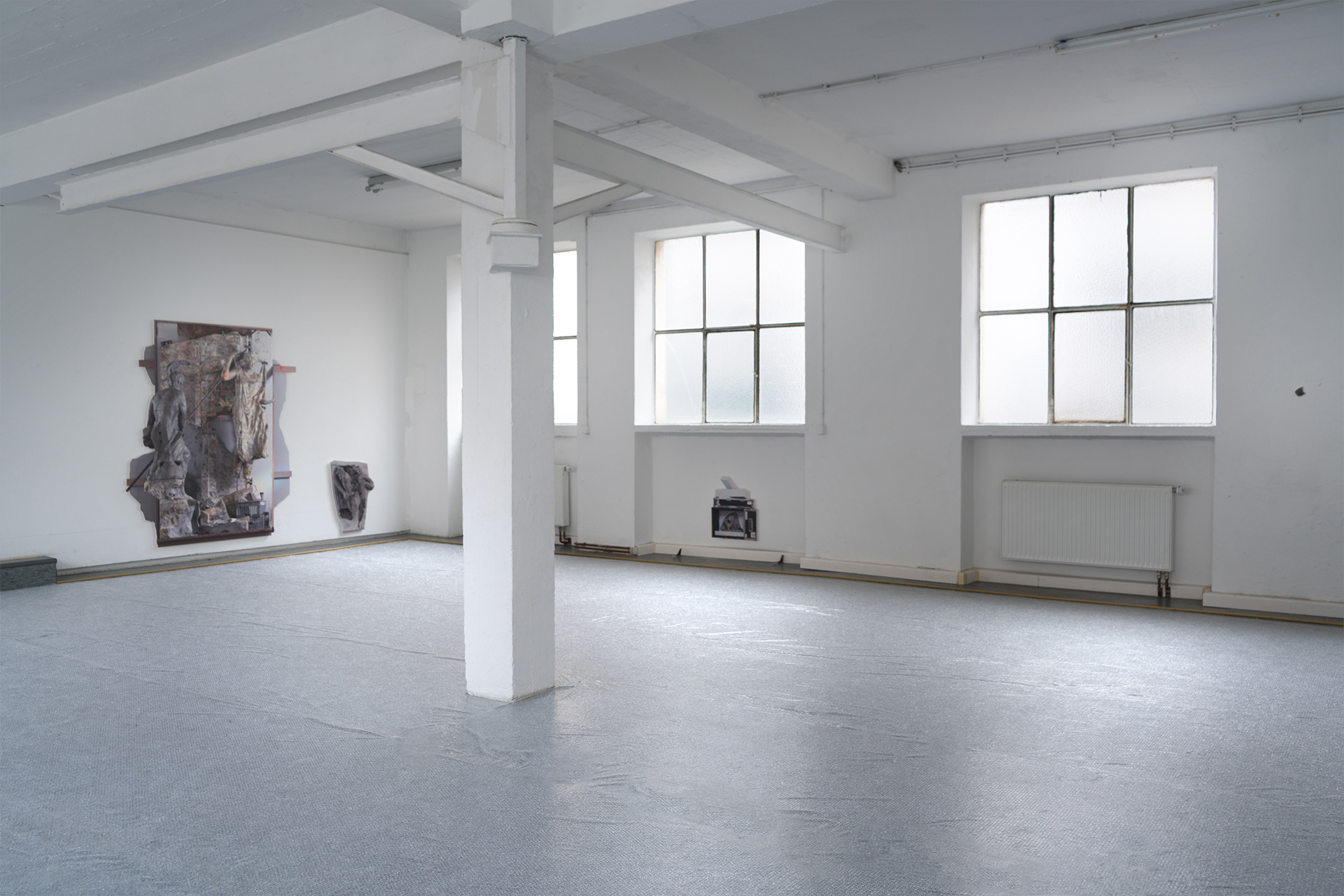
DOXA

Paul Valentin

23.03. – 26.05.2023

Lothringer 13 Studio

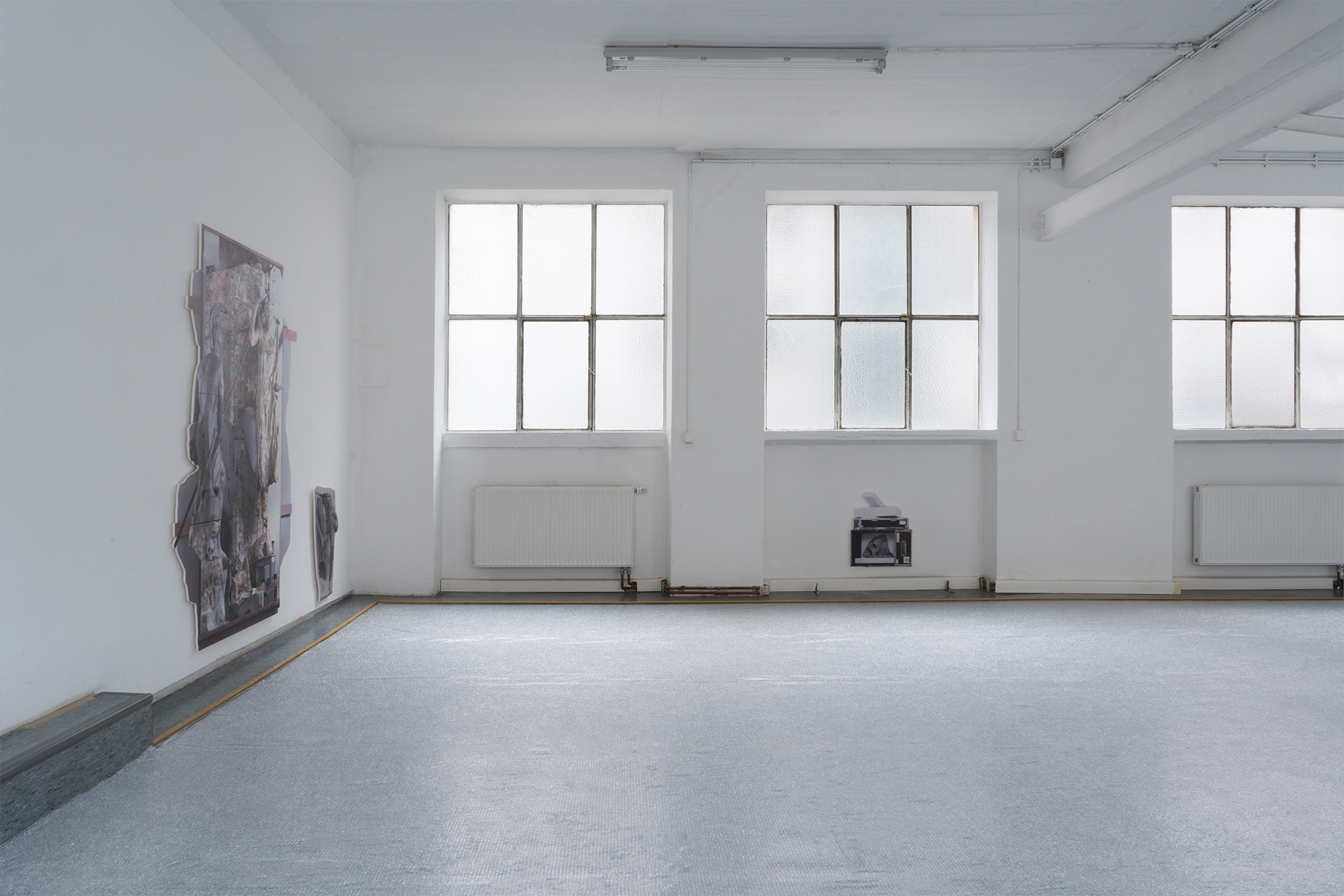
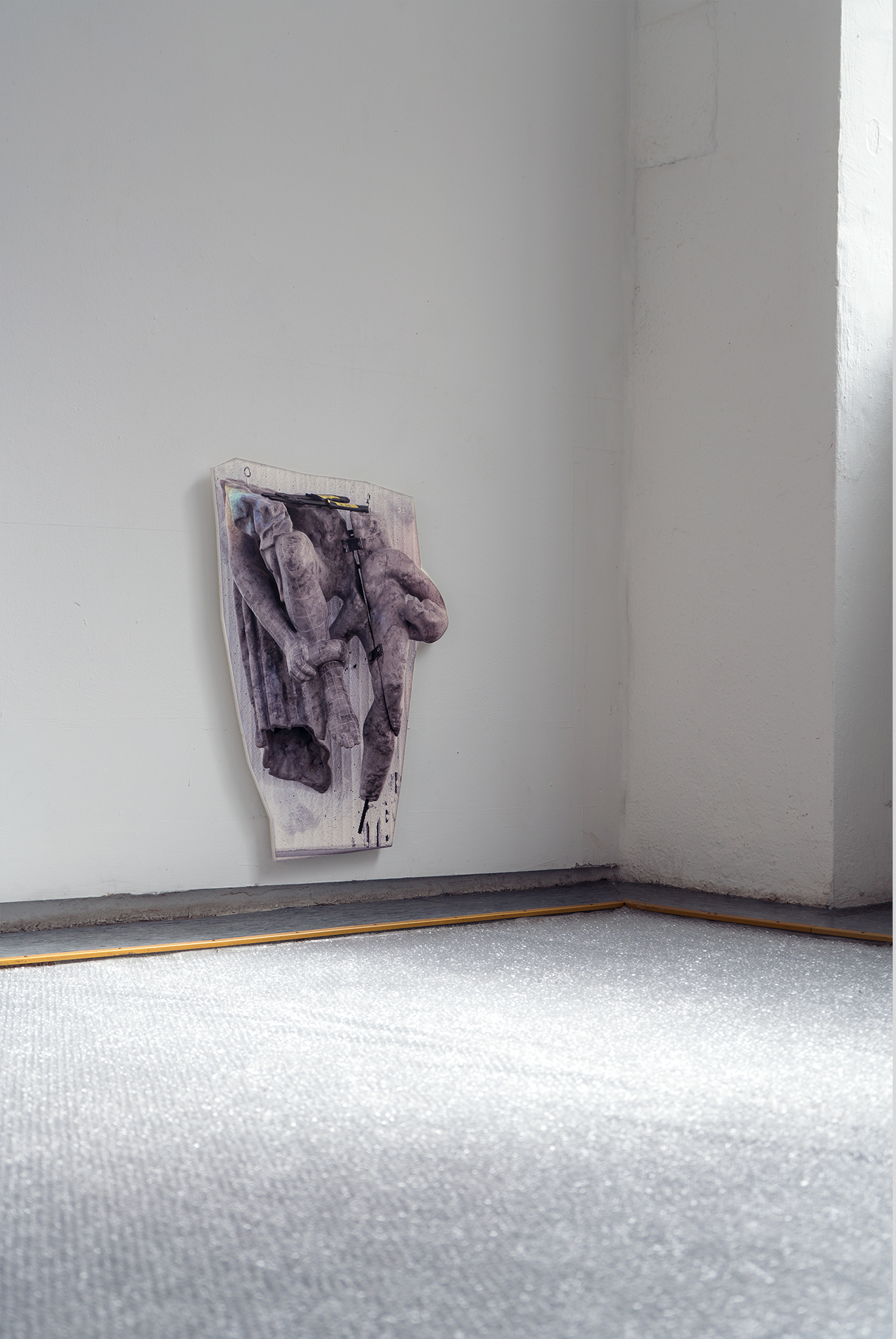
Paul Valentin, Doxa, 2023, exhibition view
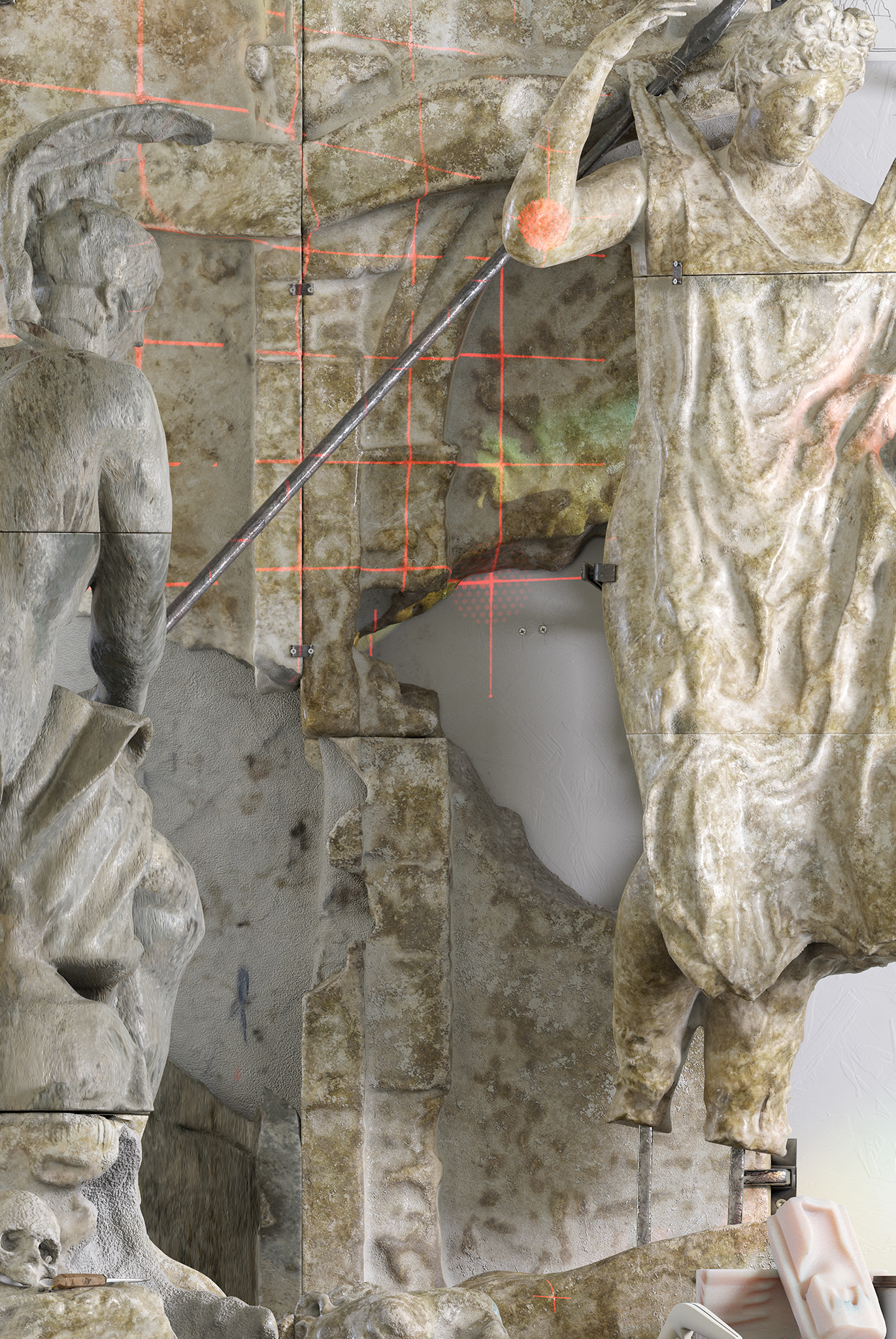
Paul Valentin, Doxa, 2023, 3D rendering, print on smartX, size variable
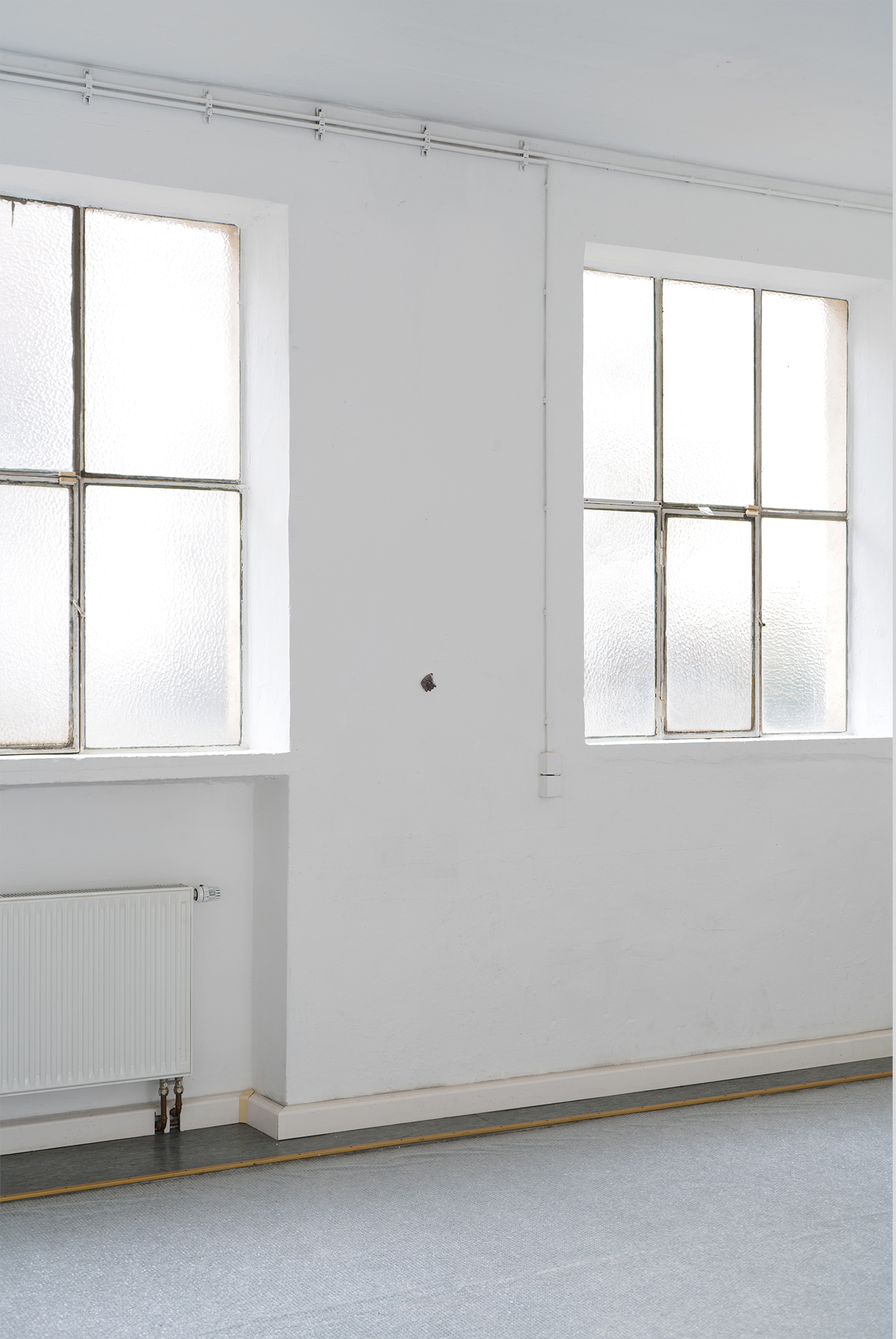
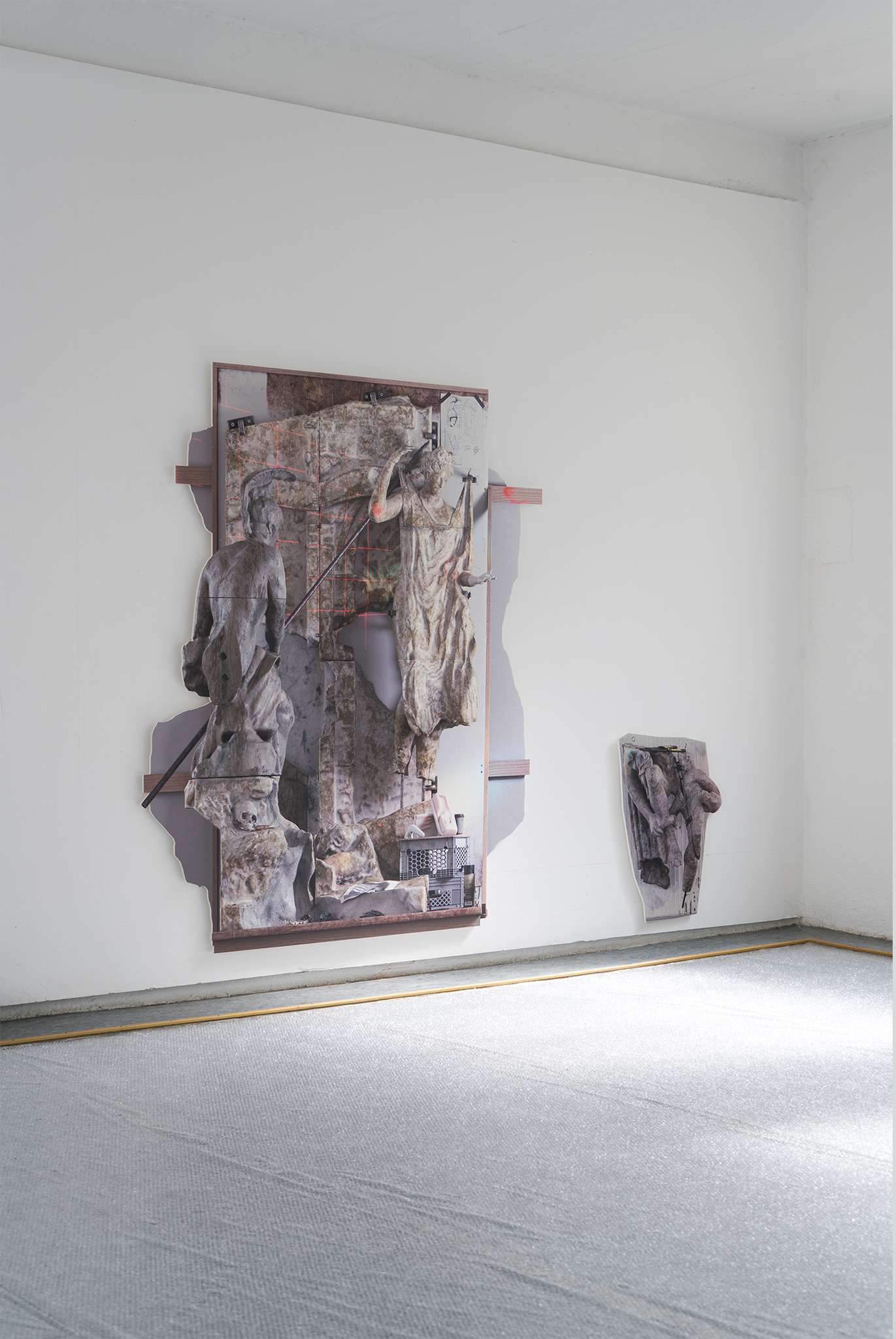
Paul Valentin, Doxa, 2023, exhibition view
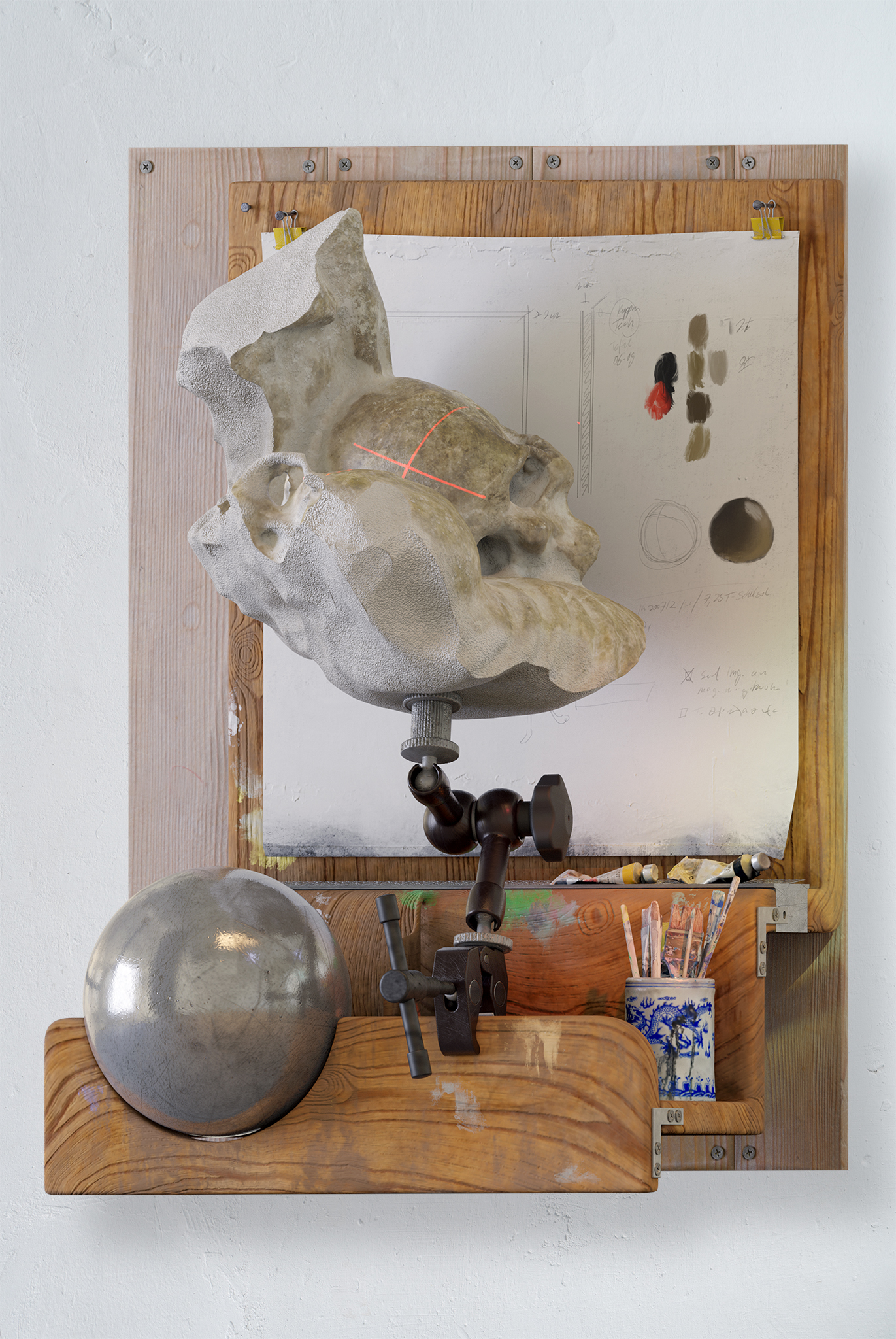
Paul Valentin, Doxa, 2023, 3D rendering, print on smartX, size variable
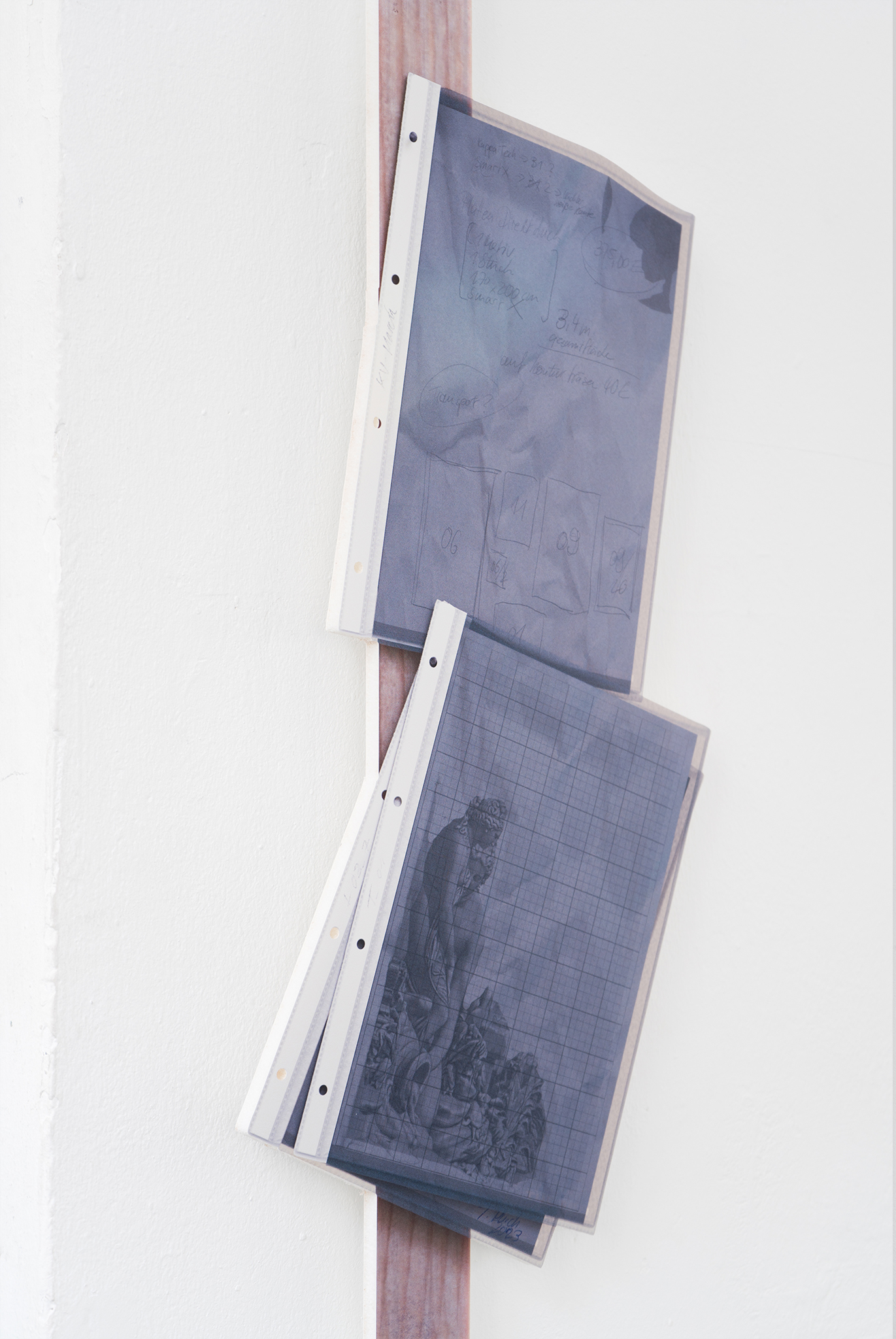
Paul Valentin, Doxa, 2023, exhibition view
Paul Valentin, Doxa, 2023, 3D rendering, print on smartX, size variable
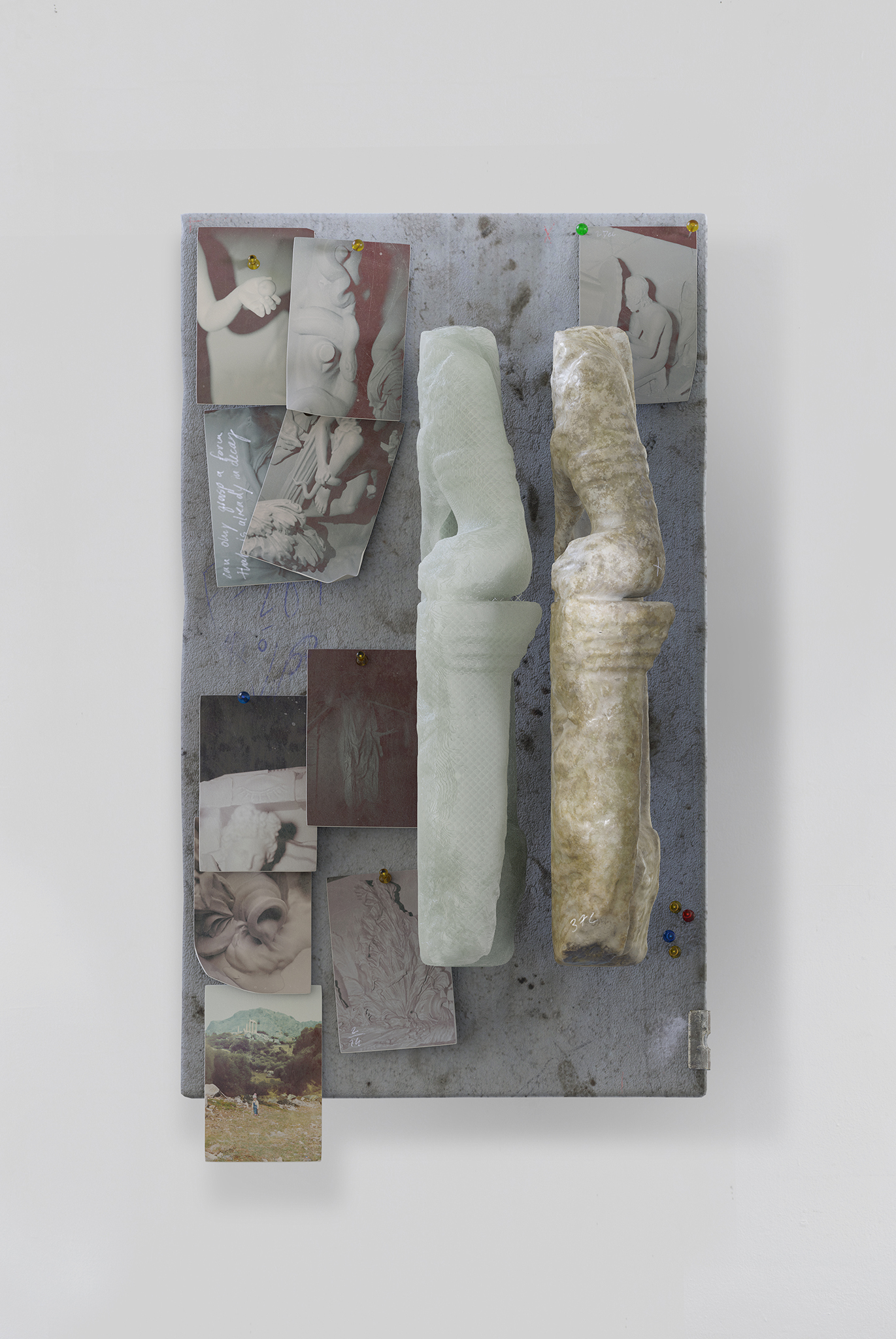
Paul Valentin, Doxa, 2023, exhibition view
Paul Valentin, Doxa, 2023, 3D rendering, print on smartX, size variable

Photos: Lukas Hoffmann

What is the truth?1 Now there is a metaphysical question for you. Hardcore baby, yeah. That’s what we are talking about. What. Is. The. Truth. Heidegger turns around and points, there – there – to the temple, a Greek one I guess but no one really knows, or cares, as it really doesn’t matter; he points to the temple nestling among rocky hills, its columns in picturesque disarray. We can see it on Paul Valentin’s holiday snapshot. The temple as a work of art sets forth the truth. If you are looking for the truth you can find it there. 

When I first encountered Heidegger’s essay as an undergraduate, “The Origin of the Work of Art” was presented to me as a critique of representation, specifically of mimesis. I admit I didn’t get it at the time. Now that I do, Heidegger does clearly state that the kind of truth he associates with the artwork has nothing to do with a painter’s capacity to produce resemblance. Truth here is not marked by the distinction between the model and the copy, the original and the fake, and in this sense his argument is anti-mimetic. Instead, he looks to the point of origin of the art work, and finds truth (with the help of van Gogh’s painting) in the way being is revealed. “Aletheia”, he claims, is the Greek term for the “unconcealedness of beings.”

This means we do not look at an artwork in a habitual way, as a thing or a piece of equipment. Heidegger rejects the interpretation of the artwork as either a substrate bearing traits, a manifold of sensations or as formed matter. These for him are various forms of assault on being. He argues that not to fall under the spell of this violence, we have to look at the temple and see how it both creates a world for us, in the sense of giving our lives its meaning, and also shelters this world by placing it back firmly on the earth, which only through the creation of this world emerges as ground. The temple as the work of art is Aletheia. 

Paul Valentin creates his temple of of the Greek goddess Aletheia using digital software. It has the usual pediments and carved reliefs of mythological figures. He then, also digitally, breaks this temple up, fragments it, ages it artificially and destroys it. He takes up these fragments – still digitally – and reassembles them in workshop that shares many of the same visual conditions as the Lothringer 13 Studio space, like some kind of virtual archeologist. The reassembled fragments are photographed, printed and scattered across gallery room. 

Thus there is no truth in Paul Valentin’s temple. Even the snapshot we see is a composite of an old photograph and an ai generated image, with some photoshopping in between. His temple does not, cannot, reveal anything. It is not even there. And yet it shows how mimesis is always at work, even in Heidegger’s argument. How does Heidegger reject the three modes in which we tend to think the artwork? By looking at how their claim to truth compares with the artwork’s truth, its revelation of being. Isn’t this also what mimesis is? I mean, isn’t the relation between a model and a copy not so much about resemblance as it is about good and bad resemblance – to what extent is the copy a faithful one? Isn’t it the copy’s claim to truth that we compare? Far then from producing a critique of representation, Heidegger’s comparison of different modes of thought would seem to fall down mimesis’s slippery slope. He too succumbs to its power. What is the truth? There is no truth, honey. Only simulacra. Paul Valentin shows that the question we need to ask is how does this simulacra work.

  1. For full effect, please read in the voice of Tom Cruise’s character in Magnolia (1999). If you haven’t seen the movie, watch it now. 

Magdalena Wisniowska 2023

DOXA

Paul Valentin

23.03. – 26.05.2023


GiG Munich is really happy to continue working with Lothringer 13 again this year, and will begin the new series of exhibitions – Thought in Practice – at the Studio space with the exhibition “Doxa,” by Paul Valentin. The series aims to bring together different artists, who share a strong interest in philosophical concepts and who make these concepts the focus of their artistic practice.

Paul Valentin’s work has long dealt with the questions of metaphysics, such as the concept of truth, nothingness, or the structure of reality. Similarly in this Lothringer exhibition, “doxa” refers to the Ancient Greek definition of opinion, opposed to the much more serious and worthy “epitome” or knowledge. The exhibition consists of digitally-constructed fictional temple of Aletheia – the Goddess of truth in Greek mythology. Its fragments are not the 3-D artefacts found by archeological teams on a remote site, but the flat illusions, created, artificially aged and distressed by the artist using computer software.  In this work Valentin presents truth as something that is always made: fragments of a temple that first had to be constructed before being destroyed.

Paul Valentin is a German artist currently based in Munich, working primarily with video and animation but also occasionally with music, digital relief and sculpture. His work has been presented at the European Media Art Festival, Haus der Kunst, Museum Villa Rot, Centro Cultural Moçambique, Sluice Biennale London and Exchange Rates Festival in New York. He was awarded the Karl & Faber Prize in 2019, as well as the Academy Association Prize that year and the Scholarship for fine arts by the City of Munich in 2021.

GiG Munich setzt auch in diesem Jahr die Zusammenarbeit mit der Lothringer 13 Halle fort. Die neue Ausstellungsreihe “Thought in Practice” startet mit der Ausstellung “Doxa” von Paul Valentin. Ziel der Reihe ist es, verschiedene Künstler:innen zusammenzubringen, die ein starkes Interesse an philosophischen Konzepten haben und diese in den Mittelpunkt ihrer künstlerischen Praxis stellen.

Paul Valentin beschäftigt sich in seinem Werk seit langem mit Fragen der Metaphysik, wie dem Begriff der Wahrheit, dem Nichts oder der Struktur der Wirklichkeit. Entsprechend bezieht sich “Doxa” auf die altgriechische Definition von Meinung in Abgrenzung zu dem viel ernsthafteren und würdigeren “Episteme” oder Wissen. Die Ausstellung besteht aus einem digital konstruierten fiktiven Tempel der Aletheia – der Göttin der Wahrheit in der griechischen Mythologie. Bei den Fragmenten handelt es sich nicht um 3-D-Artefakte, die von archäologischen Teams an einem abgelegenen Ort gefunden wurden, sondern um flache Illusionen, die der Künstler mit Hilfe von Computersoftware geschaffen, künstlich gealtert und verunstaltet hat. In diesem Werk stellt Valentin die Wahrheit als etwas dar, das immer hergestellt wird: Fragmente eines Tempels, der erst gebaut werden musste, bevor er zerstört wurde.

Paul Valentin lebt derzeit in München und arbeitet hauptsächlich mit Video und Animation, gelegentlich aber auch mit Musik, digitalen Reliefen und Skulpturen. Seine Arbeiten wurden auf dem European Media Art Festival, im Haus der Kunst, im Museum Villa Rot, im Centro Cultural Moçambique, auf der Sluice Biennale London und auf dem Exchange Rates Festival in New York präsentiert. Er wurde 2019 mit dem Karl & Faber-Preis ausgezeichnet, ebenso wie mit dem Preis des Akademievereins im selben Jahr und dem Stipendium für Bildende Kunst der Stadt München im Jahr 2021.