Hêlîn Alas,Pierre-Yves Delannoy, Lukas Hoffmann, Veronika Hilger, Ju Young Kim, Anna McCarthy, Jonathan Penca, Curtis Talwst Santiago, Valio Tchenkov, Ayaka Terajima, Gülbin Ünlü, Paul Valentin, Max Weisthoff
7.09 -28.09.2024
Temporary venue at Schillerstr. 38, Munich
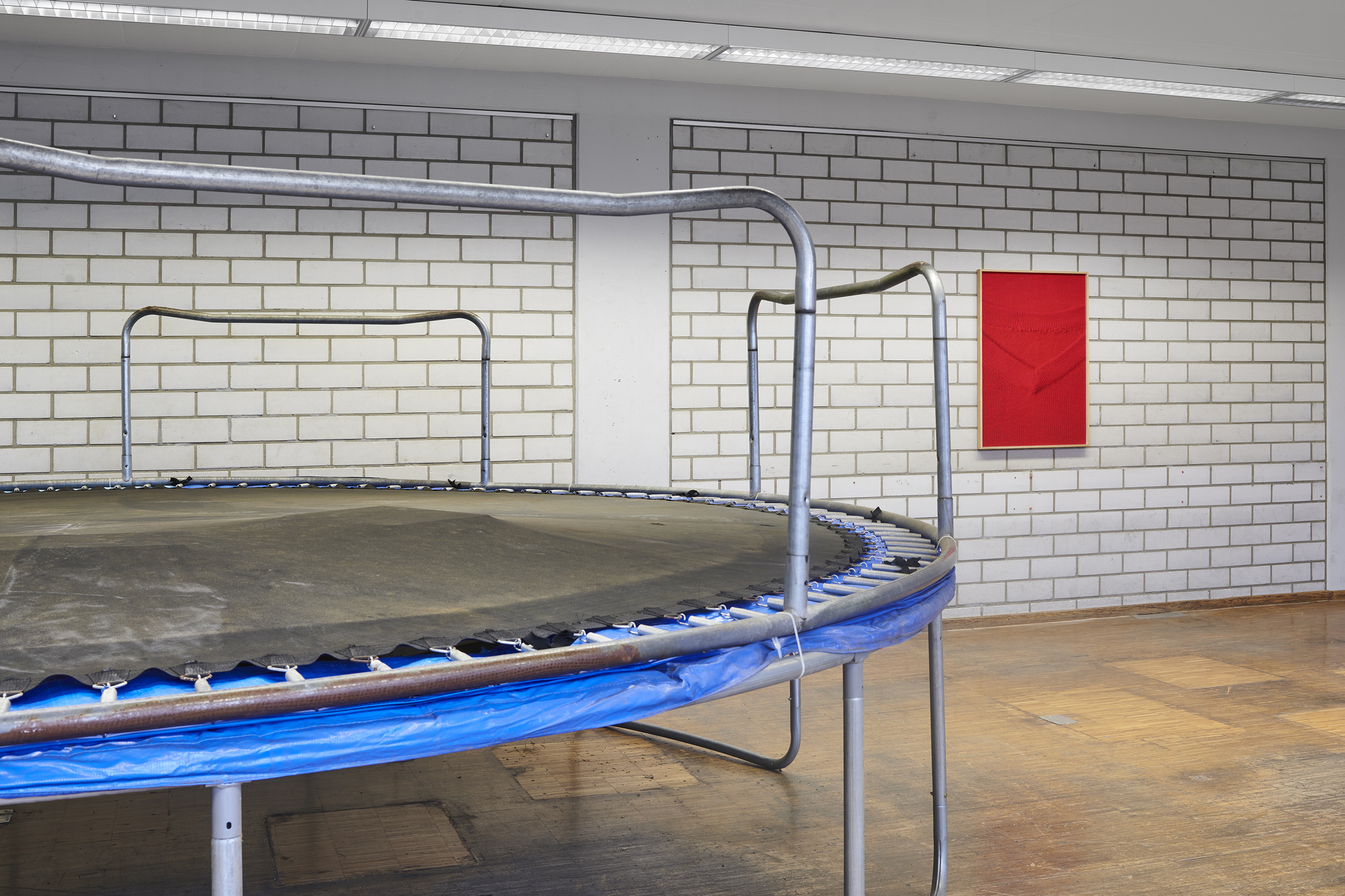
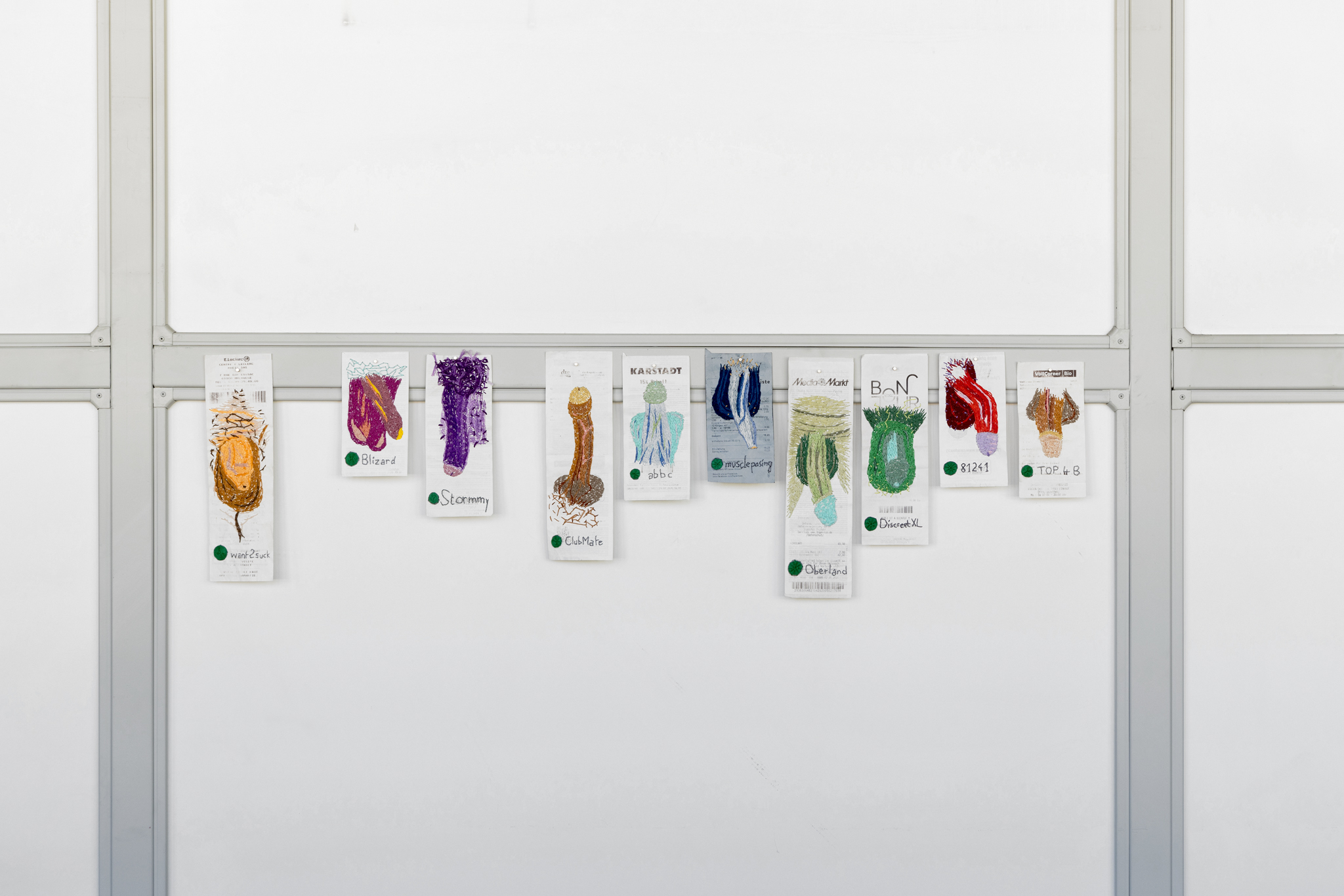
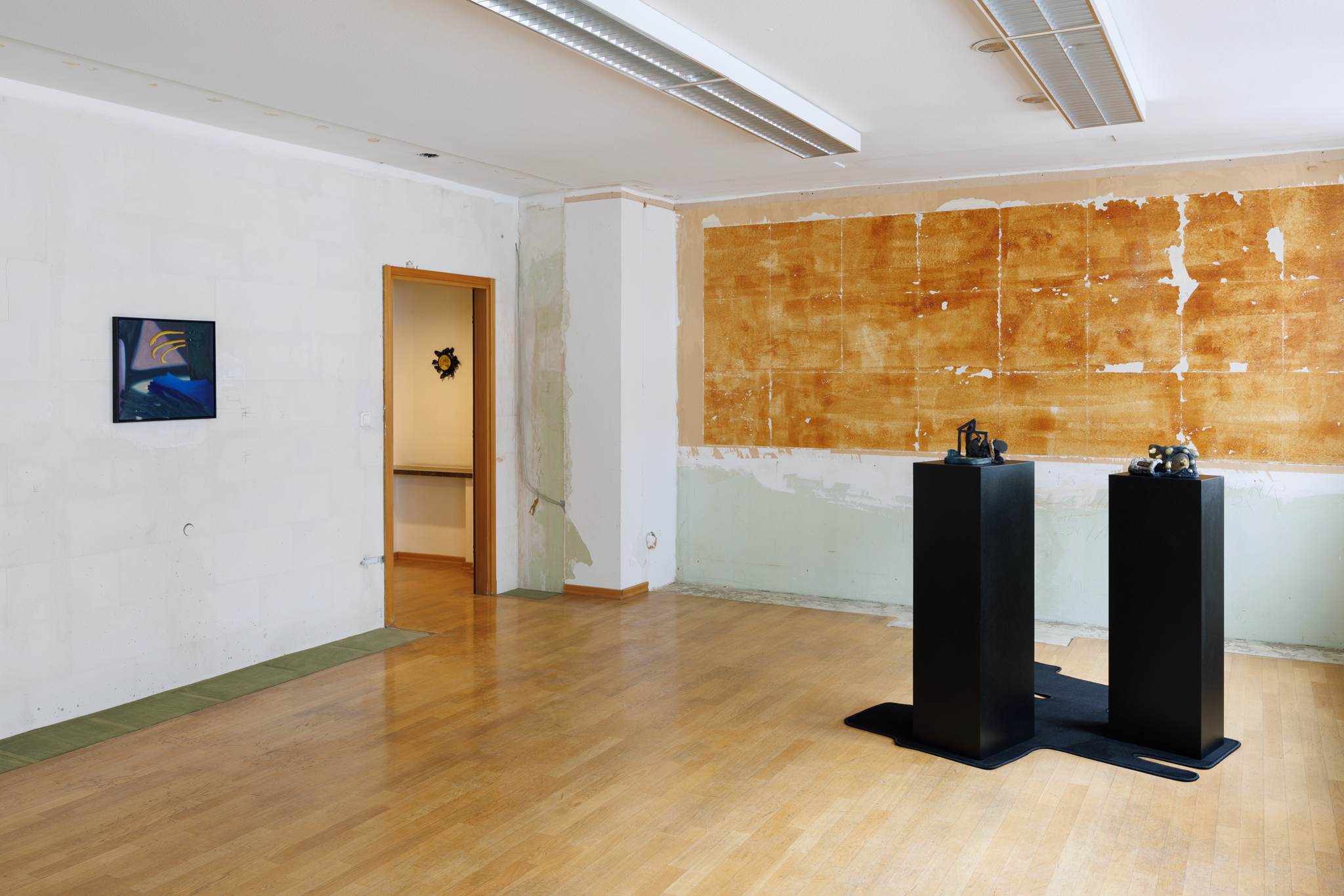
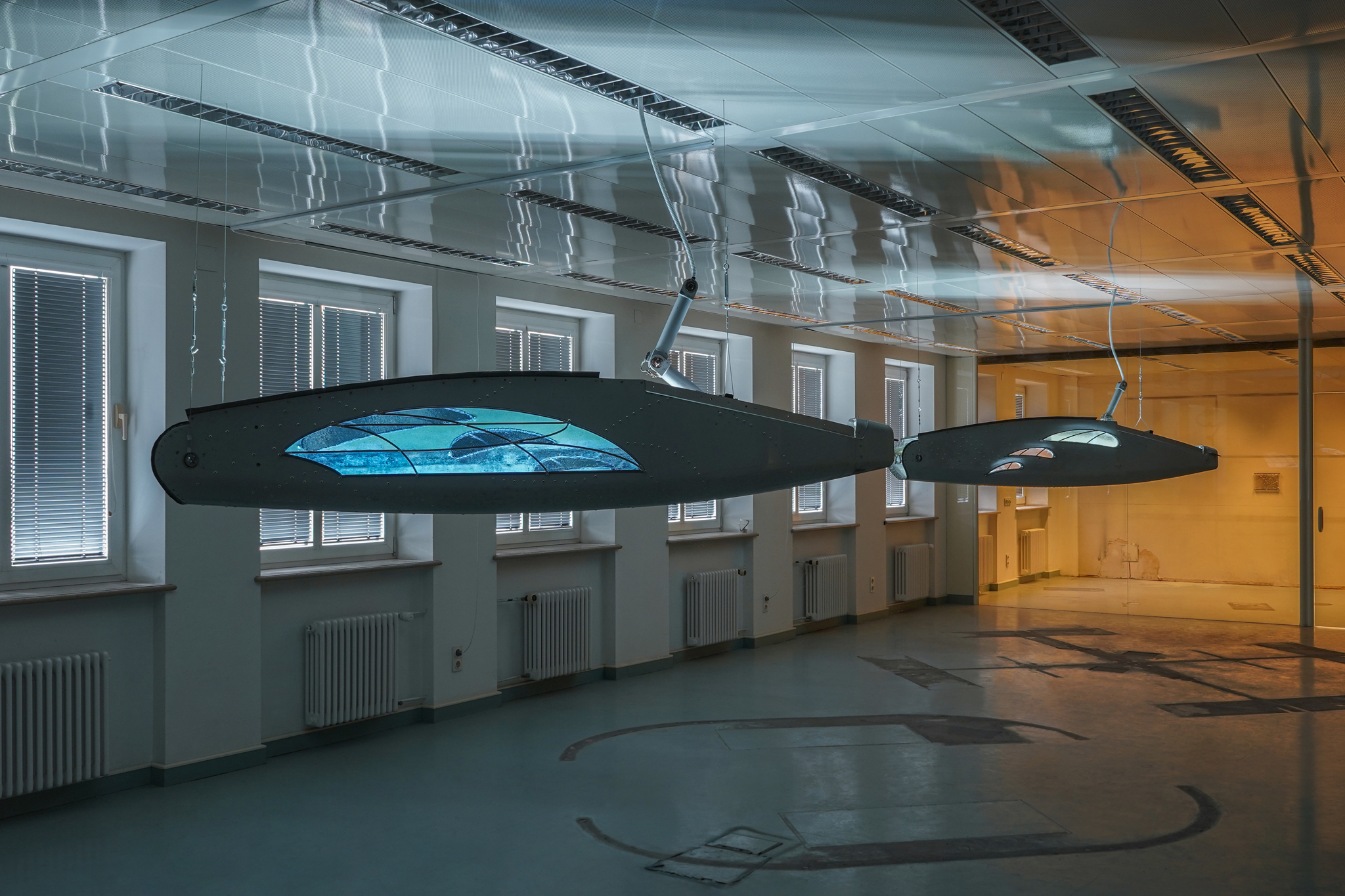
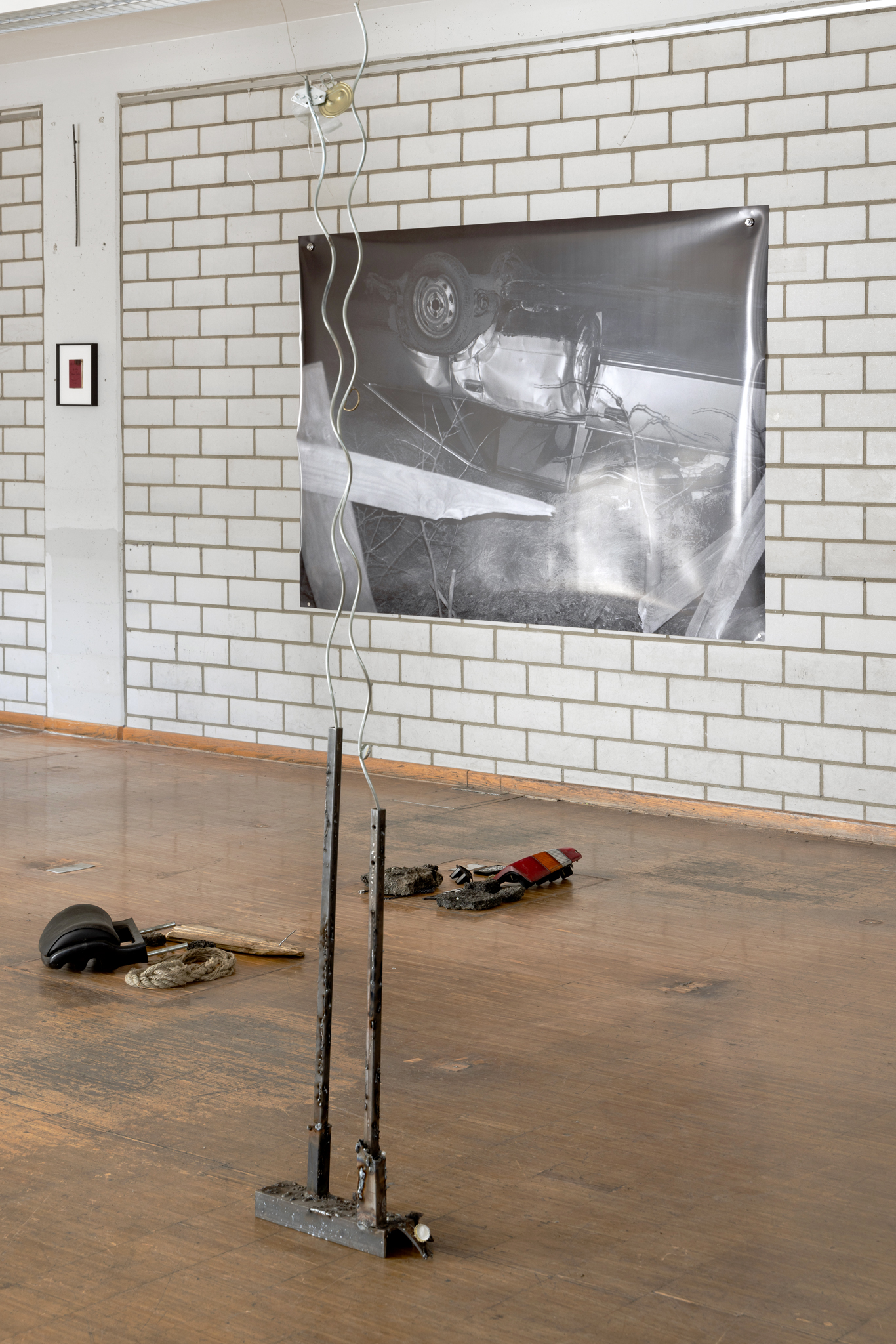
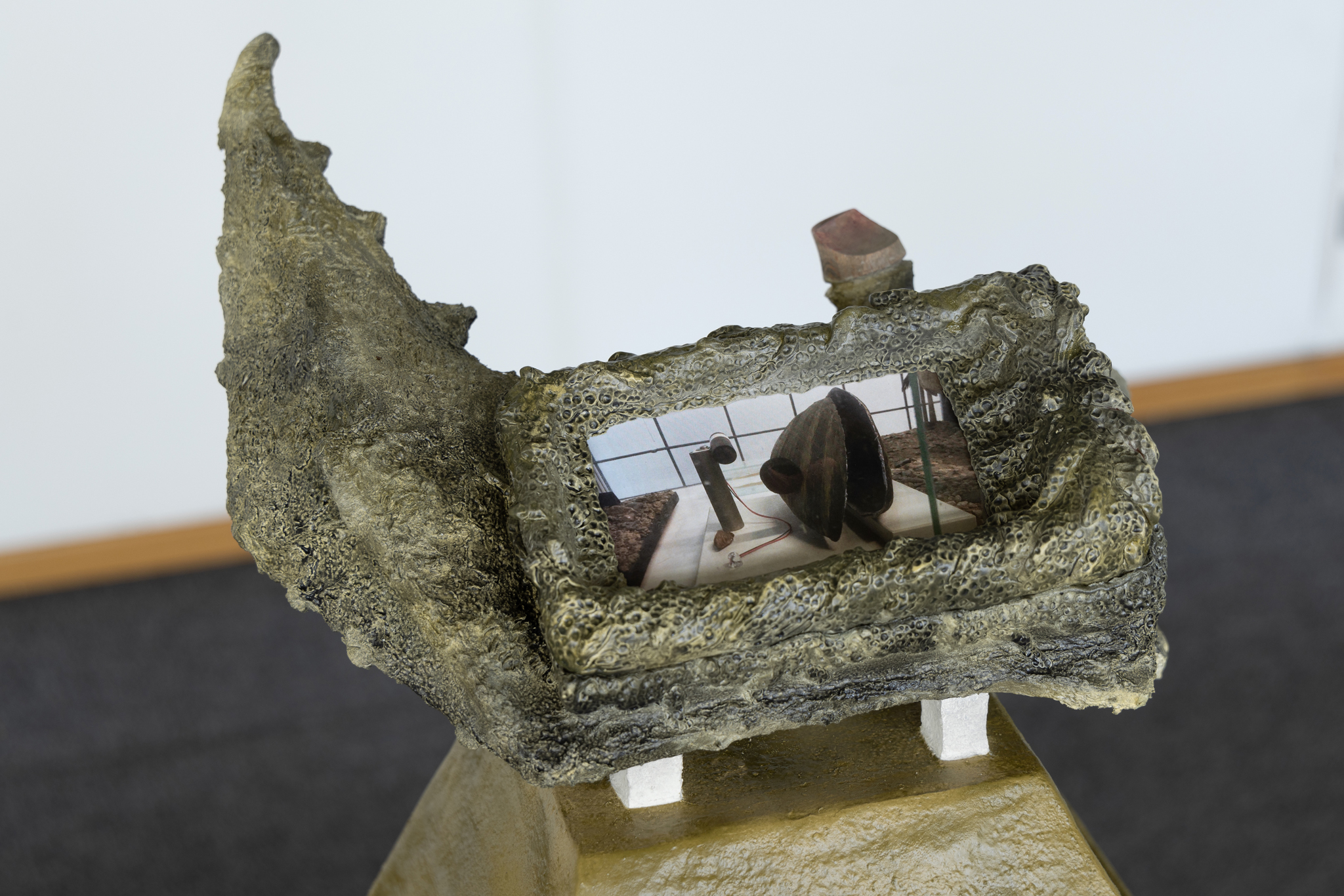
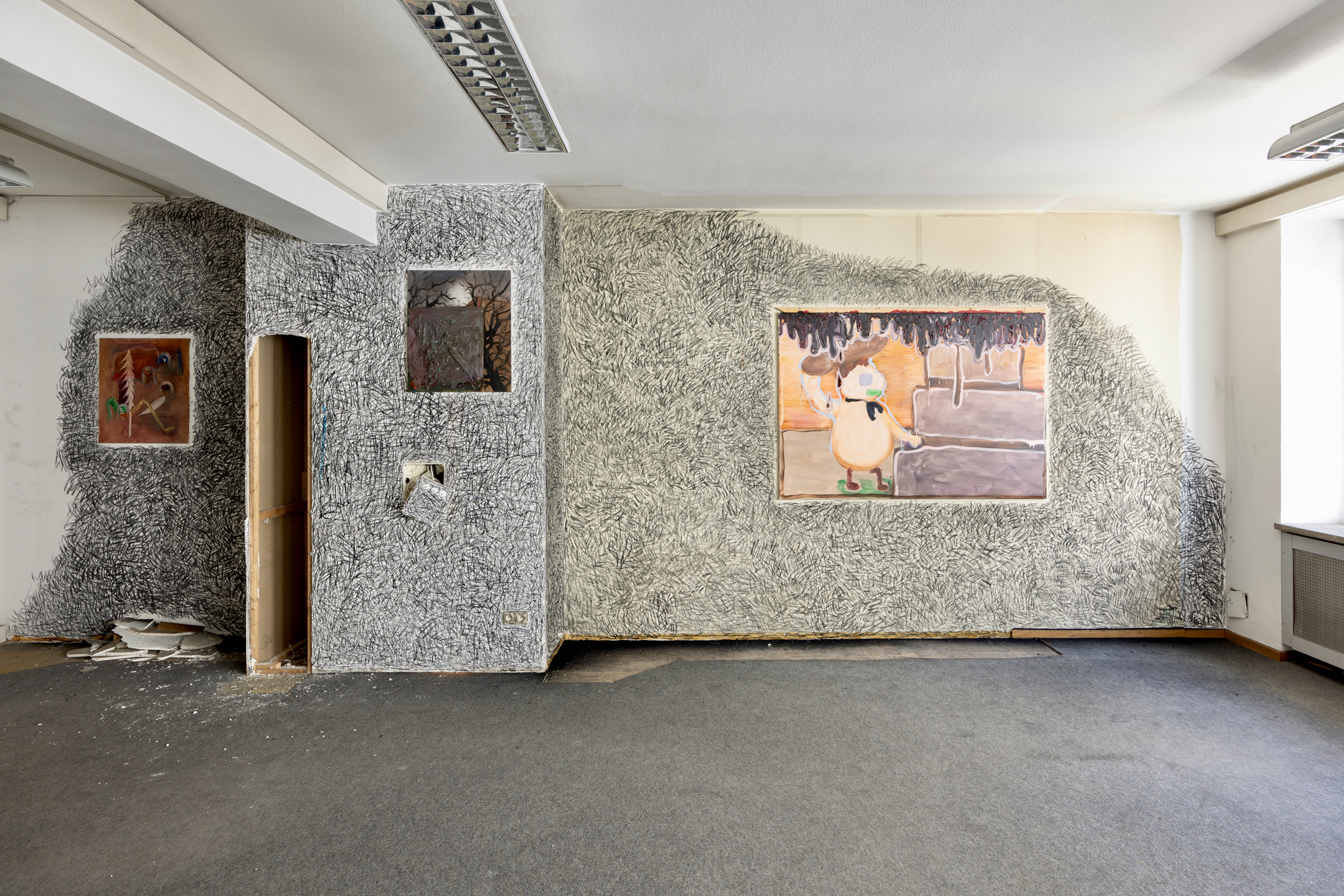
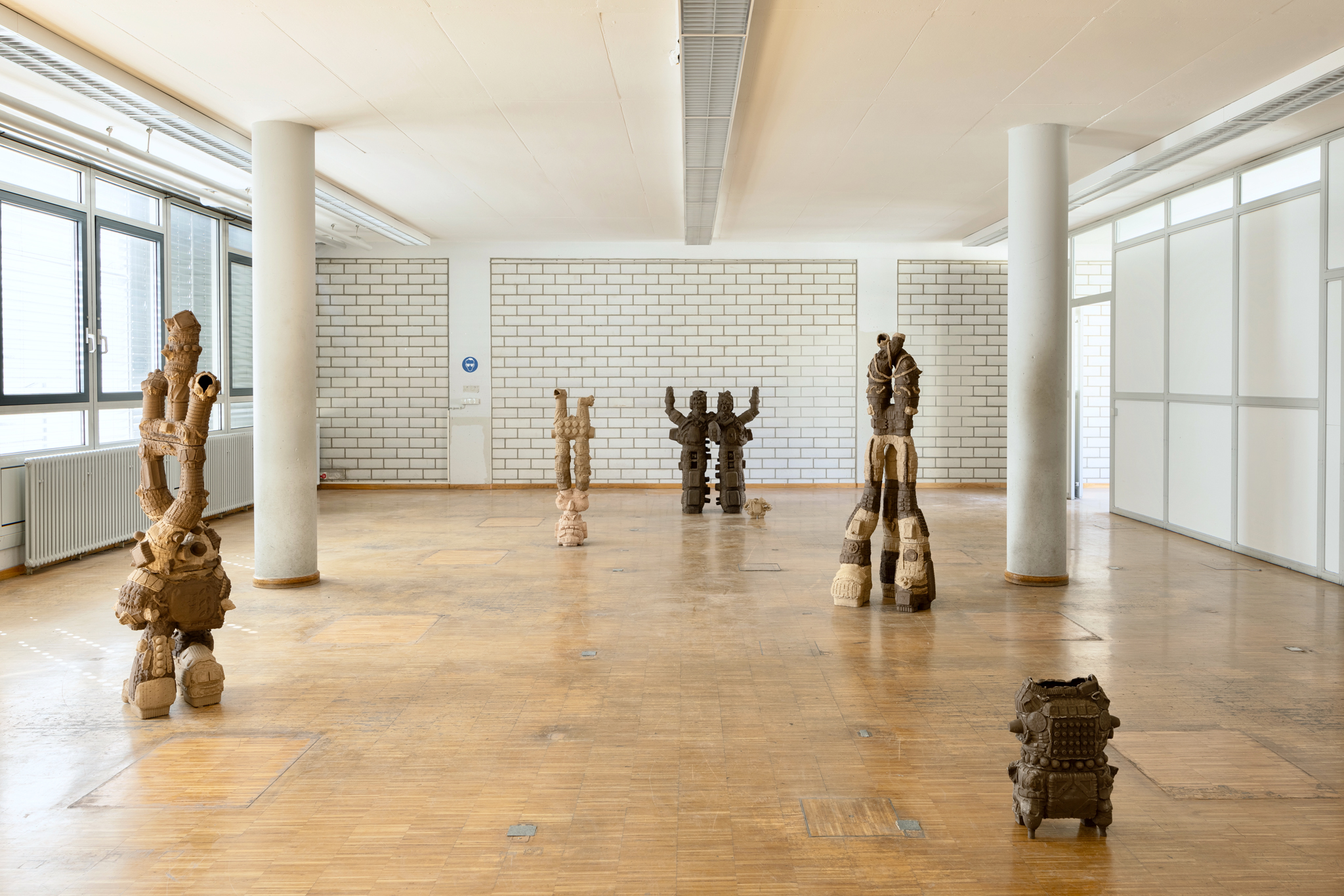
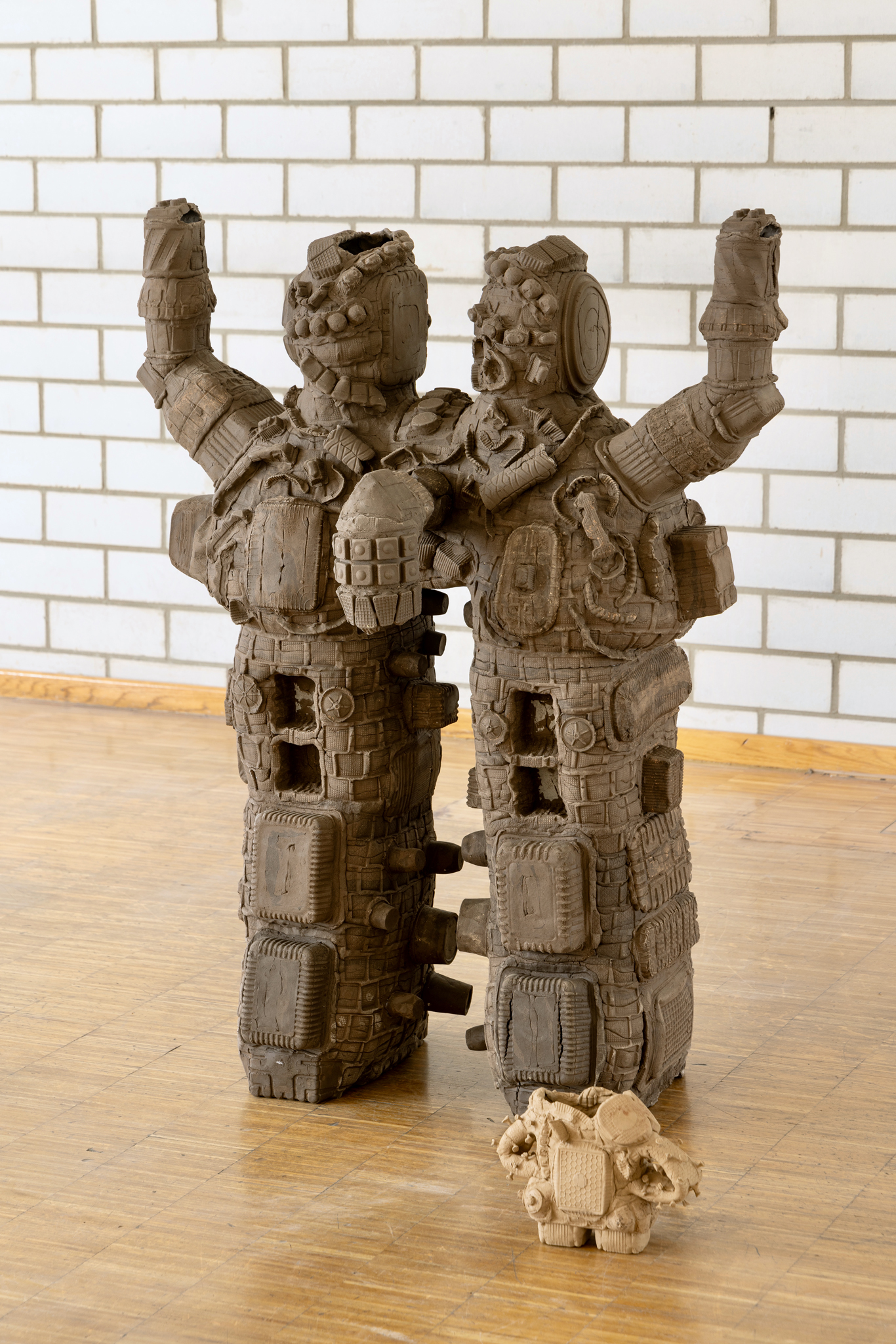
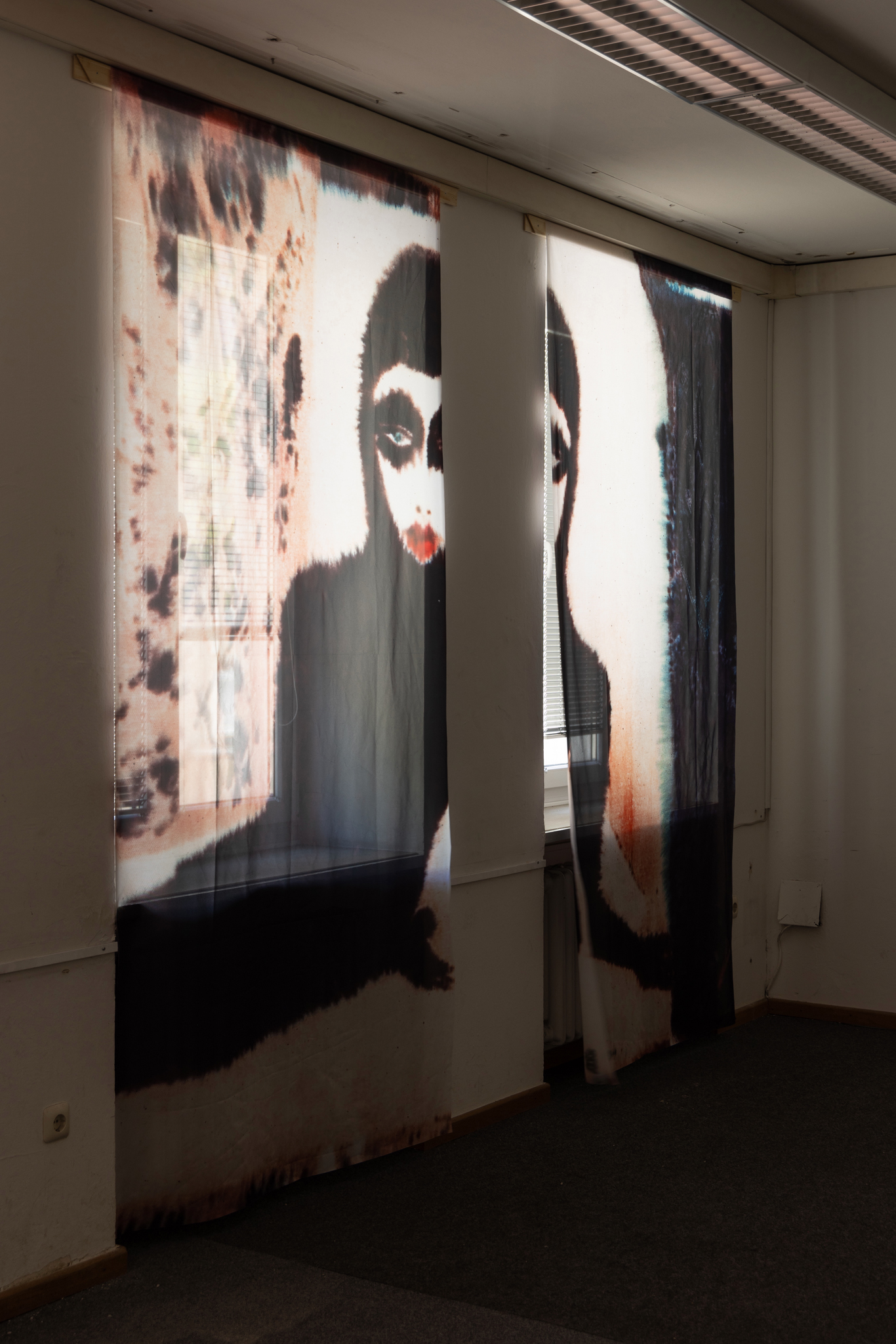
Hêlîn Alas, Carrying the Earth to the Sky, 2024, installation view with “Up and Up and Up and Up,” 2024, trampolines, cable ties, speakers, sound, cables, 490 x 165 cm and “Still Faced,” 2024 framed photo print (part of a series) 100 x 70 cm. Photo: Produktion PitzHêlîn Alas, “Traumhaus junior,” 2024, caramel, 118 x 90 x 8 cm. Photo: Produktion PitzHêlîn Alas, “Traumhaus junior,” 2024, caramel, 118 x 90 x 8 cm. Photo: Produktion PitzPierre-Yves Delannoy, “embroideries on cashier’s ticket,” 2019-24, cotton yarns, thermo paper, dimensions variable (8 x 16 cm (X10)). Photo: Thomas SplettVeronika Hilger, Carrying the Earth to the Sky, 2024, installation view. Photo: Thomas SplettVeronika Hilger, Untitled, 2024, ceramic, 27 × 24 × 3 cm. Photo: Thomas SplettLukas Hoffmann, “Figure,” 2020, MDF, oak, aluminum, acrylic glass, 50 x 45 x 8 cm. Photo: Lukas HoffmannLukas Hoffmann, “Castle,” 2024, Spraypaint, plywood, screws, MDF dyed through, 100 x 100 x 200 cm. Photo: Lukas HoffmannJu Young Kim, “Almost like Whale Watching,” 2024, a pair of aircraft fairings, stained glass, rivets, LED, 240 x 38 x 46 cm (X2). Photo: Younsik KimJu Young Kim, “Almost like Whale Watching,” 2024, a pair of aircraft fairings, stained glass, rivets, LED, 240 x 38 x 46 cm (X2). Photo: Younsik KimAnna McCarthy, Carrying the Earth to the Sky, 2024, installation view with “Car Crash b/w,” 2001, analogue photograph 230 x 160. Photo: Thomas Splett Anna McCarthy, “Car crash installation,” 2024, mixed media, dimensions variable. Photo: Thomas SplettJonathan Penca, “Synanthropop,” 2024, paper-maché, plaster, polymer clay, resin, cardboard, acrylic paint, wood, glass, digital print on paper, plinth, 120 x 60 x 60 cm. Photo: Thomas SplettJonathan Penca, “Mitten Crack,” 2024, paper-maché, plaster, polymer clay, resin, wooden bird whistle, lipstick, cardboard, acrylic paint, digital print on paper, plinth 120 x 60 x 60 cm. Photo: Thomas SplettCurtis Talwst Santiago, “History of Touch” 2024, installation view detail. Photo: Thomas SplettCurtis Talwst Santiago, “History of Touch” 2024, installation view. Photo: Thomas SplettValio Tchenkov, Carrying the Earth to the Sky, 2024, installation view. Photo: Thomas SplettValio Tchenkov, Carrying the Earth to the Sky, 2024, installation view. Photo: Thomas SplettAyaka Terajima, Carrying the Earth to the Sky, 2024, installation view. Photo: Thomas SplettAyaka Terajima, “Long legs doki,” 2023, Unglazed fired ceramic by recycled clay, 60 x 100 x 130 cm. Photo: Thomas SplettGülbin Ünlü, “Karanlik isik,” 2024, wood, printed fabric, dimensions variable (site specific installation). Photo: Thomas SplettGülbin Ünlü, “Karanlik isik,” 2024, wood, printed fabric, dimensions variable (site specific installation) detail. Photo: Thomas SplettPaul Valentin, “Kasside,” 2024, site specific video installation. Photo: Thomas SplettPaul Valentin, “Kasside,” 2024, site specific video installation. Photo: Thomas SplettMax Weisthoff, “perpetuator,” 2024, sculptural sound installation, 5 objects, cable, dimensions variable (site specific installation). Photo: Thomas SplettMax Weisthoff, “out of flesh,” 2024, mixed media installation, 2 channel video, x objects, dimensions variable (site specific installation). Photo: Thomas Splett
“Carrying the Earth to the Sky” will present works by 13 artists who are currently active in the contemporary art scene in Munich. The artists were selected in a two-stage process. First each of the 37 participants of VARIOUS OTHERS nominated one artist currently living in Munich. From this group, an international jury consisting of four institutional curators selected 13 artists who will show their work as part of the VARIOUS OTHERS program in September. The jury acknowledged that the quality of the applications received made their task both exciting and challenging. The final selection of multi-generational artists reflects the desire to see art beyond fixed categories and clichés and to honour distinctive works.
The exhibition’s curator, Magdalena Wisniowska, has meticulously chosen the works in collaboration with the artists. These will be presented together in an overarching curatorial concept at Schillerstraße 38 under the title “Carrying the Earth to the Sky”.
“The earth is something human, something we keep under our feet. The sky high above is without air, where no living thing can breathe. Moving away from one to the other means letting go of the earth and constructions that belong to it – actions, bodies, objects, sensations and desires – until only the elements, disconnected molecules, remain.”
We would like to express our gratitude to all supporters of the exhibition, particularly the owners of the property at Schillerstraße 38, the Cultural Department of the City of Munich, the Edith-Haberland-Wagner Foundation and Serviceplan Group for their generous support.
Jury: Rosa Ferré (TBA21, Madrid) Luis Silva (Kunsthalle Lissabon) Nicola Trezzi (CCA, Tel Aviv) Vivien Trommer (K21, Düsseldorf)
Lothringer Studio, Lothringer Str. 13, 81667 München
As some of you know, I have been speaking about setting up a reading group for some time. This was supposed to take place on Mondays and the idea was you would read but not socialise, ie. not drink. It is why I started writing “Sad Mondays” for Porcile, which essentially was such a one-person book club. Well, I am trying again this time on Tuesday, and I am going to call it “Sad Tuesday” – hah! – because I am so inventive.
We will be reading texts loosely relating to Paul Valentin’s exhibition. The first are as follows:
1. Heidegger’s “Origin of the Work of Art” (we need to split this up into 2 sessions I think)
2. Meyer Schapiro “The Still Life as a Personal Object – a Note on Heidegger and Van Gogh.
3. Jacques Derrida “Restitutions of the Truth in Pointing”
The first session will take place on Tuesday, the 2nd of May at 6 pm, at the Lothringer Studio upstairs. I suspect it will last an hour or so. Hope to see some of you there! If you would like a copy of the text, please email me directly at contact@gig-munich.com.
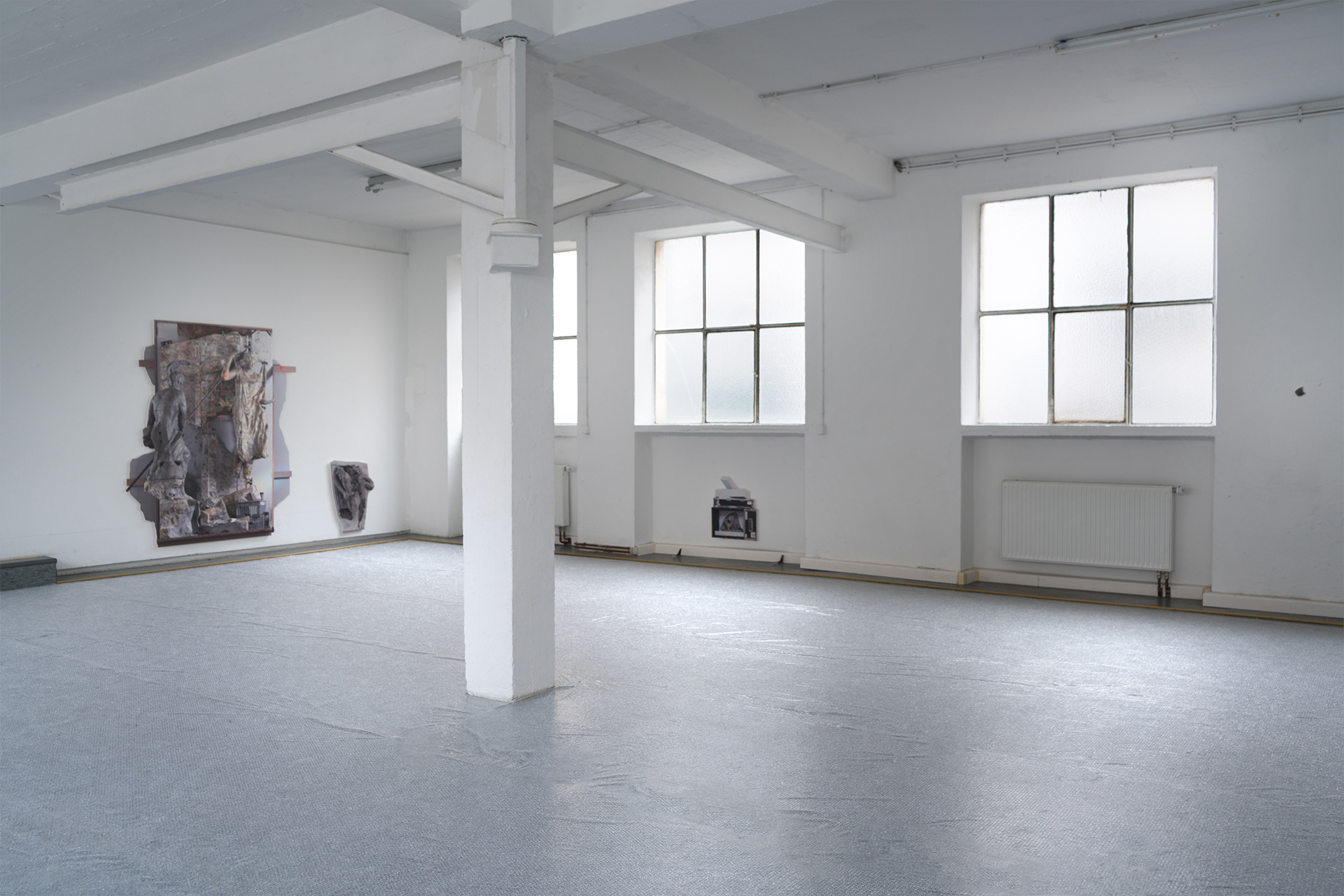
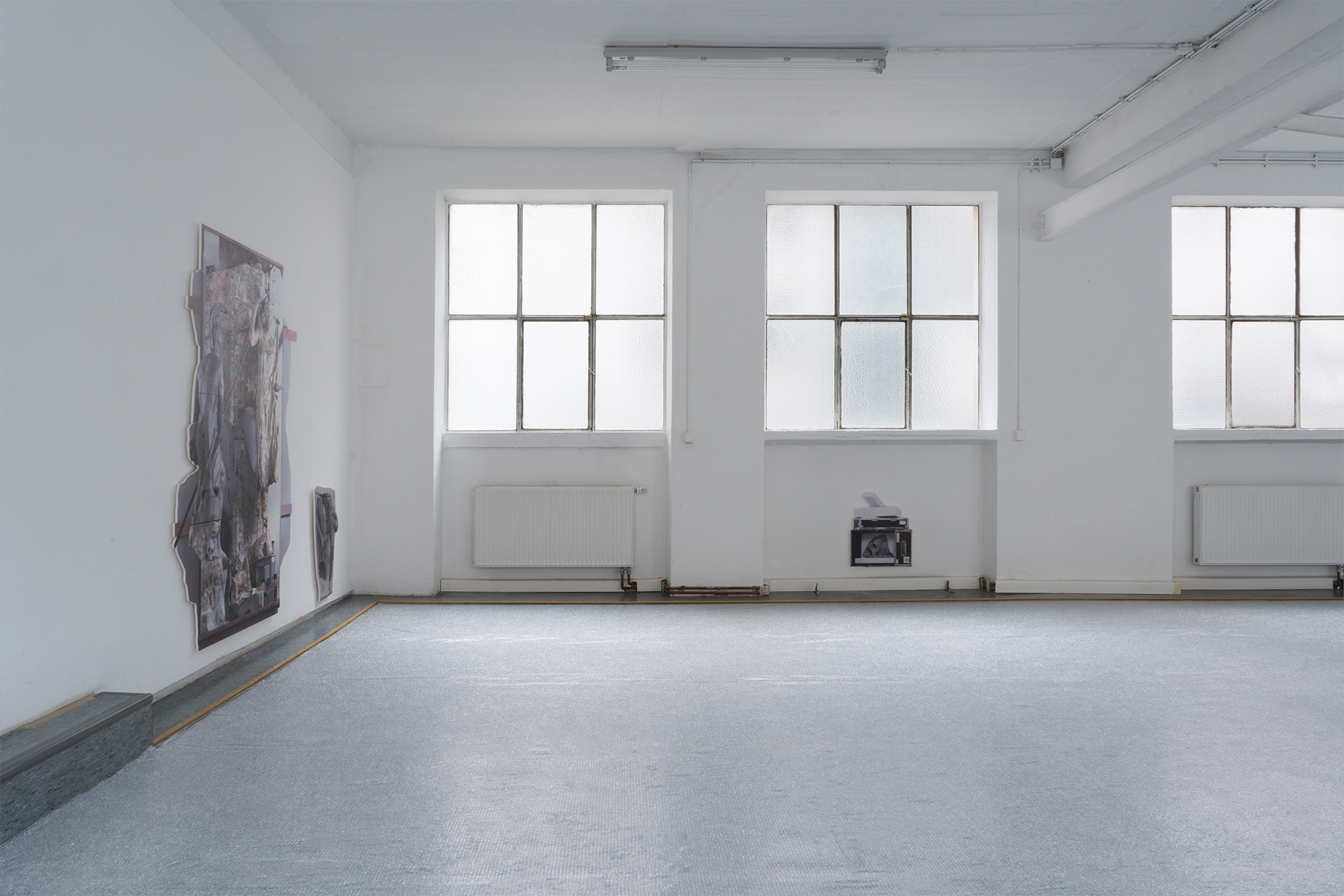
Paul Valentin, Doxa, 2023, exhibition viewPaul Valentin, Doxa, 2023, exhibition viewPaul Valentin, Doxa, 2023, exhibition viewPaul Valentin, Doxa, 2023, 3D rendering, print on smartX, size variablePaul Valentin, Doxa, 2023, 3D rendering, print on smartX, size variablePaul Valentin, Doxa, 2023, 3D rendering, print on smartX, size variablePaul Valentin, Doxa, 2023, 3D rendering, print on smartX, size variablePaul Valentin, Doxa, 2023, exhibition viewPaul Valentin, Doxa, 2023, 3D rendering, print on smartX, size variablePaul Valentin, Doxa, 2023, 3D rendering, print on smartX, size variablePaul Valentin, Doxa, 2023, 3D rendering, print on smartX, size variablePaul Valentin, Doxa, 2023, 3D rendering, print on smartX, size variablePaul Valentin, Doxa, 2023, exhibition viewPaul Valentin, Doxa, 2023, 3D rendering, print on smartX, size variablePaul Valentin, Doxa, 2023, 3D rendering, print on smartX, size variablePaul Valentin, Doxa, 2023, 3D rendering, print on smartX, size variablePaul Valentin, Doxa, 2023, 3D rendering, print on smartX, size variablePaul Valentin, Doxa, 2023, exhibition viewPaul Valentin, Doxa, 2023, 3D rendering, print on smartX, size variablePaul Valentin, Doxa, 2023, 3D rendering, print on smartX, size variable
Photos: Lukas Hoffmann
What is the truth?1 Now there is a metaphysical question for you. Hardcore baby, yeah. That’s what we are talking about. What. Is. The. Truth. Heidegger turns around and points, there – there – to the temple, a Greek one I guess but no one really knows, or cares, as it really doesn’t matter; he points to the temple nestling among rocky hills, its columns in picturesque disarray. We can see it on Paul Valentin’s holiday snapshot. The temple as a work of art sets forth the truth. If you are looking for the truth you can find it there.
When I first encountered Heidegger’s essay as an undergraduate, “The Origin of the Work of Art” was presented to me as a critique of representation, specifically of mimesis. I admit I didn’t get it at the time. Now that I do, Heidegger does clearly state that the kind of truth he associates with the artwork has nothing to do with a painter’s capacity to produce resemblance. Truth here is not marked by the distinction between the model and the copy, the original and the fake, and in this sense his argument is anti-mimetic. Instead, he looks to the point of origin of the art work, and finds truth (with the help of van Gogh’s painting) in the way being is revealed. “Aletheia”, he claims, is the Greek term for the “unconcealedness of beings.”
This means we do not look at an artwork in a habitual way, as a thing or a piece of equipment. Heidegger rejects the interpretation of the artwork as either a substrate bearing traits, a manifold of sensations or as formed matter. These for him are various forms of assault on being. He argues that not to fall under the spell of this violence, we have to look at the temple and see how it both creates a world for us, in the sense of giving our lives its meaning, and also shelters this world by placing it back firmly on the earth, which only through the creation of this world emerges as ground. The temple as the work of art is Aletheia.
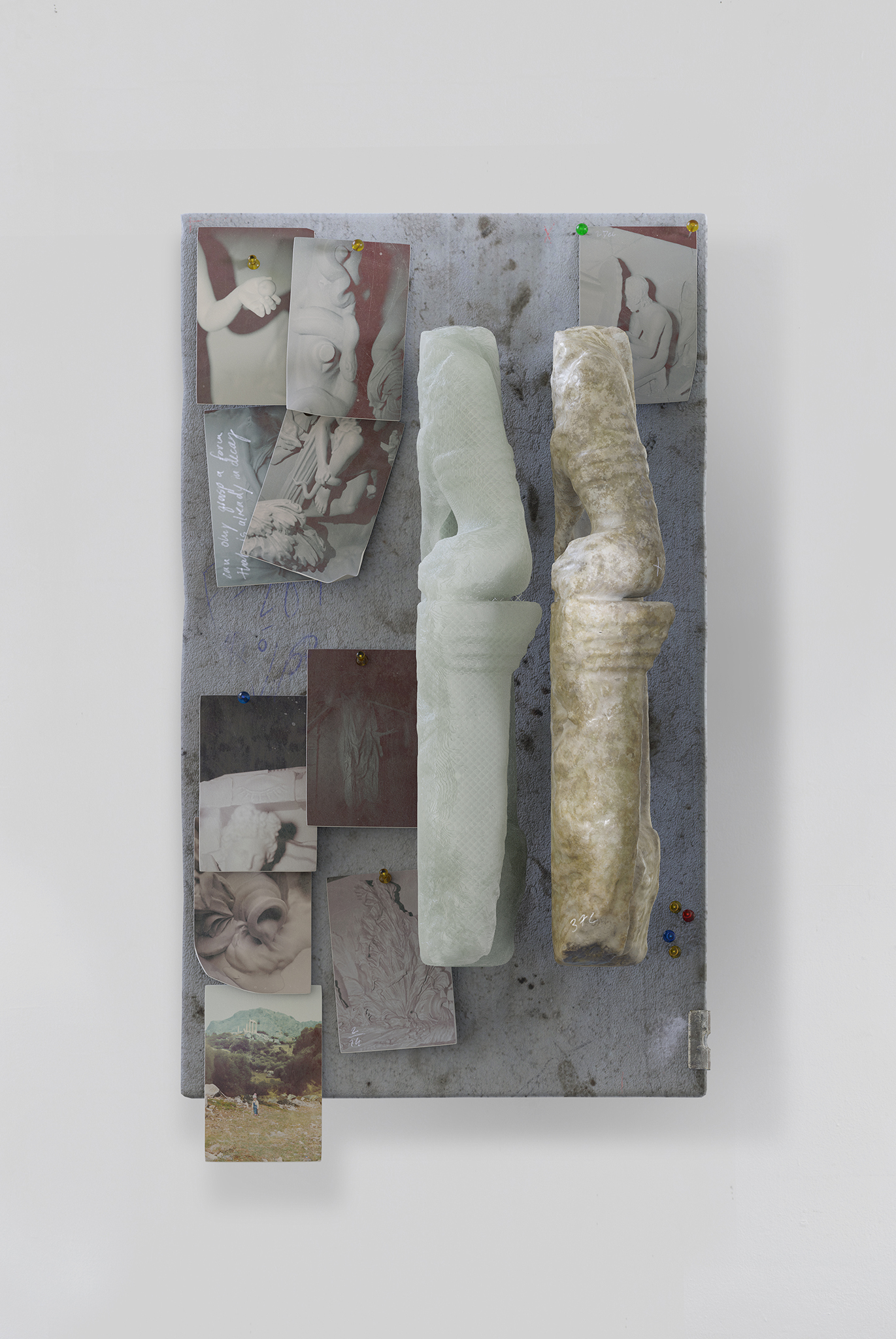
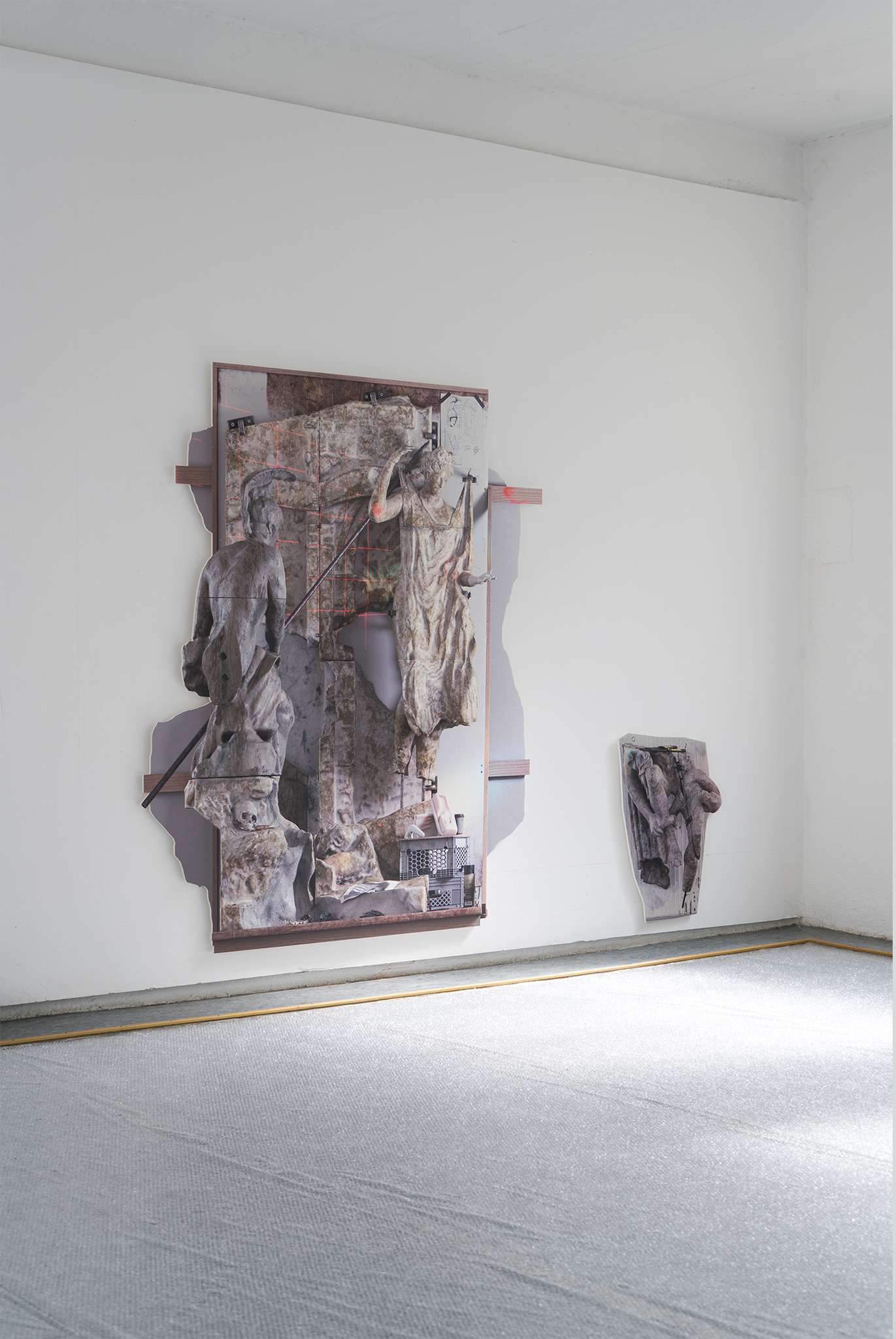
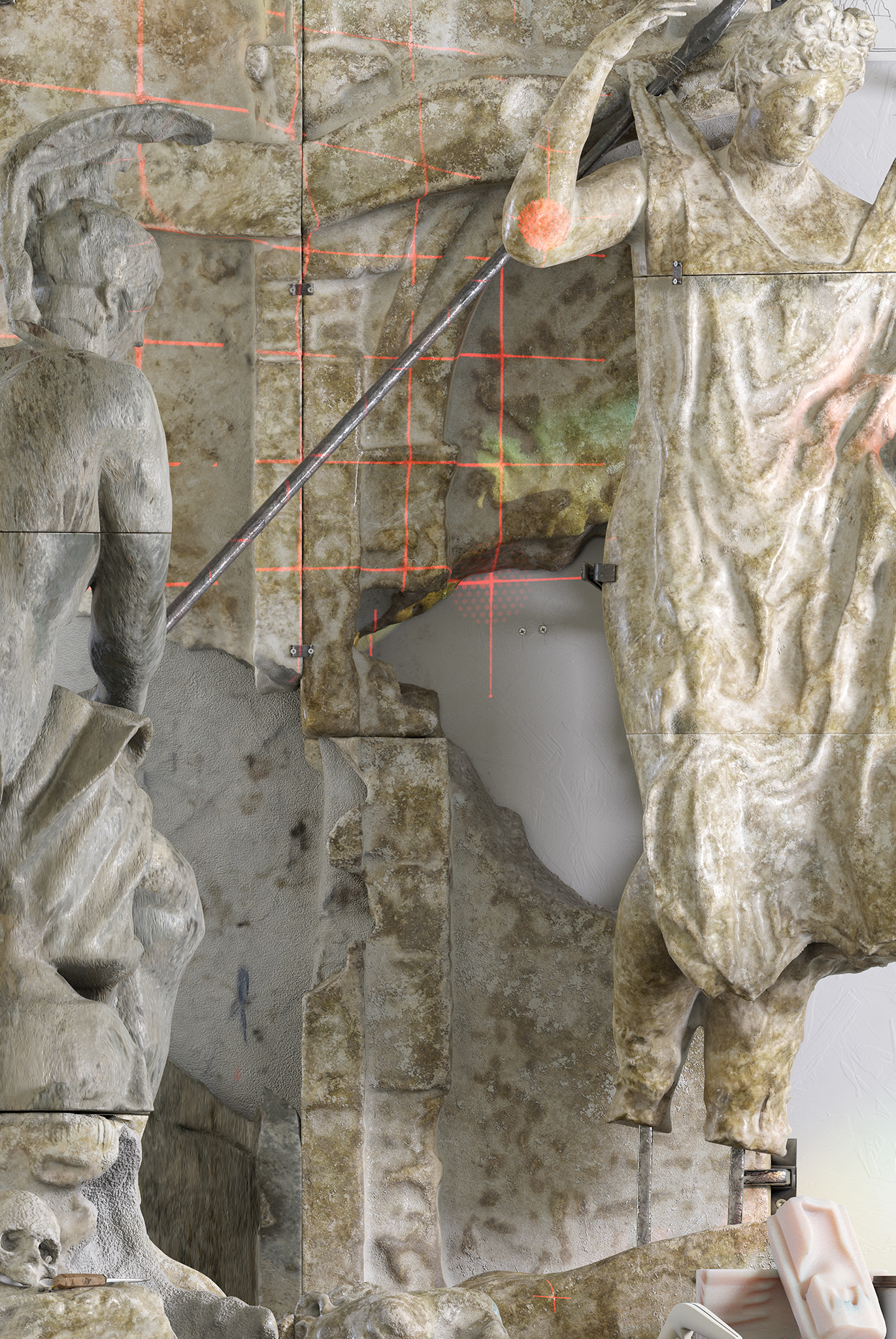
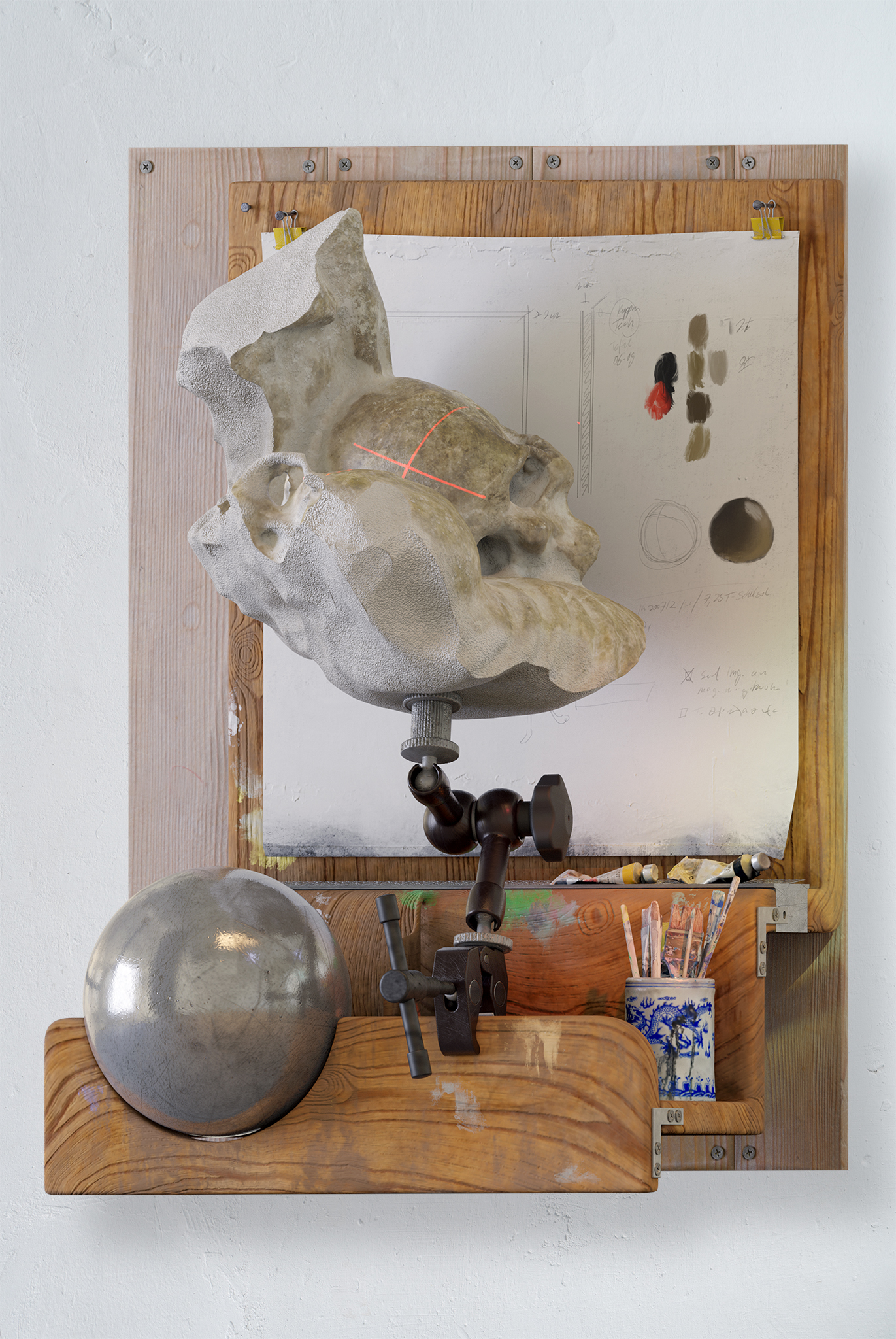
Paul Valentin creates his temple of of the Greek goddess Aletheia using digital software. It has the usual pediments and carved reliefs of mythological figures. He then, also digitally, breaks this temple up, fragments it, ages it artificially and destroys it. He takes up these fragments – still digitally – and reassembles them in workshop that shares many of the same visual conditions as the Lothringer 13 Studio space, like some kind of virtual archeologist. The reassembled fragments are photographed, printed and scattered across gallery room.
Thus there is no truth in Paul Valentin’s temple. Even the snapshot we see is a composite of an old photograph and an ai generated image, with some photoshopping in between. His temple does not, cannot, reveal anything. It is not even there. And yet it shows how mimesis is always at work, even in Heidegger’s argument. How does Heidegger reject the three modes in which we tend to think the artwork? By looking at how their claim to truth compares with the artwork’s truth, its revelation of being. Isn’t this also what mimesis is? I mean, isn’t the relation between a model and a copy not so much about resemblance as it is about good and bad resemblance – to what extent is the copy a faithful one? Isn’t it the copy’s claim to truth that we compare? Far then from producing a critique of representation, Heidegger’s comparison of different modes of thought would seem to fall down mimesis’s slippery slope. He too succumbs to its power. What is the truth? There is no truth, honey. Only simulacra. Paul Valentin shows that the question we need to ask is how does this simulacra work.
For full effect, please read in the voice of Tom Cruise’s character in Magnolia (1999). If you haven’t seen the movie, watch it now.
GiG Munich is really happy to continue working with Lothringer 13 again this year, and will begin the new series of exhibitions – Thought in Practice – at the Studio space with the exhibition “Doxa,” by Paul Valentin. The series aims to bring together different artists, who share a strong interest in philosophical concepts and who make these concepts the focus of their artistic practice.
Paul Valentin’s work has long dealt with the questions of metaphysics, such as the concept of truth, nothingness, or the structure of reality. Similarly in this Lothringer exhibition, “doxa” refers to the Ancient Greek definition of opinion, opposed to the much more serious and worthy “epitome” or knowledge. The exhibition consists of digitally-constructed fictional temple of Aletheia – the Goddess of truth in Greek mythology. Its fragments are not the 3-D artefacts found by archeological teams on a remote site, but the flat illusions, created, artificially aged and distressed by the artist using computer software. In this work Valentin presents truth as something that is always made: fragments of a temple that first had to be constructed before being destroyed.
Paul Valentin is a German artist currently based in Munich, working primarily with video and animation but also occasionally with music, digital relief and sculpture. His work has been presented at the European Media Art Festival, Haus der Kunst, Museum Villa Rot, Centro Cultural Moçambique, Sluice Biennale London and Exchange Rates Festival in New York. He was awarded the Karl & Faber Prize in 2019, as well as the Academy Association Prize that year and the Scholarship for fine arts by the City of Munich in 2021.
GiG Munich setzt auch in diesem Jahr die Zusammenarbeit mit der Lothringer 13 Halle fort. Die neue Ausstellungsreihe “Thought in Practice” startet mit der Ausstellung “Doxa” von Paul Valentin. Ziel der Reihe ist es, verschiedene Künstler:innen zusammenzubringen, die ein starkes Interesse an philosophischen Konzepten haben und diese in den Mittelpunkt ihrer künstlerischen Praxis stellen.
Paul Valentin beschäftigt sich in seinem Werk seit langem mit Fragen der Metaphysik, wie dem Begriff der Wahrheit, dem Nichts oder der Struktur der Wirklichkeit. Entsprechend bezieht sich “Doxa” auf die altgriechische Definition von Meinung in Abgrenzung zu dem viel ernsthafteren und würdigeren “Episteme” oder Wissen. Die Ausstellung besteht aus einem digital konstruierten fiktiven Tempel der Aletheia – der Göttin der Wahrheit in der griechischen Mythologie. Bei den Fragmenten handelt es sich nicht um 3-D-Artefakte, die von archäologischen Teams an einem abgelegenen Ort gefunden wurden, sondern um flache Illusionen, die der Künstler mit Hilfe von Computersoftware geschaffen, künstlich gealtert und verunstaltet hat. In diesem Werk stellt Valentin die Wahrheit als etwas dar, das immer hergestellt wird: Fragmente eines Tempels, der erst gebaut werden musste, bevor er zerstört wurde.
Paul Valentin lebt derzeit in München und arbeitet hauptsächlich mit Video und Animation, gelegentlich aber auch mit Musik, digitalen Reliefen und Skulpturen. Seine Arbeiten wurden auf dem European Media Art Festival, im Haus der Kunst, im Museum Villa Rot, im Centro Cultural Moçambique, auf der Sluice Biennale London und auf dem Exchange Rates Festival in New York präsentiert. Er wurde 2019 mit dem Karl & Faber-Preis ausgezeichnet, ebenso wie mit dem Preis des Akademievereins im selben Jahr und dem Stipendium für Bildende Kunst der Stadt München im Jahr 2021.
To enter Paul Valentin’s installation at the Rosa Stern Space – A Piano Plays In Another Room And It‘s Raining – is to step into a Plato’s cave of sorts. Awaiting you are two classic Corbusier lounge chairs in a darkened basement room. Feet up and immobile you are meant to look up at the projection on the ceiling. This is, like much of Paul Valentin’s works after Nichts from 2019, digitally animated, and in this sense is a simulation rather than some kind of camera recording. But instead of shadows of people and animals cast by objects, “wall implements wrought in wood and stone,” we see only another space, another darkened room (Plato, The Republic, 747). There is another, deeper cave in which we finds ourselves, “an ampler, stranger and deeper world,” that no longer adheres to familiar Platonic rules (Nietzsche, Beyond Good and Evil, § 289).
Paul Valentin, A Piano Plays in the Other Room and It’s Raining, 2022, video installation. Courtesy of the Artist
We enter this world through a room with a lighthouse outside the window. The light from the lighthouse runs across the rain covered window in the dim artificial glow, a phone rings, its green light blinks. The room we see seems very familiar to us and I do not just mean us gamers, who would recognise it from the 1996 classic,Lighthouse: The Dark Being. There is now a whole category of objects that seem more real when computer generated: raindrops and puddles, shiny little things out of plastic, soda cans, shattered glass, flames, plugs and sockets, fur and dust, and it is these that Paul Valentin collects, like some kind of digital Wall-E. So familiar are these computer generated things that they, and the rooms in which they live, have acquired a sheen of nostalgia, the aesthetic of liminal spaces, with its own wikipedia fandom page. Accompanying us is a suitably melancholy piano sound track and the hum of rain in the distance.
From this first shadowy room we move on to another and then another, always following the invisible camera, always staying in the rain. One room seems enormous, filled with forgotten film equipment, stage sets and props. In this room we see both the camera, a classic Arri Alexa mounted on wheels, and what it films, a wooden model of a classical building, brightly lit. But we also seem to see what is inside the wooden model, with its cornices, columns and tympana – its tapestries and parquet floor. And here too is a camera, momentarily visible to us when sparks fly from a broken power cable. When the camera follows a single coffee drop down from the machine to the floor, then above and below along the cable leading to the elevator and ventilation shaft, we enter the final space, a modern-looking bedroom upstairs. Zooming onto the vase with flowers next to the bed, we seem to be back again inside the wooden model from the beginning, with its tapestries, petals falling in from a hole in the ceiling.
Paul Valentin, A Piano Plays in the Other Room and It’s Raining, 2022, video installation. Courtesy of the Artist
Every time there is a film cut and we move from one room to another, our understanding of the spaces shifts. What seemed to us a stage set at the beginning, with false walls and fake rain, is at the end shown to be an actual lighthouse outside. This lighthouse seems to be both within the large space of the warehouse and within the wooden miniature model.There is a vertiginous circularity at work here that belongs to the gaming world rather than the film, and the first impression of the work is that of a YouTube game walkthrough, the camera movement determined by a click or sequence of clicks on the various objects – an updated and sophisticated version of classic point and click games likeMyst. We see the objects from all possible camera angles, all the different aspects: inside, outside, above, below, behind, as a stage set, captured on film, in the dark, in the light etc. The technical wizardry is breathtaking. Paul Valentin is not Plato’s puppeteer, standing behind a wall holding up simple wooden and stone objects infront of a fire so that they might cast some shadows on a wall, but rather Plato’s artist, if such an artist were at all possible: consider how he is described in Book X of the Republic, the maker of all the works of all other workmen.
For this is he who is able to make not only vessels of every kind, but plants and animals,himself and all other things – the earth and heaven and the things which are in heaven or under the earth, he makes the gods also.
This is the “extraordinary man,” “a wizard no mistake,” who Plato reveals to be nothing other than a painter.
Of course, the painter is not really such an extraordinary creator, because he is not really the maker of all these things. The painter’s concern is appearance only, and we as the gullible audience are tricked into believing his illusions. Paul Valentin revels in playing this role of the trickster, as is already in apparent in work such as Beyond the See.
Paul Valentin, Beyond the See, 2021, video installation. Courtesy of the artist.
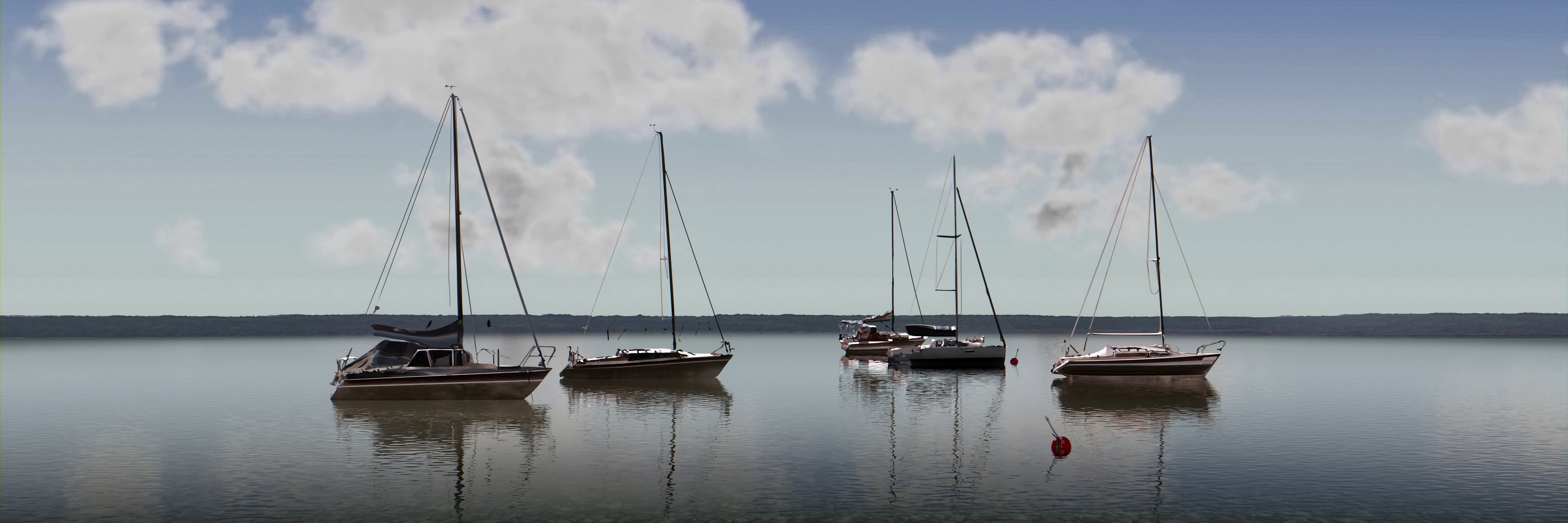
In this work, we are presented with an image of a few sailing boats bobbing gently on a lake. The sky is blue, the water still, and that is enough already to put in mind a scene out of the Truman Show. And sure enough, the image is revealed to be more complicated than at first glance, the sailing boats not boats at all, but a series of complex intertwining computer generated structures that only look like boats when the slight breeze allows them to be viewed together from the one perfect angle.
Paul Valentin, Beyond the See, 2021, video installation. Courtesy of the artist.
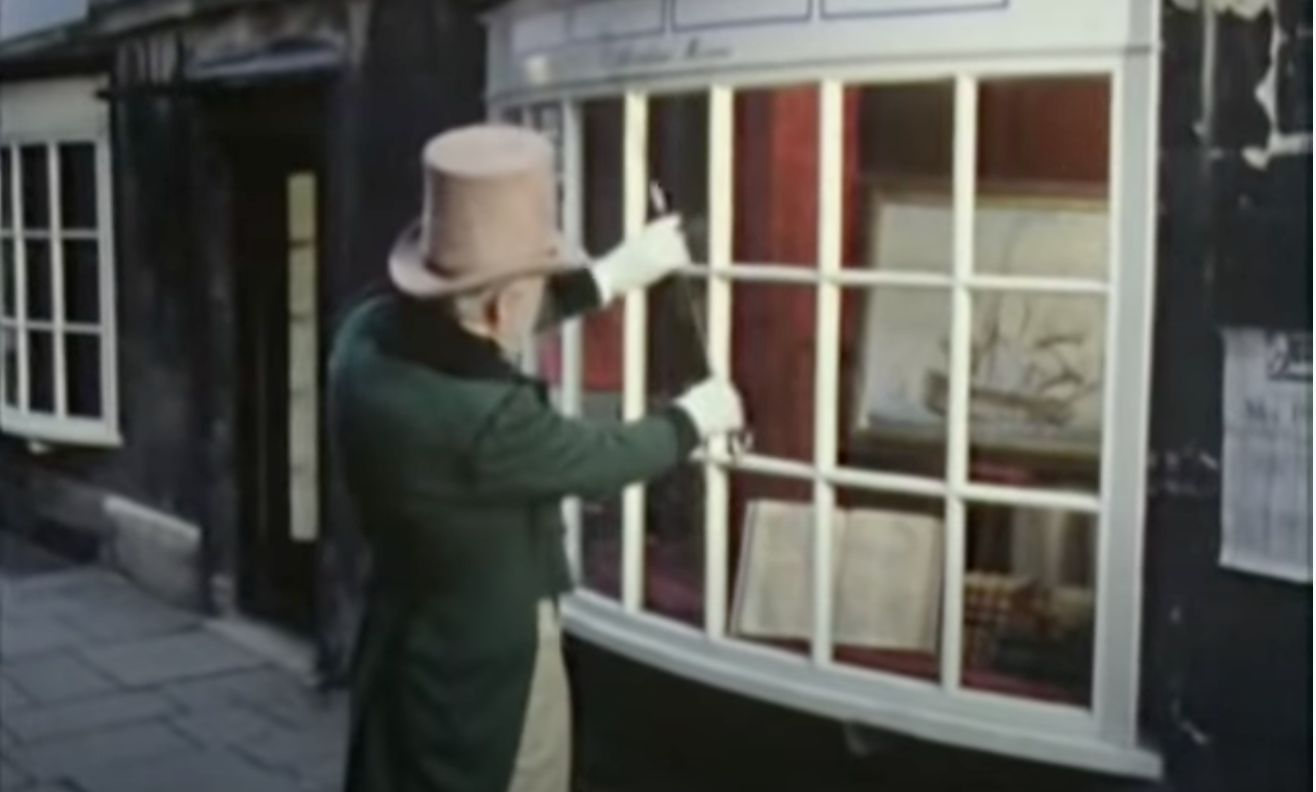
In a scene in Jane Austen’s Persuasion, Admiral Croft complains to the heroine Anna,
Here I am, you see, staring at a picture. I can never get by this shop without stopping. But what a thing here is, by way of a boat! Do look at it. Did you ever see the like? What queer fellows your fine painters must be, to think that anybody would venture their lives in such a shapeless old cockleshell as that? (202)
Persuasion, 1971 Granada television series
No one in their right mind would want to sail on one of Paul Valentin’s boats – the very idea is ludicrous. He doesn’t even try to make his boats seem believable to us. Instead he shows that things which might look like boats do not have to be boats at all. What we see is not what we think we see or know or understand. Plato’s puppeteer from the cave, his painter of beds and tables – but the figure perhaps closest to Paul Valentin, is that of the Sophist, defined by Plato as someone who is an imitator, but not a “sound one,” an imitator with “a crack” in his iron, a queer fellow indeed (Plato, The Sophist). A Sophist imitates the appearance of wisdom in his arguments, but is not actually in possession of wisdom. He spins his arguments until we are left bewildered and confused, rather than any more knowledgeable. In his short essay “Plato and the Simulacrum” Gilles Deleuze compares the Sophist to Proteus, the constantly changing, ever-shifting God of the sea, a T-1000 only possible with developments in CGI.
For Valentin’s project is very much anti-Platonic one, despite the numerous classical references to works and objects that are Platonic in spirit (is that a portrait of Socrates I see in the dark? is that Athena’s owl, the symbol of wisdom?). We tend to think of Plato’s theory of the forms in the most simple manner: there is a thing and the image, an original and a copy, the model and the simulacrum. And when looking at the world around us we believe ourselves to be as dispassionate and objective as an 18th century naturalist that Jane Austen would recognise, distinguishing the differences between things in order to categorising them correctly as a certain species belonging to a certain genus. But as Deleuze argues in “Plato and the Simulacrum” the goal of the Platonic project is not of distinctions between species, but rather distinctions between claimants. The decisions involved are only superficially of the careful naturalist, and rather must be understood as value judgements, with all the problems such value judgements involve. In our encounter with a thing – platonically speaking – we must decide to what extent its claim to authenticity is a real one: to what extent is this thing that we see, not just a copy, but a true copy of a perfect original. In other words, we establish a narrative of foundation, with an original, unchanging foundation that gives our claim its value, theobject of a claim, and a claimant – us. Or, as Deleuze describes the Neoplatonic triad, we establish an unsharable, the shared and the sharer – something almost impossible in the world of digital animation and open source programmes, in which new tools, animated objects and sequences are shared openly. The unshakeable foundation is that according to which claimants are judged and their claim measured. It is also however used to hunt down the false claimant, the bad copy, the simulacrum.
In Deleuze’s reading the simulacrum is bad, not because it is the lowly copy of the copy, as it would seem from Plato’s metaphor of the bed – there being a perfect bed of the gods, the bed made by craftsmen that follows this perfect model, and the bed of the painter, the imitation, “thrice removed from the king and from the truth” (Book X). Rather, the bed of the painter is a bad copy, because it is a false claimant, refusing the authority of resemblance. When Deleuze defines the simulacrum as the “image without the resemblance” ( this does not mean that resemblance is not at work – indeed as is also apparent in the work of Paul Valentin, it can be argued that the simulacra is nothing but resemblance. The point is however, that it is not the right kind of resemblance, the good resemblance of the object to the idea. Indeed, the problem lies in what we have seen to be the case of Paul Valentin boats: the fact that the painter’s bed has no need of the idea of the bed at all, and makes no recourse to the modality of understanding, whether knowledge or opinion. Admiral Croft dismisses the painting of the sailing boat in the window, because the depicted boat does not match the knowledge and experience of a sea faring vessel that he has acquired over the course of his naval career. He compares the painted boat with the sailing boats he knows and judges accordingly. In contrast, Paul Valentin is only interested in what Deleuze would describe as the “effect of resemblance” (49). He would be the crazed and demonic naturalist, who only looks at the patterns and surfaces and the differences in appearances, completely uninterested in how a species may relate to genus.
Deleuze describes the simulacrum as something vast – and this is true of both pieces, A Piano Plays In Another Room And It‘s Raining as well as Beyond the See. A world consisting of appearance only is necessarily enormous, encompassing endless multiple and different points of views – for after all, anything and everything can be copied by the painter. It is the animated world of video games and rooms opening onto another; it is also the world in which the resemblance to a boat is only one point of view we have of complex intertwining structures. To see the everything-at-once of all appearance involves not just wizardry, but also a madness. Those boats, are mad, as is the intoxication of flying from one room to the next, of The Piano Plays.
Deleuze associates this madness with modernity (51). Modernist work like that of Joyce, offers not different points of view of the one story, but rather a series of different and divergent narratives, as if to each point of view corresponded a new and different landscape. The video game seems to me the natural successor of this kind of modernist aesthetic: it is not, as with film, that the various story lines combine to form the one narrative, but rather, it always the simultaneous affirmation of multiple and often contrasting perspectives. It is a world in which a lighthouse can be both real and part of a stage set, inside and outside, miniature and vast. Whether modernist or not, all the works that in this way affirm heterogenous series as divergent, present a world view that is not the Platonic one based on sameness, likeness and identity. In the Platonic world view, any difference between individuals is a matter of first establishing identity. Things have to be the same, before we can detect differences. Identity for Plato would be something pre-established. But in Paul Valentin’s divergent world of the simulacrum, identity is presented as the product of disparity. It is not pre-given; it is made.
When all narratives, all heterogenous series are affirmed as equally valid there can be no distinction between the original and copy. It is the false claimant that triumphs, no longer false because in no need of a foundation to confer validity. But as Deleuze argues, the simulacrum not only overthrows Platonism (53). The false is also the power through which Platonism, as in the world of representation and identity consisting of the same and the like, is constituted. According to Deleuze’s logic, it is because of the simulacrum’s play with effect, that we can think in terms of a resemblance in the first place, and thereby establisha relation between the original and the copy.Or rather resemblance is the word we use when we think of the world platonically, rather than in terms of the simulacrum. For Deleuze, the simulacrum is Nietzsche’s concept of the Eternal Return, in which orderly representation is overthrown and chaos reigns unimpeded. There is the still “deeper cave” behind Plato’s cave is foundation-less, with no light and with no thread we can use to find our way outside (53). What returns is the divergence of all series as divergent.
With this Deleuzian twist, we can say that it is the painter of the “shapeless old cockleshell” that holds this vast false power. It is because of his skill, his play with resemblance and appearance that Admiral Croft can use his acquired knowledge to make his comparisons – it is because of what the painter does that a carpenter can make his bed or table. The same force is at work, and more so continues to be at work. In the deeper cave of Paul Valentin’s work, we are accompanied by a piano soundtrack. This is not part of the animation itself, but is played separately according to an algorithm. The same few piano notes and short sequences of notes are repeated randomly, always in different combinations, meaning that each time we view the work, the diegetic sound accompanying the projection will be changed. At one point, the room with the lighthouse might seem mysterious, at another, melancholy, yet again, tense. Or in the silence we might not notice this particular room at all and move our attention to the next. This is Paul Valentin’s final Nietzschean gesture, his way of affirming the power of the different.



























 GiG
GiG 