Kindly invited by Sperling Munich, Regerplatz 9, 81541 München
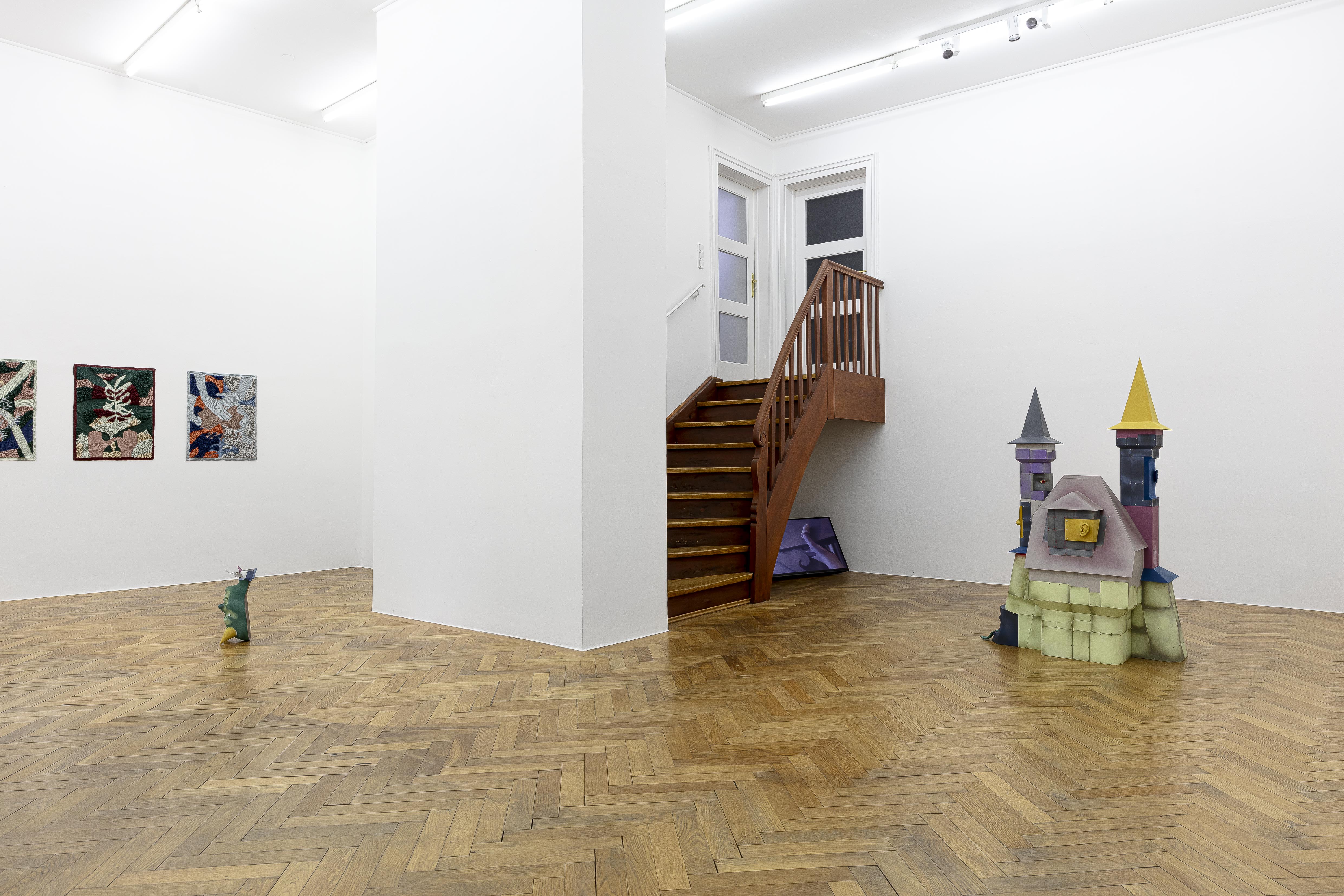
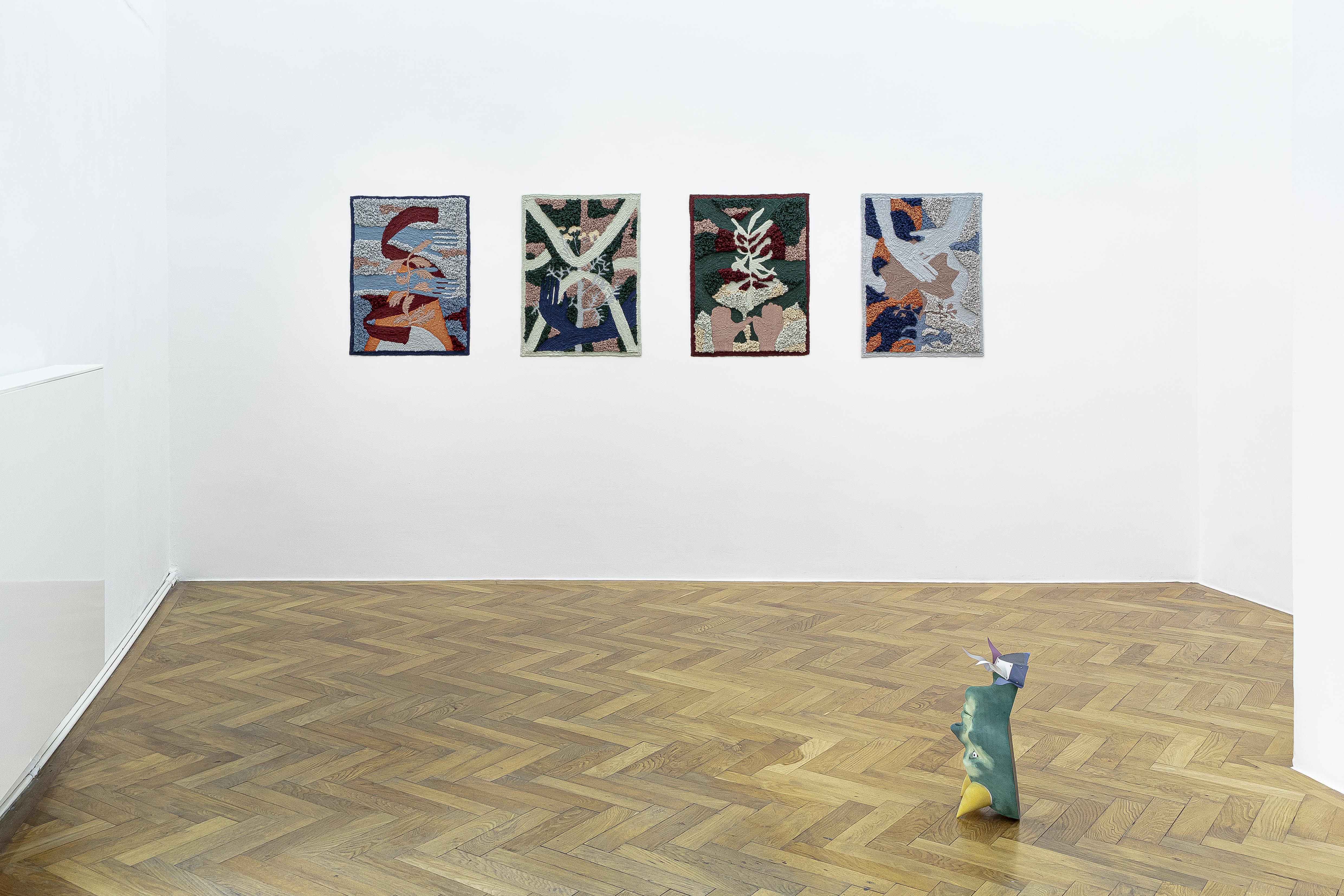
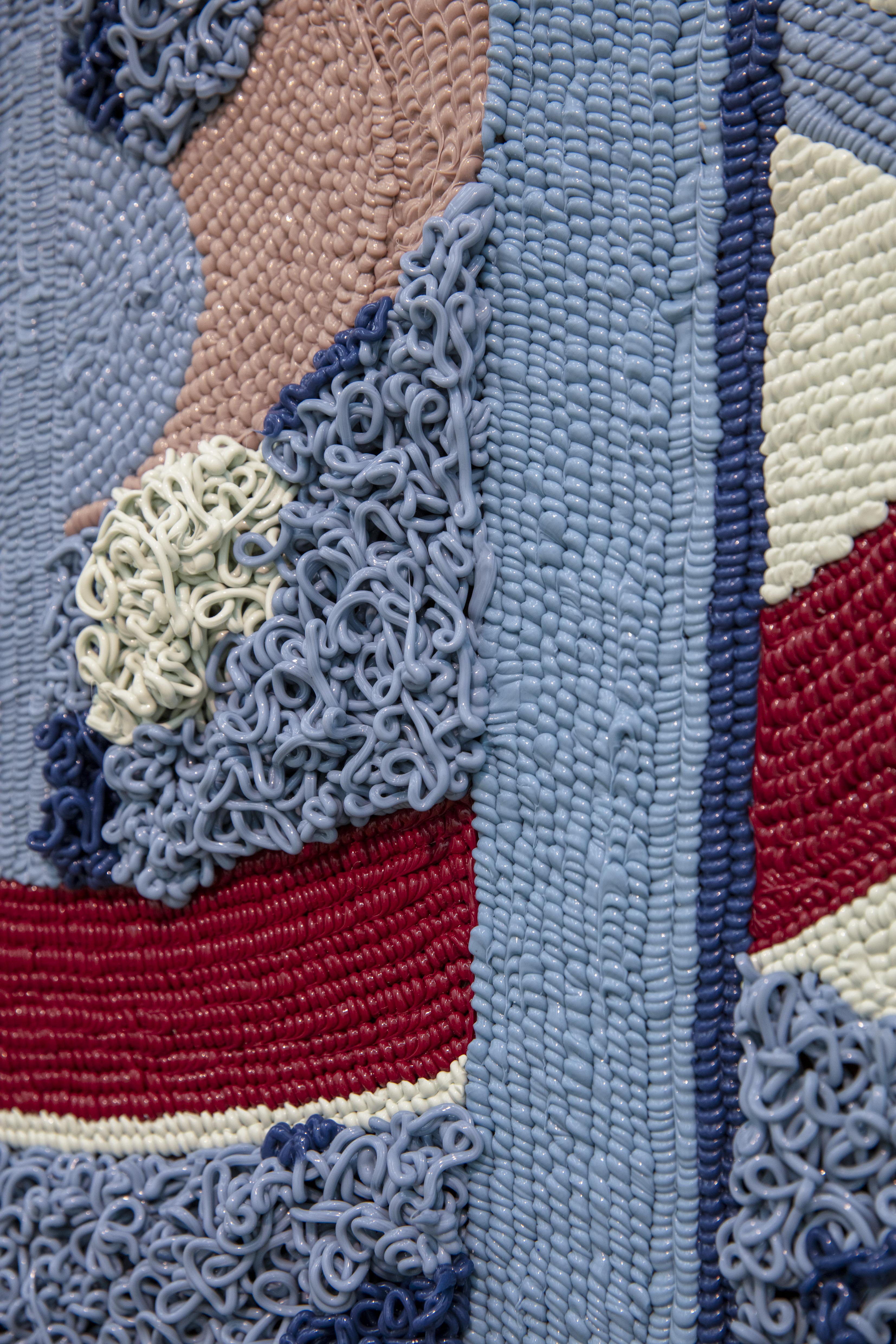
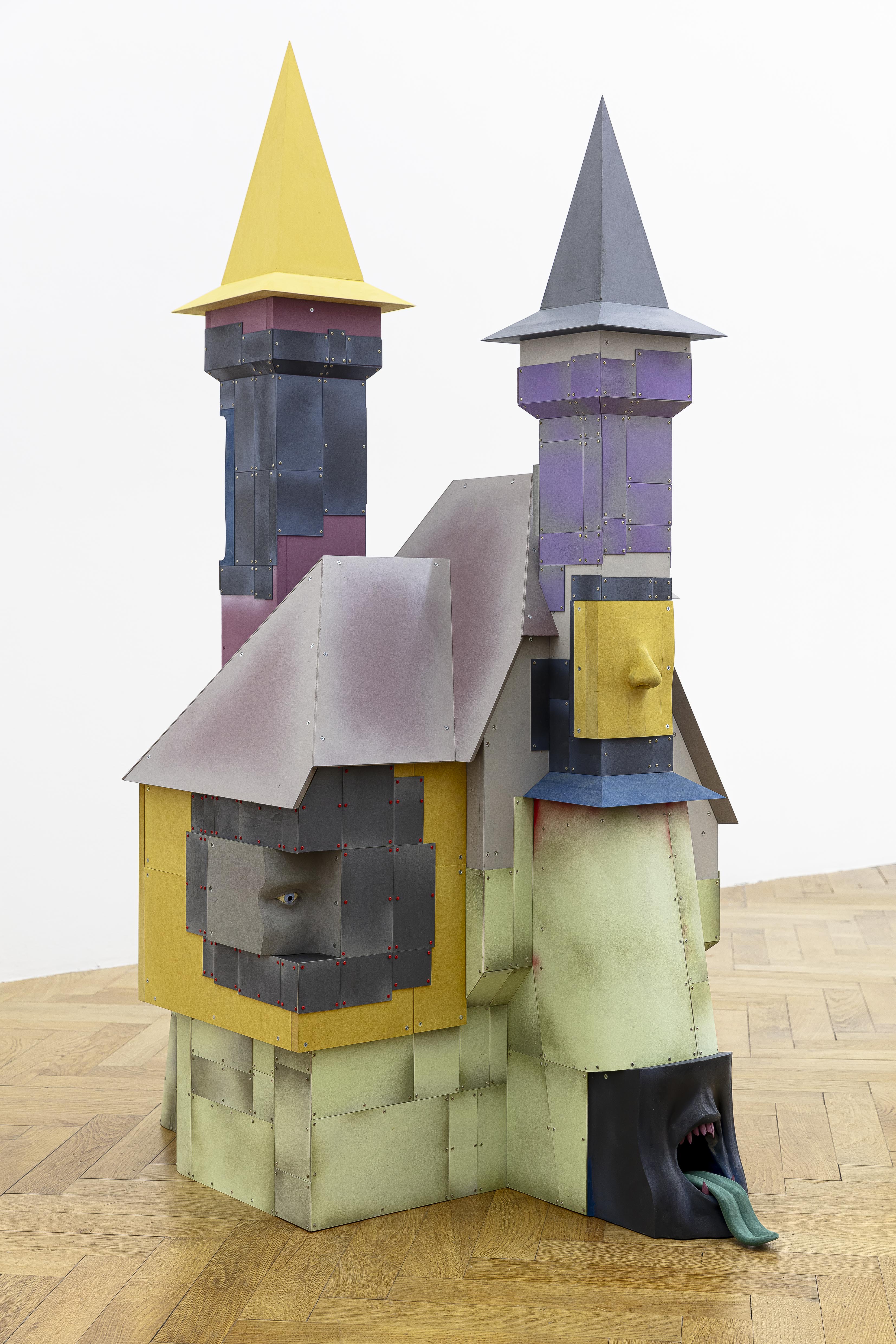
Throw of the dice, 2024, installation view. Photo: Sebastian Kissel, courtesy Sperling, Munich.Throw of the dice, 2024, installation view. Photo: Sebastian Kissel, courtesy Sperling, Munich.Throw of the dice, 2024, installation view. Photo: Sebastian Kissel, courtesy Sperling, Munich.Sophia Mainka, Oracle des Plantes series, 2024, silicone on cotton, 75 x 57 x 1 cm each. Photo: Sebastian Kissel, courtesy Sperling, Munich.Sophia Mainka, Tarot (Wheel of Fortune), 2924, silicone on cotton, 190 x 121 x 1 cm. Photo: Sebastian Kissel, courtesy Sperling, Munich.Sophia Mainka, Tarot (Wheel of Fortune), 2924, silicone on cotton, 190 x 121 x 1 cm (detail). Photo: Sebastian Kissel, courtesy Sperling, Munich.Lukas Hoffmann, Pan, MDF, paper, wood, spray-paint, 41 x 22 x 19 cm. Photo: Sebastian Kissel, courtesy Sperling, Munich.Throw off the dice, 2024, installation view. Photo: Sebastian Kissel, courtesy Sperling, Munich.Lukas Hoffmann, Schloss, 2024, paper, wood, screws, spray-paint, 158 x 102 x 75 cm. Photo: Sebastian Kissel, courtesy Sperling, Munich.Lukas Hoffmann, Schloss, 2024, paper, wood, screws, spray-paint, 158 x 102 x 75 cm. Photo: Sebastian Kissel, courtesy Sperling, Munich.Lukas Hoffmann, Schloss, 2024, paper, wood, screws, spray-paint, 158 x 102 x 75 cm (detail). Photo: Sebastian Kissel, courtesy Sperling, Munich.Lukas Hoffmann, Schloss, 2024, paper, wood, screws, spray-paint, 158 x 102 x 75 cm (detail). Photo: Sebastian Kissel, courtesy Sperling, Munich.Sophia Mainka, We used to be wild, 2024, video loop (full HD, stereo), 17 min & 17 sec. Photo: Sebastian Kissel, courtesy Sperling, Munich.
Throw of the dice – down a slippery slope
A standard game of dice is not a game of chance. At stake is probability, the odds of throwing this or that number, easily calculable. This is why we often lose, as the fable famously forewarns.[1] The young man inherits an estate and quickly gambles it away. In one sweep an entire forest is laid low. Is bad luck to blame? No, replies Fortune to an angry Pan. Just the foolishness of man.
A game of chance takes place on a far more slippery slope, like the round of croquet played in Alice in Wonderland, a game of cards of sorts.[2] Flamingos are mallets and a hedgehog is a ball. Whenever Alice wants to hit the hedgehog with the flamingo’s head, the bird turns floppy and spins round to look at her so comically that she laughs. And when she finally gets the flamingo’s head down, the hedgehog crawls away. In this game, cards move away from us and the players play all at once, quarrelling and fighting while the queen screams, “Off with their heads! Off with their heads!” For in a real game of chance, anything can happen. This would be the challenge: throwing the dice without knowing the rules of the game. To continue throwing the dice while accepting that each time the rules of the game change.
This is Nietzsche’s divine game, played across two tables, the earth and the sky.[3] Each time the dice is thrown the earth trembles, because the dice returns to us as divine. At that moment when the dice hover briefly in the air, they belong to the gods and all is possible. Our task is to affirm the entirety of possibility, any fate the gods prepared for us, cooking all of chance in one pot.[4] In this forest, we must wander bewildered and wild.[5]
In the exhibition, Sophia Mainka shows a series of wall mounted works made from silicone paste. Heavy and solid, yet curiously slippery, they are based on a Tarot deck of cards. It is peculiarly appropriate that the largest is the wheel of fortune, usually interpreted as standing for change or becoming. Fortune can be good or bad depending on the game, the question asked of the cards, open to interpretation. In Tarot, one card can mean many things and then change meaning at different times. In contrast, destiny is the thread woven through the image and cut by the three mythological sisters. The turn of the card is always fateful. Whatever the outcome of the roll of dice, this outcome is necessarily so: sky back to earth, slide and snip.
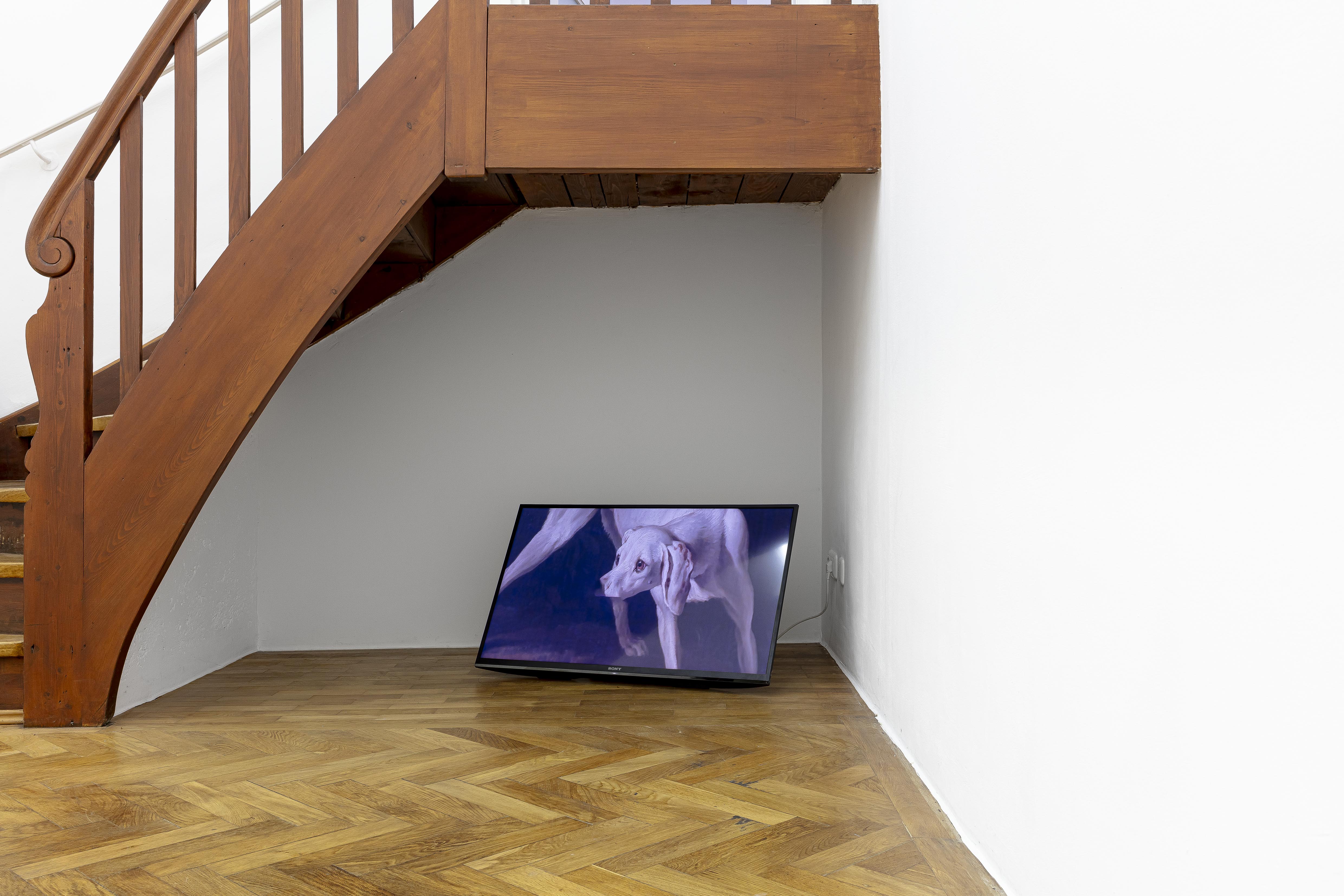
Perhaps then, we wander not quite so bewildered in this forest, as we necessarily follow our fate. But we wander on a surface without ground or depth, because free of cause. Everything in Mainka’s work takes place on the surface, like the hybrid creature scuttering around the ornate interiors of the Musée de la Chasse et de la Nature in her video. It imitates not animals, but depictions of them. The two talking dogs are not half-human but half-sculpture, their head and paws the same silicone as Mainka’s wall pieces. In Nazim Bakour’s music score, they do not bark, but whoop with the sound of the cuica drum.
Lukas Hoffmann too stages a fictional world that has something of Lewis Carroll’s unsettling absurdity about it. There is a wooden castle with ears, eyes, a wide open mouth and a nose, and it is both too big and too small. Drink me, eat this, nibble both sides of the mushroom circle. As Alice grows bigger, her initial self also becomes smaller, pulled in both directions at once. With components jutting out and sliding in, the body both outside and inside, the castle too grows small as it becomes big. “Becoming without measure, a veritable becoming-mad.”[6] Observing this madness is the upside down head of Pan, the mischievous god of the wild. A mascaron fallen from its pediment. Run away in panic, it urges us – run away in chaos, it smiles.
[3] Friedrich Nietzsche, Thus Spoke Zarathustra, Book III, “Before Sunrise”, trans. Kaufmann, p.166cd and “The Seven Seals” 3, p. 258. See also Deleuze’s reading in Gilles Deleuze, Nietzsche and Philosophy, trans. Hugh Tomlinson, (London and New York: Continuum, 2002) p. 25–7.
[4] Zarathustra, Book III “The Bedwarfing Virtue” 3, p. 189.
To enter Paul Valentin’s installation at the Rosa Stern Space – A Piano Plays In Another Room And It‘s Raining – is to step into a Plato’s cave of sorts. Awaiting you are two classic Corbusier lounge chairs in a darkened basement room. Feet up and immobile you are meant to look up at the projection on the ceiling. This is, like much of Paul Valentin’s works after Nichts from 2019, digitally animated, and in this sense is a simulation rather than some kind of camera recording. But instead of shadows of people and animals cast by objects, “wall implements wrought in wood and stone,” we see only another space, another darkened room (Plato, The Republic, 747). There is another, deeper cave in which we finds ourselves, “an ampler, stranger and deeper world,” that no longer adheres to familiar Platonic rules (Nietzsche, Beyond Good and Evil, § 289).
Paul Valentin, A Piano Plays in the Other Room and It’s Raining, 2022, video installation. Courtesy of the Artist
We enter this world through a room with a lighthouse outside the window. The light from the lighthouse runs across the rain covered window in the dim artificial glow, a phone rings, its green light blinks. The room we see seems very familiar to us and I do not just mean us gamers, who would recognise it from the 1996 classic,Lighthouse: The Dark Being. There is now a whole category of objects that seem more real when computer generated: raindrops and puddles, shiny little things out of plastic, soda cans, shattered glass, flames, plugs and sockets, fur and dust, and it is these that Paul Valentin collects, like some kind of digital Wall-E. So familiar are these computer generated things that they, and the rooms in which they live, have acquired a sheen of nostalgia, the aesthetic of liminal spaces, with its own wikipedia fandom page. Accompanying us is a suitably melancholy piano sound track and the hum of rain in the distance.
From this first shadowy room we move on to another and then another, always following the invisible camera, always staying in the rain. One room seems enormous, filled with forgotten film equipment, stage sets and props. In this room we see both the camera, a classic Arri Alexa mounted on wheels, and what it films, a wooden model of a classical building, brightly lit. But we also seem to see what is inside the wooden model, with its cornices, columns and tympana – its tapestries and parquet floor. And here too is a camera, momentarily visible to us when sparks fly from a broken power cable. When the camera follows a single coffee drop down from the machine to the floor, then above and below along the cable leading to the elevator and ventilation shaft, we enter the final space, a modern-looking bedroom upstairs. Zooming onto the vase with flowers next to the bed, we seem to be back again inside the wooden model from the beginning, with its tapestries, petals falling in from a hole in the ceiling.
Paul Valentin, A Piano Plays in the Other Room and It’s Raining, 2022, video installation. Courtesy of the Artist
Every time there is a film cut and we move from one room to another, our understanding of the spaces shifts. What seemed to us a stage set at the beginning, with false walls and fake rain, is at the end shown to be an actual lighthouse outside. This lighthouse seems to be both within the large space of the warehouse and within the wooden miniature model.There is a vertiginous circularity at work here that belongs to the gaming world rather than the film, and the first impression of the work is that of a YouTube game walkthrough, the camera movement determined by a click or sequence of clicks on the various objects – an updated and sophisticated version of classic point and click games likeMyst. We see the objects from all possible camera angles, all the different aspects: inside, outside, above, below, behind, as a stage set, captured on film, in the dark, in the light etc. The technical wizardry is breathtaking. Paul Valentin is not Plato’s puppeteer, standing behind a wall holding up simple wooden and stone objects infront of a fire so that they might cast some shadows on a wall, but rather Plato’s artist, if such an artist were at all possible: consider how he is described in Book X of the Republic, the maker of all the works of all other workmen.
For this is he who is able to make not only vessels of every kind, but plants and animals,himself and all other things – the earth and heaven and the things which are in heaven or under the earth, he makes the gods also.
This is the “extraordinary man,” “a wizard no mistake,” who Plato reveals to be nothing other than a painter.
Of course, the painter is not really such an extraordinary creator, because he is not really the maker of all these things. The painter’s concern is appearance only, and we as the gullible audience are tricked into believing his illusions. Paul Valentin revels in playing this role of the trickster, as is already in apparent in work such as Beyond the See.
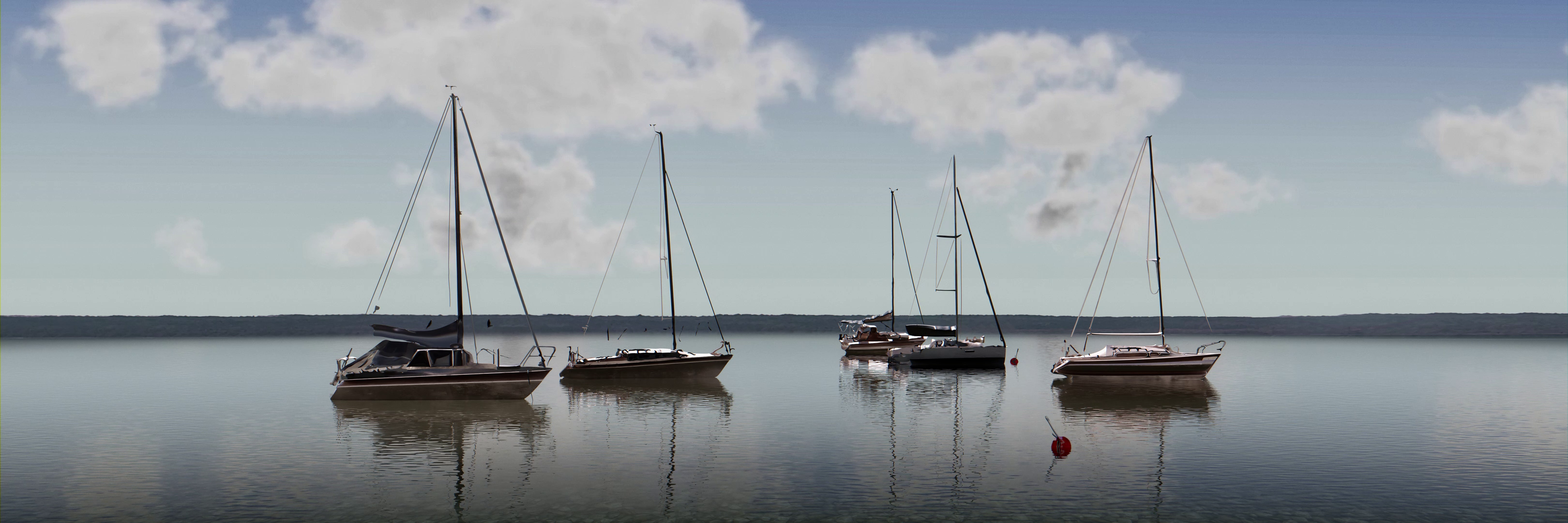
Paul Valentin, Beyond the See, 2021, video installation. Courtesy of the artist.
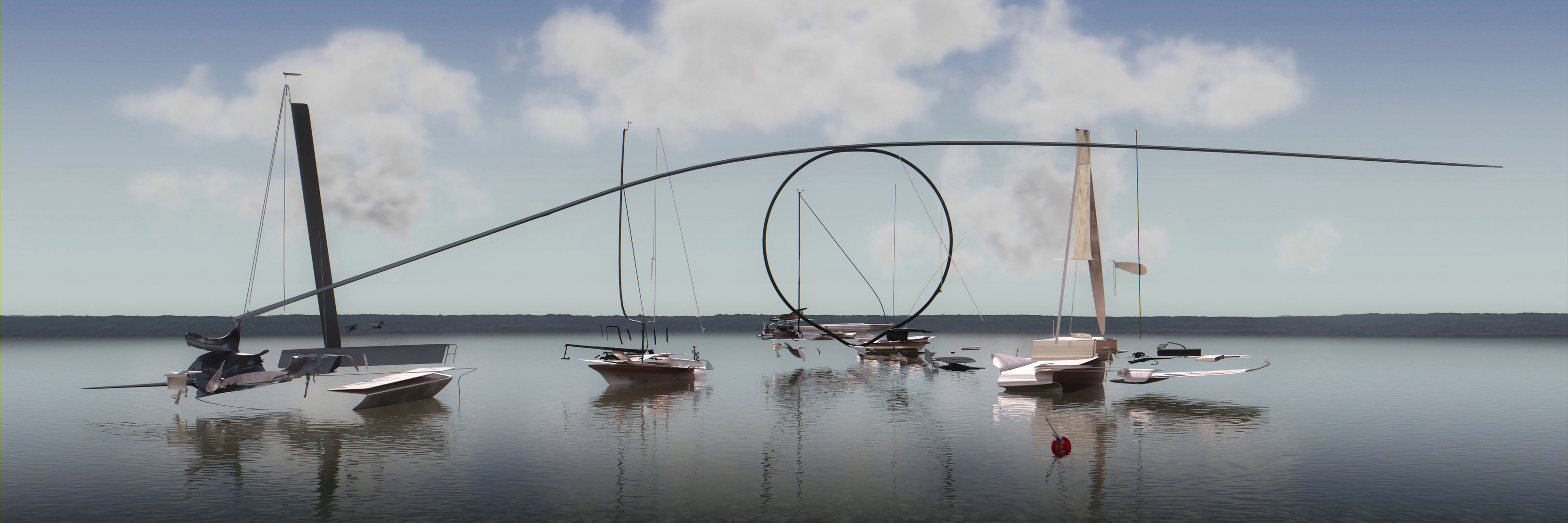
In this work, we are presented with an image of a few sailing boats bobbing gently on a lake. The sky is blue, the water still, and that is enough already to put in mind a scene out of the Truman Show. And sure enough, the image is revealed to be more complicated than at first glance, the sailing boats not boats at all, but a series of complex intertwining computer generated structures that only look like boats when the slight breeze allows them to be viewed together from the one perfect angle.
Paul Valentin, Beyond the See, 2021, video installation. Courtesy of the artist.
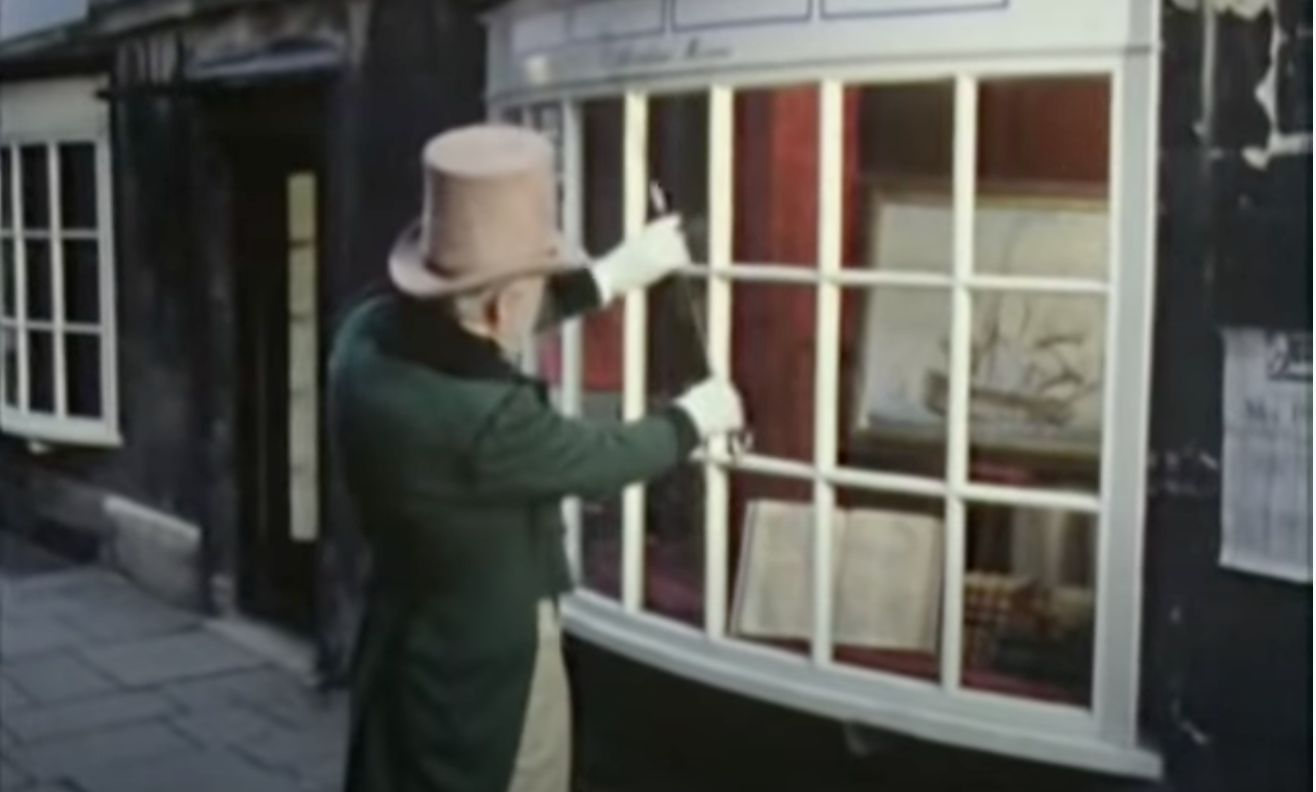
In a scene in Jane Austen’s Persuasion, Admiral Croft complains to the heroine Anna,
Here I am, you see, staring at a picture. I can never get by this shop without stopping. But what a thing here is, by way of a boat! Do look at it. Did you ever see the like? What queer fellows your fine painters must be, to think that anybody would venture their lives in such a shapeless old cockleshell as that? (202)
Persuasion, 1971 Granada television series
No one in their right mind would want to sail on one of Paul Valentin’s boats – the very idea is ludicrous. He doesn’t even try to make his boats seem believable to us. Instead he shows that things which might look like boats do not have to be boats at all. What we see is not what we think we see or know or understand. Plato’s puppeteer from the cave, his painter of beds and tables – but the figure perhaps closest to Paul Valentin, is that of the Sophist, defined by Plato as someone who is an imitator, but not a “sound one,” an imitator with “a crack” in his iron, a queer fellow indeed (Plato, The Sophist). A Sophist imitates the appearance of wisdom in his arguments, but is not actually in possession of wisdom. He spins his arguments until we are left bewildered and confused, rather than any more knowledgeable. In his short essay “Plato and the Simulacrum” Gilles Deleuze compares the Sophist to Proteus, the constantly changing, ever-shifting God of the sea, a T-1000 only possible with developments in CGI.
For Valentin’s project is very much anti-Platonic one, despite the numerous classical references to works and objects that are Platonic in spirit (is that a portrait of Socrates I see in the dark? is that Athena’s owl, the symbol of wisdom?). We tend to think of Plato’s theory of the forms in the most simple manner: there is a thing and the image, an original and a copy, the model and the simulacrum. And when looking at the world around us we believe ourselves to be as dispassionate and objective as an 18th century naturalist that Jane Austen would recognise, distinguishing the differences between things in order to categorising them correctly as a certain species belonging to a certain genus. But as Deleuze argues in “Plato and the Simulacrum” the goal of the Platonic project is not of distinctions between species, but rather distinctions between claimants. The decisions involved are only superficially of the careful naturalist, and rather must be understood as value judgements, with all the problems such value judgements involve. In our encounter with a thing – platonically speaking – we must decide to what extent its claim to authenticity is a real one: to what extent is this thing that we see, not just a copy, but a true copy of a perfect original. In other words, we establish a narrative of foundation, with an original, unchanging foundation that gives our claim its value, theobject of a claim, and a claimant – us. Or, as Deleuze describes the Neoplatonic triad, we establish an unsharable, the shared and the sharer – something almost impossible in the world of digital animation and open source programmes, in which new tools, animated objects and sequences are shared openly. The unshakeable foundation is that according to which claimants are judged and their claim measured. It is also however used to hunt down the false claimant, the bad copy, the simulacrum.
In Deleuze’s reading the simulacrum is bad, not because it is the lowly copy of the copy, as it would seem from Plato’s metaphor of the bed – there being a perfect bed of the gods, the bed made by craftsmen that follows this perfect model, and the bed of the painter, the imitation, “thrice removed from the king and from the truth” (Book X). Rather, the bed of the painter is a bad copy, because it is a false claimant, refusing the authority of resemblance. When Deleuze defines the simulacrum as the “image without the resemblance” ( this does not mean that resemblance is not at work – indeed as is also apparent in the work of Paul Valentin, it can be argued that the simulacra is nothing but resemblance. The point is however, that it is not the right kind of resemblance, the good resemblance of the object to the idea. Indeed, the problem lies in what we have seen to be the case of Paul Valentin boats: the fact that the painter’s bed has no need of the idea of the bed at all, and makes no recourse to the modality of understanding, whether knowledge or opinion. Admiral Croft dismisses the painting of the sailing boat in the window, because the depicted boat does not match the knowledge and experience of a sea faring vessel that he has acquired over the course of his naval career. He compares the painted boat with the sailing boats he knows and judges accordingly. In contrast, Paul Valentin is only interested in what Deleuze would describe as the “effect of resemblance” (49). He would be the crazed and demonic naturalist, who only looks at the patterns and surfaces and the differences in appearances, completely uninterested in how a species may relate to genus.
Deleuze describes the simulacrum as something vast – and this is true of both pieces, A Piano Plays In Another Room And It‘s Raining as well as Beyond the See. A world consisting of appearance only is necessarily enormous, encompassing endless multiple and different points of views – for after all, anything and everything can be copied by the painter. It is the animated world of video games and rooms opening onto another; it is also the world in which the resemblance to a boat is only one point of view we have of complex intertwining structures. To see the everything-at-once of all appearance involves not just wizardry, but also a madness. Those boats, are mad, as is the intoxication of flying from one room to the next, of The Piano Plays.
Deleuze associates this madness with modernity (51). Modernist work like that of Joyce, offers not different points of view of the one story, but rather a series of different and divergent narratives, as if to each point of view corresponded a new and different landscape. The video game seems to me the natural successor of this kind of modernist aesthetic: it is not, as with film, that the various story lines combine to form the one narrative, but rather, it always the simultaneous affirmation of multiple and often contrasting perspectives. It is a world in which a lighthouse can be both real and part of a stage set, inside and outside, miniature and vast. Whether modernist or not, all the works that in this way affirm heterogenous series as divergent, present a world view that is not the Platonic one based on sameness, likeness and identity. In the Platonic world view, any difference between individuals is a matter of first establishing identity. Things have to be the same, before we can detect differences. Identity for Plato would be something pre-established. But in Paul Valentin’s divergent world of the simulacrum, identity is presented as the product of disparity. It is not pre-given; it is made.
When all narratives, all heterogenous series are affirmed as equally valid there can be no distinction between the original and copy. It is the false claimant that triumphs, no longer false because in no need of a foundation to confer validity. But as Deleuze argues, the simulacrum not only overthrows Platonism (53). The false is also the power through which Platonism, as in the world of representation and identity consisting of the same and the like, is constituted. According to Deleuze’s logic, it is because of the simulacrum’s play with effect, that we can think in terms of a resemblance in the first place, and thereby establisha relation between the original and the copy.Or rather resemblance is the word we use when we think of the world platonically, rather than in terms of the simulacrum. For Deleuze, the simulacrum is Nietzsche’s concept of the Eternal Return, in which orderly representation is overthrown and chaos reigns unimpeded. There is the still “deeper cave” behind Plato’s cave is foundation-less, with no light and with no thread we can use to find our way outside (53). What returns is the divergence of all series as divergent.
With this Deleuzian twist, we can say that it is the painter of the “shapeless old cockleshell” that holds this vast false power. It is because of his skill, his play with resemblance and appearance that Admiral Croft can use his acquired knowledge to make his comparisons – it is because of what the painter does that a carpenter can make his bed or table. The same force is at work, and more so continues to be at work. In the deeper cave of Paul Valentin’s work, we are accompanied by a piano soundtrack. This is not part of the animation itself, but is played separately according to an algorithm. The same few piano notes and short sequences of notes are repeated randomly, always in different combinations, meaning that each time we view the work, the diegetic sound accompanying the projection will be changed. At one point, the room with the lighthouse might seem mysterious, at another, melancholy, yet again, tense. Or in the silence we might not notice this particular room at all and move our attention to the next. This is Paul Valentin’s final Nietzschean gesture, his way of affirming the power of the different.









 GiG
GiG 