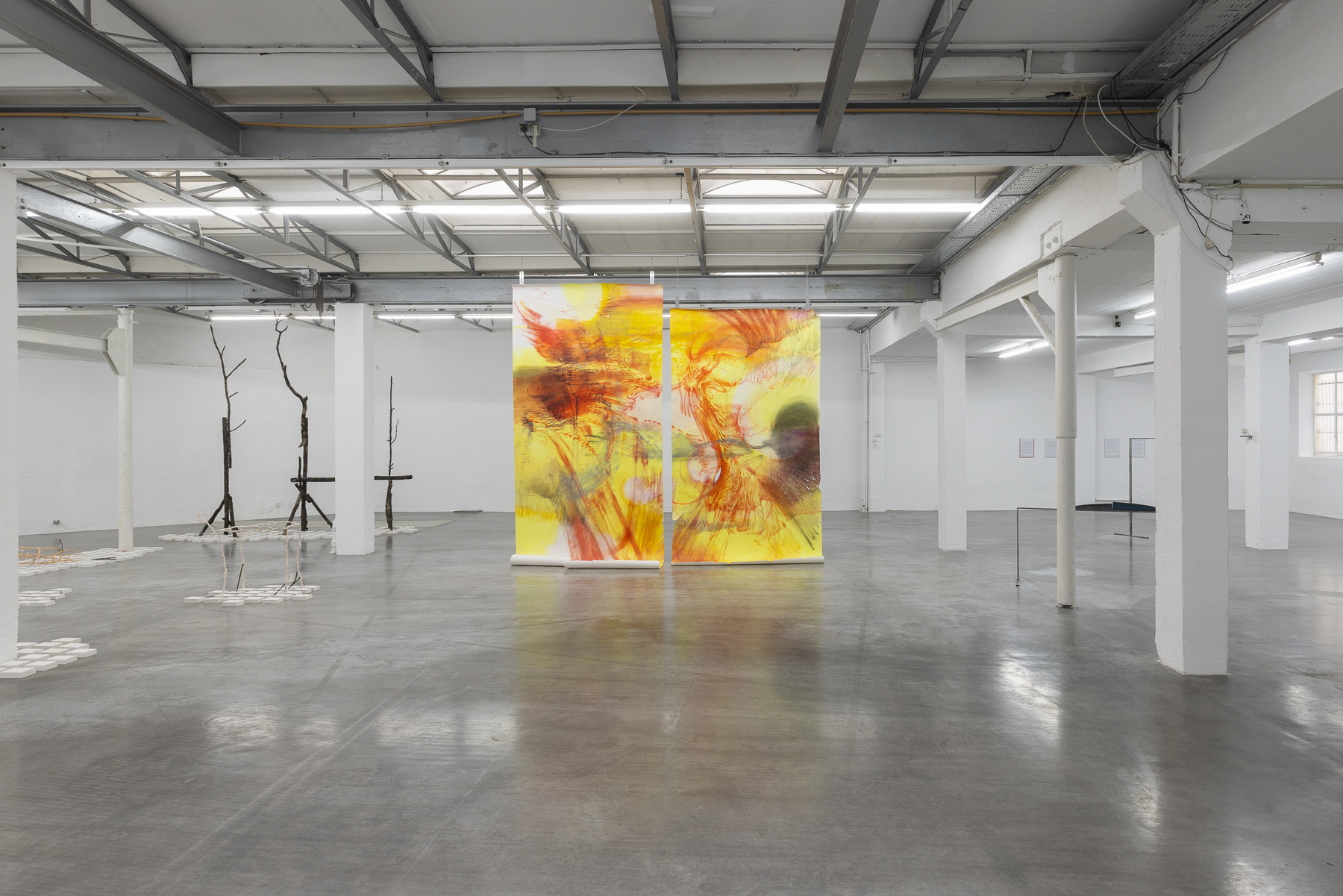
Animal Elegance

Jakob Gilg, Anka Helfertova, Julia Klemm and Jonathan Penca

9.10. – 7.11.2025

with Pracownia Portretu, Łódź, Poland
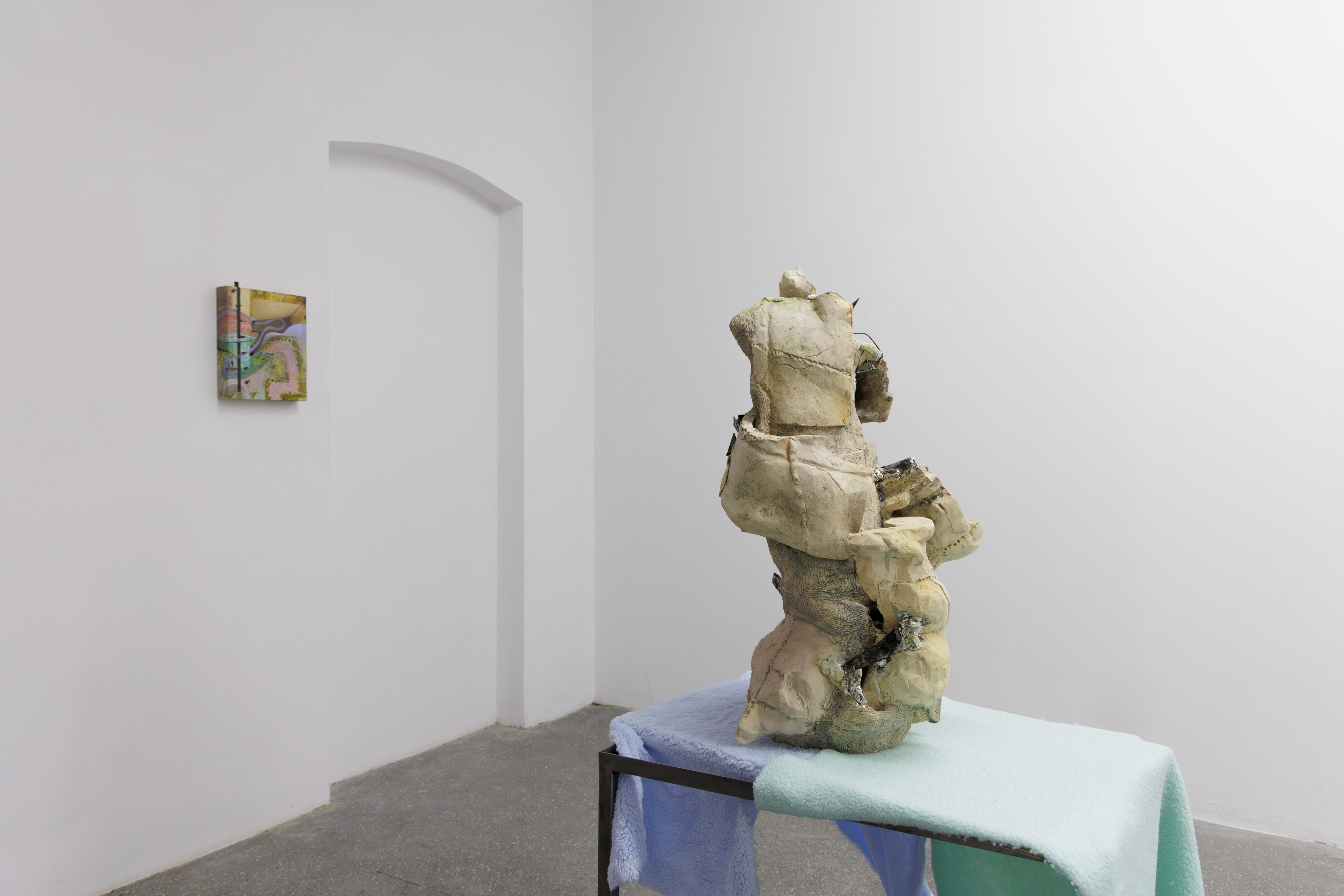
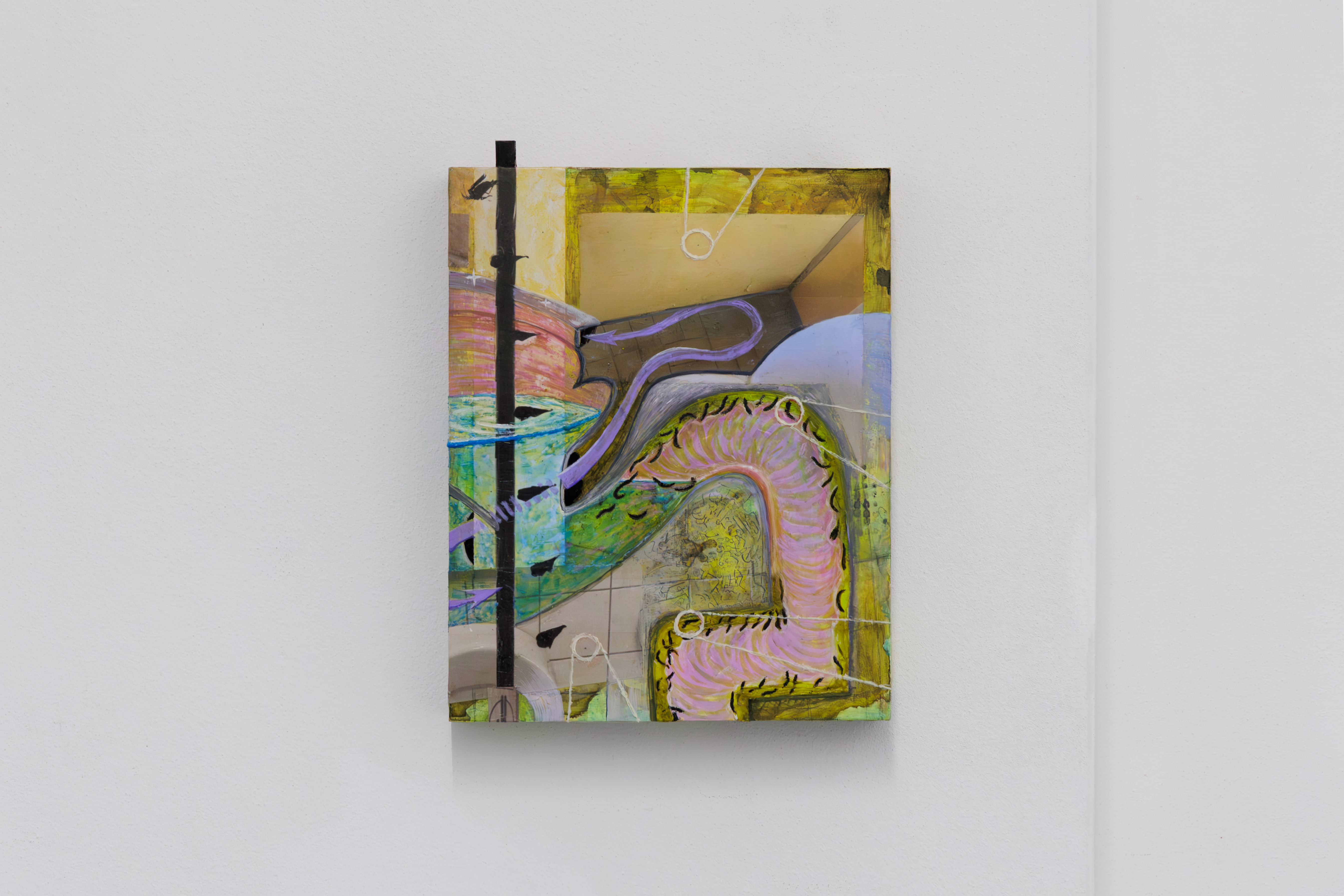
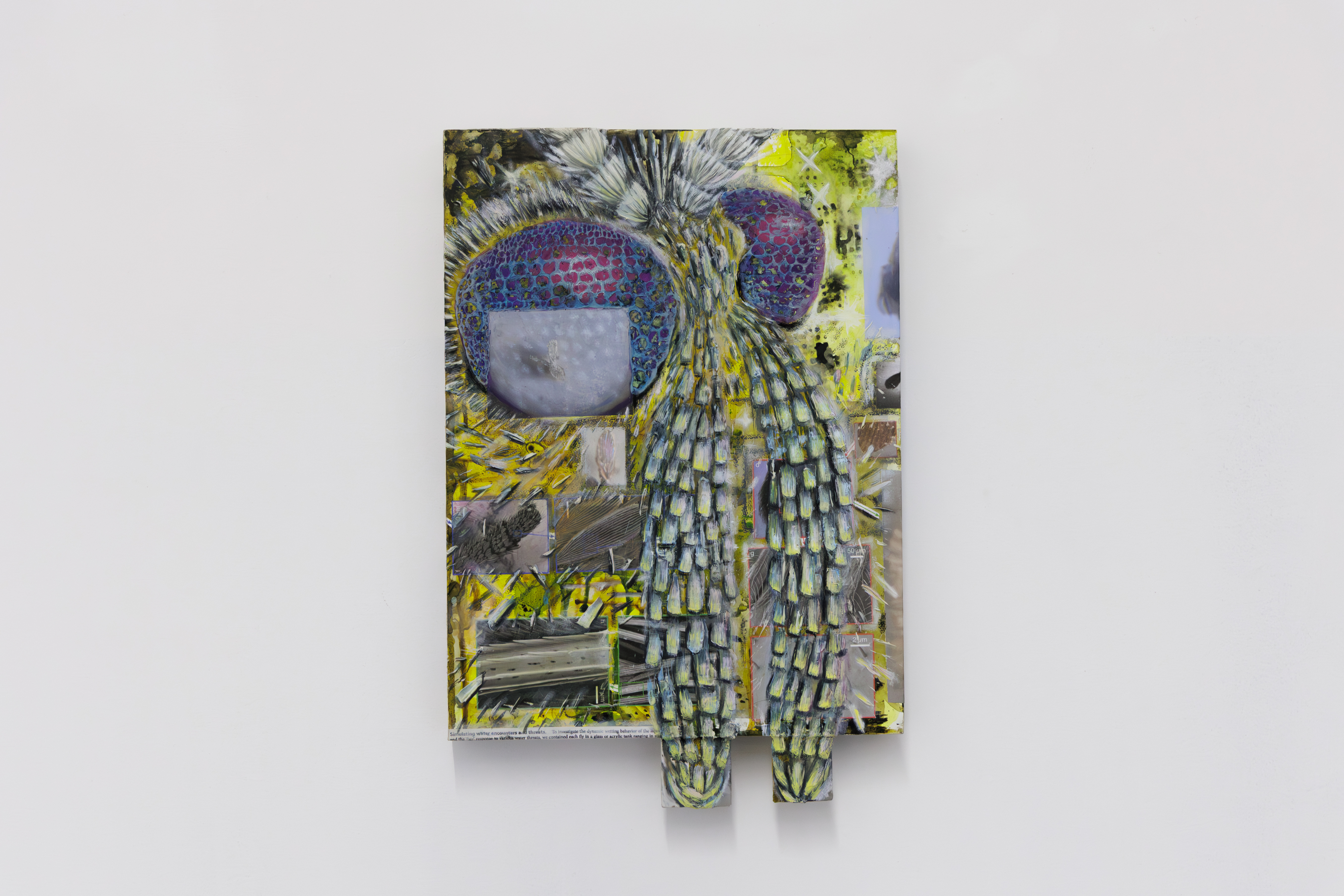
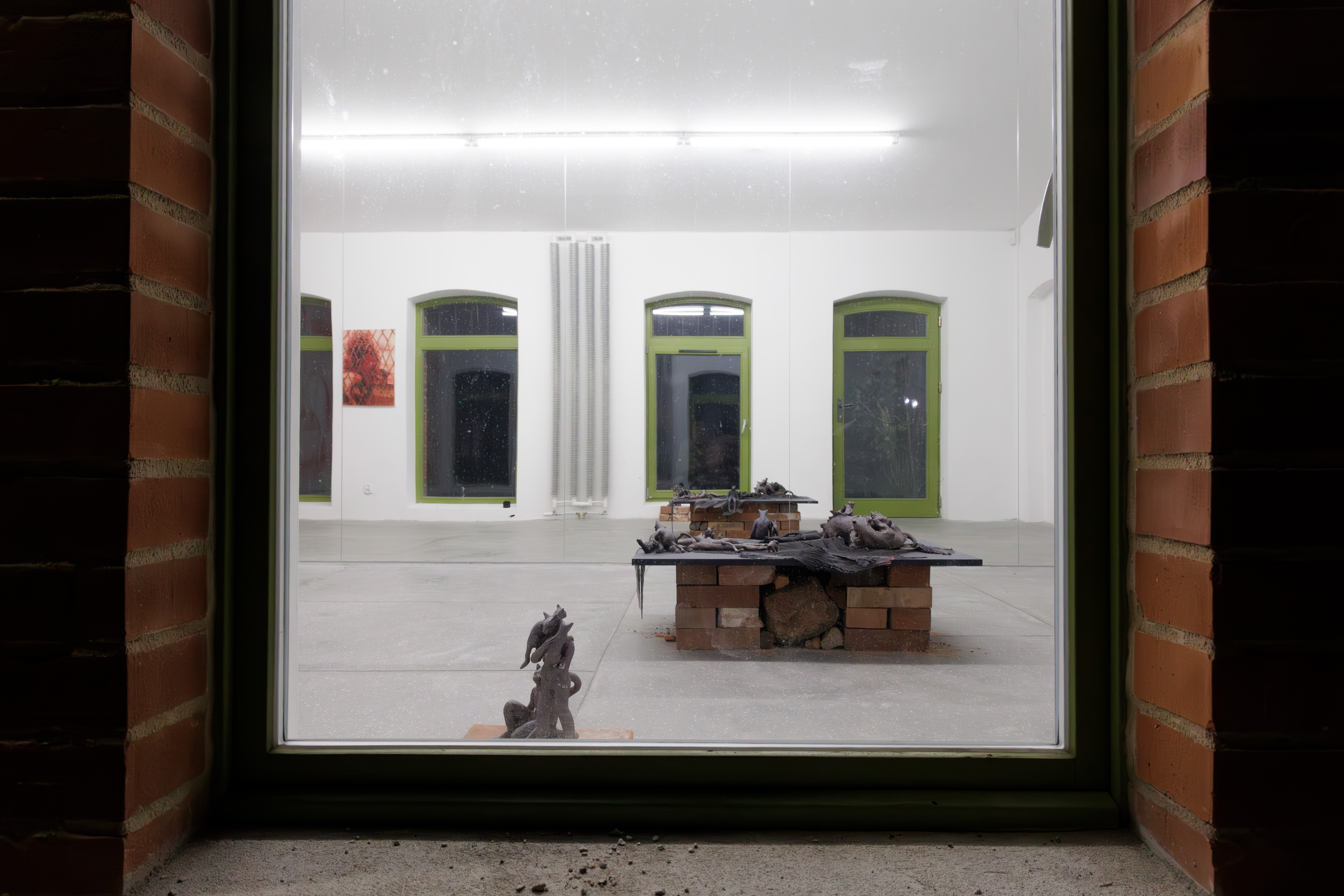
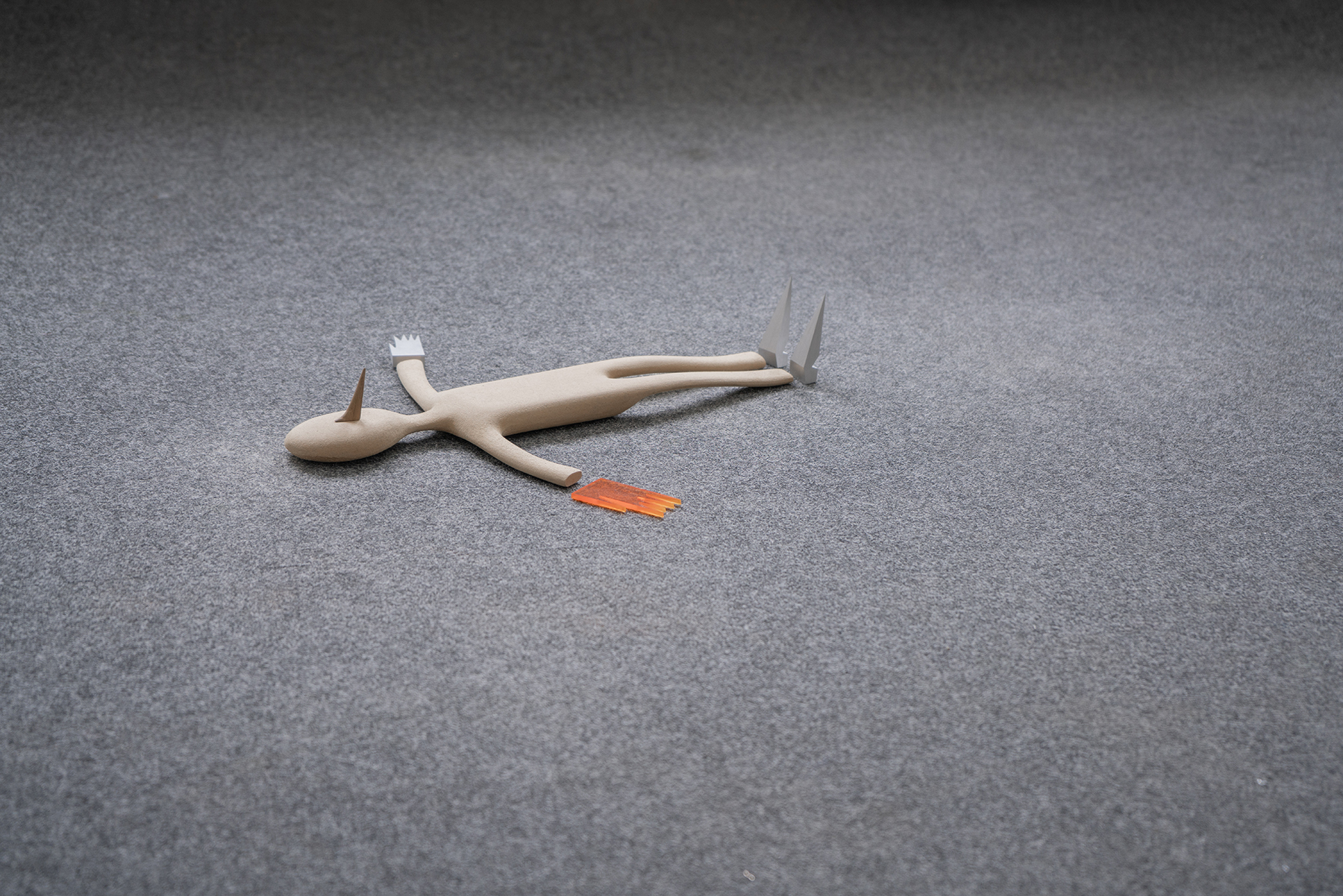
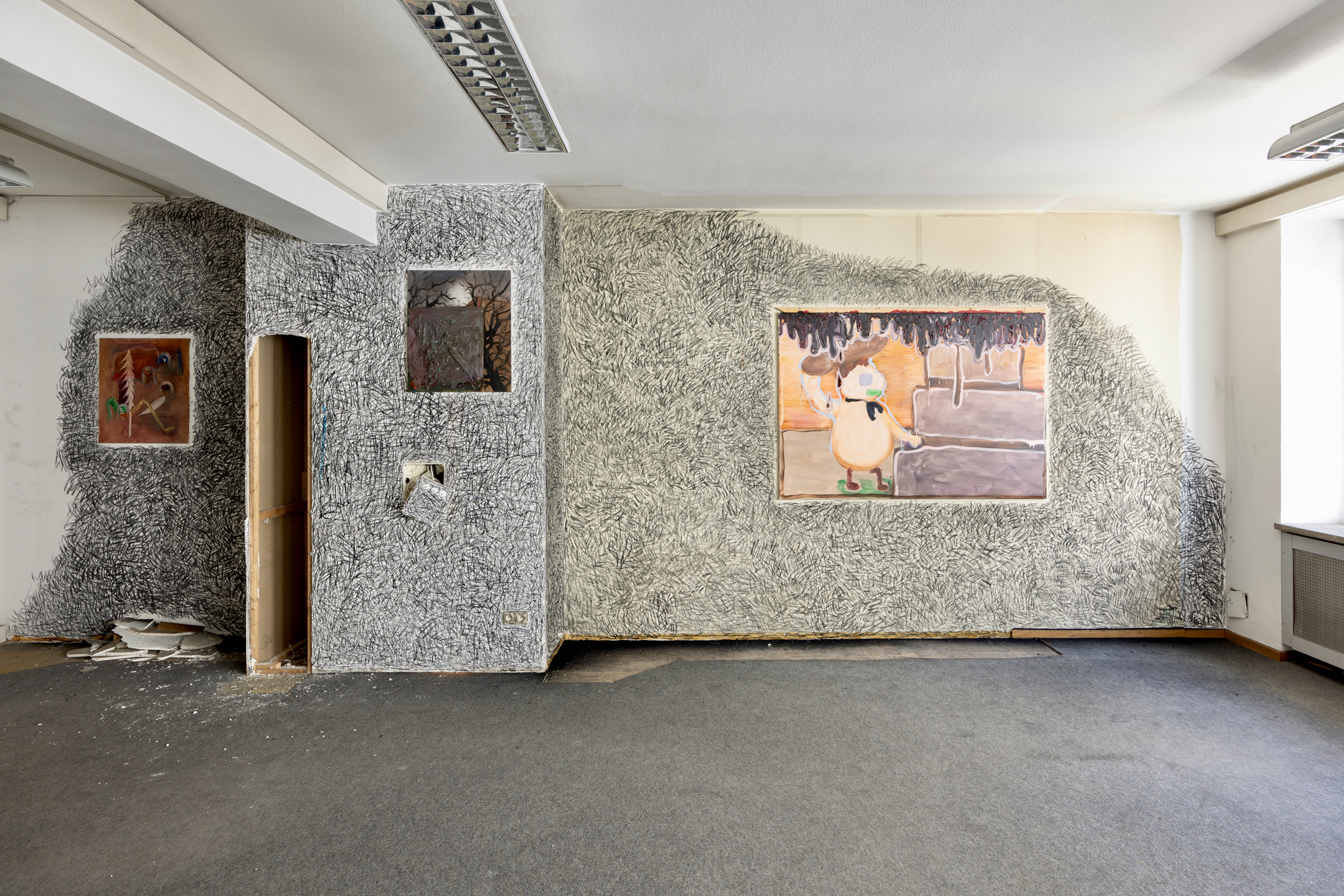
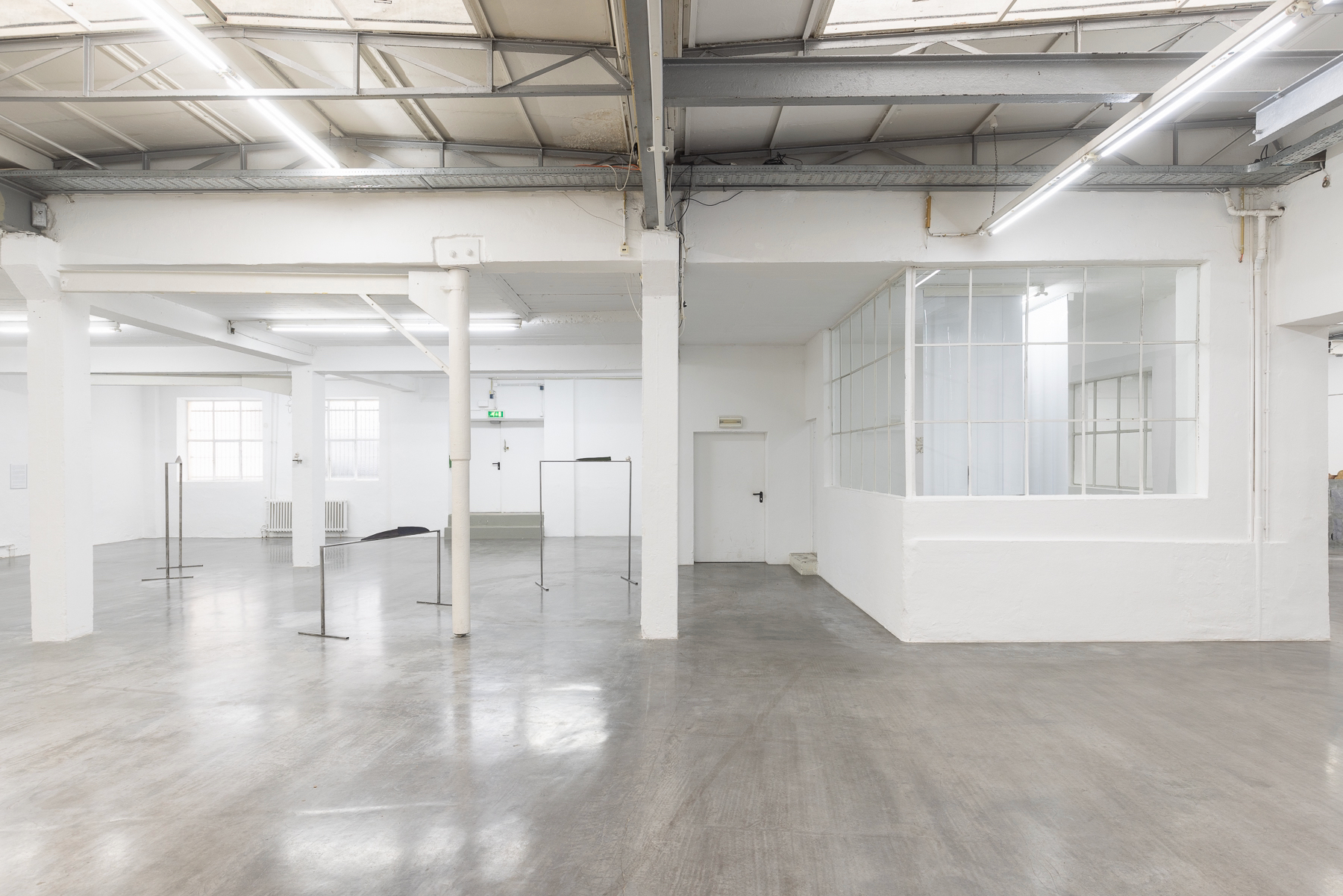
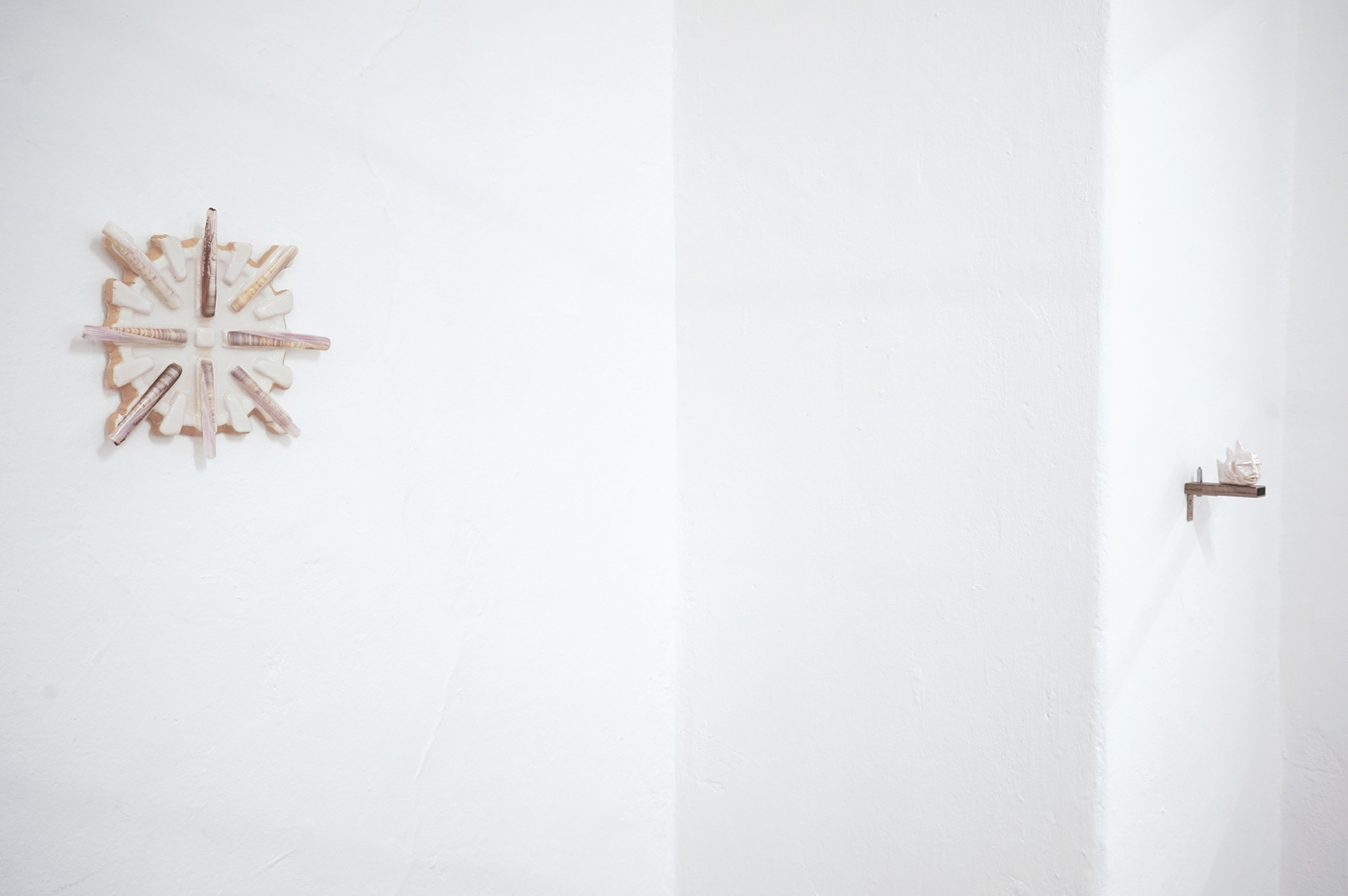
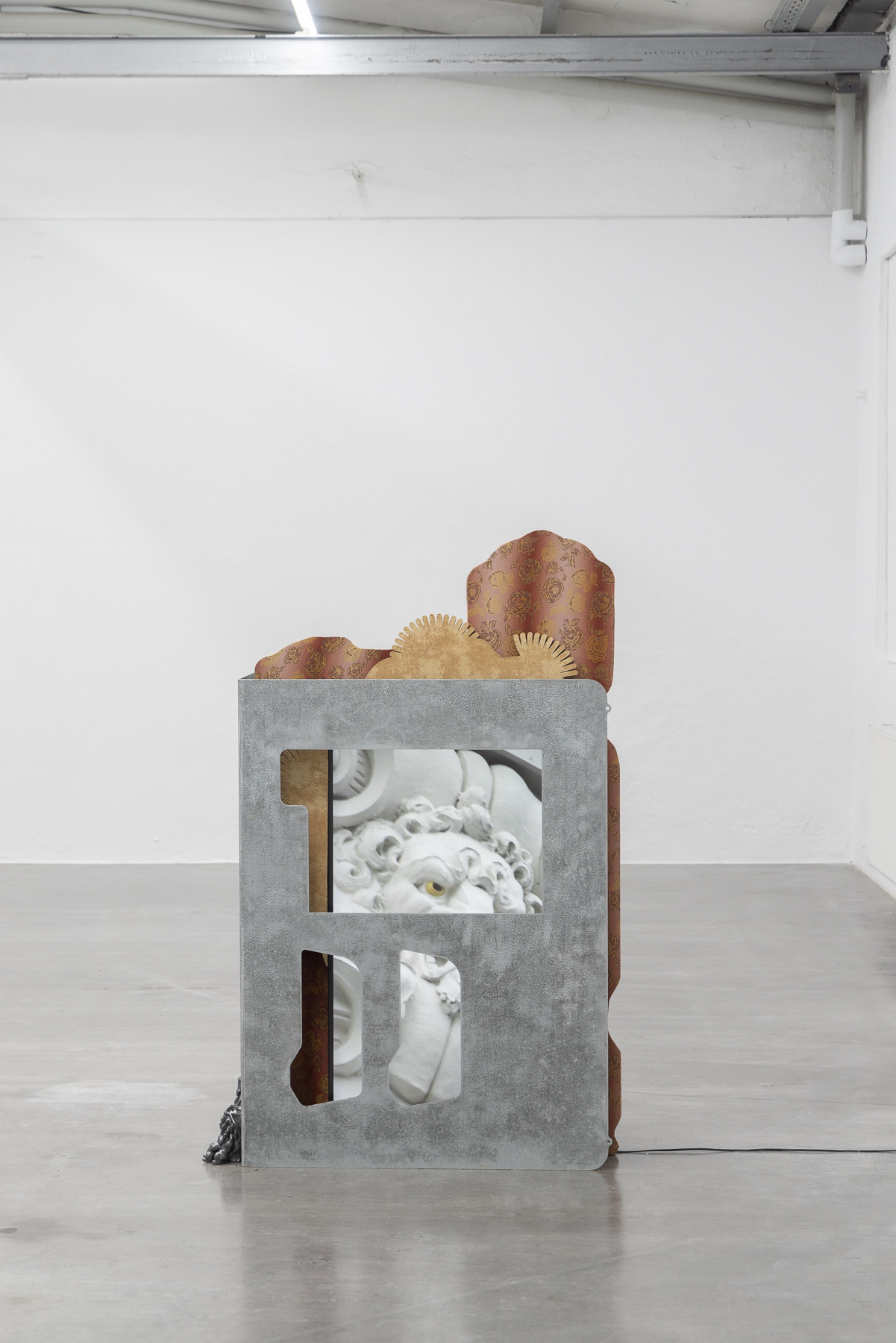
Animal Elegance, installation view (Jonathan Penca, Colonna Sonora, 2025, acrylic and
gouache paint, acrylic resin, biro, pencil, gesso and ink on wood. 31 x 24 x 5 cm; Julia Klemm, A chimera is not a pet 2, 2025, steel, glaze, ceramic, pigment, 44 x 38 x 74 cm, )
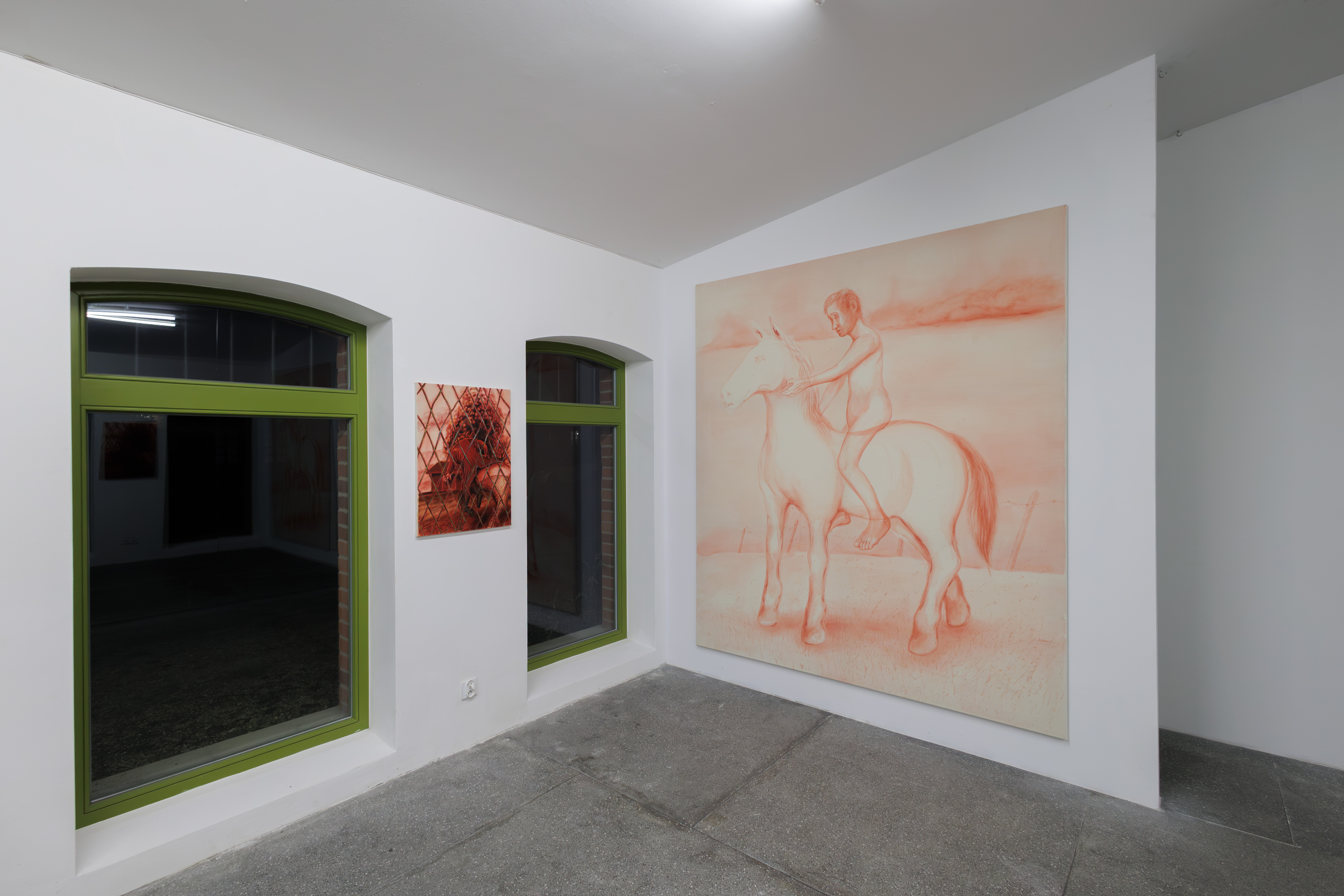
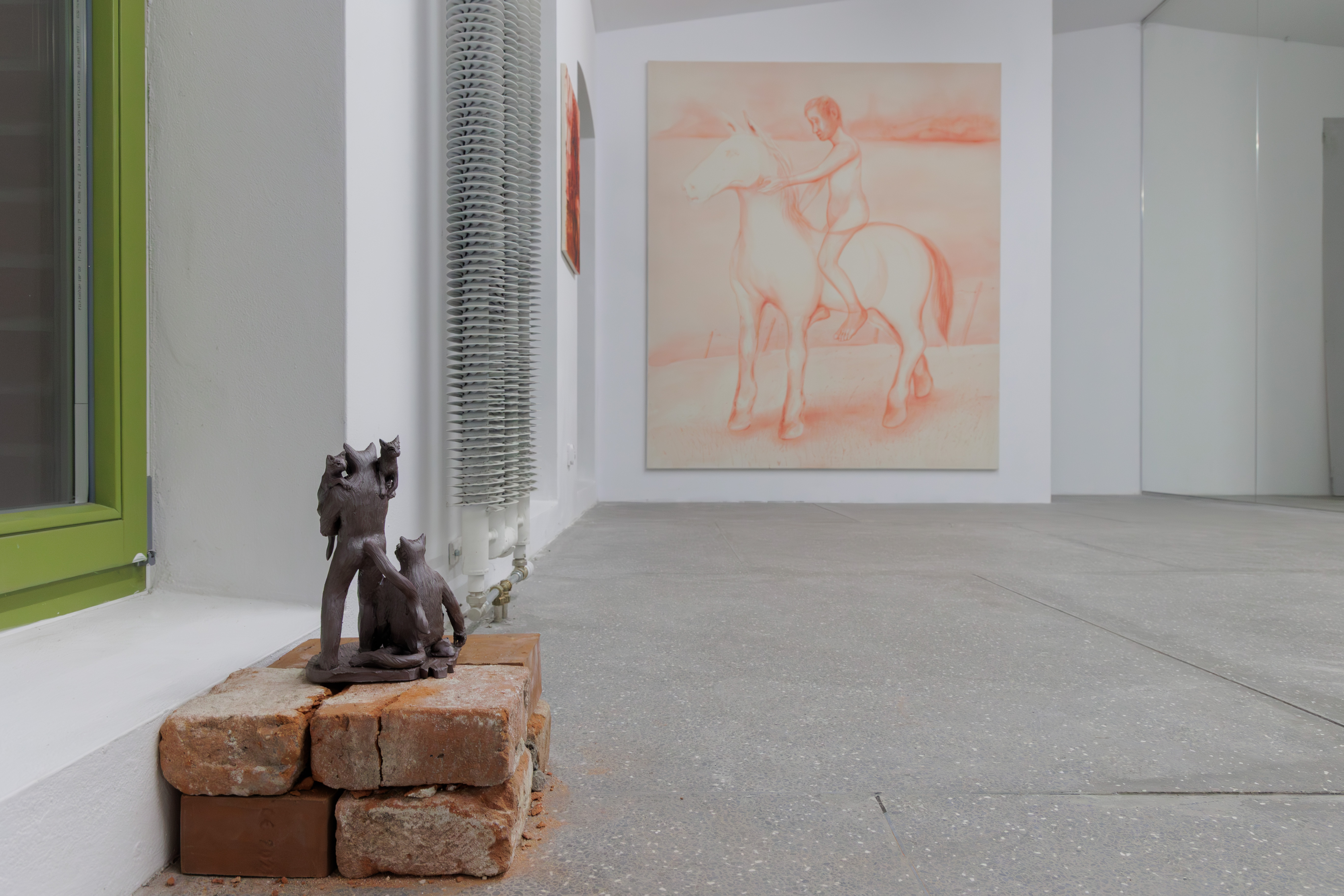
Animal Elegance, installation view (Jonathan Penca, Colonna Sonora, 2025, acrylic and
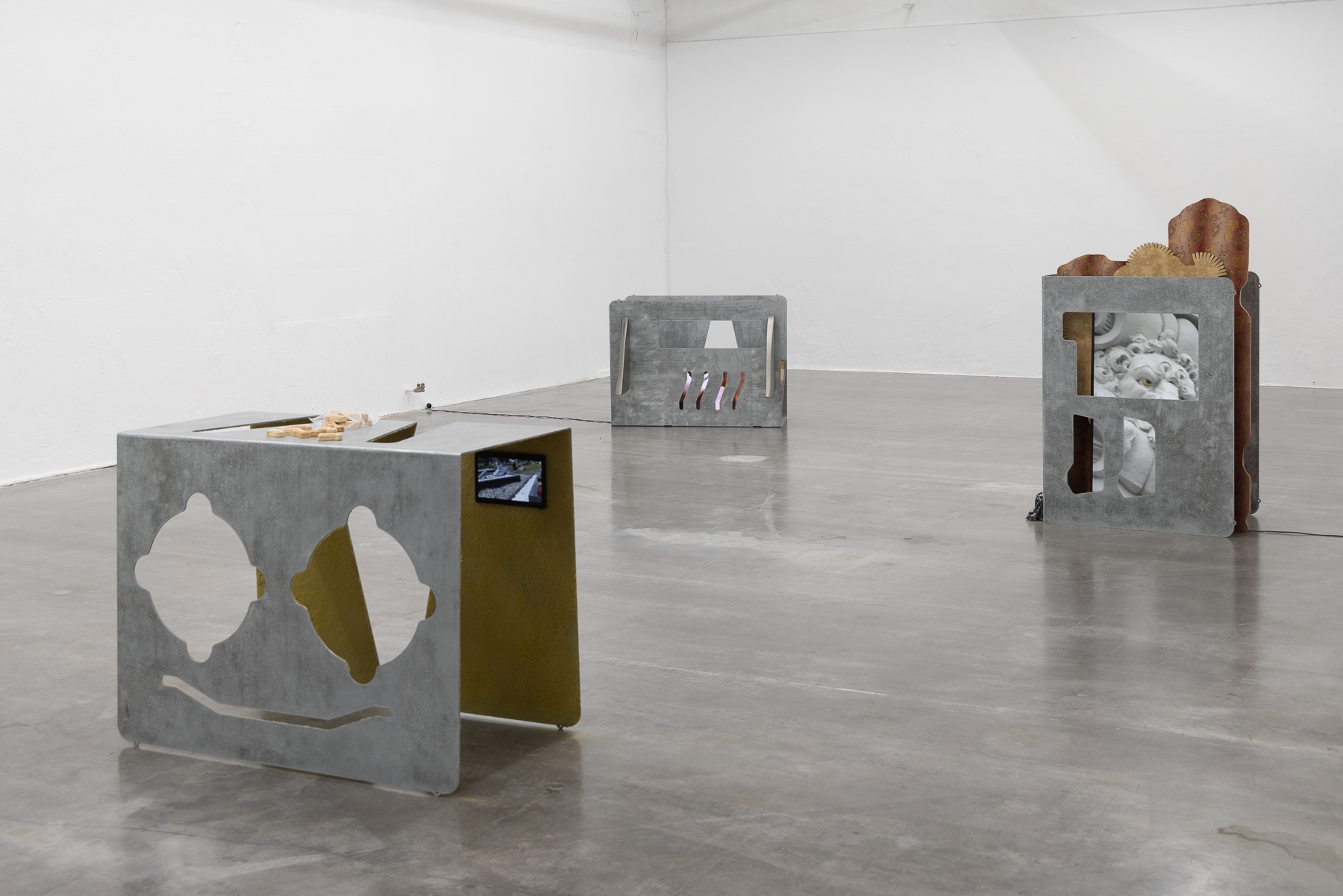
gouache paint, acrylic resin, biro, pencil, gesso and ink on wood. 31 x 24 x 5 cm, ; Julia Klemm, A chimera is not a pet 2, 2025, steel, glaze, ceramic, pigment, 44 x 38 x 74 cm,; Julia Klemm, A chimera is not a pet 3 , 2025, steel, glaze, ceramic, pigment, 46 x 34 x 42 cm)
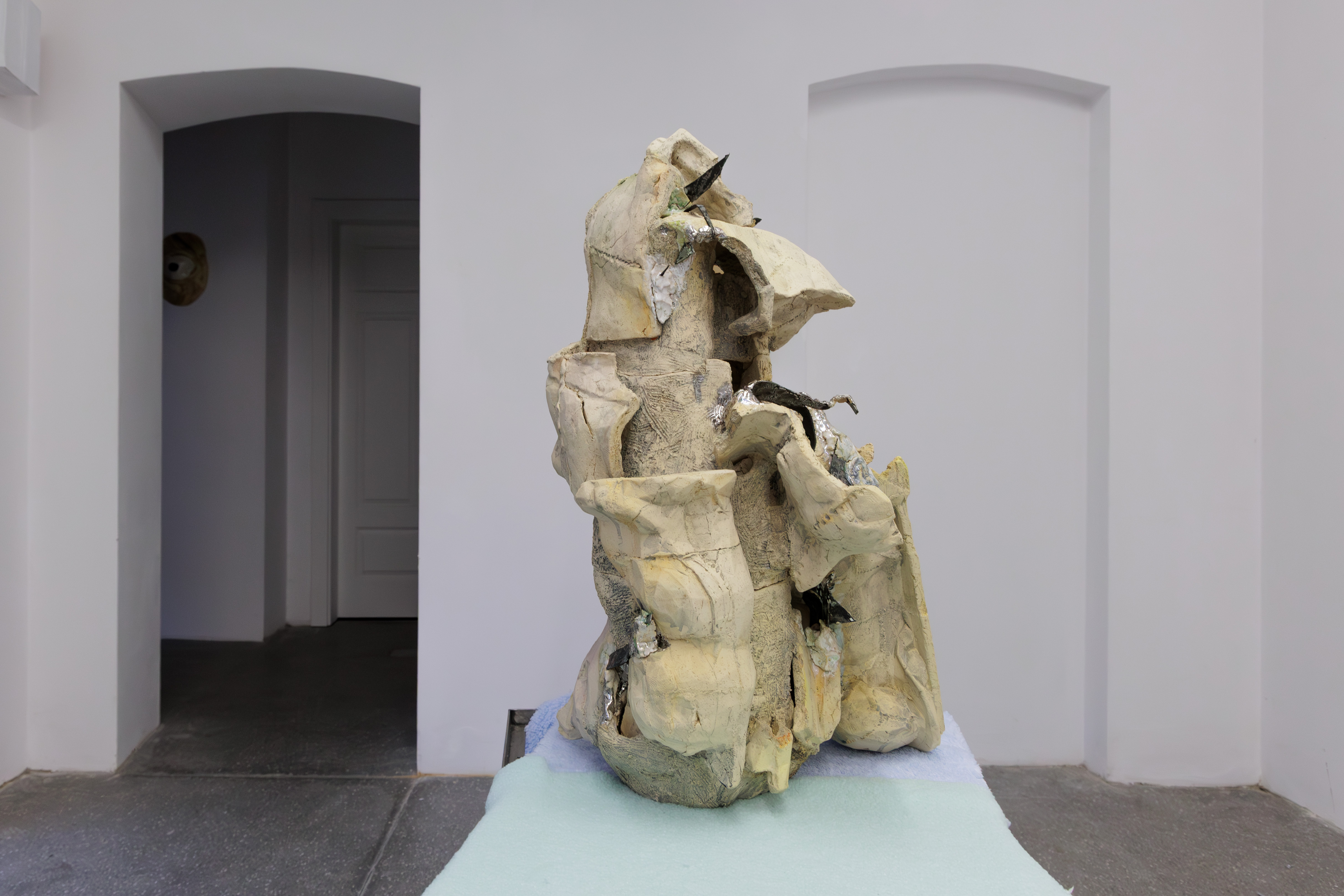
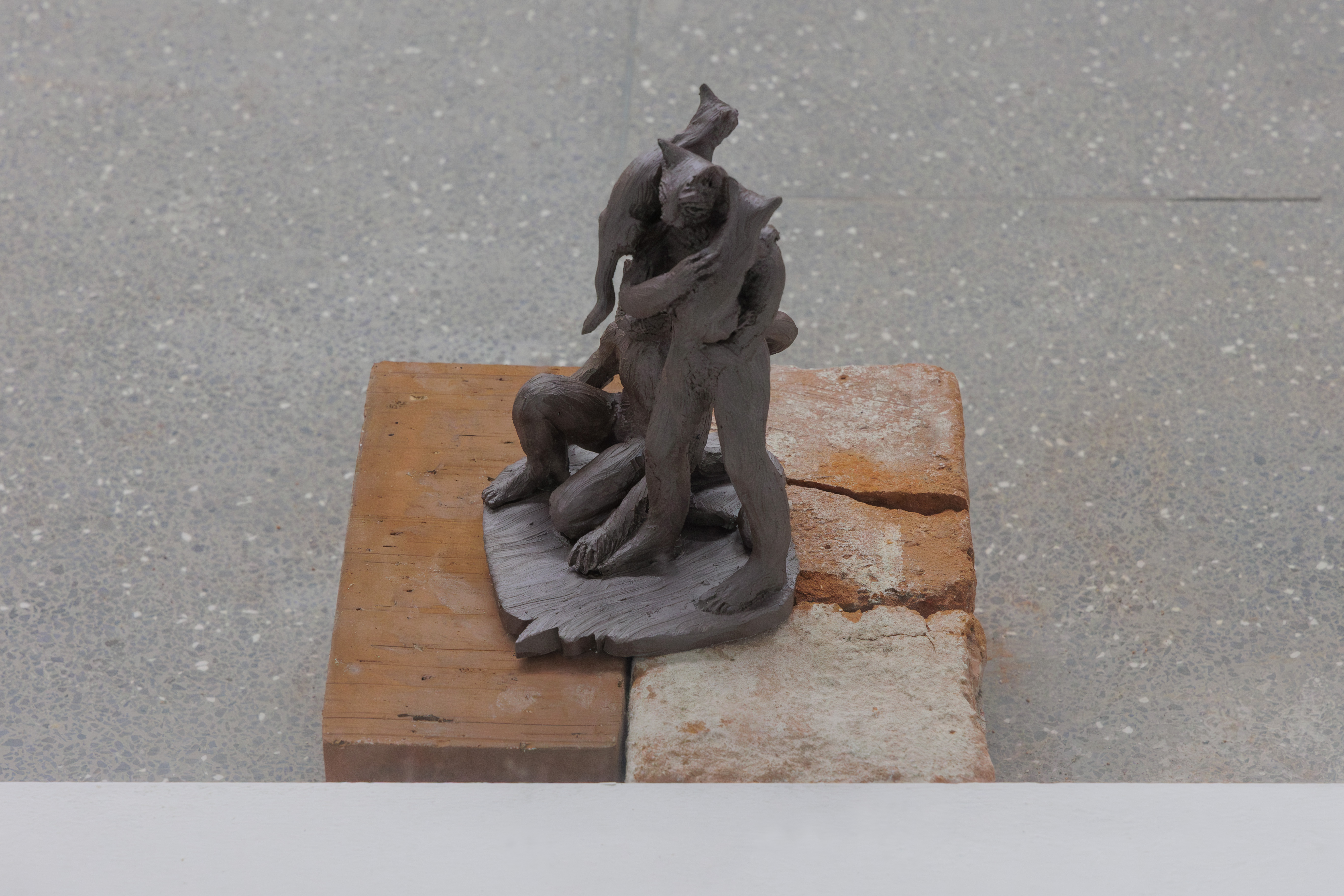
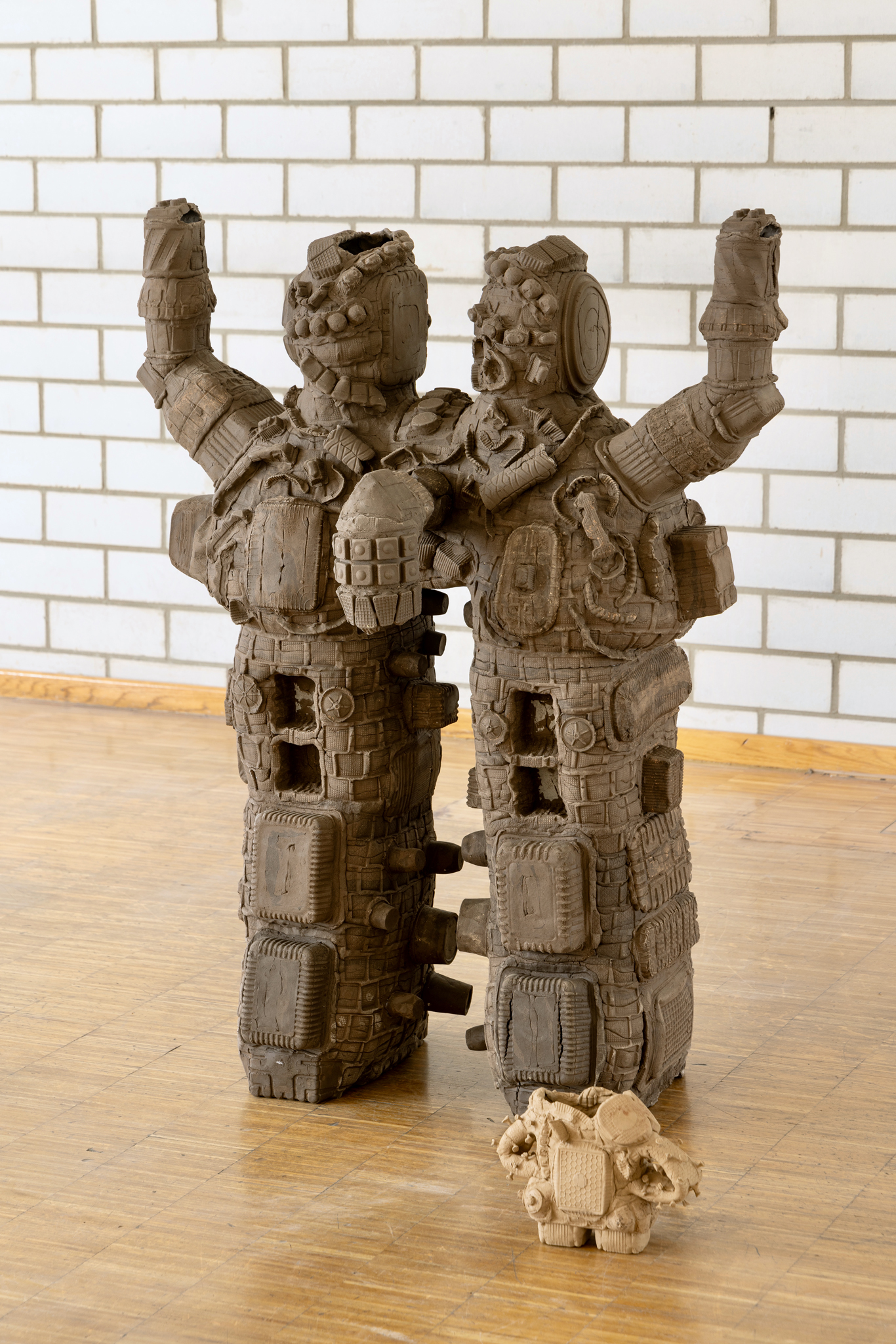
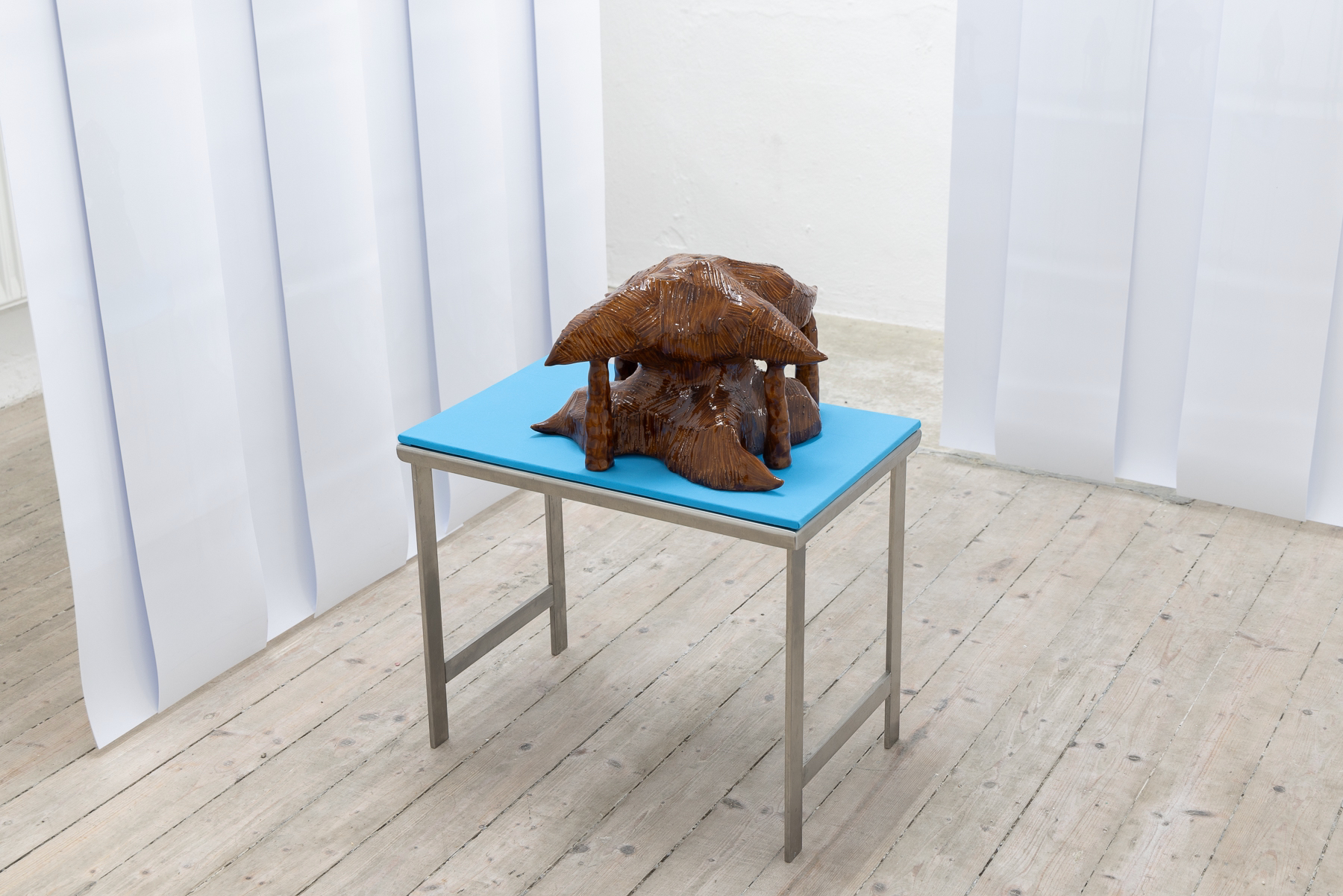
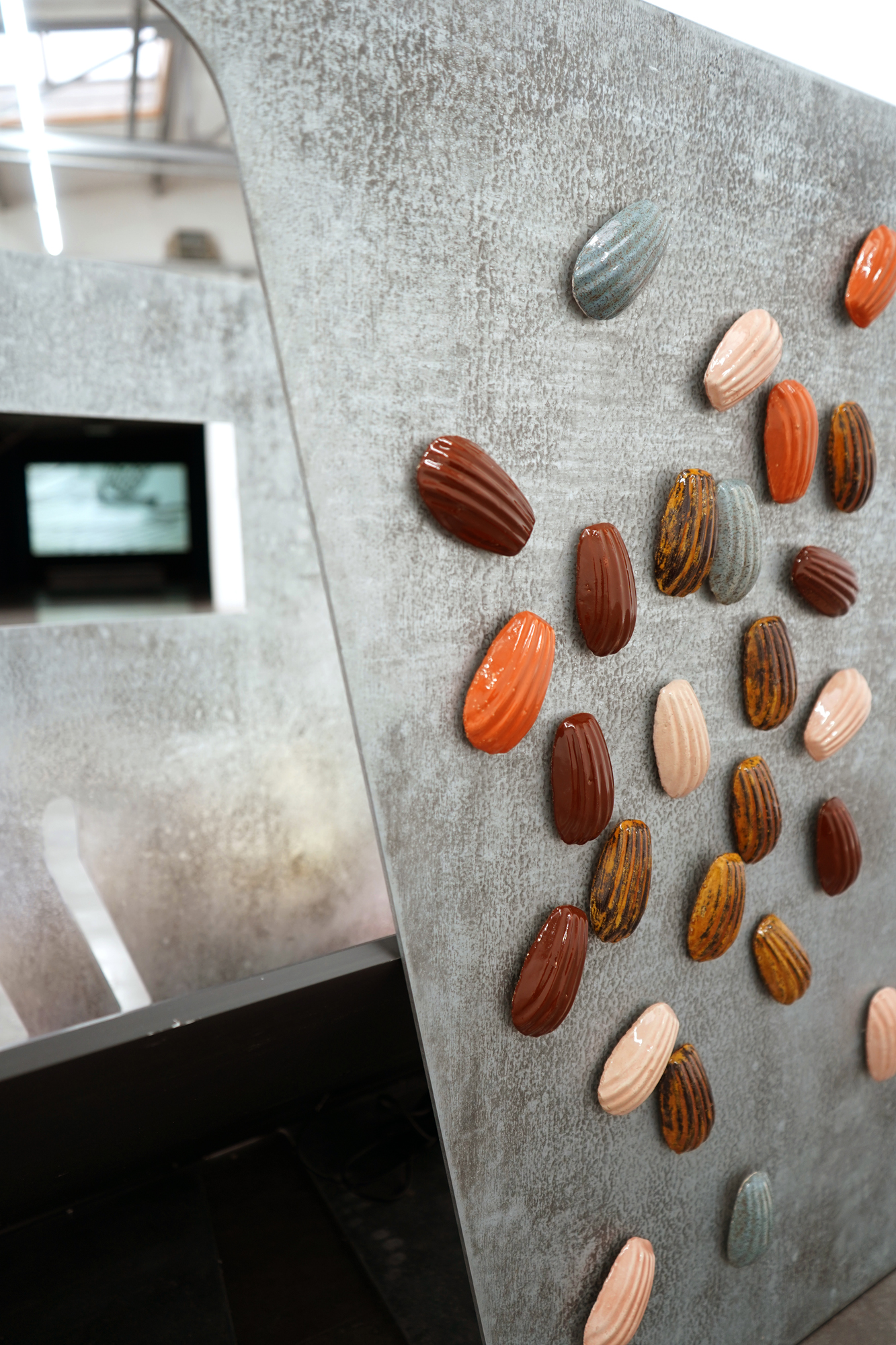
Julia Klemm, A chimera is not a pet 2,2025, steel, glaze, ceramic, pigment, 44 x 38 x 74 cm,
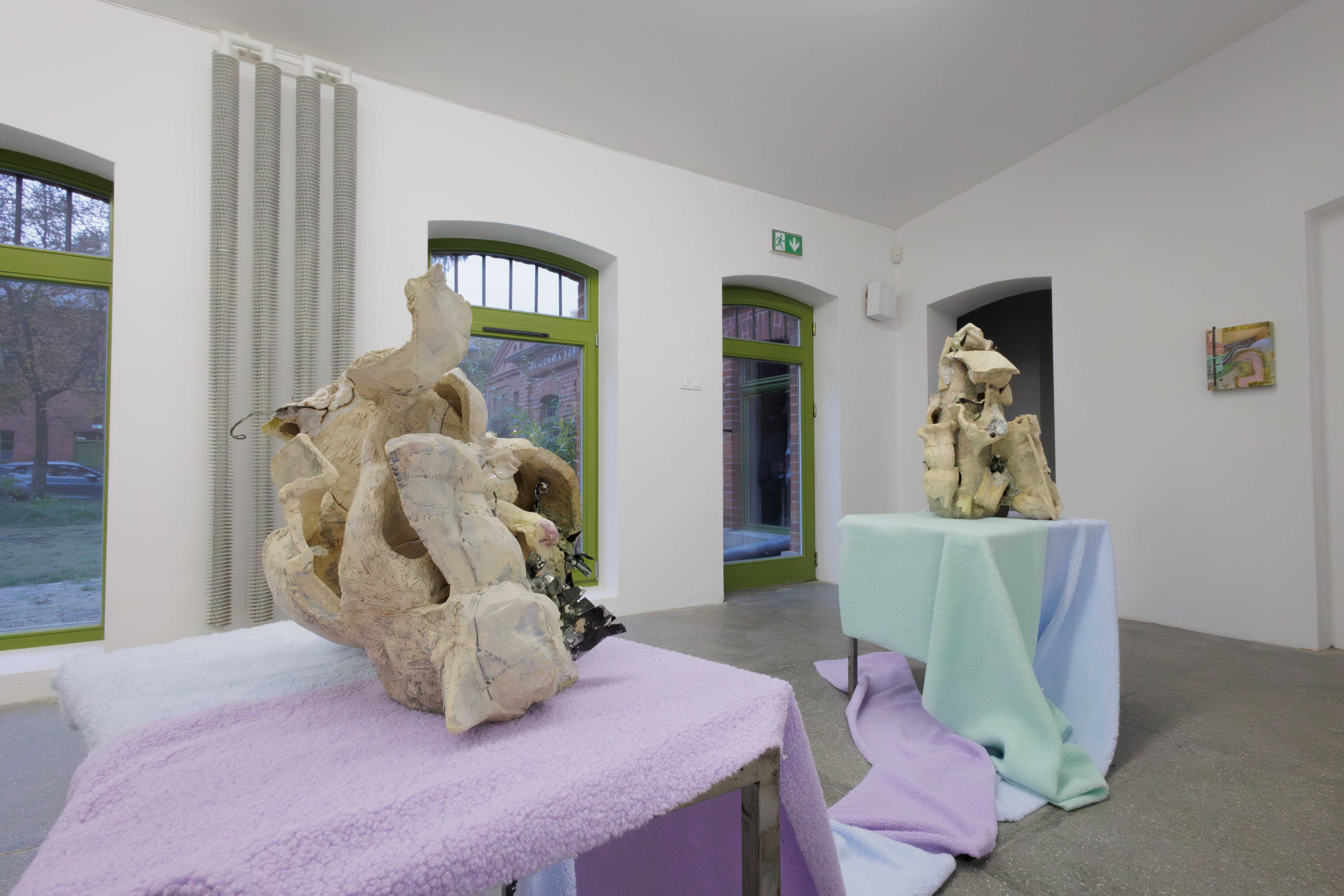
Animal Elegance, installation view (Jonathan Penca, Colonna Sonora, 2025, acrylic and
gouache paint, acrylic resin, biro, pencil, gesso and ink on wood. 31 x 24 x 5 cm; Julia Klemm, A chimera is not a pet 2,2025, steel, glaze, ceramic, pigment, 44 x 38 x 74 cm,; Julia Klemm, A chimera is not a pet 3 , 2025, steel, glaze, ceramic, pigment, 46 x 34 x 42 cm)
Jonathan Penca, Colonna Sonora, 2025, acrylic and
gouache paint, acrylic resin, biro, pencil, gesso and ink on wood. 31 x 24 x 5 cm,
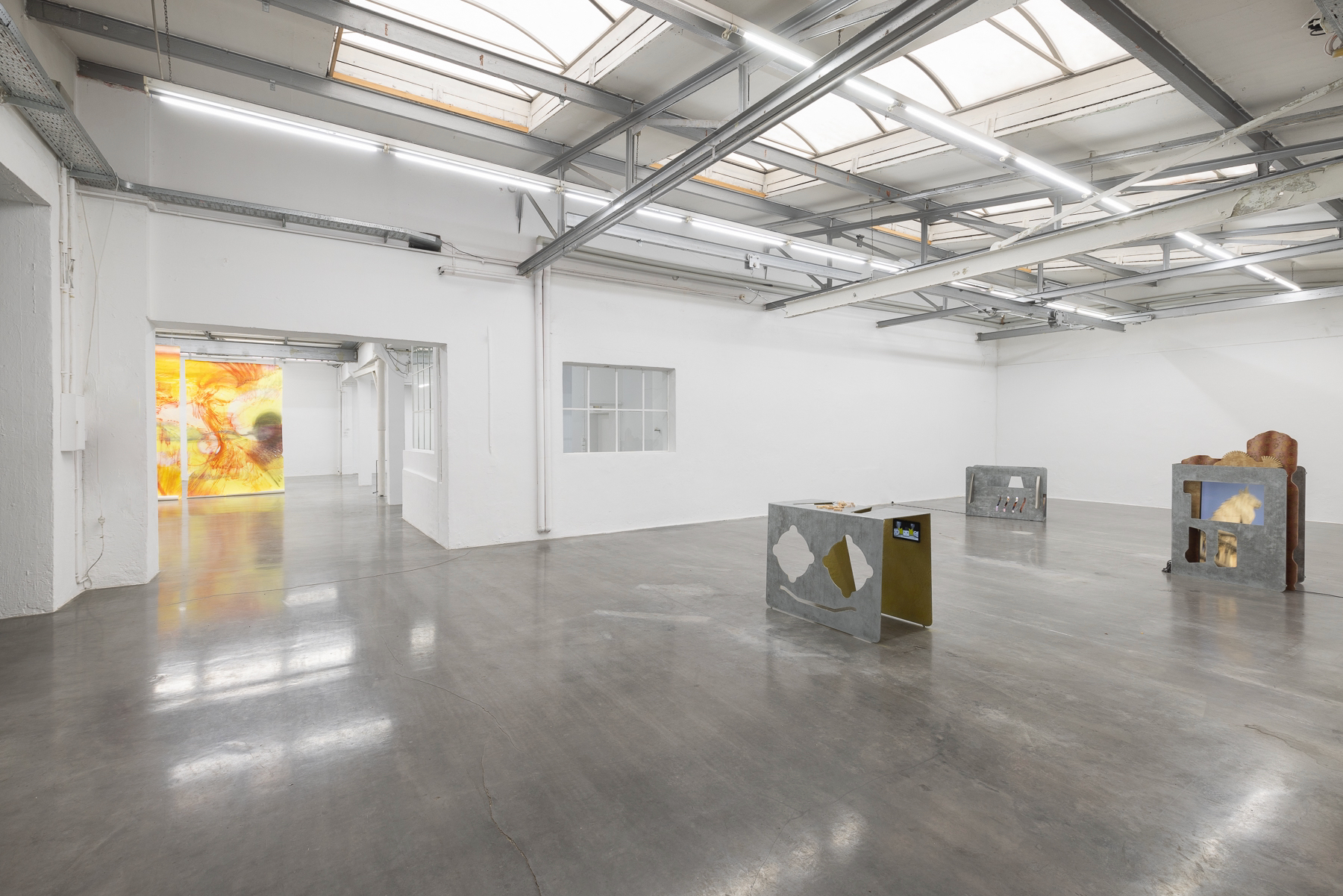
Animal Elegance, installation view , 2025
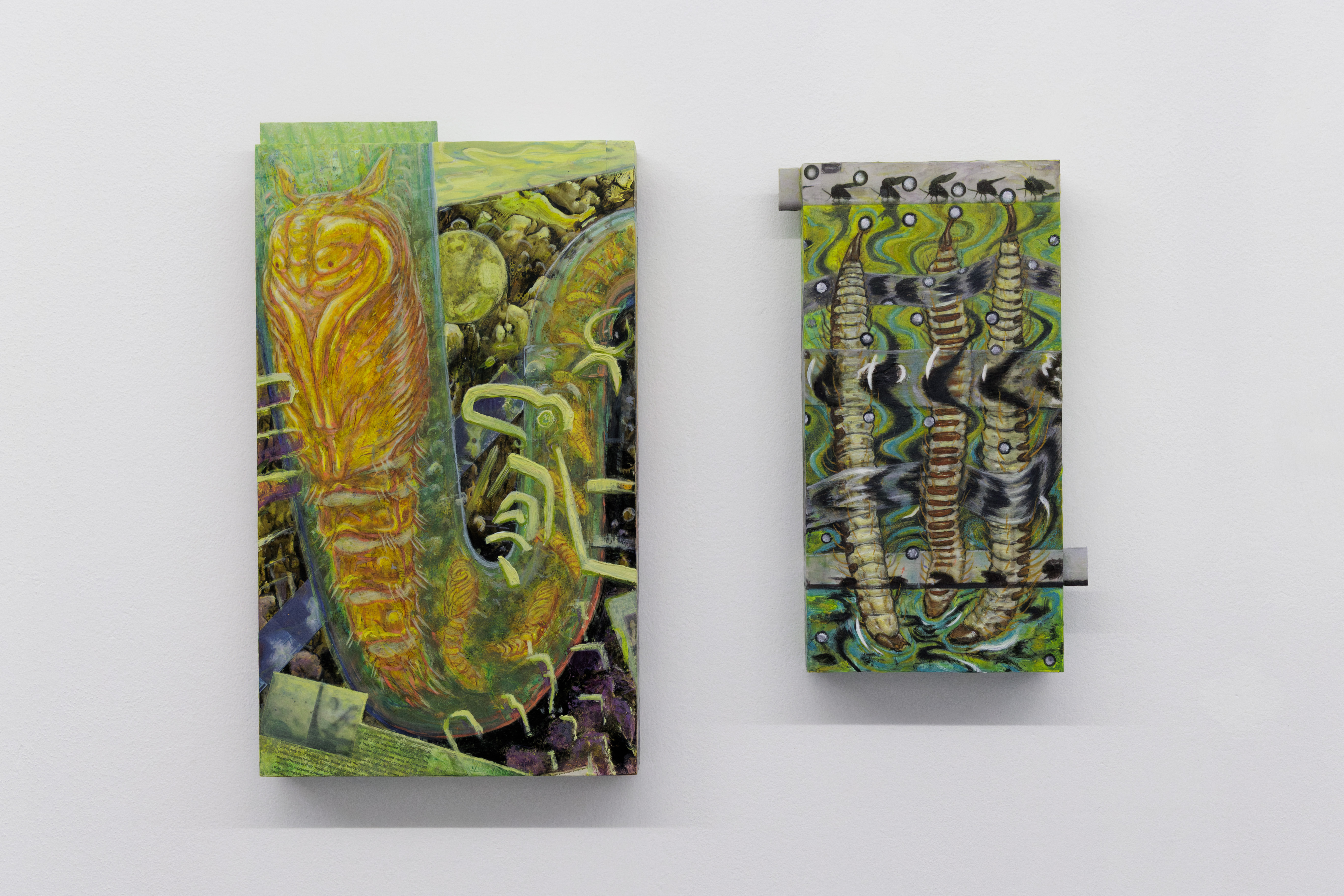
Jonathan Penca, inglers Groove, 2025, gouache, acrylic, watercolour, acrylic resin, pencil, gesso, ink and paper on wood, 52 x 30 x 5 cm; Jonathan Penca, Tufty Sequence, 2025, gouache, acrylic, acrylic resin, biro, gesso, ink and paper on wood, 40 x 19 x 5 cm)
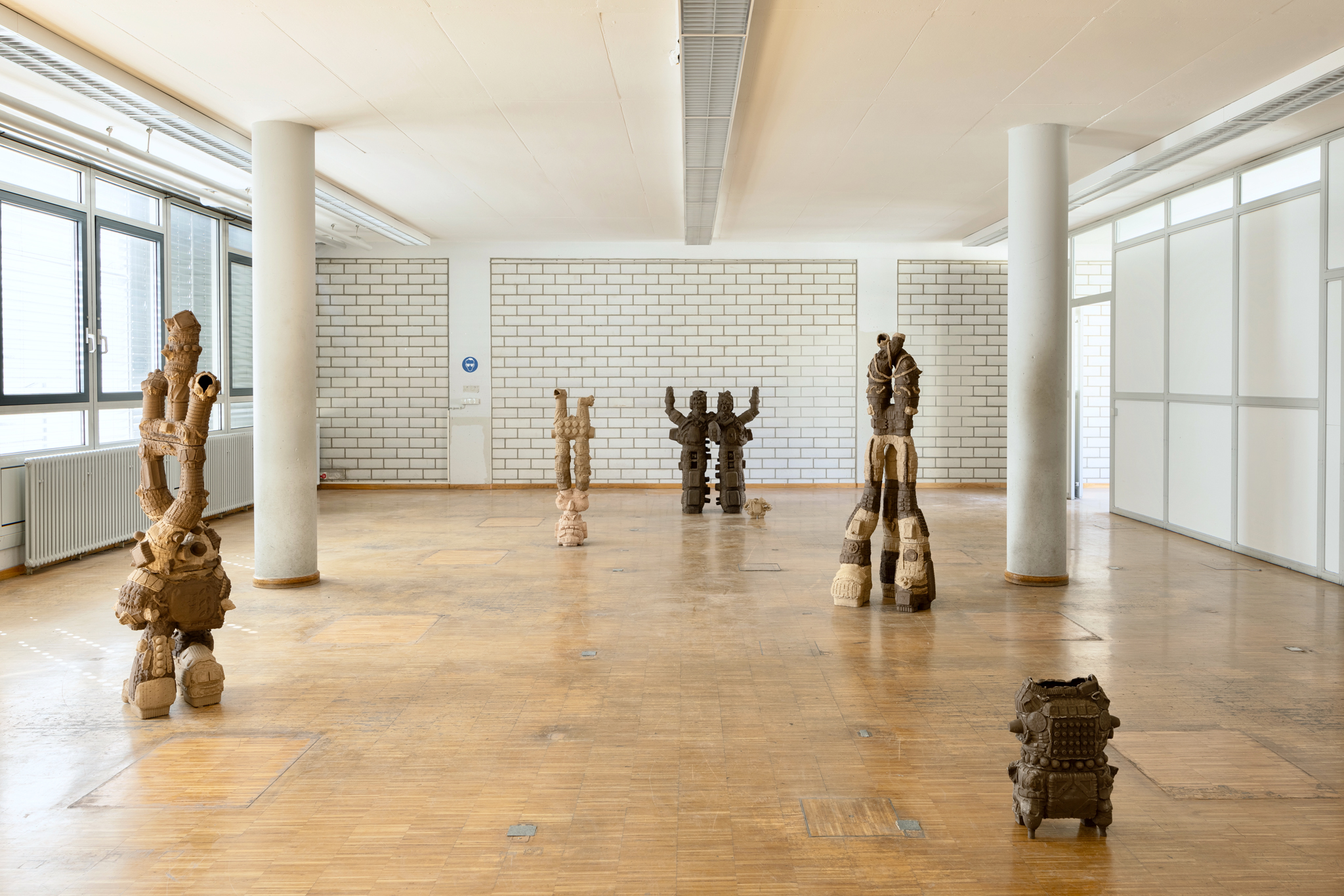
Animal Elegance, 2025, installation view

Julia Klemm, Transcending territories, 2024, glaze, ceramic, pigment, 32 x 30 x 48 cm
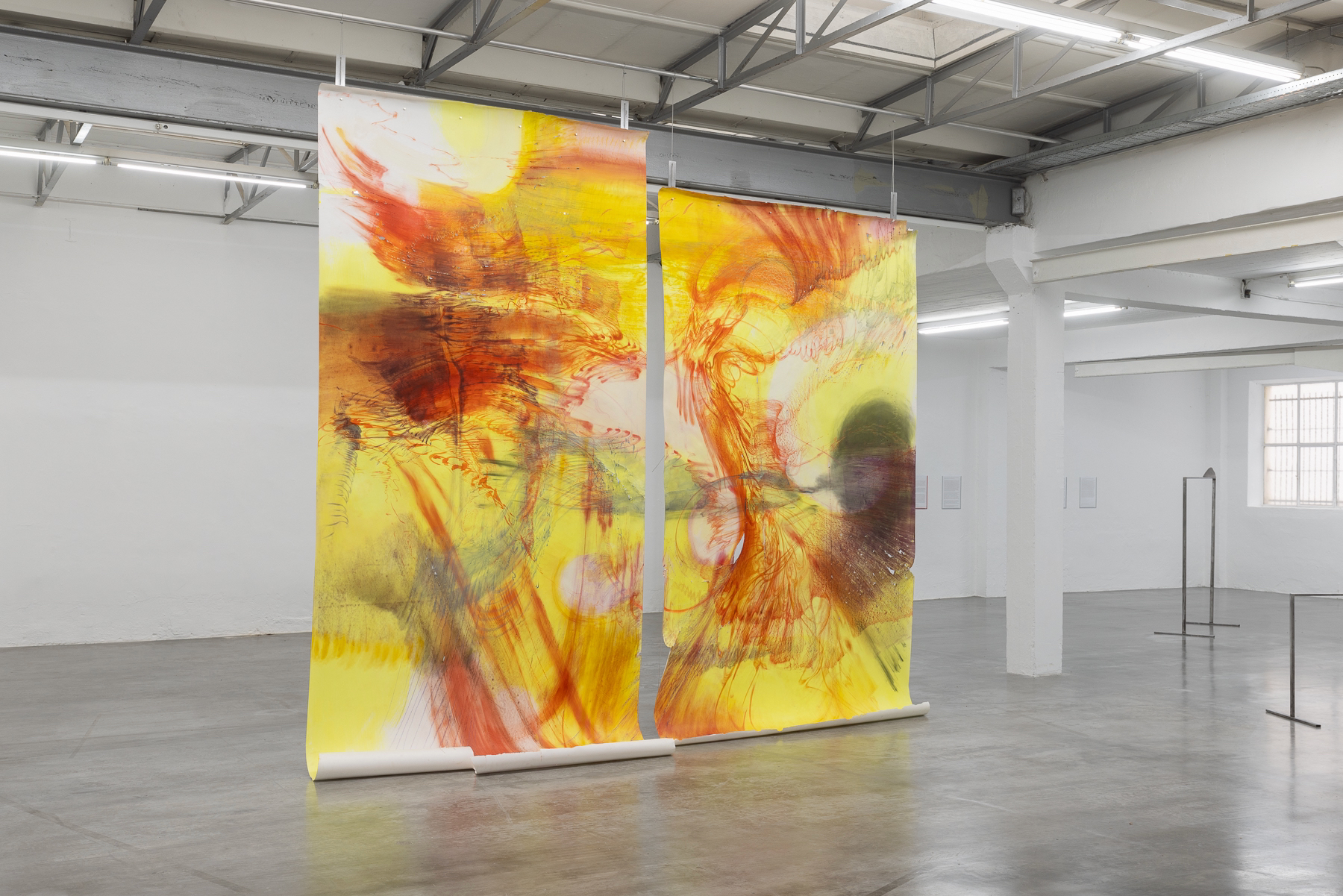
Animal Elegance, 2025, installation view
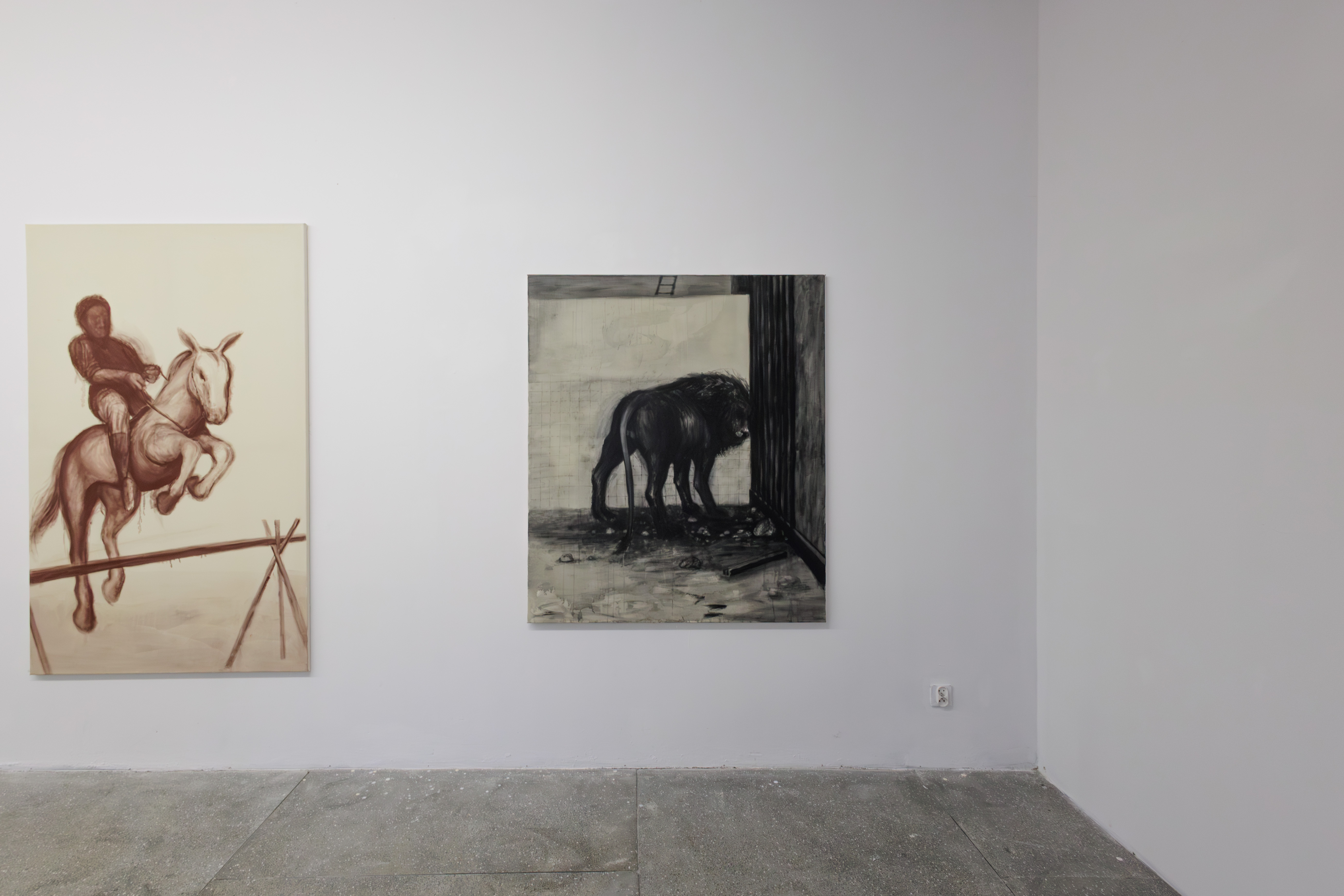
Jakob Gilg, Alignment, 2025, pigment and acrylic medium on canvas, 180 x 110 cm; Jakob Gilg, Virgo, 2025, pigment and acrylic medium on canvas, 140 x 120 cm)
Jonathan Penca, Clogmia, 2025, gouache, acrylic resin, gesso, ink, makeup powder and paper on wood, 44 x 30 x 5 cm
Jakob Gilg, I’m sorry, 2024, pigment and acrylic medium on canvas, 25o x 200 cm; Jakob Gilg, Kindling, 2025, pigment and acrylic medium on canvas, 70 x 50 cm
Jakob Gilg, Kindling, 2025, pigment and acrylic medium on canvas, 70 x 50 cm
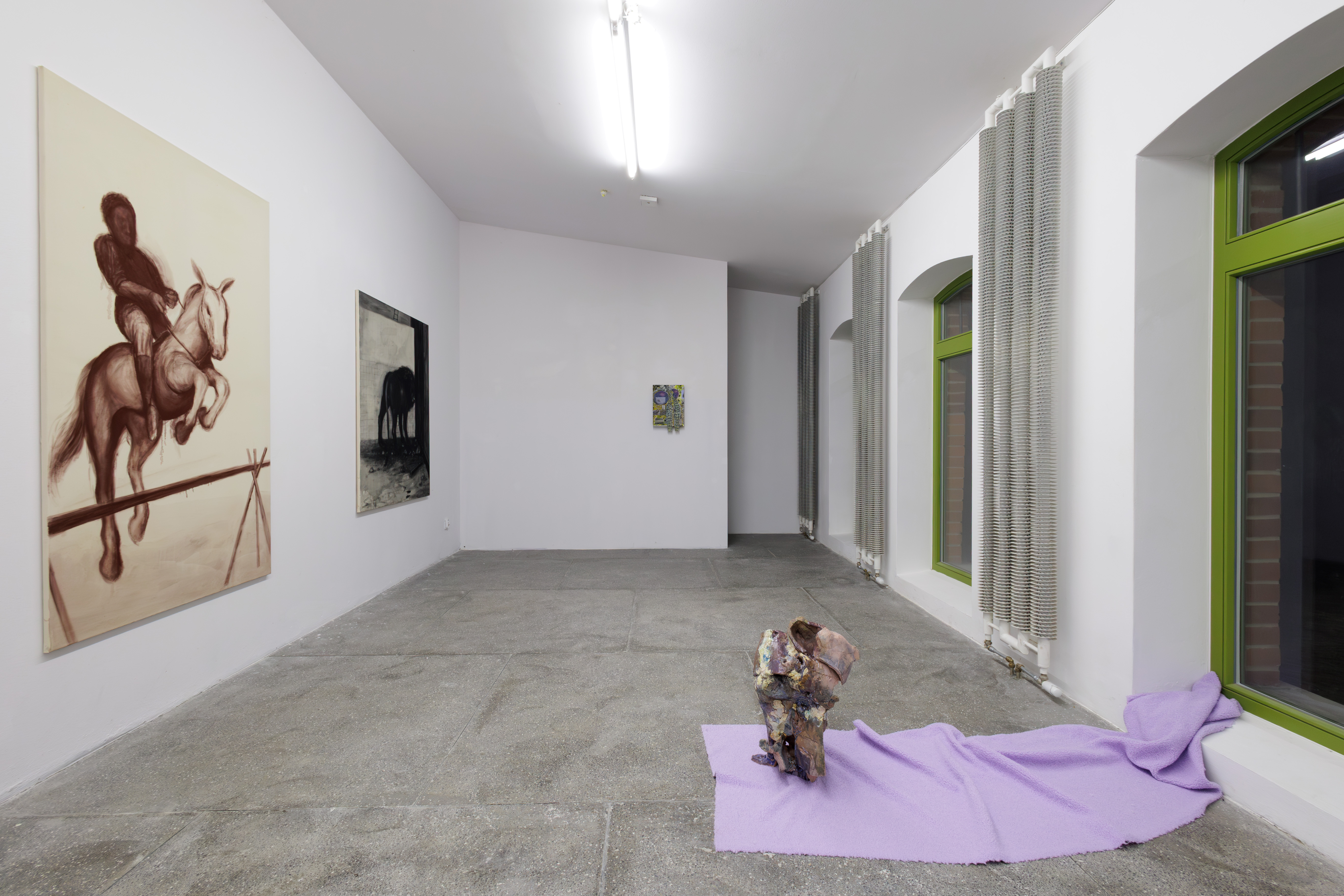
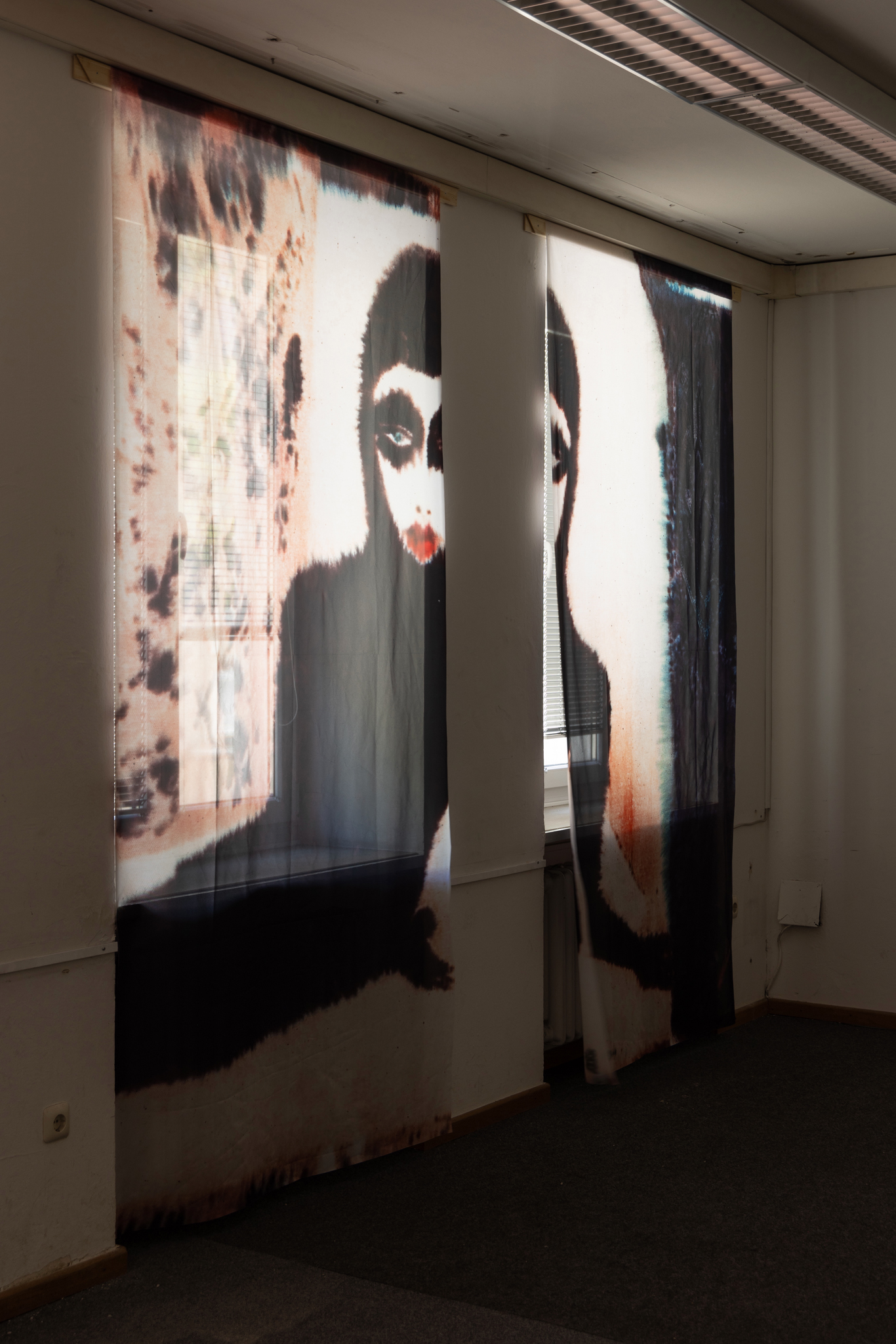
Animal Elegance, 2025, installation view
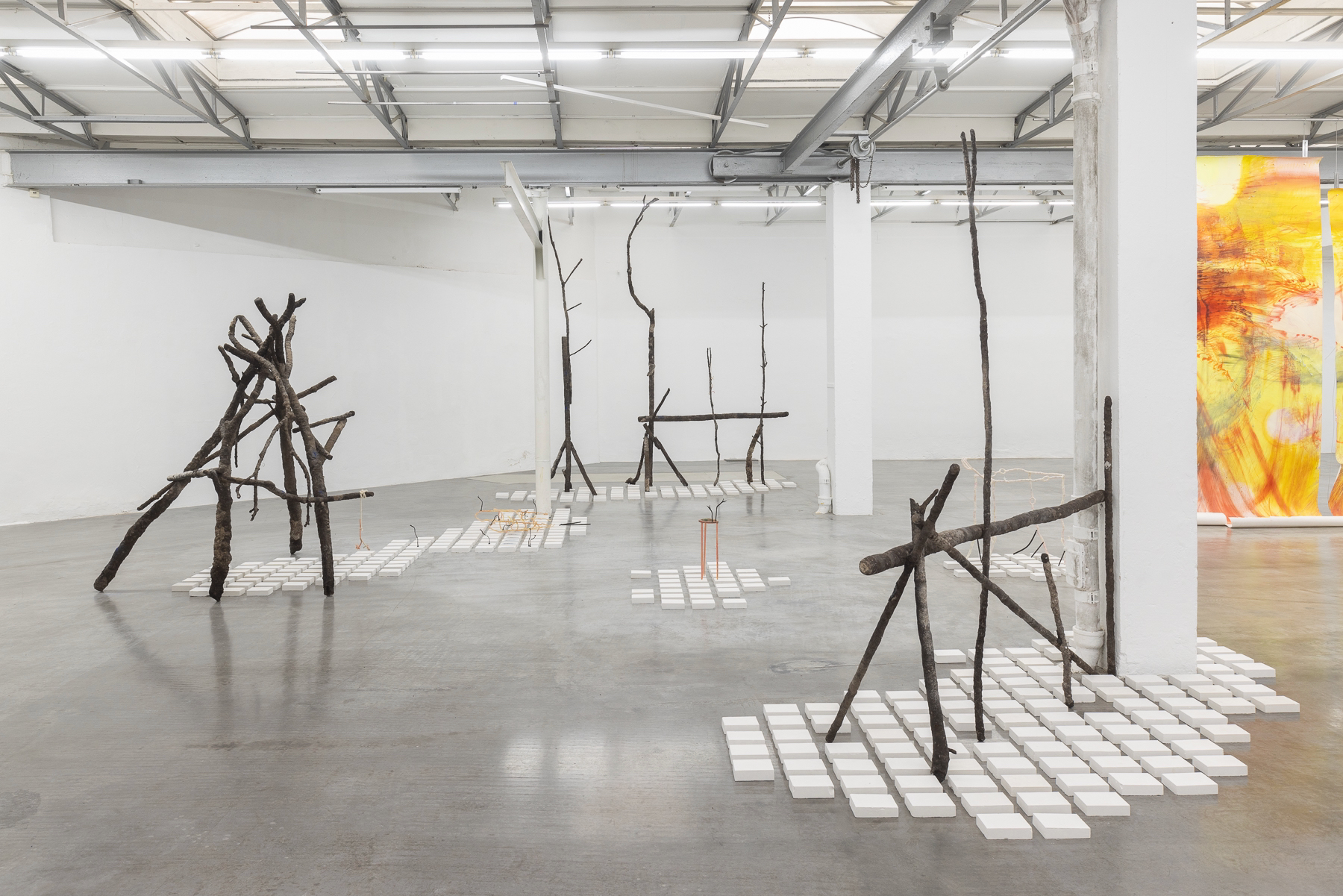
Anka Helfertova, To be in a time of war ( I keep changing my address but war never loses my scent) 2025, bricks, stone, MDF board, silicon, pigment, ceramic, 55 x 120 x 77 cm and 40 x 30 x 30 cm
Animal Elegance, 2025, installation view

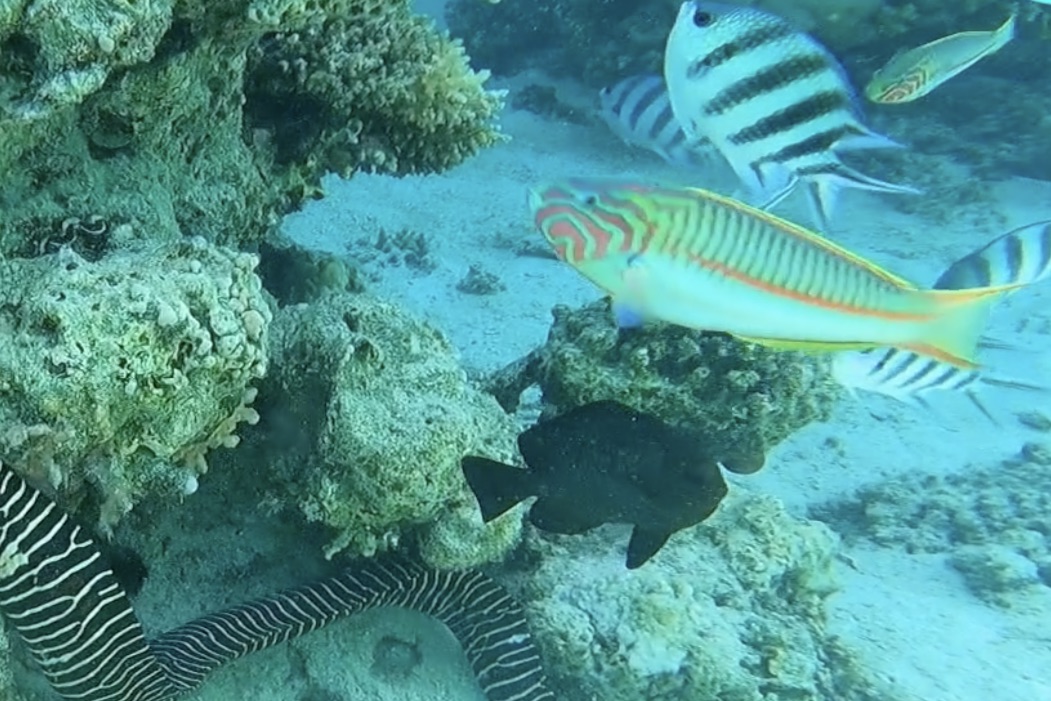
There is a fascist, who lives in my head, and he has been there for a while. I speak to him almost everyday about different things, mainly things I see in the news or read about online, but sometimes also about art. Recently I was telling him about the fish, Kluzinger’s wrasse, which reminded me of a passage I read in “A Thousand Plateaus” by Deleuze and Guattari. They ascribe to a tropical fish an animal elegance, because of the way it uses its colourful design to blend in with its surroundings. The lines of the design are abstract and yet have the capacity to construct an entire underwater world. 

Look, I tell him, we think we know what a fish is, the way you think you know what a dog or horse or lion is, an animal, a species, a type. Certainly your lot has made enough statues and animal monuments – porcelain shepherd dog figurines graced your tables. A fish lives in water and like all other fish has scales, fins and gills.  We can compare this fish to another and note down the similarities of their characteristics, in order to classify them, genus: Thalassoma, family: Labridae. You think we know what kind of an animal a fish is. There it is. Put it in an aquarium. 

Ah, I say, but can we see the animal Deleuze and Guattari describe as possessing an English kind of elegance? With a refinement that does not seek attention, but that remains quietly unobtrusive?  This involves the appreciation of the small and the detailed, like those drain moths found in Jonathan Penca’s paintings, charming us with their fuzzy faces and furry wings. More than that, unobtrusiveness requires an effort. To go through life unnoticed is not easy and drain moths have a life cycle with four stages, larvae feeding on toilet sludge before developing into pupae. 

There are animals we see and animals we do not. The animals we do see, we organise and use, tame and breed. We control them as meticulously as Eadweard Muybridge did, when he set up multiple cameras to capture the image of the horse in motion or a lion in a cage, the starting point of Jakob Gilg’s paintings. We assign animals different roles: you there, you look soft and cuddly, you will be a pet. And you, you over there, so powerful and strong, you we will make into a symbol. Kitsch ceramic cats and scaled-down digital scans of lion monuments tumble, shatter and recombine in Julia Klemm’s work. 

But this animal you don’t see, is something other than a molar entity, a different “affair” as Deleuze and Guattari would say, involving “becoming” not “being.” And it might seem we are meant to think this becoming morphologically, as the becoming of something else, a change from one permanent state to another, equally permanent one. A human could become a cat perhaps – or a cat, a human – as in the work of Anka Helfertova. Violence swirls around and we try to find our peace, not to lose ourselves within. To think becoming is to think loss, the elimination of all of our complaints, demands, unsatisfied desires, “everything that roots us in ourselves,” so that at the end, we are left with nothing, which is also everything. Becoming-animal is always a becoming-imperceptible, a shrinking best found in science fiction novels, the shrinking man becoming smaller and smaller without ever disappearing. Because when animals are thought in their becoming, the molecular comes into play, those invisible abstract forces that in their millions of interactions are actually responsible for constituting a world. To think an animal in its becoming is to engage with these molecular forces at work.

This is the demand elegance places on us: to think less of ourselves and more of the other. It is to be more attuned to our surroundings by paying attention to what continues to constitute us, which is always small and inorganic, indiscernible and impersonal. Elegance is a kind of molecular attention, but with a focus that opens out onto the world. To think things in their becoming molecularly is also to think in terms of the cosmos in its entirety. And then we might indeed stop seeing fish, but we will begin to see everything else.

Magdalena Wiśniowska 2025
Animal Elegance

Jakob Gilg, Anka Helfertova, Julia Klemm and Jonathan Penca

9.10. – 7.11.2025

with Pracownia Portretu, Łódź, Poland

Screenshot

In the imaginary conversation with a fascist that I seem to almost daily conduct in my head, I like to present him (my fascist is always a man) the example of an animal, this time of a fish. Deleuze and Guattari describe this fish as being “criss-crossed by abstract lines” – I like to think of the Klunzinger’s Wrasse I saw on a recent trip to Egypt, criss-crossed by a rainbow of colour.

Here it is, I would say, look at this fish, look how beautiful it is, the colours, the design. The pattern doesn’t seem to follow the shape of the fish. There is an orange line across, stripes above, more pink wavy lines around its chubby face. Very bright. But in a certain trick of the light, the fish merges almost completely with its underwater environment. What is abstract, a matter of shape, line and colour, allows the fish to become rock, sand or a bit of coral. As Deleuze and Guattari write “this fish is criss-crossed by abstract lines that resemble nothing, that do not even follow its organic divisions; but thus disorganized, disarticulated, it worlds with the lines of a rock, sand, and plants, becoming imperceptible.”

The fish worlds and when it worlds it becomes imperceptible. It loses itself in the most vibrant way to become unnoticed and thus more firmly part of the world it belongs to. In losing itself it can become everything else.

VO Special: Carrying the Earth to the Sky

Hêlîn Alas,Pierre-Yves Delannoy, Lukas Hoffmann, Veronika Hilger, Ju Young Kim, Anna McCarthy, Jonathan Penca, Curtis Talwst Santiago, Valio Tchenkov, Ayaka Terajima, Gülbin Ünlü, Paul Valentin, Max Weisthoff

7.09 -28.09.2024

Temporary venue at Schillerstr. 38, Munich

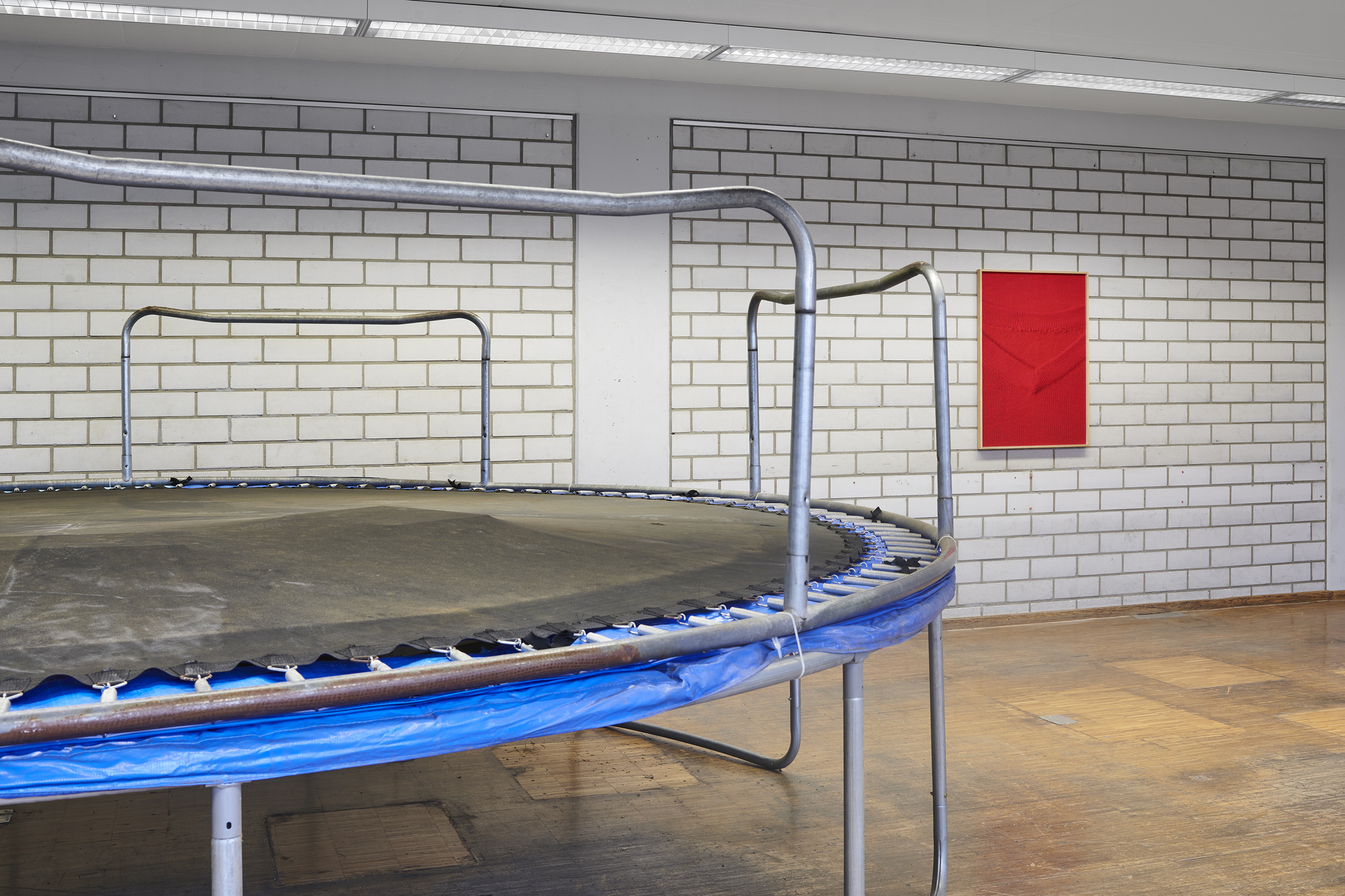
Hêlîn Alas, Carrying the Earth to the Sky, 2024, installation view with “Up and Up and Up and Up,” 2024, trampolines, cable ties, speakers, sound, cables, 490 x 165 cm and “Still Faced,” 2024
framed photo print (part of a series) 100 x 70 cm. Photo: Produktion Pitz
Hêlîn Alas, “Traumhaus junior,” 2024, caramel, 118 x 90 x 8 cm. Photo: Produktion Pitz
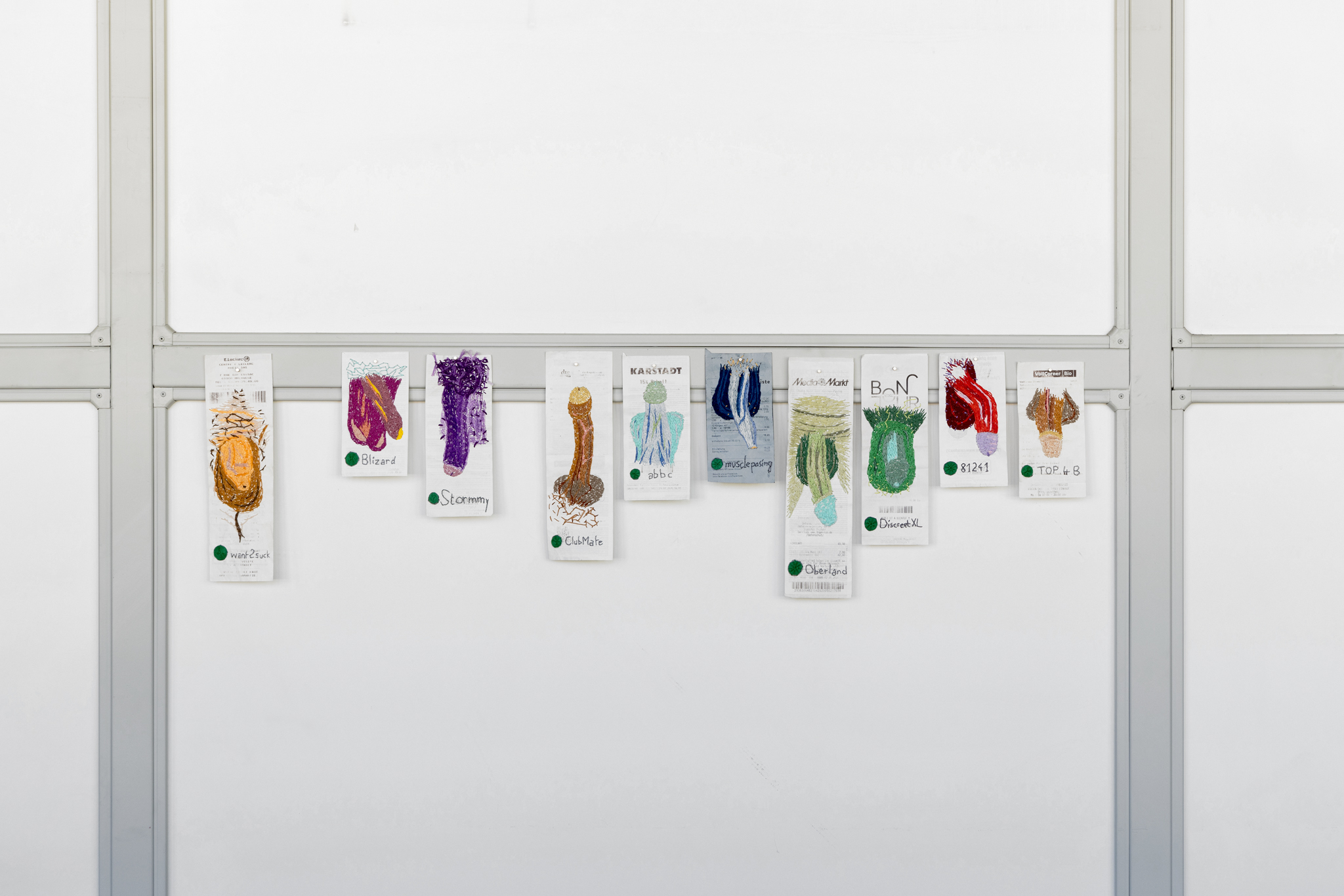
Pierre-Yves Delannoy, “embroideries on cashier’s ticket,” 2019-24, cotton yarns, thermo paper, dimensions variable (8 x 16 cm (X10)). Photo: Thomas Splett
Veronika Hilger, Carrying the Earth to the Sky, 2024, installation view. Photo: Thomas Splett
Veronika Hilger, Untitled, 2024, ceramic, 27 × 24 × 3 cm. Photo: Thomas Splett
Lukas Hoffmann, “Figure,” 2020, MDF, oak, aluminum, acrylic glass, 50 x 45 x 8 cm. Photo: Lukas Hoffmann
Lukas Hoffmann, “Castle,” 2024, Spraypaint, plywood, screws, MDF dyed through, 100 x 100 x 200 cm. Photo: Lukas Hoffmann
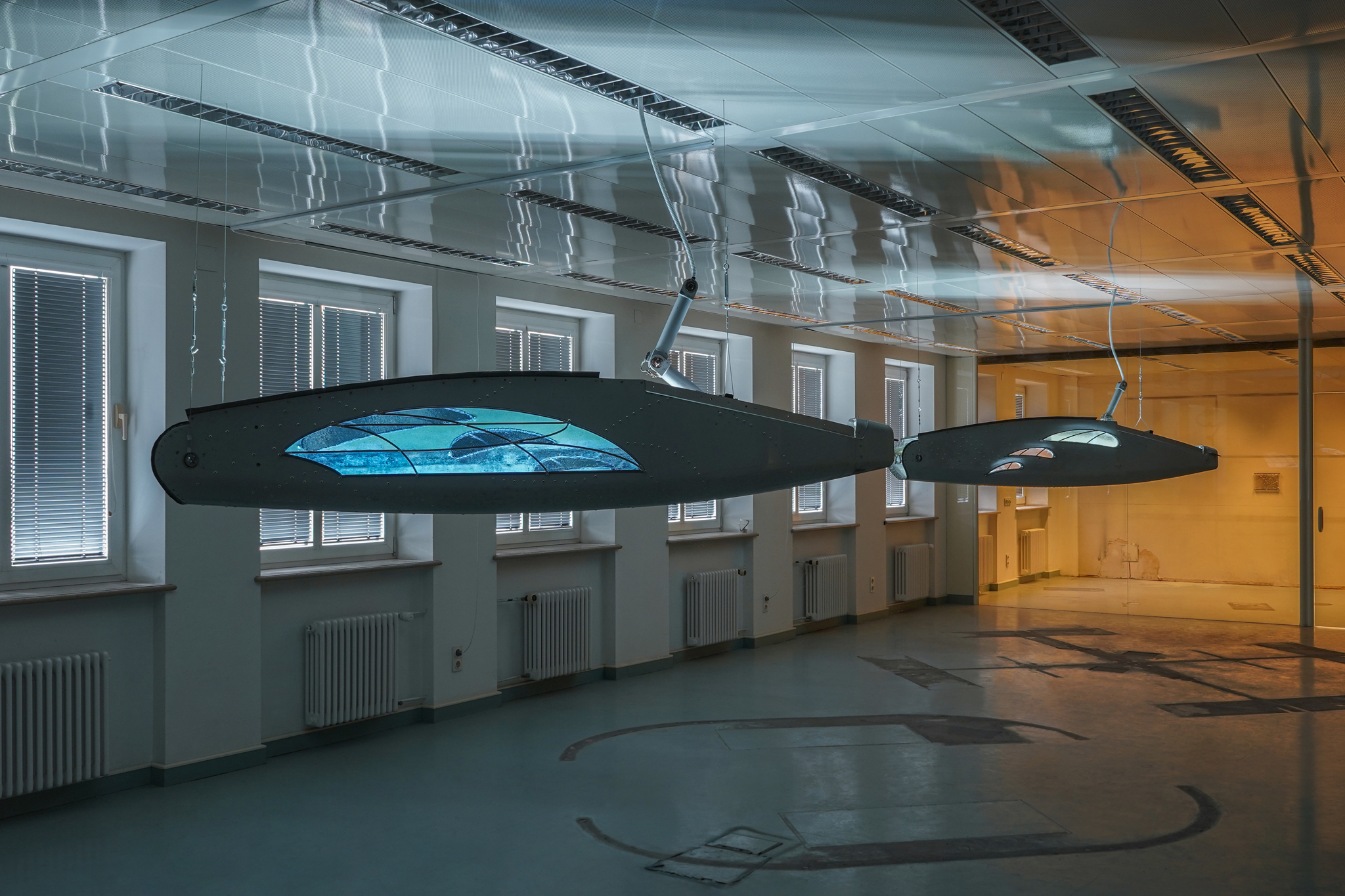
Ju Young Kim, “Almost like Whale Watching,” 2024, a pair of aircraft fairings, stained glass, rivets, LED, 240 x 38 x 46 cm (X2). Photo: Younsik Kim
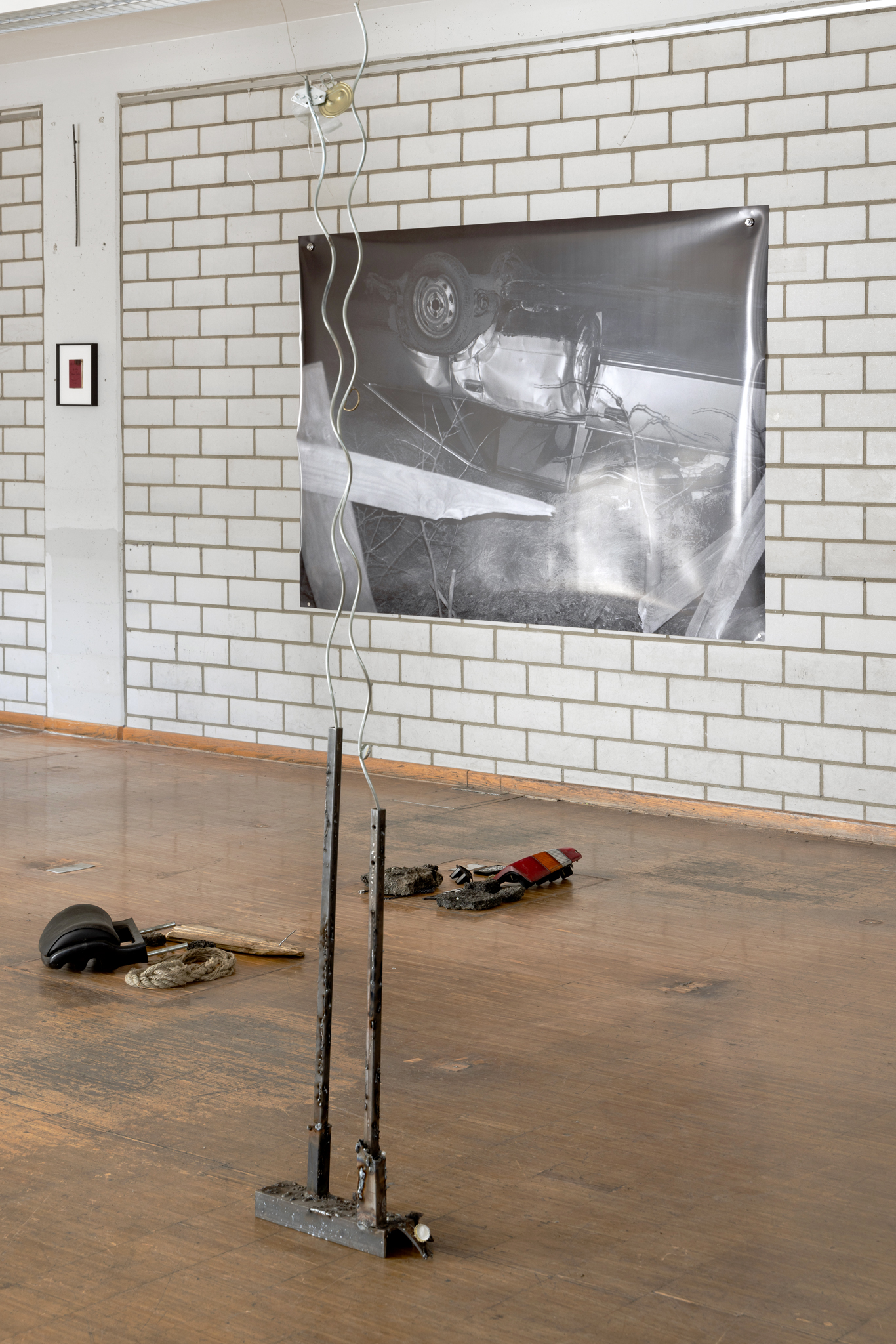
Anna McCarthy, Carrying the Earth to the Sky, 2024, installation view with “Car Crash b/w,” 2001, analogue photograph 230 x 160. Photo: Thomas Splett 
Anna McCarthy, “Car crash installation,” 2024, mixed media, dimensions variable. Photo: Thomas Splett
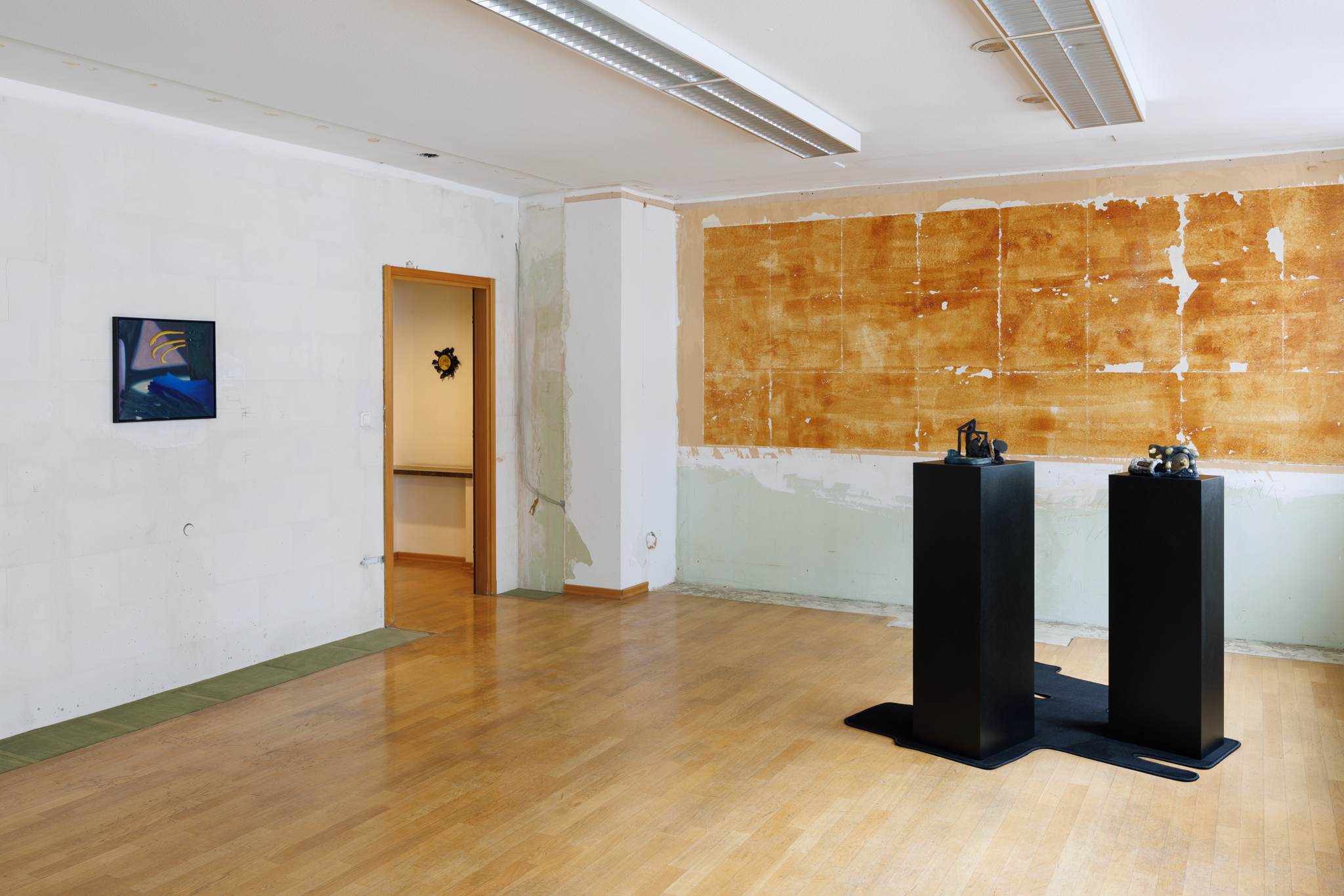
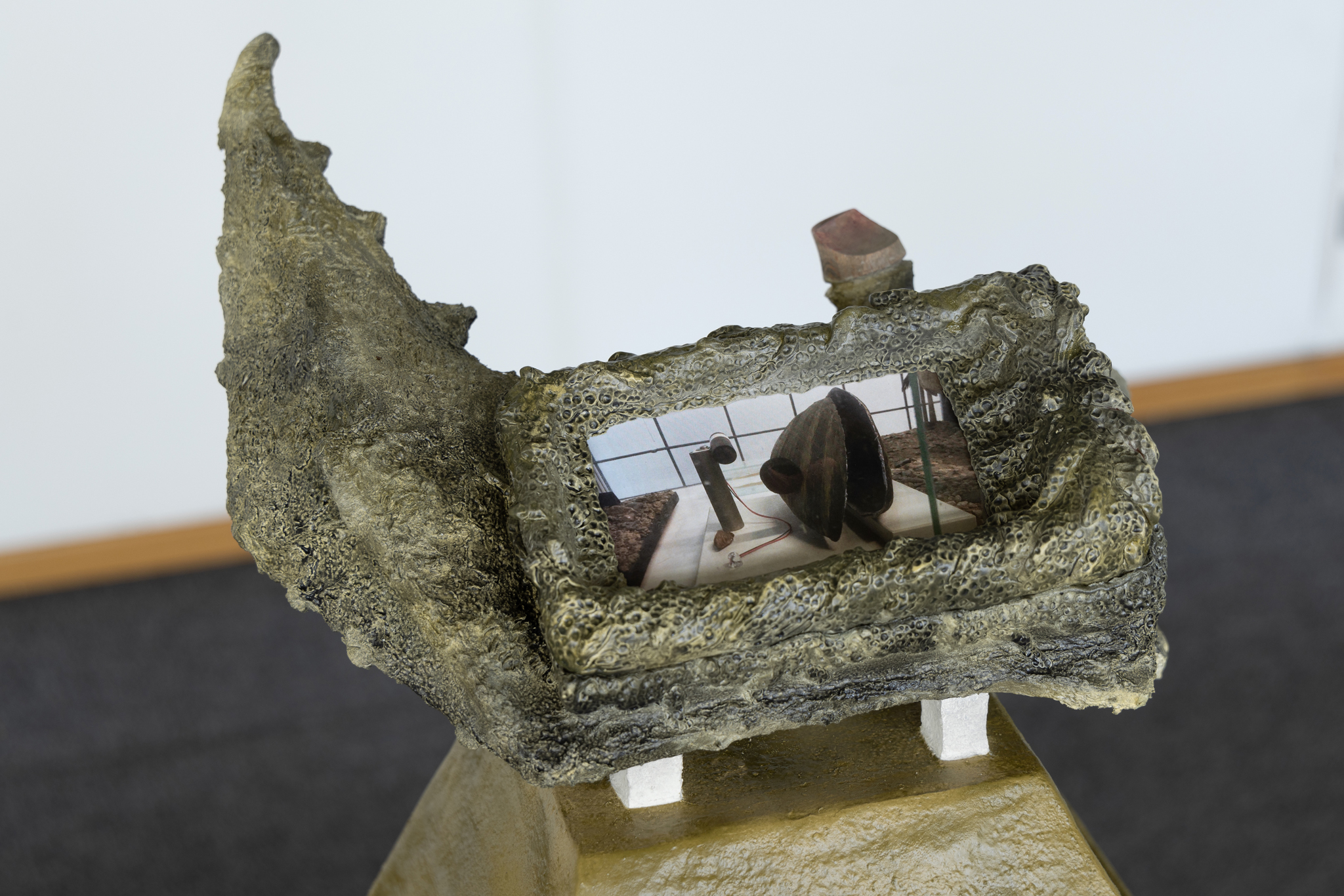
Jonathan Penca, “Synanthropop,” 2024, paper-maché, plaster, polymer clay, resin, cardboard, acrylic paint, wood, glass, digital print on paper, plinth, 120 x 60 x 60 cm. Photo: Thomas Splett
Jonathan Penca, “Mitten Crack,” 2024, paper-maché, plaster, polymer clay, resin, wooden bird whistle, lipstick, cardboard, acrylic paint, digital print on paper, plinth 120 x 60 x 60 cm. Photo: Thomas Splett
Curtis Talwst Santiago, “History of Touch” 2024, installation view detail. Photo: Thomas Splett
Curtis Talwst Santiago, “History of Touch” 2024, installation view. Photo: Thomas Splett
Valio Tchenkov, Carrying the Earth to the Sky, 2024, installation view. Photo: Thomas Splett
Ayaka Terajima, Carrying the Earth to the Sky, 2024, installation view. Photo: Thomas Splett
Ayaka Terajima, “Long legs doki,” 2023, Unglazed fired ceramic by recycled clay, 60 x 100 x 130 cm. Photo: Thomas Splett
Gülbin Ünlü, “Karanlik isik,” 2024, wood, printed fabric, dimensions variable (site specific installation). Photo: Thomas Splett
Gülbin Ünlü, “Karanlik isik,” 2024, wood, printed fabric, dimensions variable (site specific installation) detail. Photo: Thomas Splett
Paul Valentin, “Kasside,” 2024,  site specific video installation. Photo: Thomas Splett
Max Weisthoff, “perpetuator,” 2024, sculptural sound installation, 5 objects, cable, dimensions variable (site specific installation). Photo: Thomas Splett
Max Weisthoff, “out of flesh,” 2024, mixed media installation, 2 channel video, x objects, dimensions variable (site specific installation). Photo: Thomas Splett

“Carrying the Earth to the Sky” will present works by 13 artists who are currently active in the contemporary art scene in Munich. The artists were selected in a two-stage process. First each of the 37 participants of VARIOUS OTHERS nominated one artist currently living in Munich. From this group, an international jury consisting of four institutional curators selected 13 artists who will show their work as part of the VARIOUS OTHERS program in September. The jury acknowledged that the quality of the applications received made their task both exciting and challenging. The final selection of multi-generational artists reflects the desire to see art beyond fixed categories and clichés and to honour distinctive works.

The exhibition’s curator, Magdalena Wisniowska, has meticulously chosen the works in collaboration with the artists. These will be presented together in an overarching curatorial concept at Schillerstraße 38 under the title “Carrying the Earth to the Sky”.

“The earth is something human, something we keep under our feet. The sky high above is without air, where no living thing can breathe. Moving away from one to the other means letting go of the earth and constructions that belong to it – actions, bodies, objects, sensations and desires – until only the elements, disconnected molecules, remain.”

We would like to express our gratitude to all supporters of the exhibition, particularly the owners of the property at Schillerstraße 38, the Cultural Department of the City of Munich, the Edith-Haberland-Wagner Foundation and Serviceplan Group for their generous support.

Jury:
Rosa Ferré (TBA21, Madrid)
Luis Silva (Kunsthalle Lissabon)
Nicola Trezzi (CCA, Tel Aviv)
Vivien Trommer (K21, Düsseldorf)

From Animal to Mineral

Judith Adelmann, Rachel Fäth, Sophia Mainka, Hannah Mitterwallner, Jonathan Penca, Maria VMier

15.12. 2023 – 18.02.2024

Lothringer Halle, Lothringer Str. 13, 81667 München

From Animal to Mineral, 2023, installation view. Photo: Thomas Splett
Maria VMier, Noch o.T. [ZINNOBER-SCHWEFEL],2023, Ink, pigment, tempera, pencil, chalk and charcoal on perforated paper. Photo: Thomas Splett.
Maria VMier, Noch o.T. [ZINNOBER-SCHWEFEL],2023, Ink, pigment, tempera, pencil, chalk and charcoal on perforated paper (detail) Photo: Thomas Splett
Hannah Mitterwallner, Mis-play, 2023, plaster, wood, sugar, installation view. Photo: Thomas Splett
Hannah Mitterwallner, Mis-play, 2023, plaster, wood, sugar, detail. Photo: Thomas Splett
Hannah Mitterwallner, Mis-play, 2023, plaster, wood, sugar, installation view. Photo: Thomas Splett
Hannah Mitterwallner, Mis-play, 2023, plaster, wood, sugar (detail). Photo: Hannah Mitterwallner
Judith Adelmann, I like your curvy waves, 2023, glazed ceramic, steel, plastic, installation view. Photo: Thomas Splett
Judith Adelmann, I like your curvy waves, 2023, glazed ceramic, steel, installation view. Photo: Thomas Splett
Judith Adelmann, I like your curvy waves, 2023, glazed ceramic, steel (detail). Photo: Thomas Splett
Hannah Mitterwallner, Mis-play, 2023, plaster, wood, sugar (detail).
Judith Adelmann, I like your curvy waves, 2023, glazed ceramic, metal, readymades (detail). Photo: Thomas Splett
From Animal to Mineral, 2023, installation view
Sophia Mainka, Habit Loss, 2023, Metal, fabric, wood, leather imitate, plastics, glazed ceramics, video. Photo: Thomas Splett
Sophia Mainka, Habit Loss, 2023, Metal, fabric, wood, leather imitate, plastics, glazed ceramics, video (detail).
Sophia Mainka, Habit Loss, 2023, Metal, fabric, wood, leather imitate, plastics, glazed ceramics, video. Photo: Thomas Splett
Jonathan Penca with Jakob Penca, Field Plots, 2023, animation film, 14 min, installation view. Photo: Thomas Splett.
Rachel Fäth, Passage, 2022, Glass, steel, screws and nuts. Photo: Thomas Splett.

Texts included in the exhibition:

From Animal to Mineral

Judith Adelmann, Rachel Fäth, Sophia Mainka, Hannah Mitterwallner, Jonathan Penca, Maria VMier

15.12. 2023 – 18.02.2024

Lothringer Halle, Lothringer Str. 13, 81667 München

Filmstill_Mainka_HabitLoss(1)


“Animals” are wolves mainly, rats and the wasp. “Mineral” is everything imperceptible: elements, particles and molecules. To go from animal to mineral is to experience becoming, to step across a threshold and change. 

I began my reading of A Thousand Plateaus, specifically the chapter “1730: Becoming-Intense, Becoming-Animal, Becoming- Imperceptible …” 1 during the corona pandemic, when environmental concerns were at the forefront of almost every media discussion. Defining humanity’s role in nature seemed like an important task and Deleuze and Guattari’s work was useful in addressing the too easy distinction between nature and culture. I liked how Deleuze and Guattari saw the dominance of our species over others as a philosophical problem of autonomy where Man as a thinking being is subject only to the laws of his own construction. For them, the capacity for conscious thought conferred upon Man a dignity denied to other creatures, making their voices unheard. 

Whereas, in A Thousand Plateaus Deleuze and Guattari present nature as an endless variability, the “whole thousand-voiced multiple” of Difference and Repetition 2. Here, nature is a multi-voiced body, where the voices constituting this body resound in each other in a “clamor of Being.” In this din, my voice is one of many and many voices resonate in mine 3. For Deleuze and Guattari, to change the human collective relation, not just to animals, but to earth itself, would demand that we stop hearing just our own voice and become aware of the noise of others. This is the experience of becoming-animal, becoming-imperceptible. It is to shed Man’s mantle and learn how to listen, becoming the voice of many. 

Since 2021 I have realised a series of exhibitions at various locations in responses to different aspects of this chapter of A Thousand Plateaus, whether to its ideas of nature, technology or memory. This exhibition at Lothringer 13 Halle confronts the idea of becoming, specifically in our relation to nature, more directly. In different ways all the artists participating in this exhibition share these concerns, many acutely aware of working in the era of the Anthropocene, where the human impact on the planet can no longer be denied.

To their cluster of voices I add my own, belonging to the writer. The texts I have written over the past few years in response to Deleuze and Guattari’s chapter on becoming are on display throughout the room. The texts resonate with the artwork, and the art inhabits the text. The exhibition is an experiment in the construction of a multi-voiced population, a pack of wolves, a people of rats. 

Magdalena Wisniowska, November 2023

1) Deleuze, Gilles and Guattari, Félix, A Thousand Plateaus, trans. Brian Massumi, (Minneapolis, London: University of Minesota Press, 2005).
2) Deleuze, Gilles, Difference and Repetition, trans. Paul Patton (New York: Columbia University Press, 1994), 304.
3) Ibid.