VO Special: Carrying the Earth to the Sky

Hêlîn Alas,Pierre-Yves Delannoy, Lukas Hoffmann, Veronika Hilger, Ju Young Kim, Anna McCarthy, Jonathan Penca, Curtis Talwst Santiago, Valio Tchenkov, Ayaka Terajima, Gülbin Ünlü, Paul Valentin, Max Weisthoff

7.09 -28.09.2024

Temporary venue at Schillerstr. 38, Munich
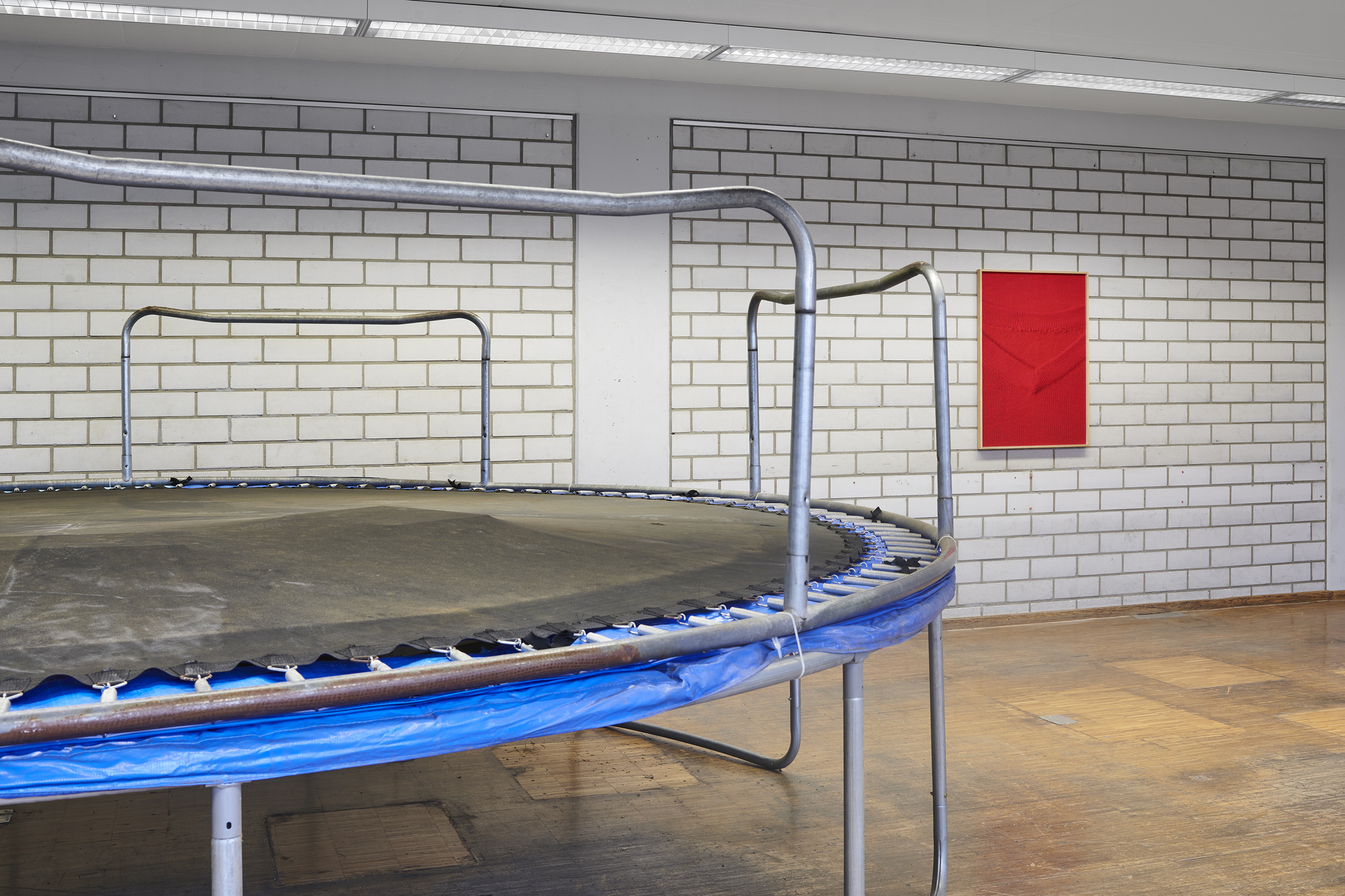
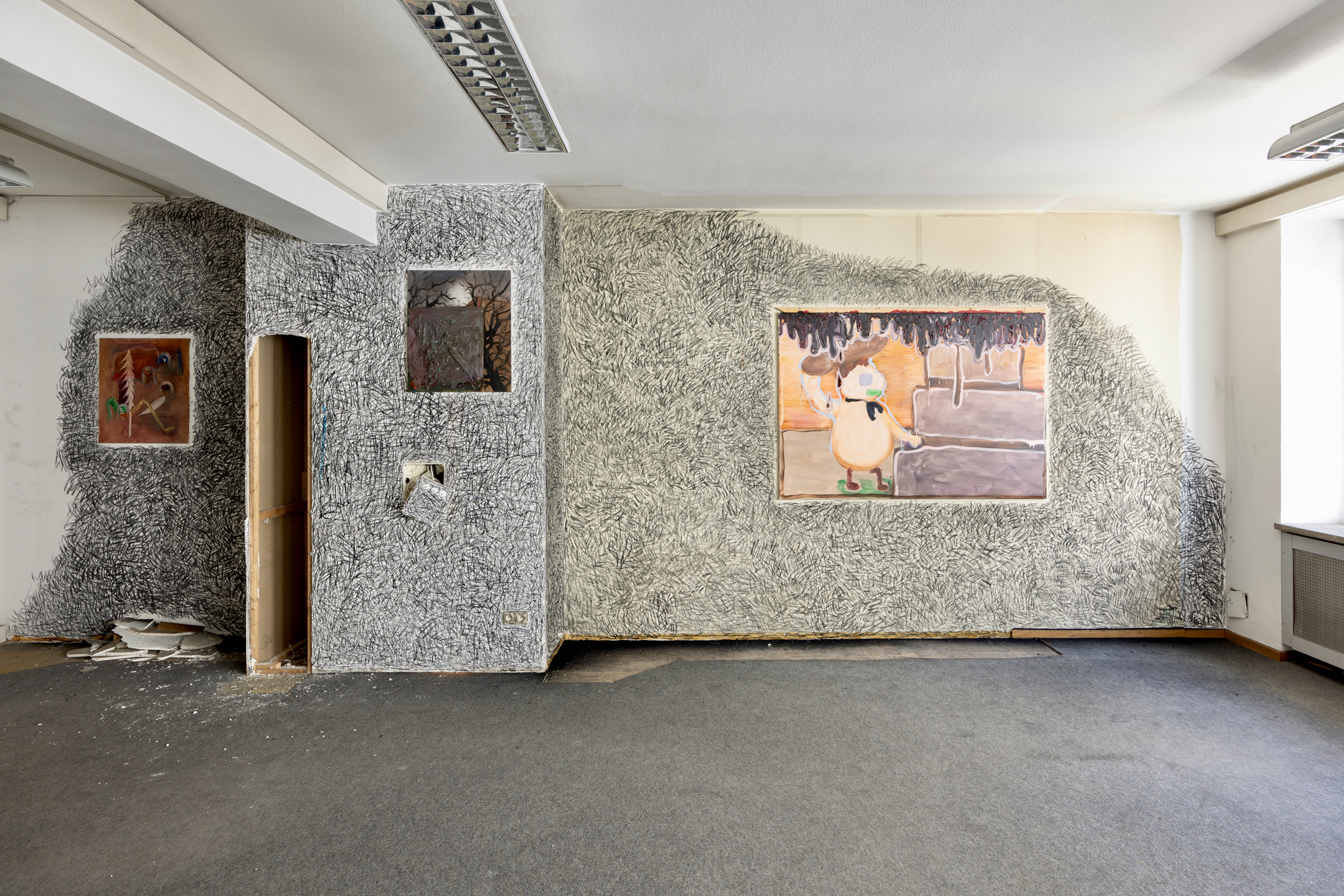
Hêlîn Alas, Carrying the Earth to the Sky, 2024, installation view with “Up and Up and Up and Up,” 2024, trampolines, cable ties, speakers, sound, cables, 490 x 165 cm and “Still Faced,” 2024
framed photo print (part of a series) 100 x 70 cm. Photo: Produktion Pitz
Hêlîn Alas, “Traumhaus junior,” 2024, caramel, 118 x 90 x 8 cm. Photo: Produktion Pitz
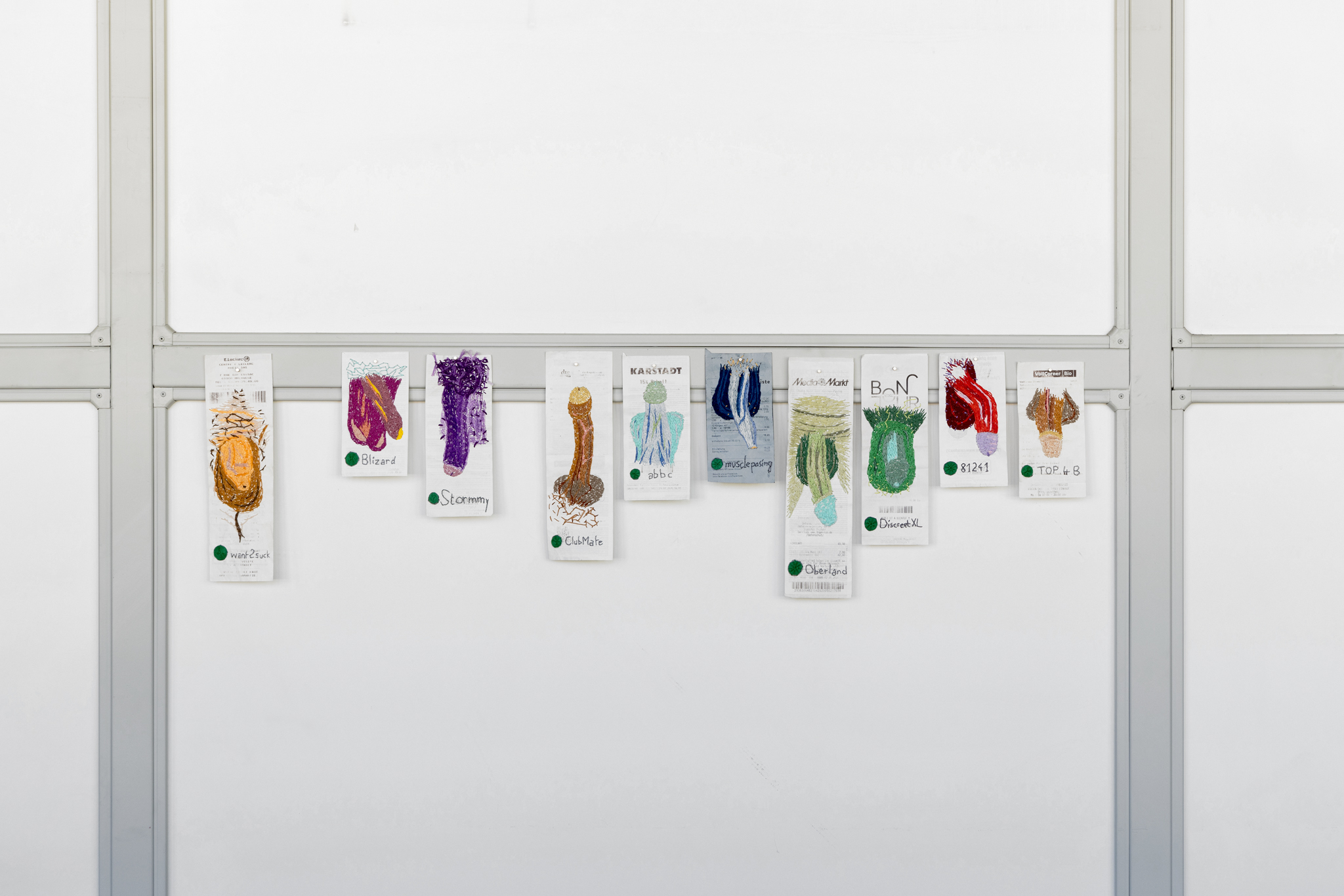
Pierre-Yves Delannoy, “embroideries on cashier’s ticket,” 2019-24, cotton yarns, thermo paper, dimensions variable (8 x 16 cm (X10)). Photo: Thomas Splett
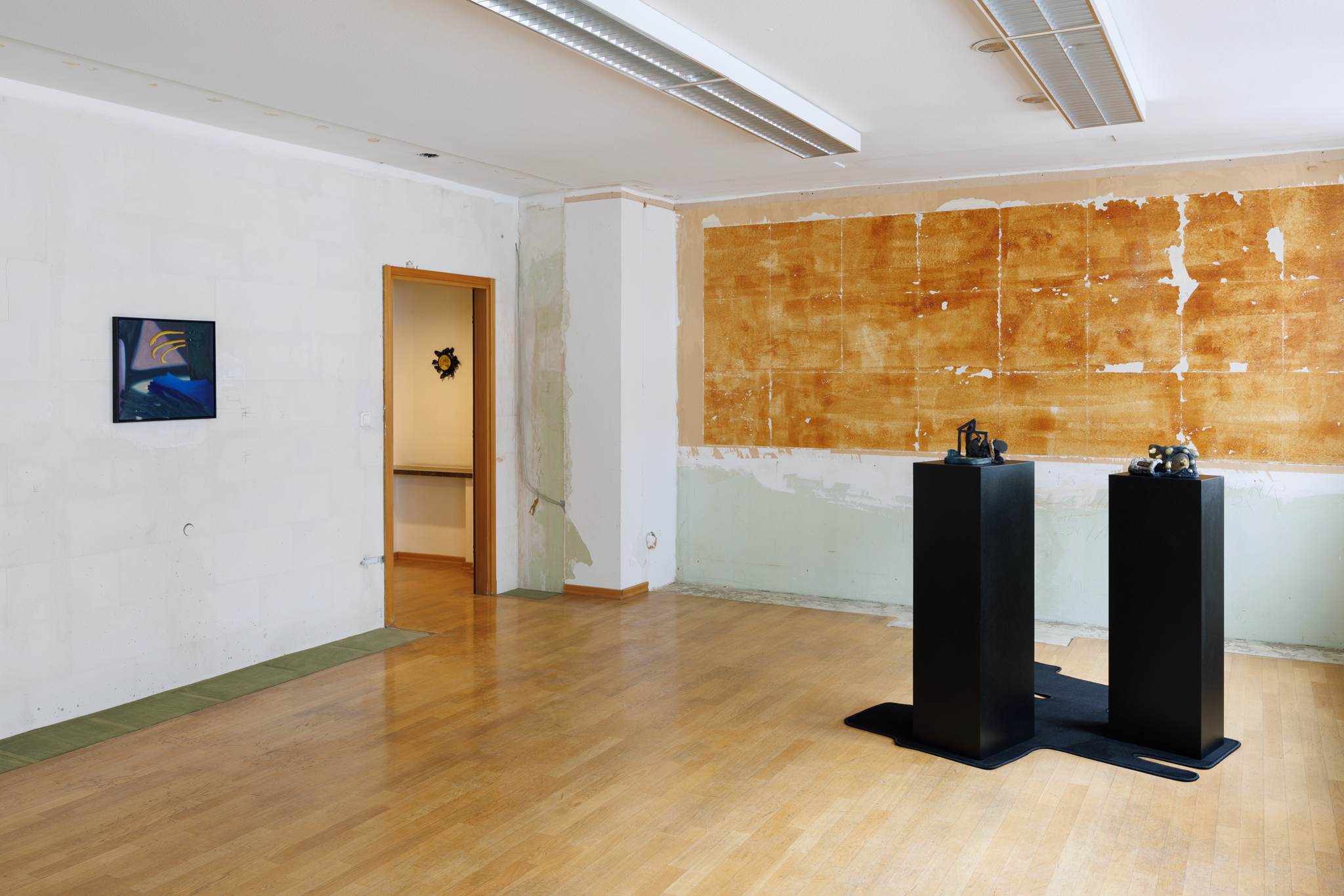
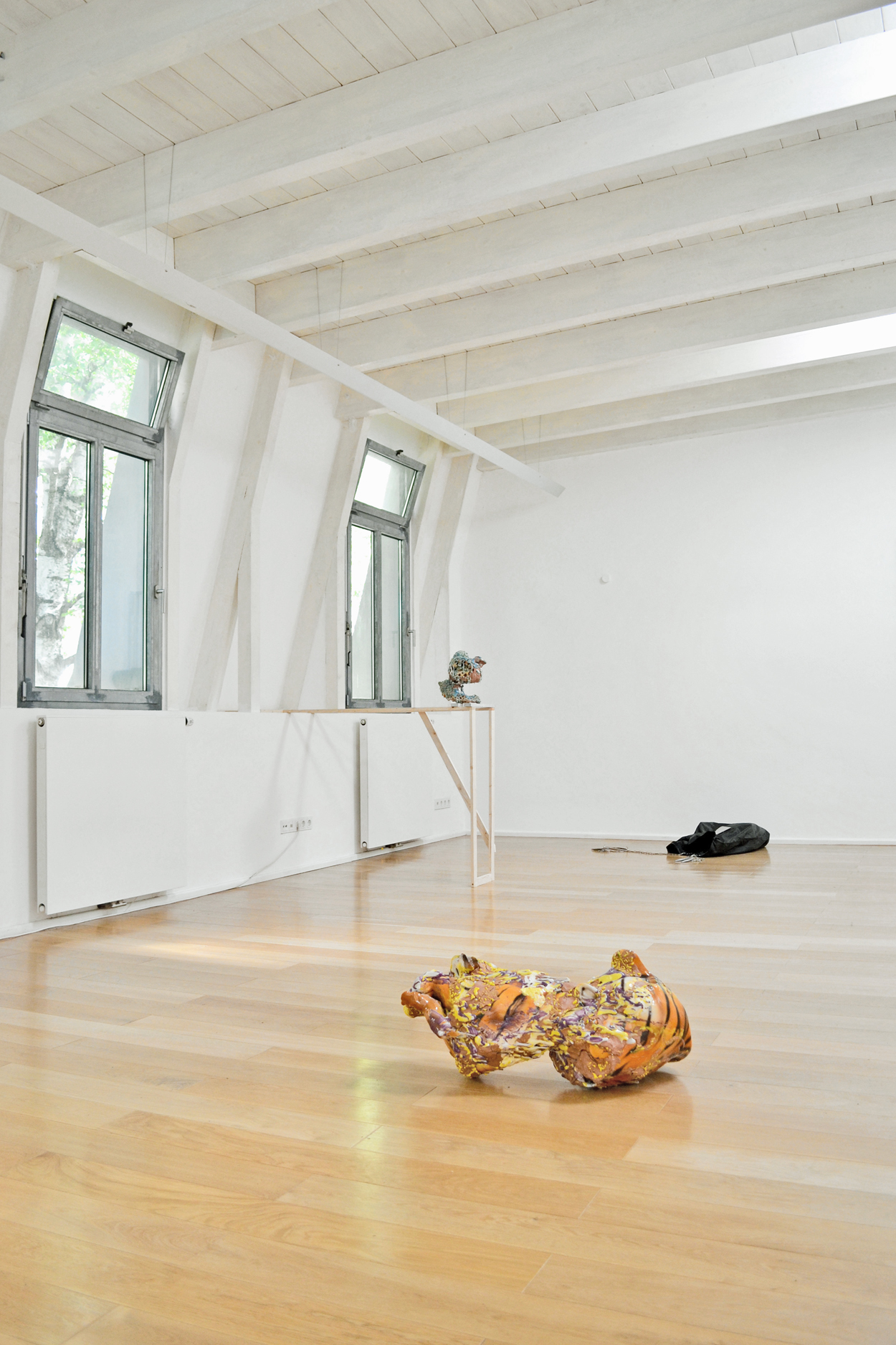
Veronika Hilger, Carrying the Earth to the Sky, 2024, installation view. Photo: Thomas Splett
Veronika Hilger, Untitled, 2024, ceramic, 27 × 24 × 3 cm. Photo: Thomas Splett
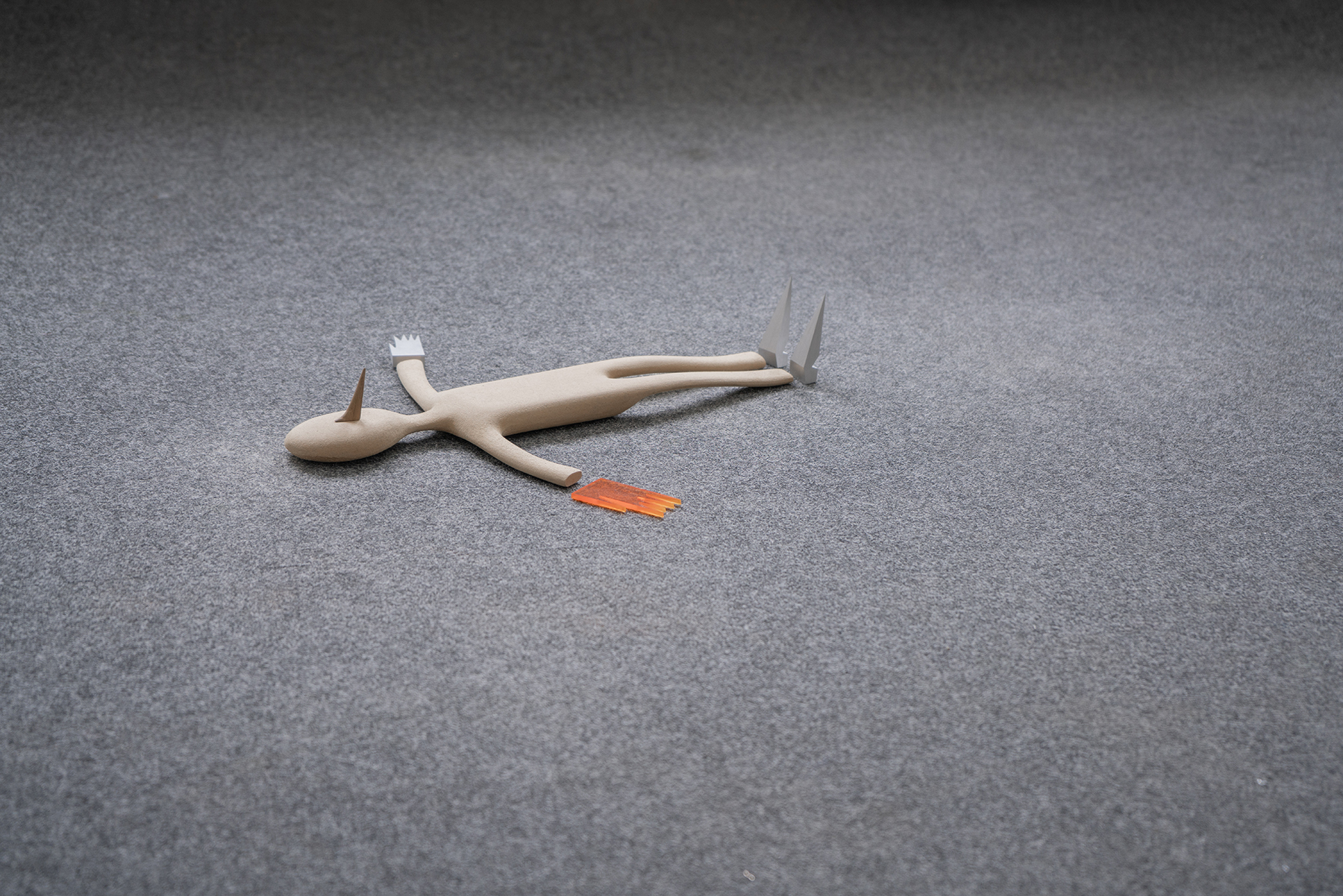
Lukas Hoffmann, “Figure,” 2020, MDF, oak, aluminum, acrylic glass, 50 x 45 x 8 cm. Photo: Lukas Hoffmann
Lukas Hoffmann, “Castle,” 2024, Spraypaint, plywood, screws, MDF dyed through, 100 x 100 x 200 cm. Photo: Lukas Hoffmann
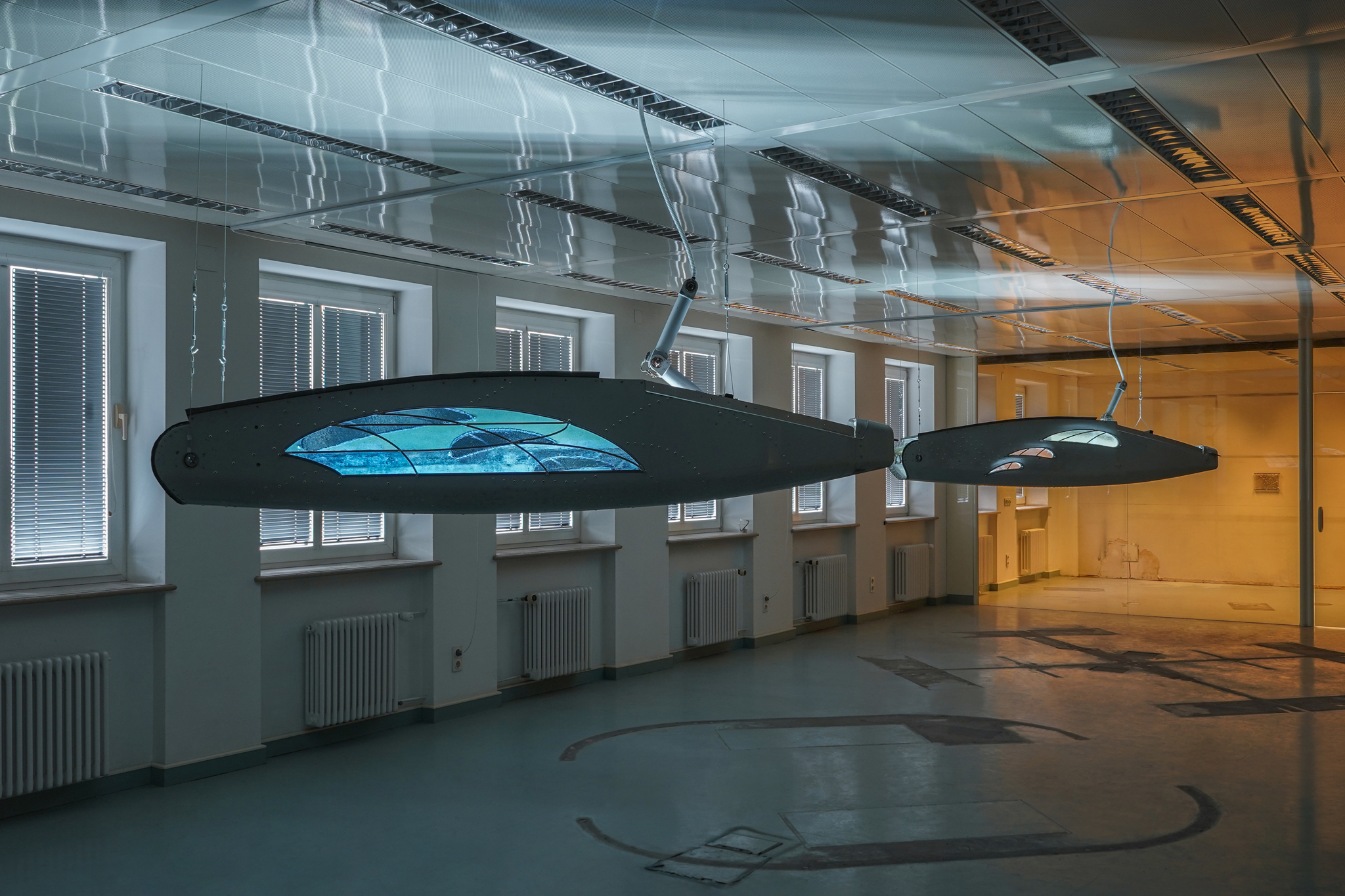
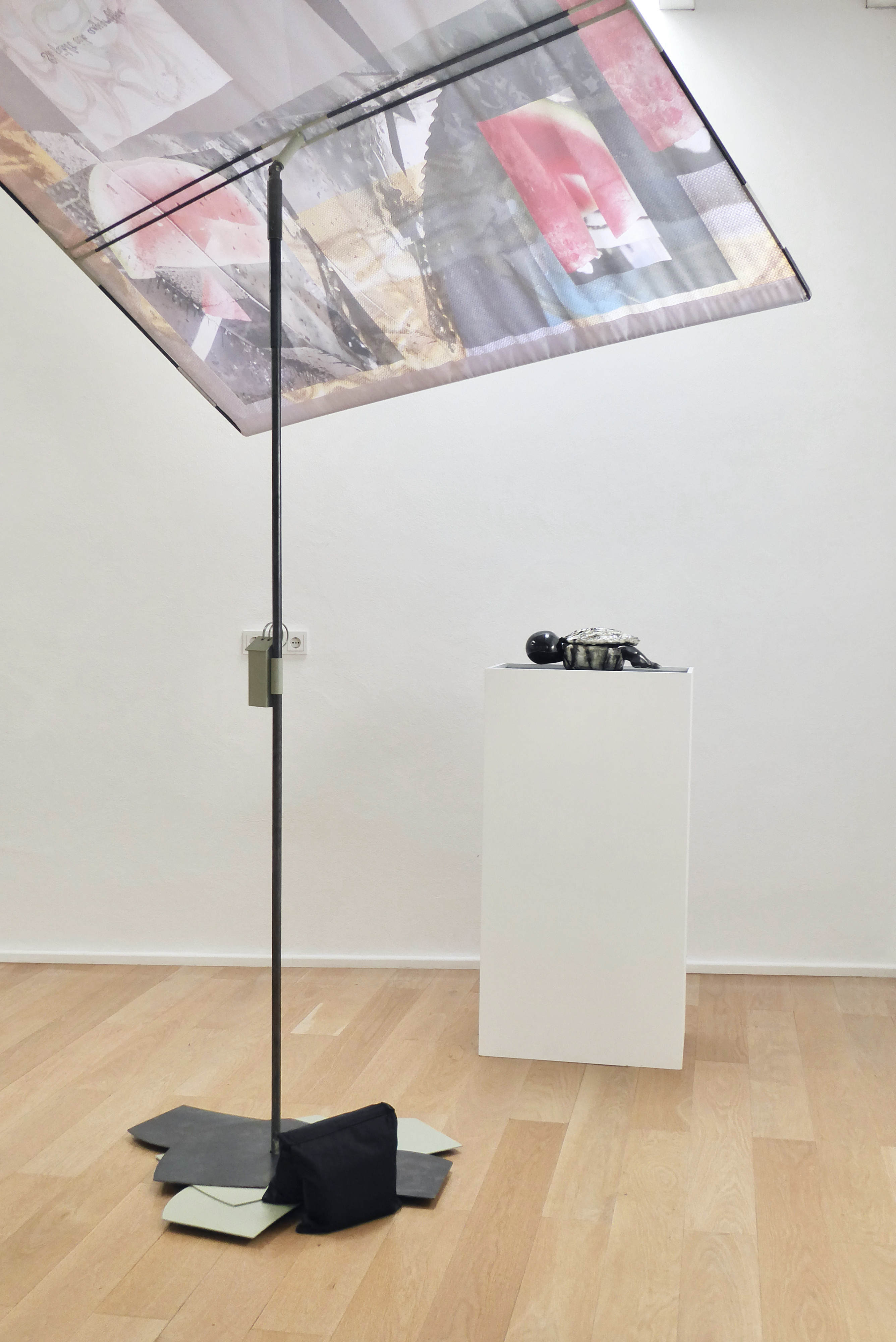
Ju Young Kim, “Almost like Whale Watching,” 2024, a pair of aircraft fairings, stained glass, rivets, LED, 240 x 38 x 46 cm (X2). Photo: Younsik Kim
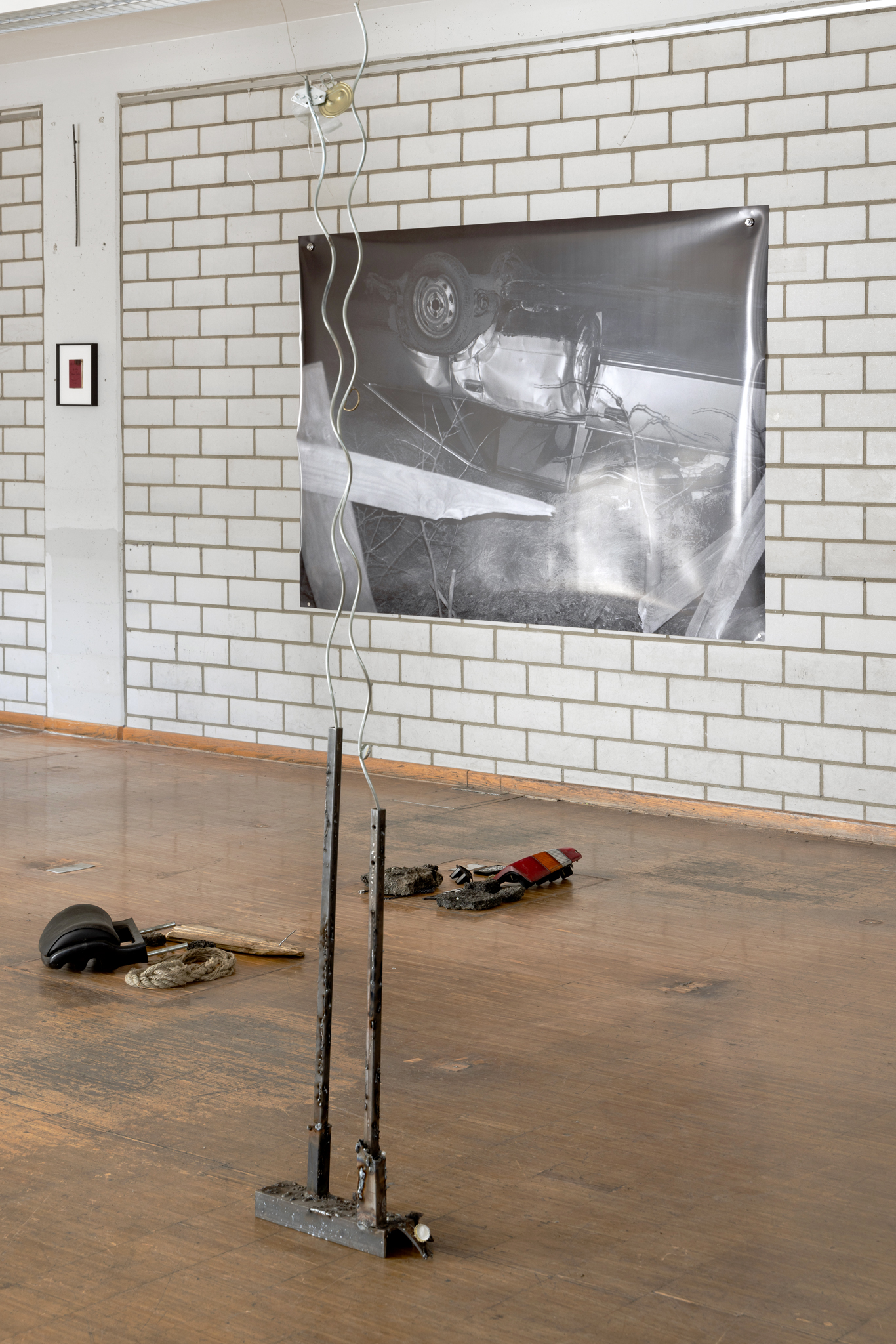
Anna McCarthy, Carrying the Earth to the Sky, 2024, installation view with “Car Crash b/w,” 2001, analogue photograph 230 x 160. Photo: Thomas Splett 
Anna McCarthy, “Car crash installation,” 2024, mixed media, dimensions variable. Photo: Thomas Splett
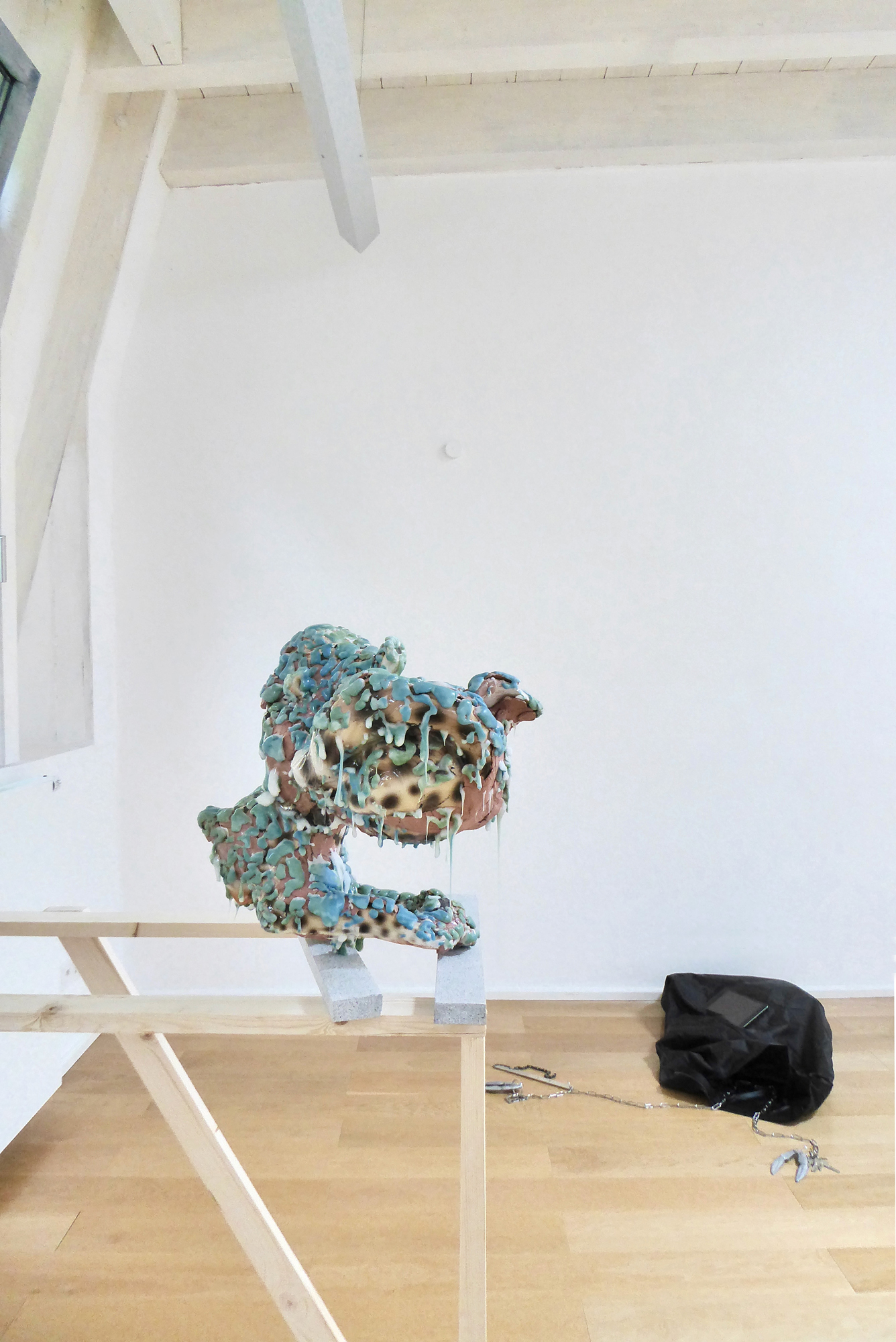
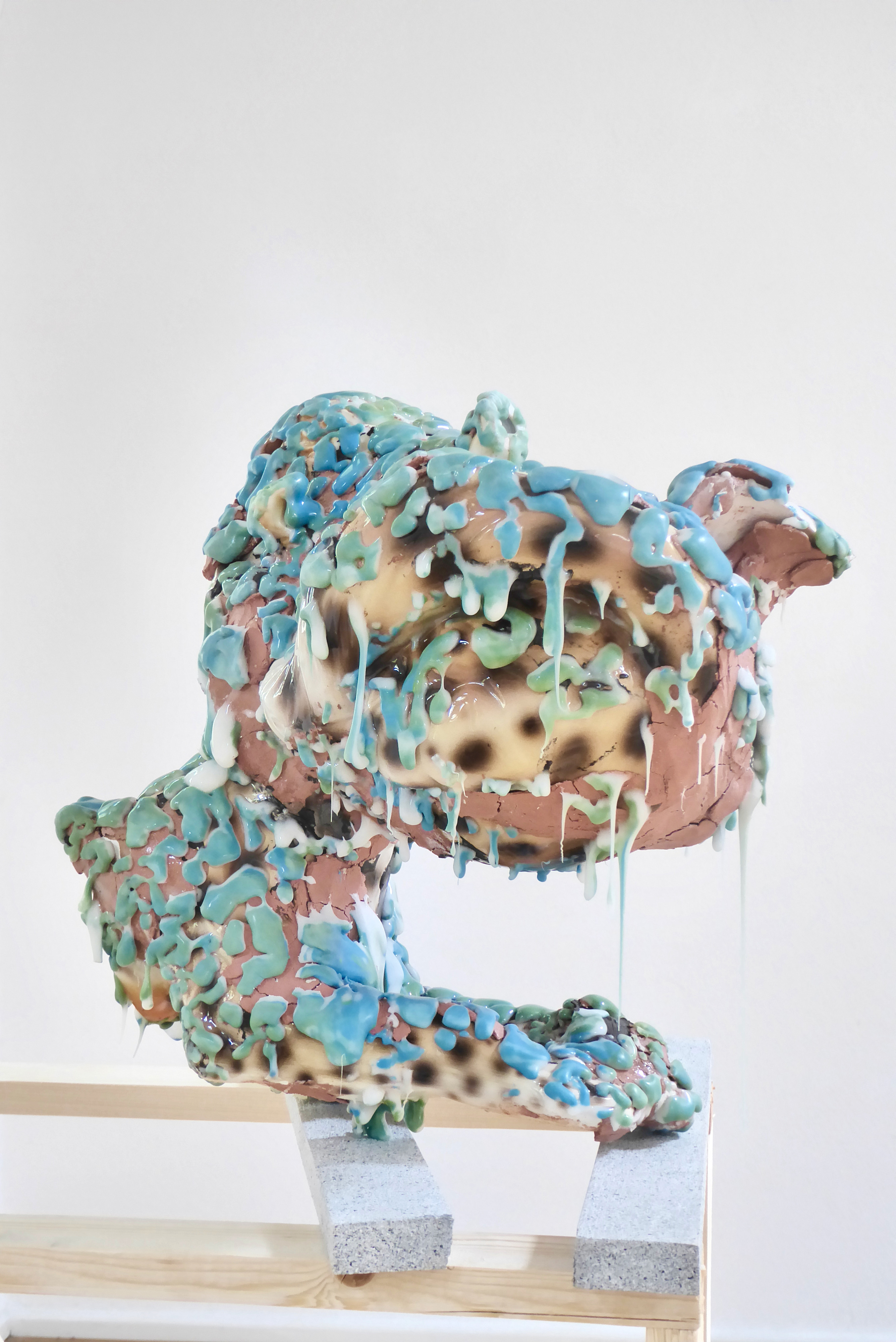
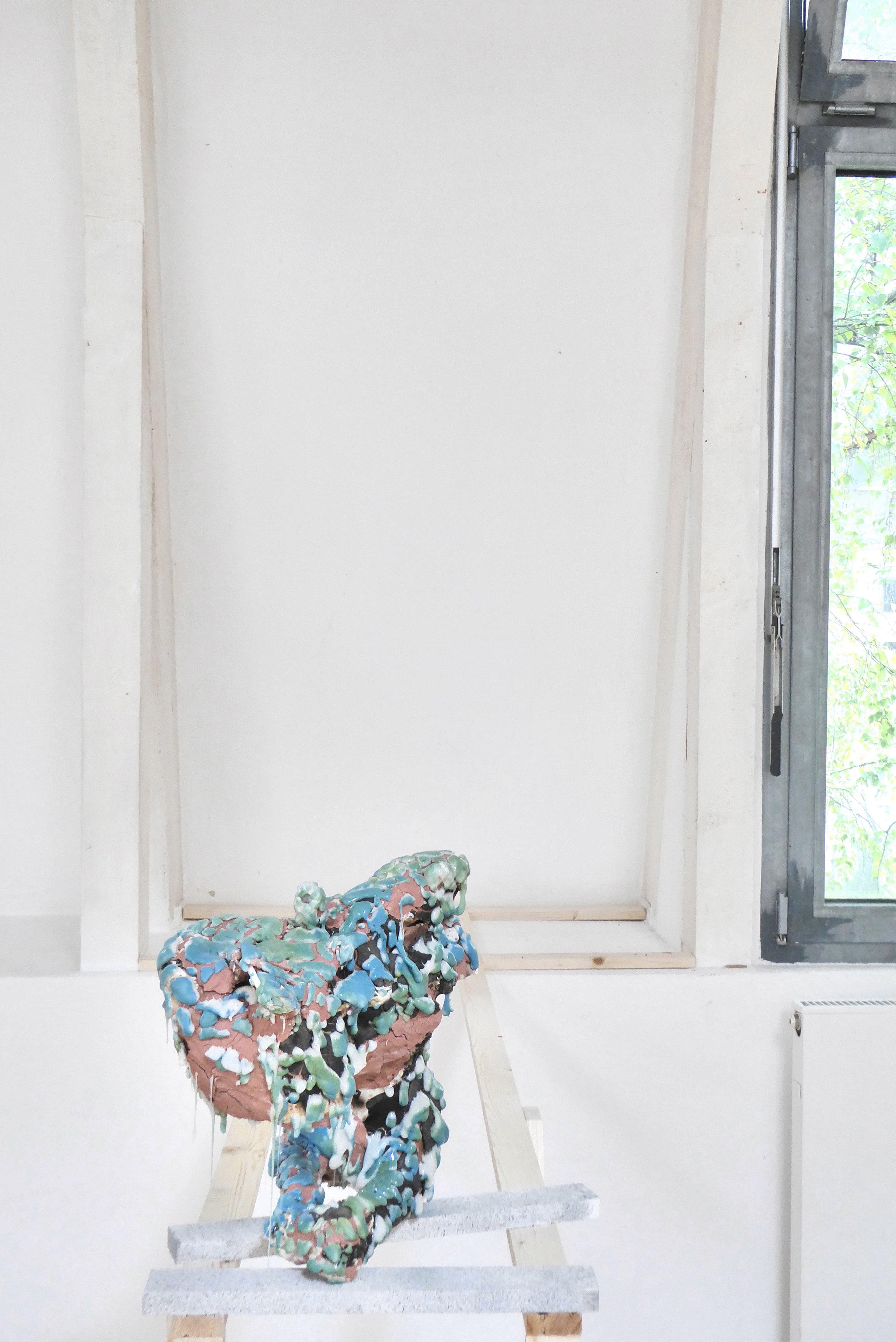
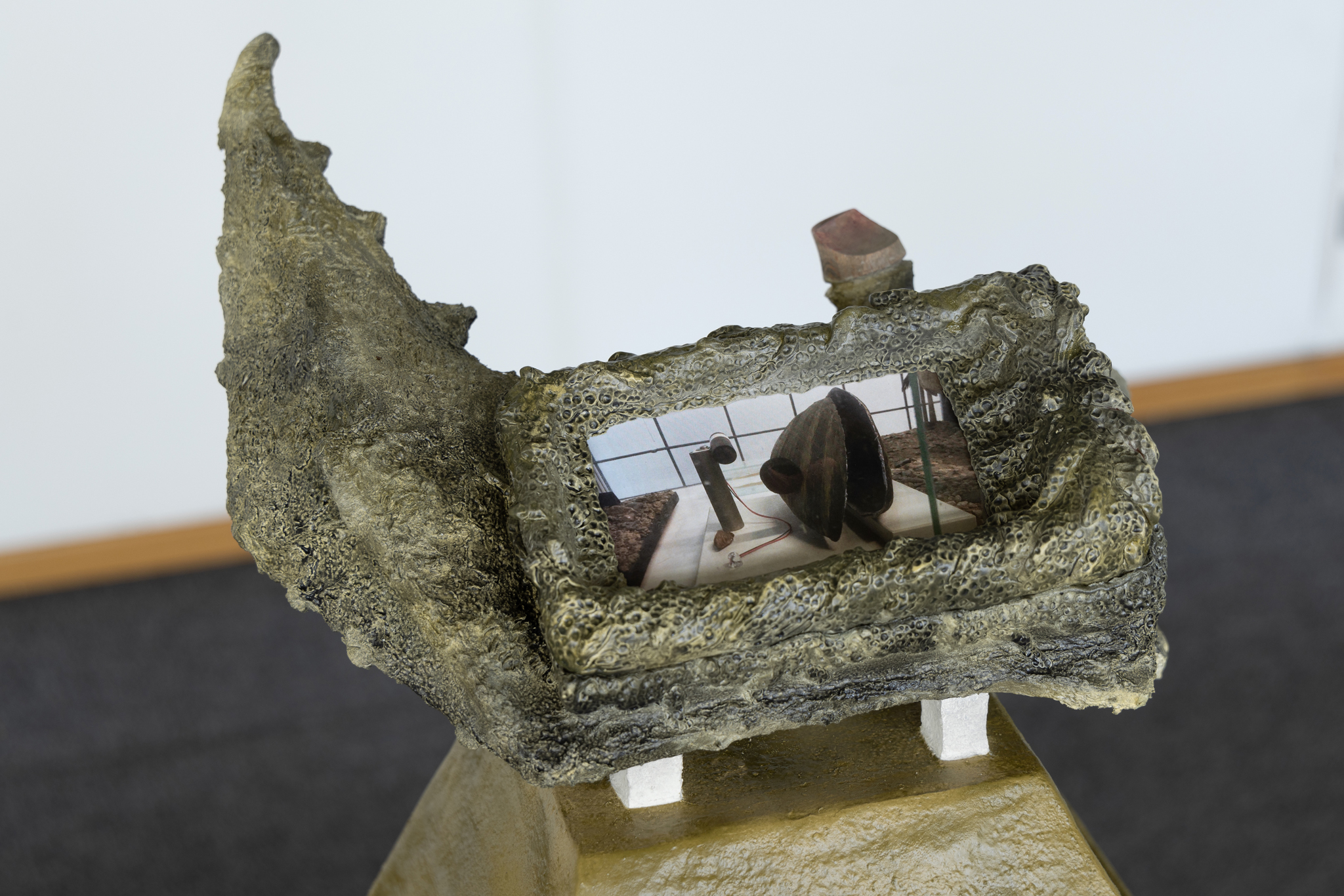
Jonathan Penca, “Synanthropop,” 2024, paper-maché, plaster, polymer clay, resin, cardboard, acrylic paint, wood, glass, digital print on paper, plinth, 120 x 60 x 60 cm. Photo: Thomas Splett
Jonathan Penca, “Mitten Crack,” 2024, paper-maché, plaster, polymer clay, resin, wooden bird whistle, lipstick, cardboard, acrylic paint, digital print on paper, plinth 120 x 60 x 60 cm. Photo: Thomas Splett
Curtis Talwst Santiago, “History of Touch” 2024, installation view detail. Photo: Thomas Splett
Curtis Talwst Santiago, “History of Touch” 2024, installation view. Photo: Thomas Splett
Valio Tchenkov, Carrying the Earth to the Sky, 2024, installation view. Photo: Thomas Splett
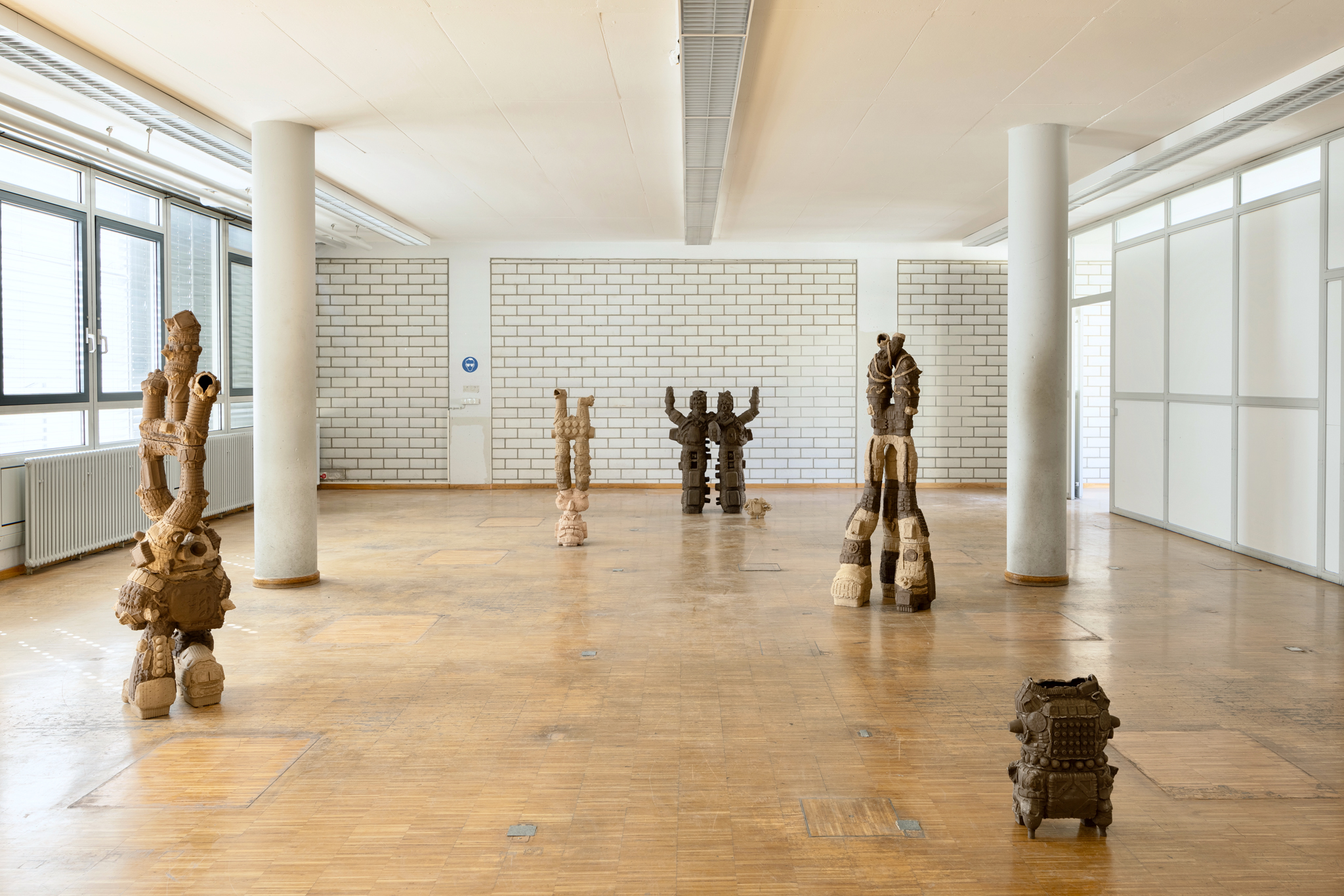
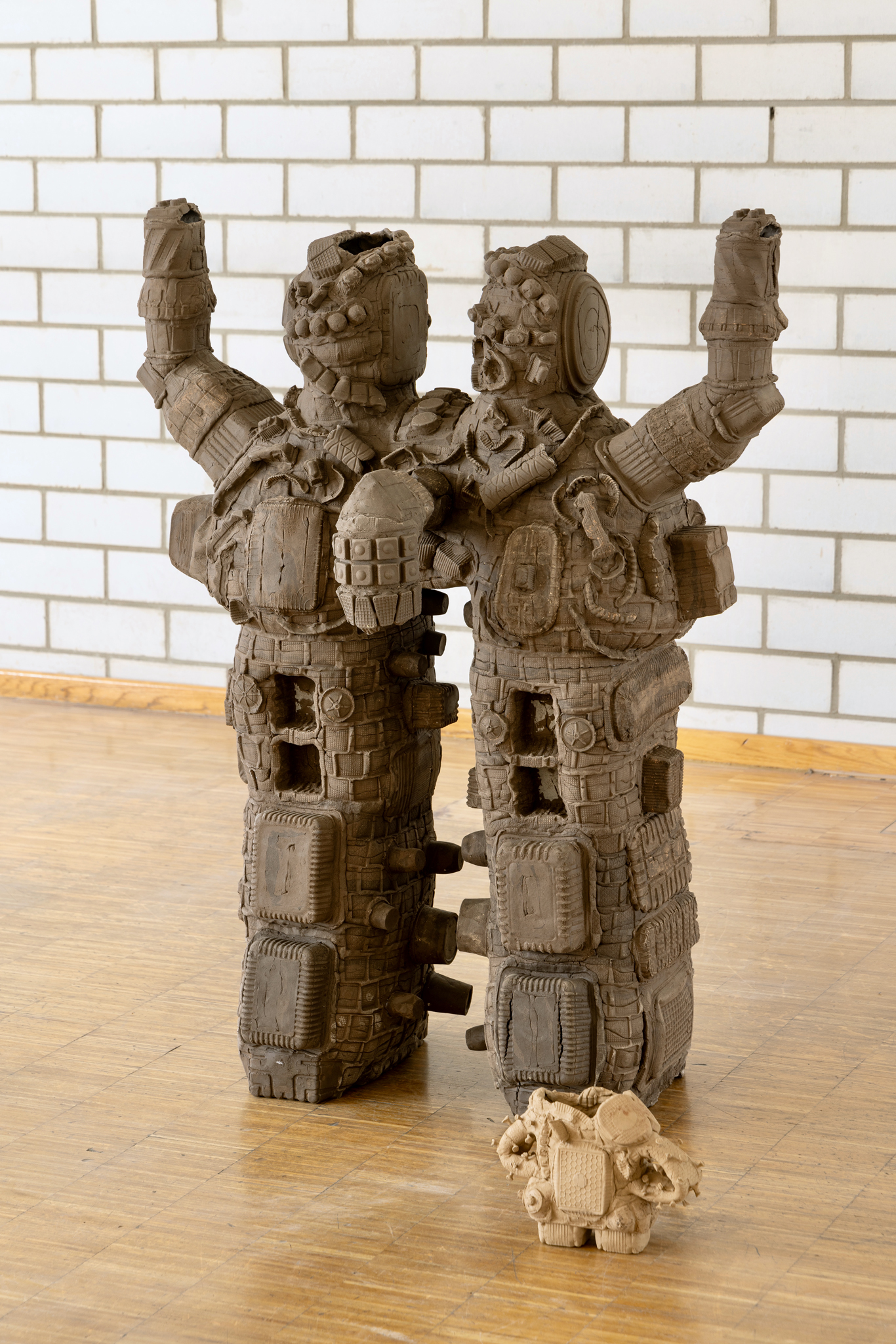
Ayaka Terajima, Carrying the Earth to the Sky, 2024, installation view. Photo: Thomas Splett
Ayaka Terajima, “Long legs doki,” 2023, Unglazed fired ceramic by recycled clay, 60 x 100 x 130 cm. Photo: Thomas Splett
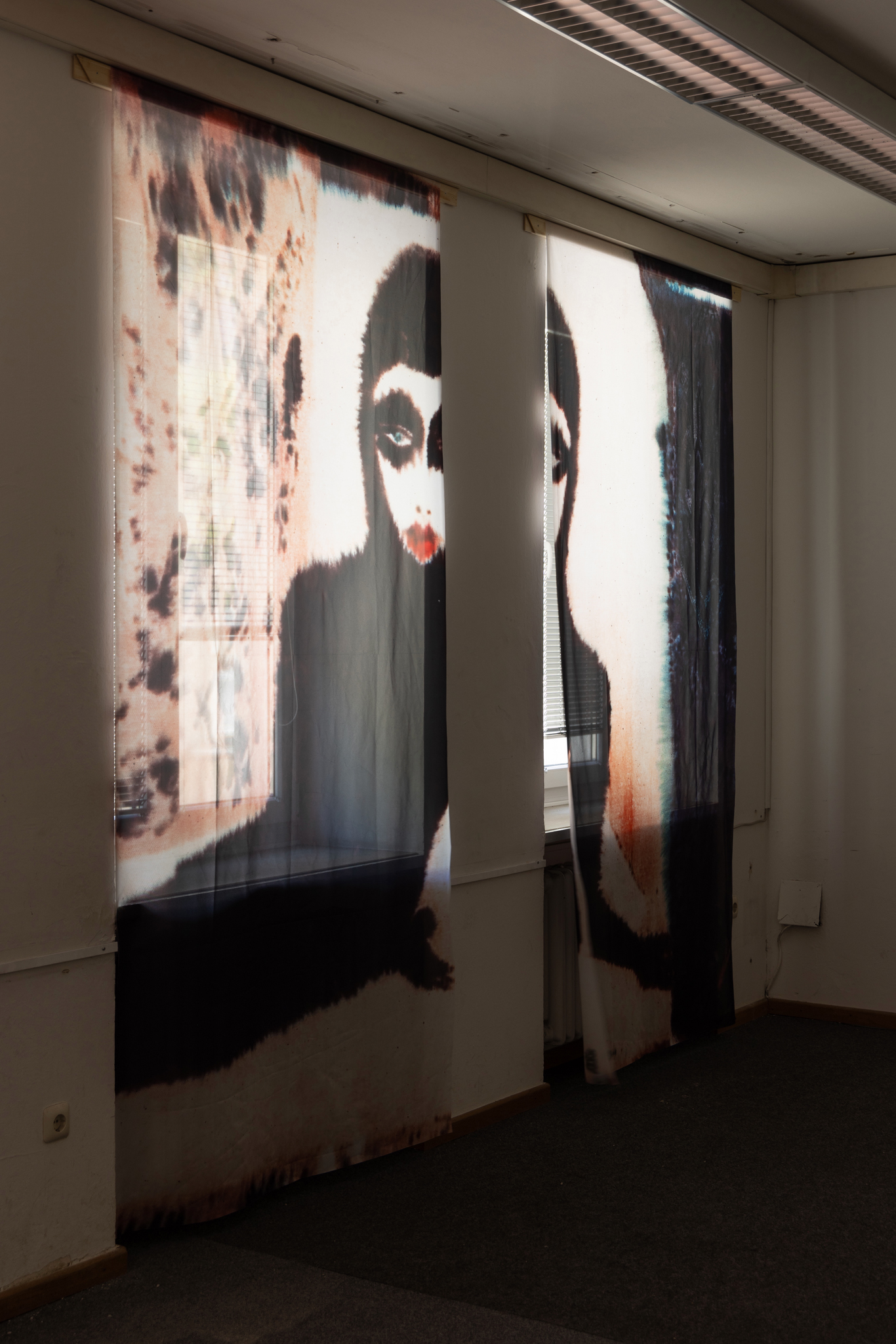
Gülbin Ünlü, “Karanlik isik,” 2024, wood, printed fabric, dimensions variable (site specific installation). Photo: Thomas Splett
Gülbin Ünlü, “Karanlik isik,” 2024, wood, printed fabric, dimensions variable (site specific installation) detail. Photo: Thomas Splett
Paul Valentin, “Kasside,” 2024,  site specific video installation. Photo: Thomas Splett
Max Weisthoff, “perpetuator,” 2024, sculptural sound installation, 5 objects, cable, dimensions variable (site specific installation). Photo: Thomas Splett
Max Weisthoff, “out of flesh,” 2024, mixed media installation, 2 channel video, x objects, dimensions variable (site specific installation). Photo: Thomas Splett

“Carrying the Earth to the Sky” will present works by 13 artists who are currently active in the contemporary art scene in Munich. The artists were selected in a two-stage process. First each of the 37 participants of VARIOUS OTHERS nominated one artist currently living in Munich. From this group, an international jury consisting of four institutional curators selected 13 artists who will show their work as part of the VARIOUS OTHERS program in September. The jury acknowledged that the quality of the applications received made their task both exciting and challenging. The final selection of multi-generational artists reflects the desire to see art beyond fixed categories and clichés and to honour distinctive works.

The exhibition’s curator, Magdalena Wisniowska, has meticulously chosen the works in collaboration with the artists. These will be presented together in an overarching curatorial concept at Schillerstraße 38 under the title “Carrying the Earth to the Sky”.

“The earth is something human, something we keep under our feet. The sky high above is without air, where no living thing can breathe. Moving away from one to the other means letting go of the earth and constructions that belong to it – actions, bodies, objects, sensations and desires – until only the elements, disconnected molecules, remain.”

We would like to express our gratitude to all supporters of the exhibition, particularly the owners of the property at Schillerstraße 38, the Cultural Department of the City of Munich, the Edith-Haberland-Wagner Foundation and Serviceplan Group for their generous support.

Jury:
Rosa Ferré (TBA21, Madrid)
Luis Silva (Kunsthalle Lissabon)
Nicola Trezzi (CCA, Tel Aviv)
Vivien Trommer (K21, Düsseldorf)
From Animal to Mineral

Judith Adelmann, Rachel Fäth, Sophia Mainka, Hannah Mitterwallner, Jonathan Penca, Maria VMier

15.12. 2023 – 18.02.2024

Lothringer Halle, Lothringer Str. 13, 81667 München

Filmstill_Mainka_HabitLoss(1)


“Animals” are wolves mainly, rats and the wasp. “Mineral” is everything imperceptible: elements, particles and molecules. To go from animal to mineral is to experience becoming, to step across a threshold and change. 

I began my reading of A Thousand Plateaus, specifically the chapter “1730: Becoming-Intense, Becoming-Animal, Becoming- Imperceptible …” 1 during the corona pandemic, when environmental concerns were at the forefront of almost every media discussion. Defining humanity’s role in nature seemed like an important task and Deleuze and Guattari’s work was useful in addressing the too easy distinction between nature and culture. I liked how Deleuze and Guattari saw the dominance of our species over others as a philosophical problem of autonomy where Man as a thinking being is subject only to the laws of his own construction. For them, the capacity for conscious thought conferred upon Man a dignity denied to other creatures, making their voices unheard. 

Whereas, in A Thousand Plateaus Deleuze and Guattari present nature as an endless variability, the “whole thousand-voiced multiple” of Difference and Repetition 2. Here, nature is a multi-voiced body, where the voices constituting this body resound in each other in a “clamor of Being.” In this din, my voice is one of many and many voices resonate in mine 3. For Deleuze and Guattari, to change the human collective relation, not just to animals, but to earth itself, would demand that we stop hearing just our own voice and become aware of the noise of others. This is the experience of becoming-animal, becoming-imperceptible. It is to shed Man’s mantle and learn how to listen, becoming the voice of many. 

Since 2021 I have realised a series of exhibitions at various locations in responses to different aspects of this chapter of A Thousand Plateaus, whether to its ideas of nature, technology or memory. This exhibition at Lothringer 13 Halle confronts the idea of becoming, specifically in our relation to nature, more directly. In different ways all the artists participating in this exhibition share these concerns, many acutely aware of working in the era of the Anthropocene, where the human impact on the planet can no longer be denied.

To their cluster of voices I add my own, belonging to the writer. The texts I have written over the past few years in response to Deleuze and Guattari’s chapter on becoming are on display throughout the room. The texts resonate with the artwork, and the art inhabits the text. The exhibition is an experiment in the construction of a multi-voiced population, a pack of wolves, a people of rats. 

Magdalena Wisniowska, November 2023

1) Deleuze, Gilles and Guattari, Félix, A Thousand Plateaus, trans. Brian Massumi, (Minneapolis, London: University of Minesota Press, 2005).
2) Deleuze, Gilles, Difference and Repetition, trans. Paul Patton (New York: Columbia University Press, 1994), 304.
3) Ibid.

We breathe the remains of everything that was

Zuza Piekoszewska, Natalia Karczewska, Magda Starska, Grzegorz Bożek, Paweł Marcinek und Przemysław Piniak

(curated by Łęctwo)

31.07 – 19.08.2022

Lothringer 13 Studio, Lothringer Straße 13, 81667 Munich

Opening: Sunday 31st July, 3 – 8 pm

Guest Speaker: Dr. Sebastian Truskolaski, 6 pm

Zuza Piekoszewska, Future Traveller, 2020, metal, bioplastic and acrylic

‘We breathe the remains of everything that was’ is the first of the exhibition series ‘Re-collection’ organised by GiG Munich at Lothringer 13 Studio from July to December 2022. 

GiG Munich is currently operating nomadically as GiG air, presenting work at different locations both physical and virtual. For 2022, Lothringer 13 Halle  invited GiG Munich to produce the ‘Re-collection’ exhibition series at the Lothringer 13 Studio, a continuation of the previous series ‘Thinking Nature’ that took place at GiG Munich in 2021, For this first exhibition at a new location, GiG Munich collaborates with the hybrid space Łęctwo run by Przemek Sowiński, to present the work of Zuza Piekoszewska, Natalia Karczewska, Magda Starska, Grzegorz Bożek, Paweł Marcinek and Przemysław Piniak.

If GiG Munich’s focus has always been the more abstract and theoretical, Łęctwo’s interests tend to lie in the immediate and physical, as well as the intimate. Łęctwo’s programme of contemporary art always has had this utopian element, art as a deeply personal drive to transform the surrounding reality, enacting real change in our cognitive lives. In their exhibition together, GiG Munich and Łęctwo look together at the idea of cultural memory, in relation to nature, biology and human.


“Wir atmen die Überreste von allem, was war” ist der erste Teil der Ausstellungsreihe “Re-collection”, die von GiG Munich im Lothringer 13 Studio von Juli bis Dezember 2022 organisiert wird. 

 GiG Munich ist derzeit als GiG air nomadisch aktiv und präsentiert Arbeiten an verschiedenen Orten, sowohl physisch als auch virtuell. Für 2022 hat die Lothringer 13 Halle GiG Munich  eingeladen, die Ausstellungsreihe “Re-collection” im Lothringer 13 Studio zu produzieren in Fortsetzung der Reihe “Thinking Nature”, die 2021 bei GiG Munich stattfand. Für diese erste Ausstellung an einem neuen Ort kooperiert GiG Munich mit Łęctwo von Przemek Sowiński und zeigt Arbeiten von Zuza Piekoszewska, Natalia Karczewska, Magda Starska, Grzegorz Bożek, Paweł Marcinek und Przemysław Piniak.

Während sich GiG Munich seit jeher auf das Abstrakte und Theoretische konzentriert, liegt das Interesse von Łęctwo eher im Unmittelbaren und Körperlichen sowie im Intimen. Das Programm von Łęctwo für zeitgenössische Kunst hatte schon immer diesen utopischen Aspekt, da es die Kunst als einen zutiefst persönlichen Antrieb zur Veränderung der uns umgebenden Realität ansieht, der einen echten Wandel in unserem kognitiven Leben bewirkt. In ihrer gemeinsamen Ausstellung befassen sich GiG Munich und Łęctwo mit der Idee des kulturellen Gedächtnisses in Bezug auf die Natur, die Biologie und die menschliche Existenz.


Na każdych kroku trafiamy na rozciągnięte w czasie pozostałości naszej własnej egzystencji. Szczątki i pyły poprzedniego istnienia przenikają nasze płuca, przywołując pamięć tego co robili nasi przodkowie. Pozostawione przez nas rzeczy stają się surowcami nowych procesów, a śmierć  jest tylko epizodem nigdy niekończocęgo się cyklu. W tym wszystkim najbardziej realna wydaje się teraźniejszość, ale czmyże jest skoro ciągle się od nas odsuwa. Każdy nasz oddech wypełnia atmosferę, stając się przeszłością w chwili zaczerpnięcia nowego. Każdy nasz wydech zawiera ułamek przewidywanej przyszłości. Te dwa czasy pozostają w ścisłej relacji. Być może odzyskujemy to, co już dawno zniknęło nam z zasięgu wzroku. Ciągłość rzeczy, w której każda materia, przeszłość i przyszłość przenikają do nas horyzontalnie, nie tylko na poziomie odczuwania metafizycznego, ale realnej zmiany genów, dając nadzieję na zupełnie inną, hybrydyczną formę istnienia.

Przemek Sowiński

At every step, we encounter the remnants our own existence spread out in time. The debris and dust of our previous lives penetrate our lungs, evoking the memory of what our ancestors did. The things left behind by us become the raw materials of new processes, and death is only an episode of a never ending cycle. In all of this, the present seems to be the most real, but what is this present, when it always moves away from us? Each of our breaths fills the atmosphere, becoming the past with every new gulp of air we inhale. Each exhaled breath contains a fraction of the foreseeable future.  These two times remains in close relation.  Perhaps we are recovering what has long since disappeared from our sight. The continuity of things, in which all matter, past and future permeate us horizontally, not only at the level of metaphysical feeling, but of real genetic transformation, giving hope for a completely different, hybrid form of being.

trans. Magdalena Wisniowska

Auf Schritt und Tritt stoßen wir auf die zeitlich gestreckten Überreste unserer eigenen Existenz. Der Schutt und Staub unseres früheren Lebens dringt in unsere Lungen ein und ruft die Erinnerung an das hervor, was unsere Vorfahren getan haben. Die Dinge, die wir zurückgelassen haben, werden zu Rohstoffen für neue Prozesse, und der Tod ist nur eine Episode in einem nie endenden Kreislauf. In all dem scheint die Gegenwart am realsten zu sein, aber wie kann die das sein, wenn sie sich ständig von uns entfernt. Jeder Atemzug, den wir nehmen, füllt die Atmosphäre und wird in dem Moment, in dem wir einen neuen Atemzug nehmen, zur Vergangenheit. Jedes Ausatmen enthält einen Bruchteil der vorhersehbaren Zukunft. Diese beiden Zeiten stehen in engem Zusammenhang. Vielleicht holen wir zurück, was schon lange aus unserem Blickfeld verschwunden ist. Die Kontinuität der Dinge, in der alle Materie, Vergangenheit und Zukunft uns horizontal durchdringen, nicht nur auf der Ebene des metaphysischen Gefühls, sondern der realen genetischen Transformation, die Hoffnung auf eine völlig andere, hybride Form des Daseins gibt.

LOST AND FOUND

Julia Klemm, Justin Lieberman, Lilian Robl, Pat Shoulder, Johanna Strobel

30.07 – 2.09.2021

Lost and Found, 2021, installation view

Lost and Found, 2021, installation view

Lost and Found, 2021, installation view

Lost and Found, 2021, installation view

Lost and Found, 2021, installation view

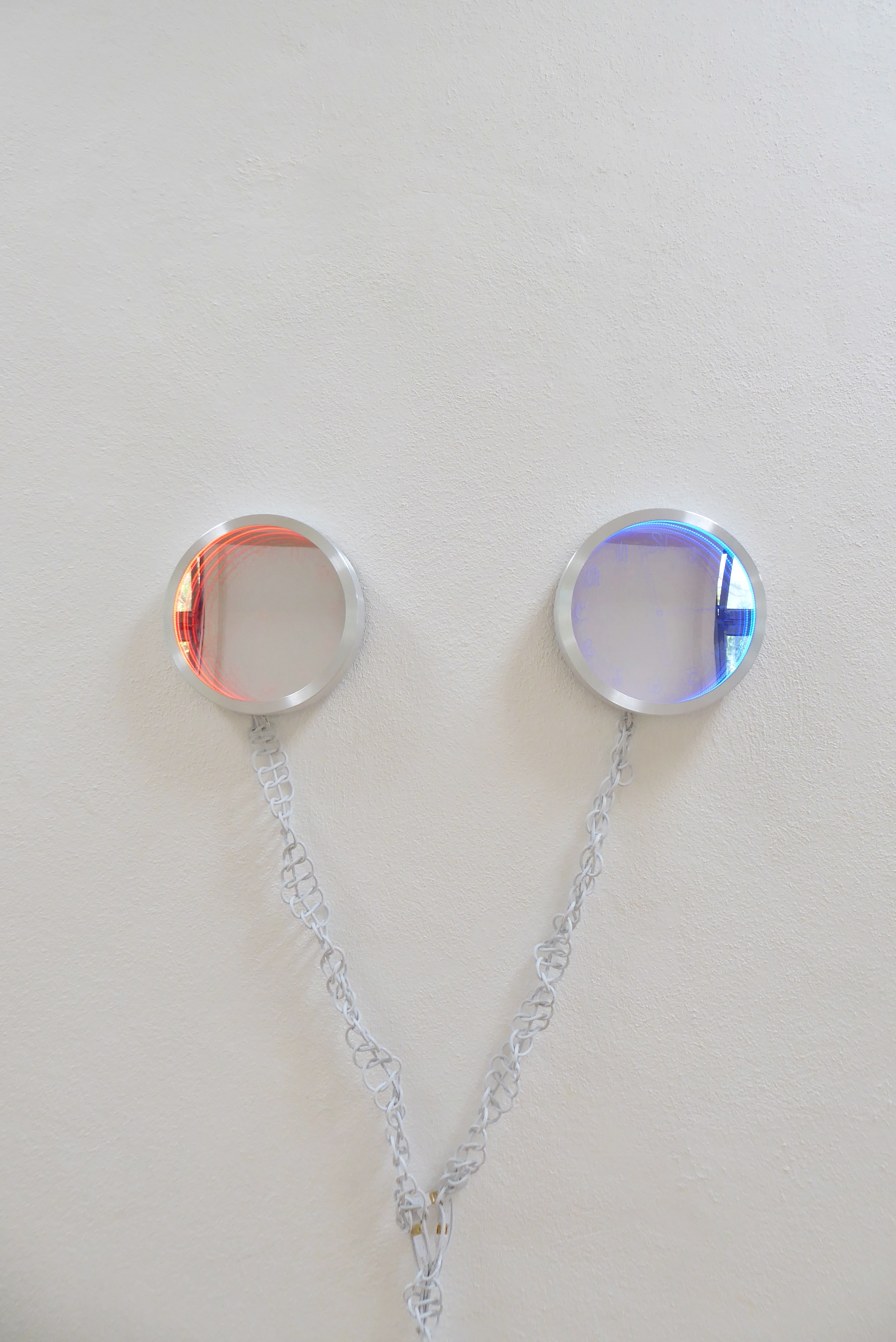
Johanna Strobel, False Friends, 2021, acrylic mirrors, plastic, glass, aluminium, clockworks 

(clockwise and counterclockwise), LEDs, USB extension cords, digital timer, size variable (each approx. 25

x 25 x 5 cm)

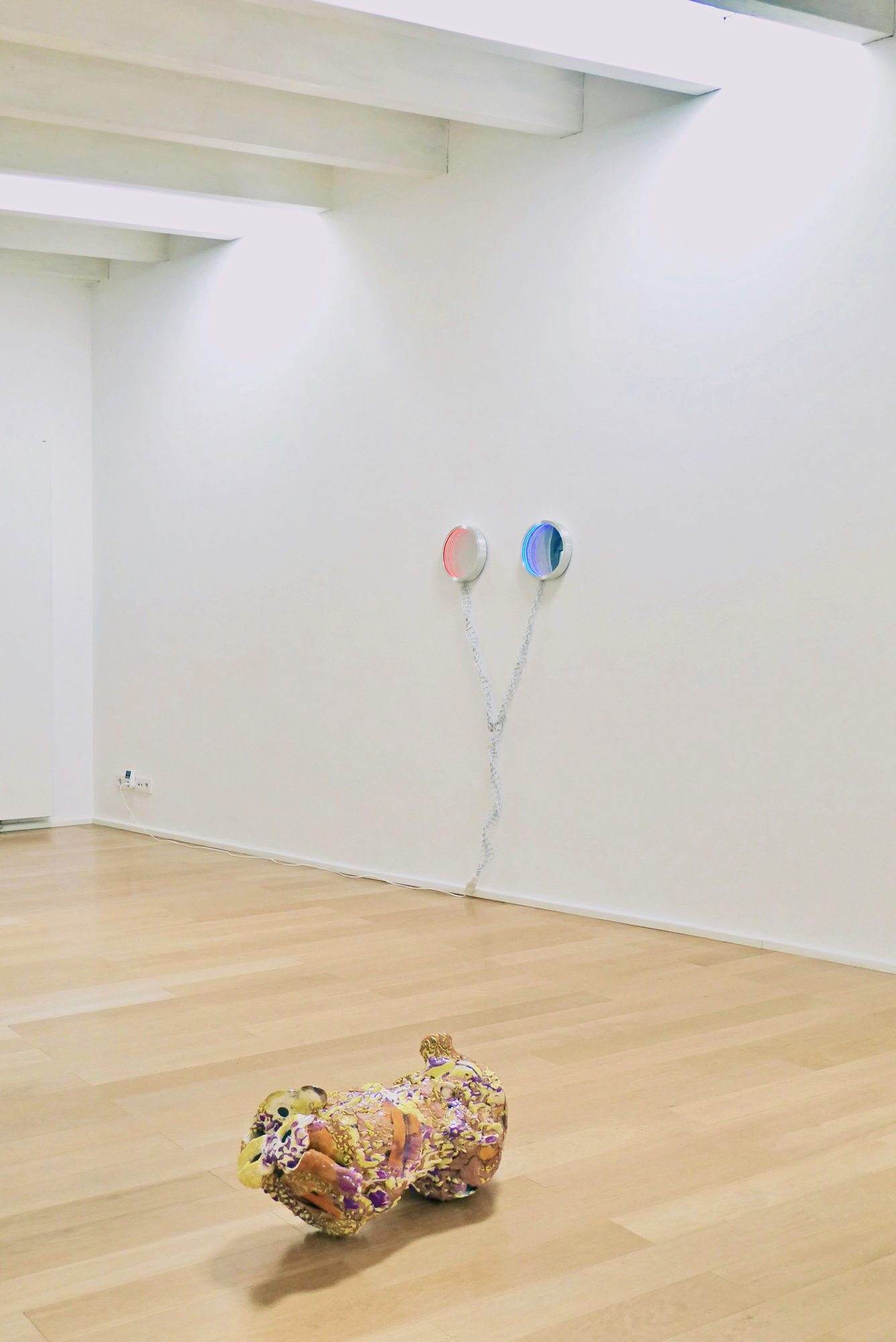
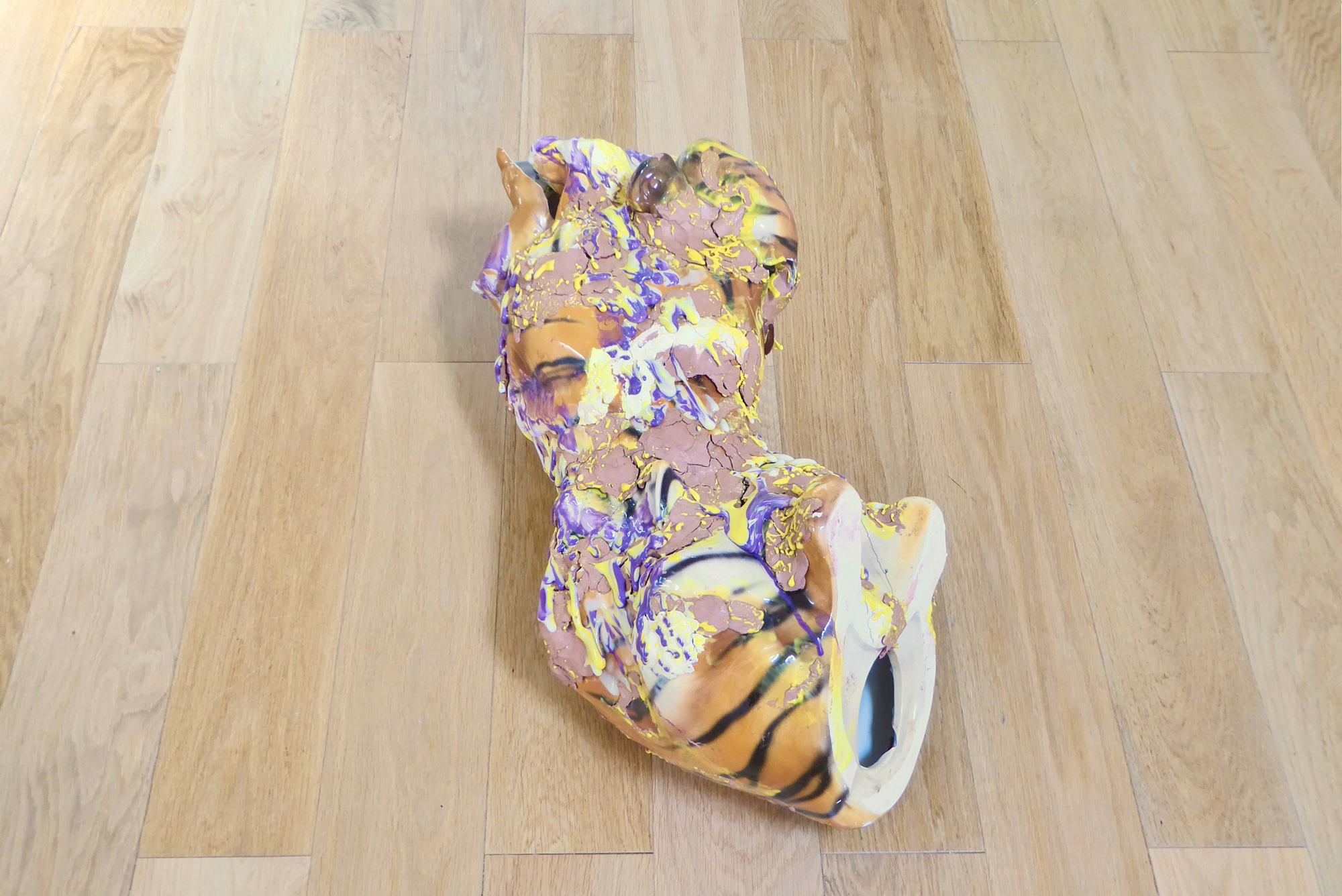
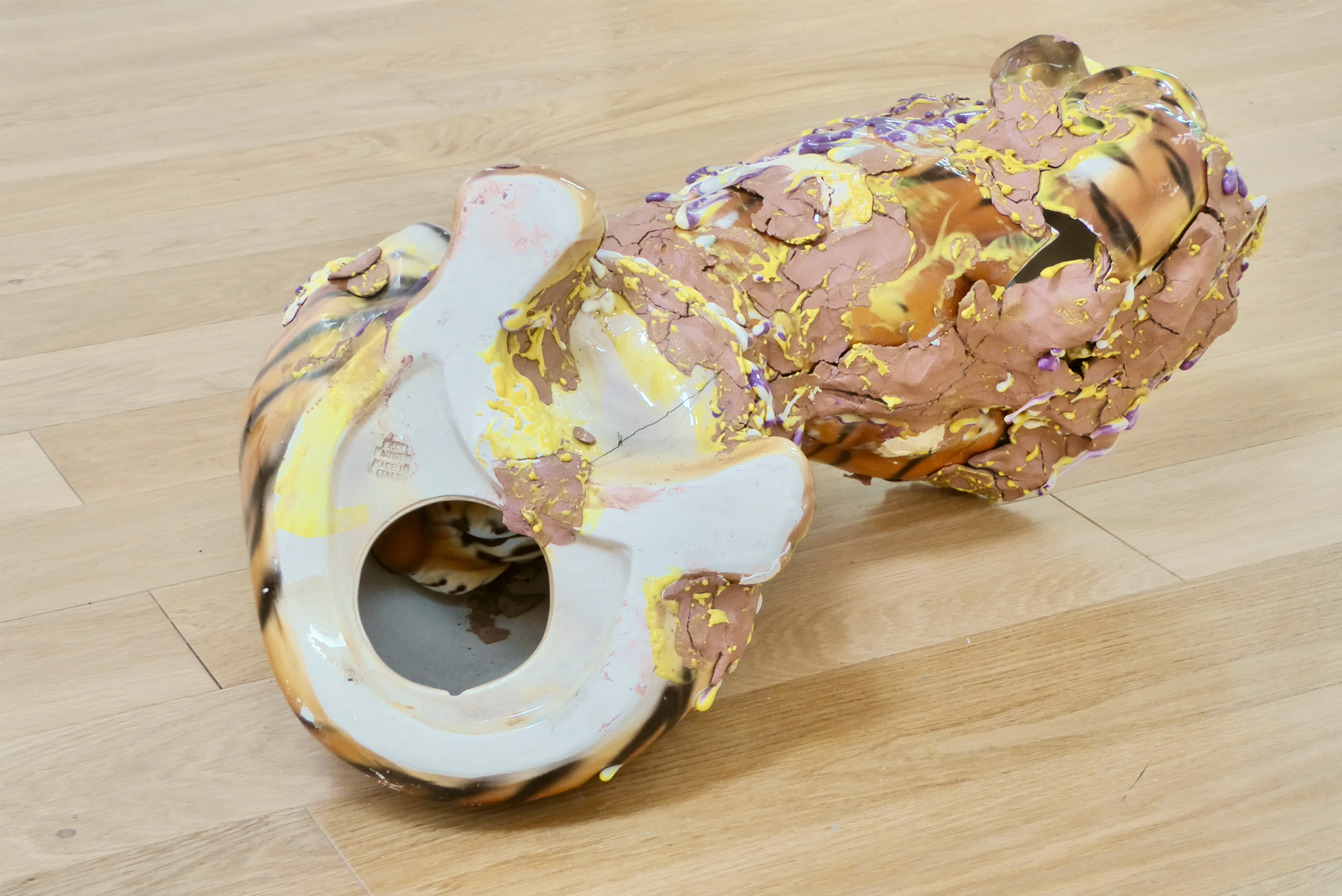
Julia Klemm, untitled, 2020, ceramic, glaze, second-hand ceramic leopards, 76 x 30 x 33 cm

Julia Klemm, untitled, 2020, ceramic, glaze, second-hand ceramic leopards, 76 x 30 x 33 cm

Lost and Found, 2021, installation view,

Julia Klemm, untitled, 2021, ceramic, glaze, second-hand ceramic leopard, 32 x 28 x 33 cm

Julia Klemm, untitled, 2021, ceramic, glaze, second-hand ceramic leopard, 32 x 28 x 33 cm

Julia Klemm, untitled, 2021, ceramic, glaze, second-hand ceramic leopard, 32 x 28 x 33 cm

Pat Shoulder, Sun Umbrella, 2020, Steel, paint, print on textile

Lost and Found, 2021, installation view

Justin Lieberman, Obscure Readability, 2020, ceramic, glass and pedestal with sand, 41 x 22 x 12 cm (Courtesy of Galerie Christine Mayer)

Justin Lieberman, Obscure Readability, 2020, ceramic, glass and pedestal with sand, 41 x 22 x 12 cm (Courtesy of Galerie Christine Mayer)

Lilian Robl,Winning Hearts and Minds, 2016, 5 min 55 sec (plus textile bag and assorted metal objects)

A naturalist, specifically an 18th century one, likes to classify. After an expedition to the jungles of some remote land he – and it is almost always a he – takes out his specimens and begins to compare. This one looks like the second, the third does not, the fourth has some features of the first two, but also some traits seen in the third. He makes up categories and puts labels on boxes, marking the time and place at which the specimens were found. He then takes out a scalpel and cuts them open in order to examine their inner structure. Here are the muscles and these are the breathing organs. This is the skin, and under the microscope he can see the epidermal structure. Visually speaking, the naturalist proceeds mimetically, by finding patterns and organising resemblances. He looks and compares. He judges accordingly. 

There are however animals that escape the naturalist’s grasp. Fictional beings like vampires and werewolves, who live in darkness of our imaginations and spread by infecting others with their poisonous bite – these can be easily dismissed as unworthy of our serious attention. Viruses and pandemics less so. A virus can hardly be deemed alive, reproducing only in the host’s body. Although it mutates, it does not develop to evolve into ever more complex organisms. While it can be placed into groups of similar viruses, it eludes the classificatory system with its orders, families, genera and species.

The exhibition ‘Lost and Found’ has a slightly dystopian, even post-apocalyptic quality, of various objects assembled in haste and then disregarded, leftovers from a Mad-Max film set. A preview exhibition, it consists of artists who will hopefully be part of GiG Munich’s ‘Thinking Nature’ 2022 programme, which examines the relationship between man and nature, as it presents itself in thought. These artists were selected because their practices are not of class and order, but rather of mutation and infection. We see this most in Julia Klemm’s sculpture were kitsch ceramic animals are broken up and then reassembled, set precariously on their rickety plinths. Pat Shoulder’s work is collaborative, a result of an exchange of letters between the two artists during the first lockdown. The order of time is put into question with Johanna Strobel’s installations and  logic disintegrates in Lilian Robl’s videos.  There is a celebration of nature’s structures in the glass turtle shells of Justin Lieberman but again this order is not that of the naturalist. As with the others, it is a viral order of an unnatural kind. 

LOST AND FOUND

30.07 – 2.03.2021

Soft Opening: 29.07.21, 6 – 9 pm

As the previously planned exhibition had to unfortunately be cancelled, GiG Munich would like to use this opportunity to introduce a few artists, who it will be collaborating with next year as part of the ongoing ‘Thinking Nature’ series. Lost and Found is a preview exhibition, ‘lost’ because of the work that got lost in the post, ‘found’, because of the new work about to be discovered. The exhibition is a spontaneous one – what will happen, will happen. 

Save the date: On Repeat!

21st September – 26th October

Alasdair Duncan, Jenny Dunseath, Jonah Gebka, Jane Harris, Melina Hennicker, Steffen Kern, Claudio Matthias Bertolini, Michael Schmidt, Amanda Ure, Magdalena Wisniowska

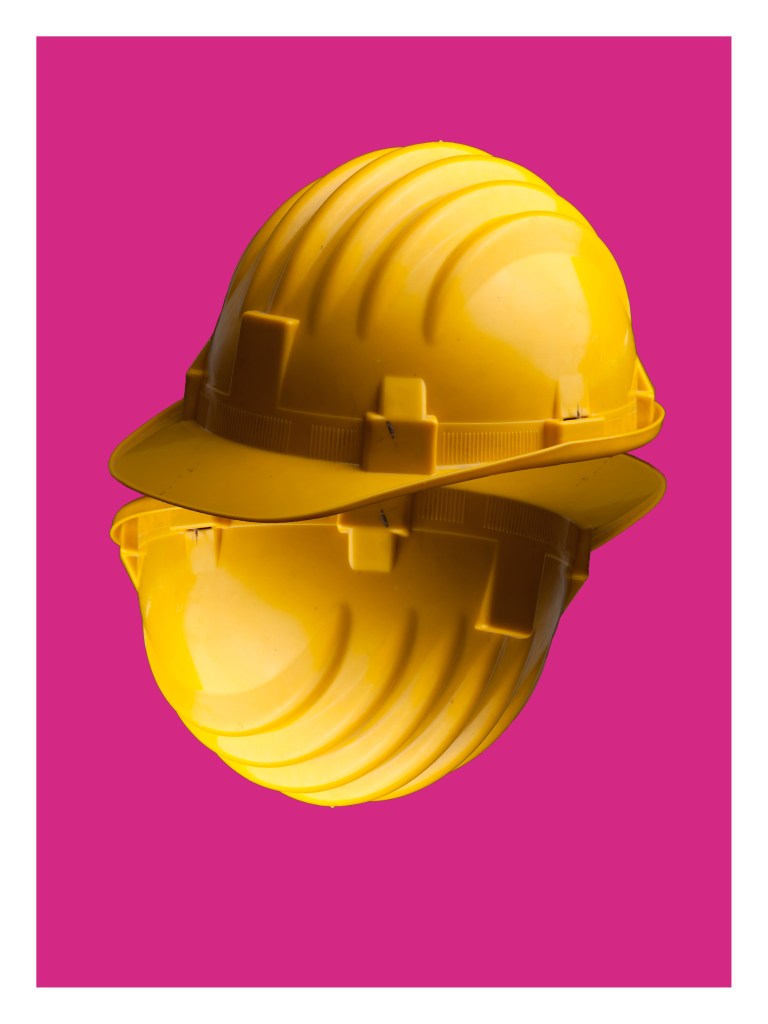
FINAL_hard_hard_hat_hat_PINK

Repetition. Not opposed to originality. Not the repetition of the same. But a call to productivity. To discovery and experimentation. To repeat is to start again, over and over. It is to affirm the unexpected and the new.