Lecture by Magdalena Wisniowska
29.11.2018
MUNICH
16.12.2018 – 11.01.2019
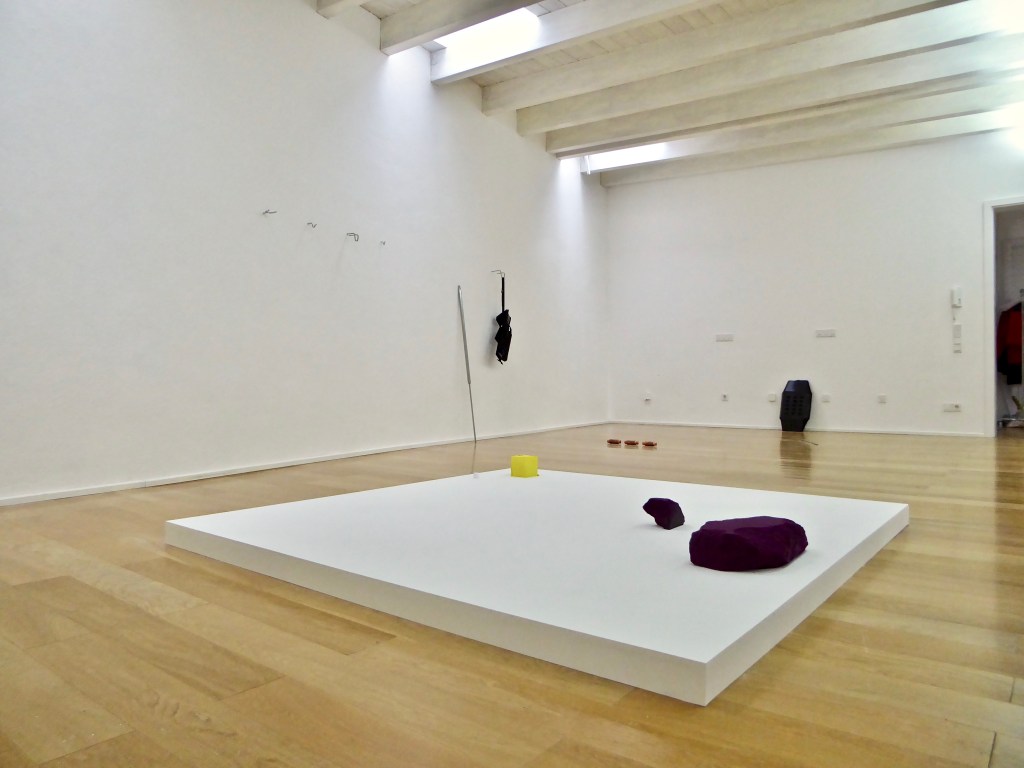
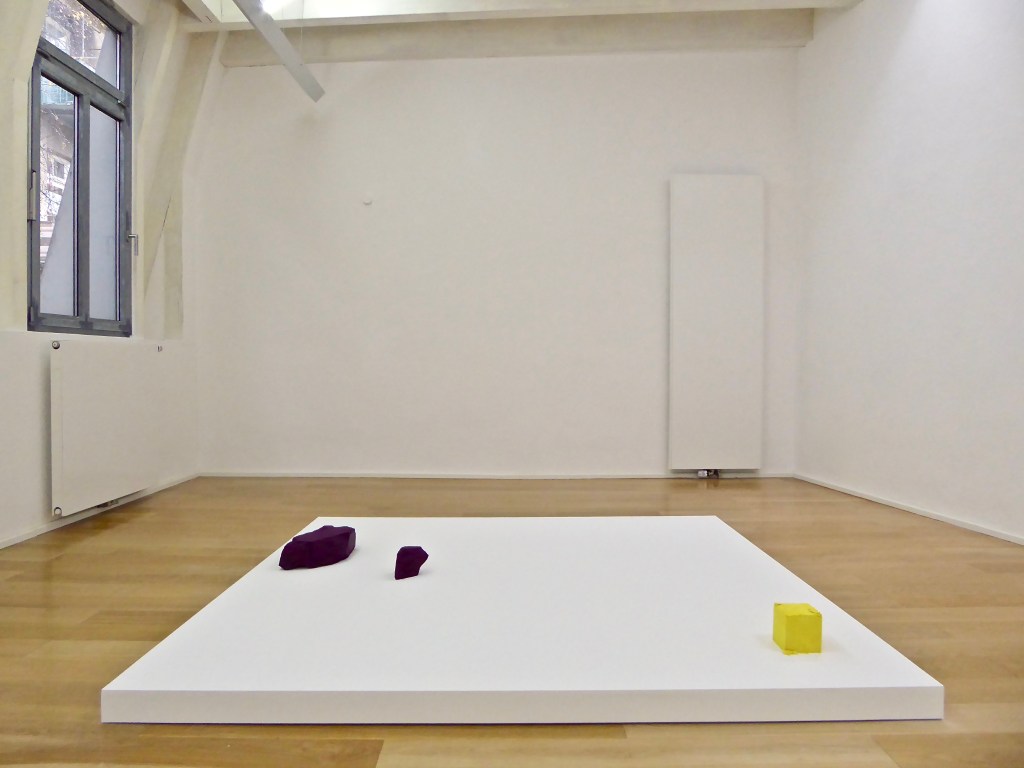
elements, 2018, installation view
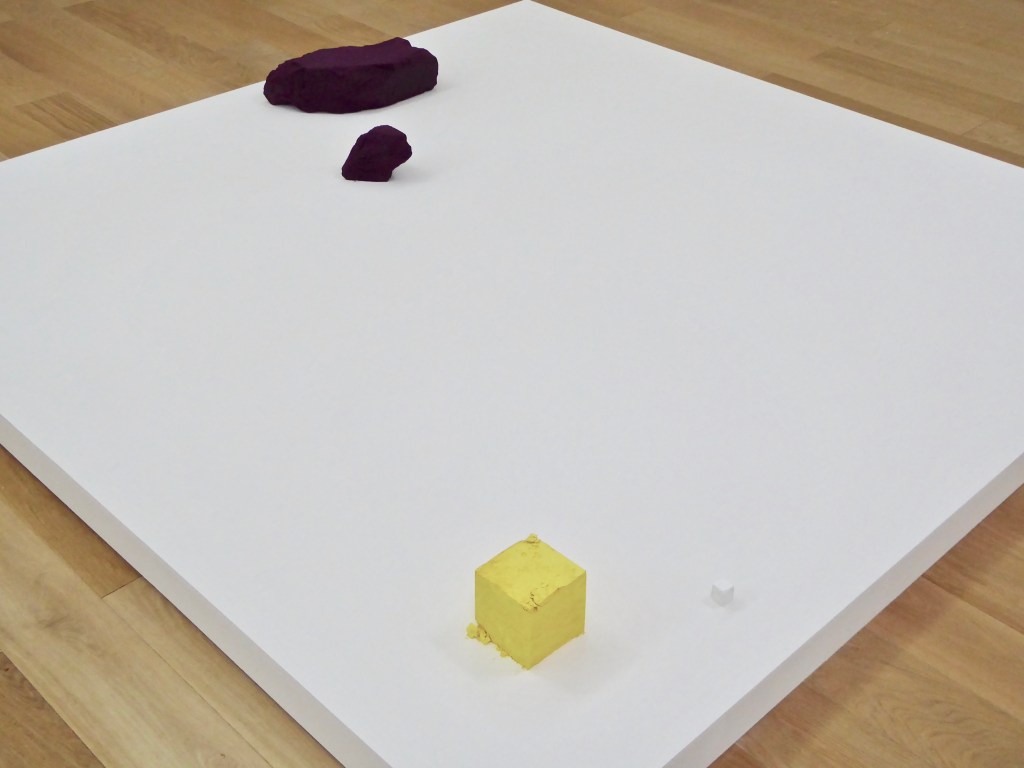
Andrea Zabric, Pigment sculptures (Berlin red and Naples Yellow) 2018, pigment, dimensions variable
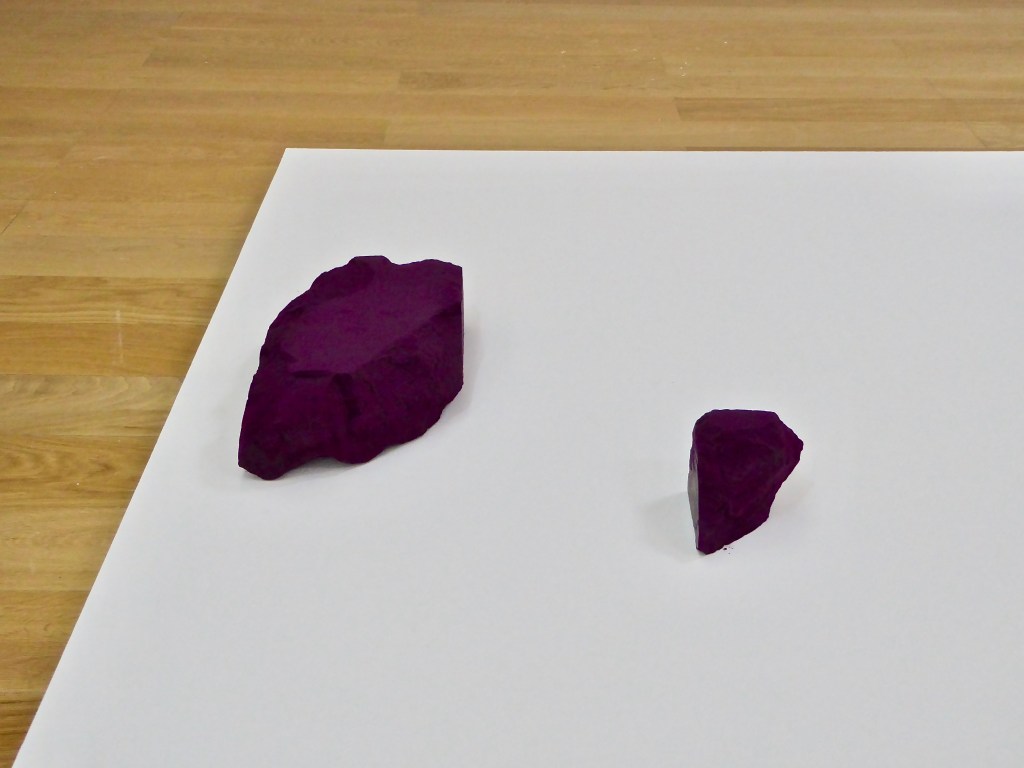
Andrea Zabric, Pigment sculpture (Berlin red) 2018, pigment, dimensions variable
Andrea Zabric, Pigment sculptures (Naples yellow, 43870,) 2018, pigment, 12 x 10 x 10 cm
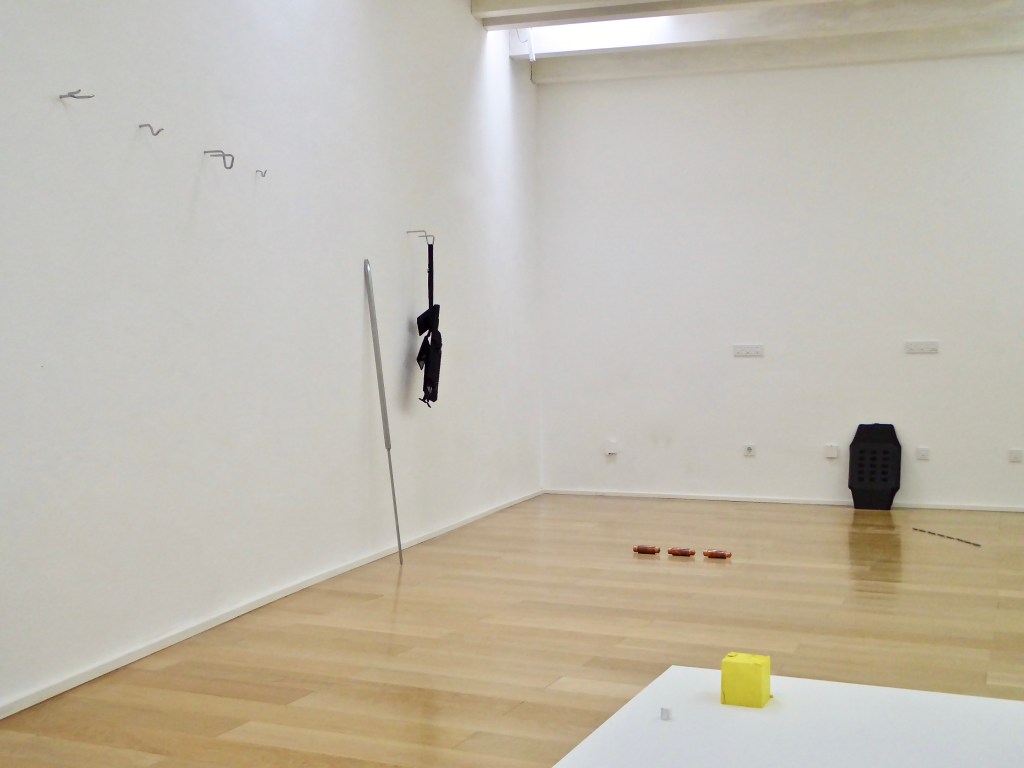
elements, 2018, installation view
Lukas Hoffmann, o. T., 2018, Series of 4, each in edition of 10, Stainless steel, dimensions variable
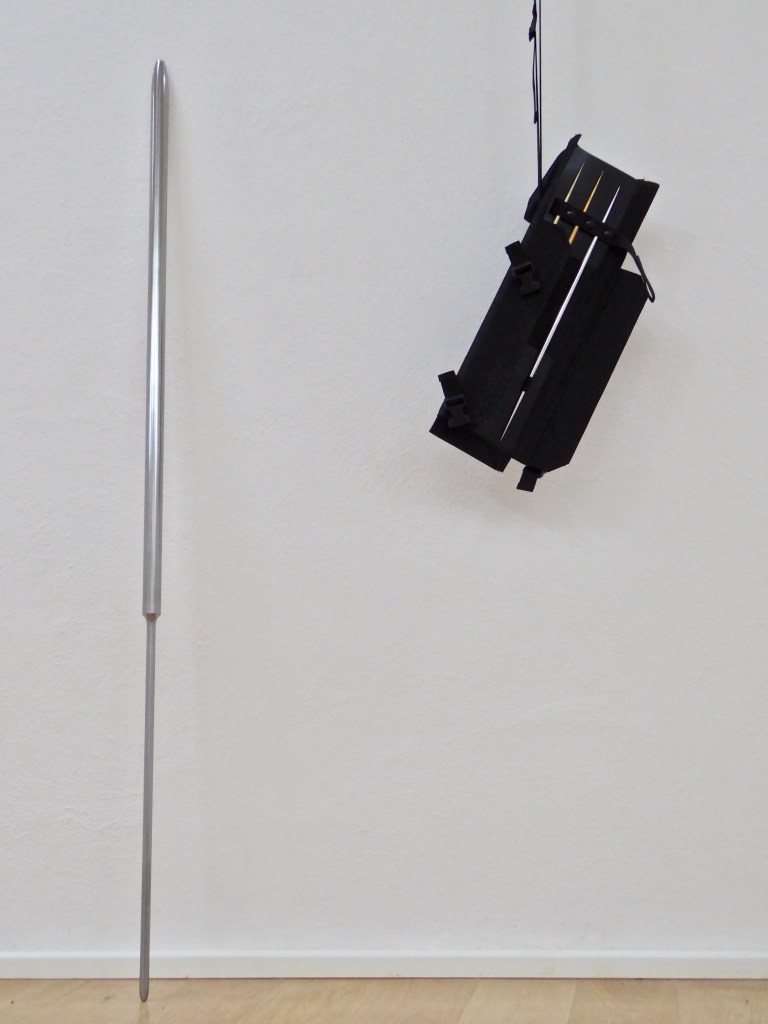
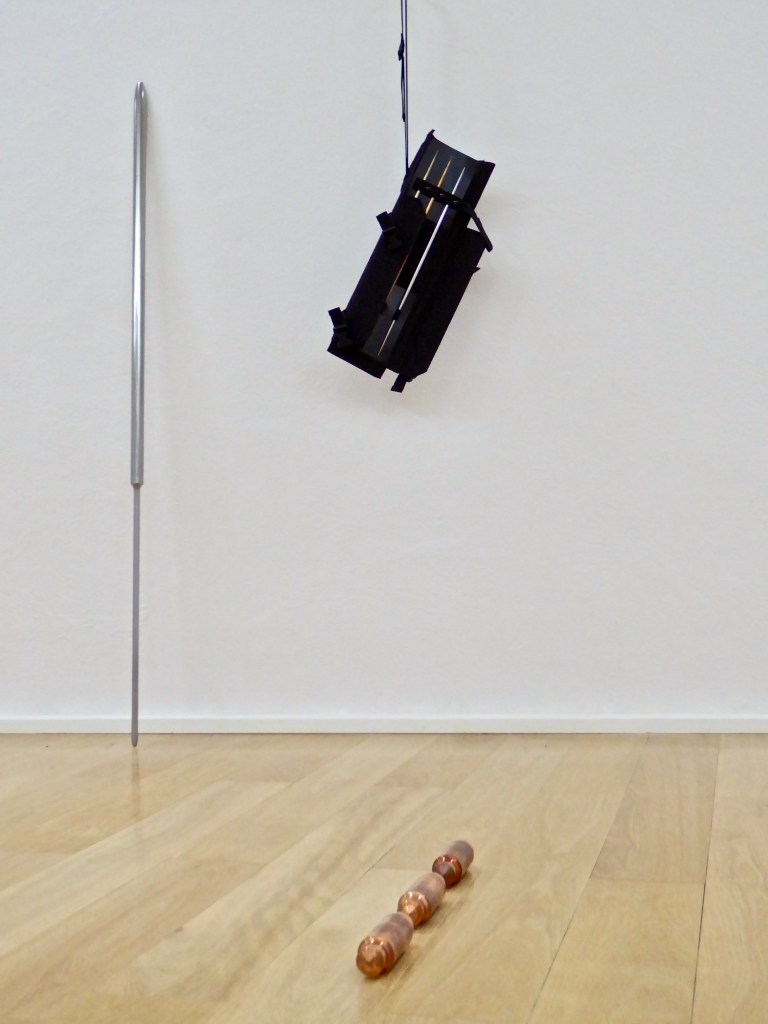
Lukas Hoffmann, o. T. and o. T, 2018, stainless steel, various textiles, pvc, plastic fittings, steel, aluminium bronze, German silver, 150 x 3 x 3 cm and 50 x 15 x 3 cm
Lukas Hoffman, o. T., 2018, various textiles, pvc, plastic fittings, steel, aluminium bronze, german silver, 150 x 3 x 3 cm
Lukas Hoffmann in elements, 2018, installation view
Lukas Hoffmann, o. T., 2018, bronze, 15 x 4 x 4 cm each
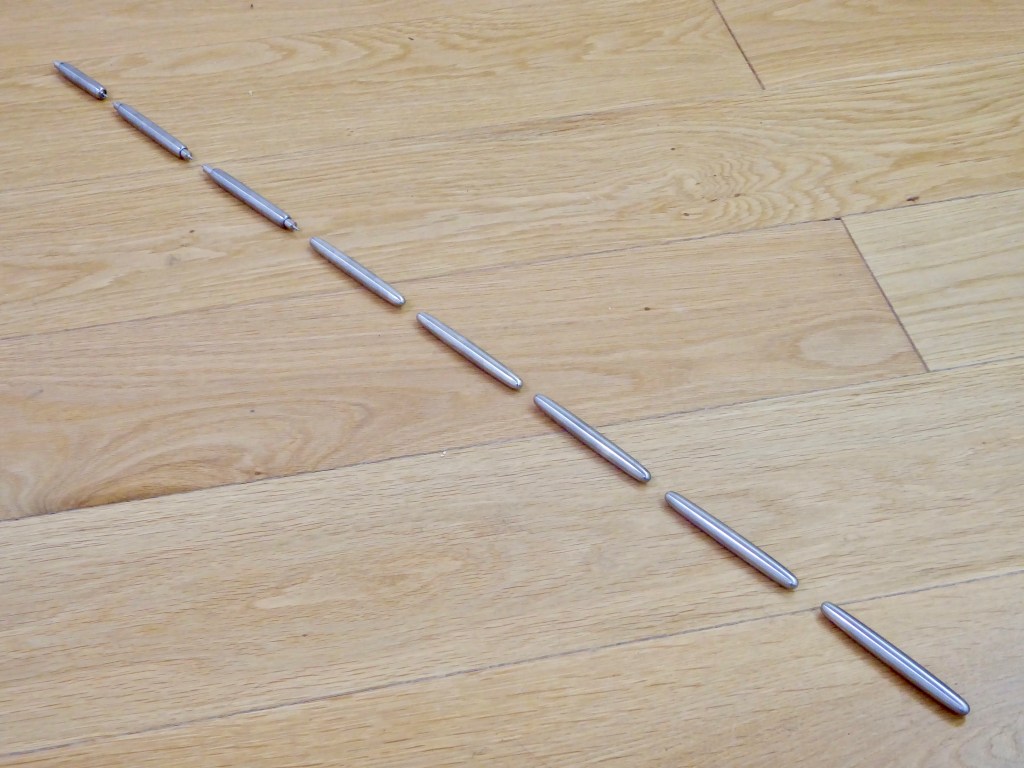
Lukas Hoffmann, o. T., 2018, series of 5, stainless steel, 9 x 1 cm each
Lukas Hoffmann, o. T. and o. T., 2018, stainless steel and various textiles, pvc, 9 x 1 cm each and 65 x 35 x 8 cm
Lukas Hoffmann, o. T., 2018, various textiles, pvc, 65 x 35 x 8 cm
The show elements, featuring new work by Lukas Hoffmann and Andrea Zabric, is GiG Munich’s first collaboration with Klasse Pia Fries, Akademie der bildene Kunst, München. Klasse Pia Fries is well known for its focus on abstract painting, especially in its material aspect. Both Andrea Zabric, a recent graduate (2018), and Lukas Hoffmann, a student at the class, incorporate material elements in their practice, but in a strongly conceptual rather than a painterly fashion.
Carbon, aluminium, iron, copper – basic chemical elements are at play in the work, often in their purest form. These instead of being manipulated by the artist’s hand are left in their natural alien state. Matter is subject to its own internal logic not the artist’s touch, and the method of production incorporates industrial, mechanical, and printing processes. While this is obviously human in origin, technology as much a product of man as any painting, when combined with the emphasis on materiality, lends their investigations a scientific rather than artistic quality. As an attempt to think the world outside of the personal relationship we have with it, the work relates to speculative realist concerns currently present in art and philosophy. It shares with speculative realism a taste for the dogmatic, the formal and the mathematical.
Zabric’s signature pigment sculptures, quite literally, take centre stage. Painting becomes reduced to its primary components: space, ground and pigment. The pigment is not mixed with medium and spread across the ground in its customary way, but is compressed at high pressure to form unusually perfect cuboid shapes. This gives her colours an uncanny density, a new found depth that recalls the violence of its making. For GiG Munich Zabric has produced three new pieces in pigments she had not used before. The work is also more experimental than previously, in that she allows the pieces to crumble, thus exposing their innate vulnerability.
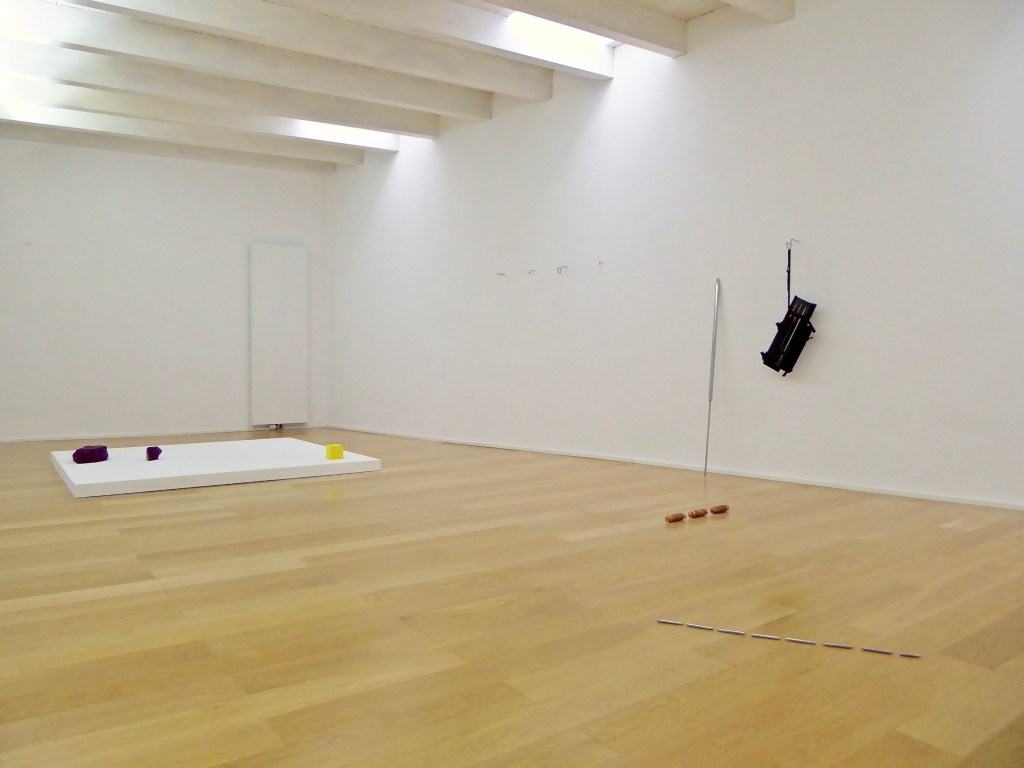
For all its implications of aggression, Hoffmann’s work is curiously invisible, scattered around the room, sometimes disguised as items of furniture. Instead of paintings, we encounter clothes hooks, a javelin is placed against the wall ready for use. Bullets (or are they exercise bars? maybe dildos?) lie waiting on the floor. The casual method of display serves to highlight the works tactile qualities, drawing us in. In a moment of masochism, we want to touch the sharp points with our fingertip and wait for the skin to break. Yet simultaneously we feel that to do so would be an imposition, we would enter a space that its not for us, that belongs to someone else, or indeed to the work itself. Quietly, the work turns away from us and withdraws into its own realm.
Magdalena Wisniowska 2018
26.11.2018 – 18.01.2019

Vernissage: Freitag 16. November, 18 – 21 Uhr,
16 November 2018 – 18 Januar 2019
Bitte nach Vereinbarung unter contact@gig-munich.com
Finissage: Freitag 18. Januar 2019, 19 – 21 Uhr
The exhibition elements, showcasing new work by Lukas Hoffmann and Andrea Zabric is GiG Munich’s first collaboration with Klasse Pia Fries, Akademie der Bildenden Künste München.
What connects the two young, upcoming artists is a shared interest in materialism, where their version of materialism belongs more to the philosophical developments centred around Speculative Realism than to the handmade, expressive variety traditionally associated with the activity of painting. Operating at the intersection of materialism and realism, they submit to the view that the primacy afforded to matter necessarily demotes the importance of the human understanding of it. If matter is all there is, then its reality must be encountered for itself. In their quasi-scientific, quasi-magical approaches, they reject the emphasis on the multiplicity of interpretations that art borrowed from dominant modes of contemporary critical theory (post-structuralism, deconstruction, psychoanalysis) in order to pursue an almost essential, almost dogmatic, grounding of reality. With this comes a violence, whether this is manifested in the high pressure Zabric submits her pigments to, or the highly polished weapon-like quality of Hoffmann’s metal work. They show that the material world, the inhuman one, is intense, forceful, elemental.
Magdalena Wisniowska 2018
Opening: Freitag 21. September, 18 – 21 Uhr
22. September – 26. October 2018
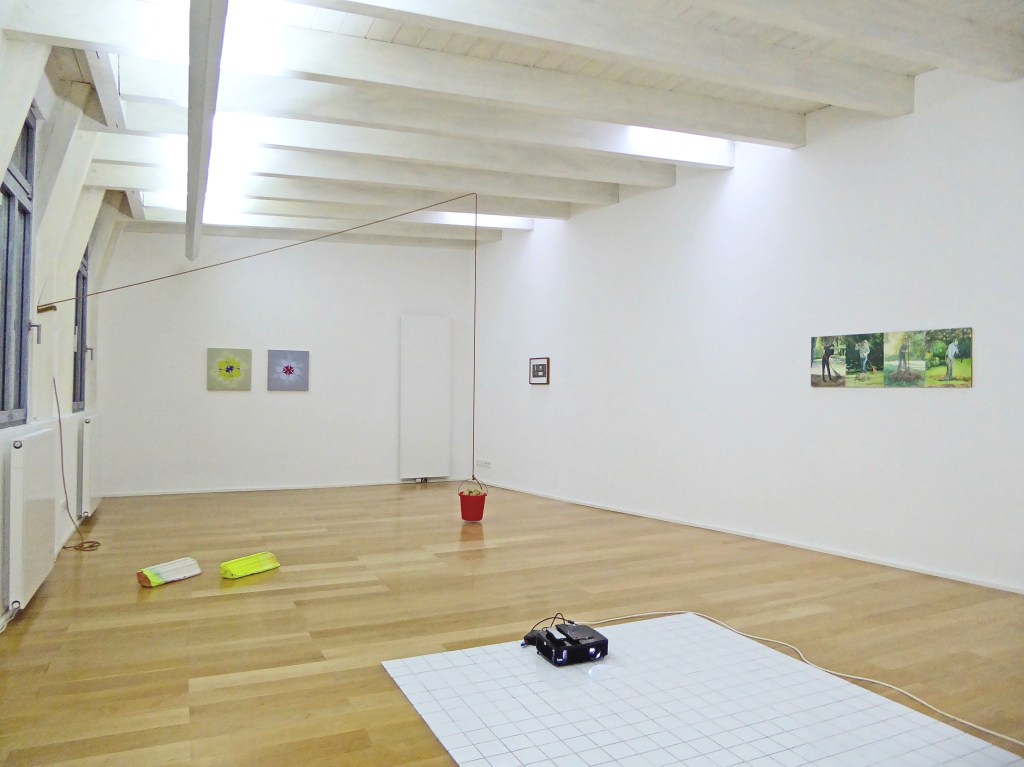
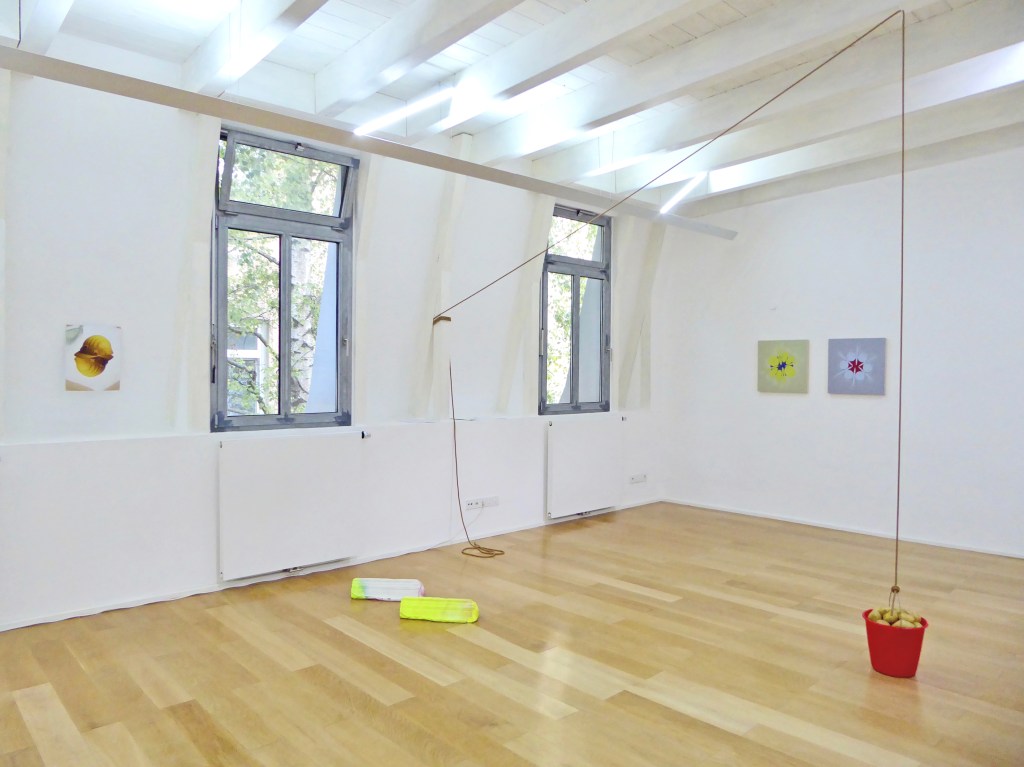
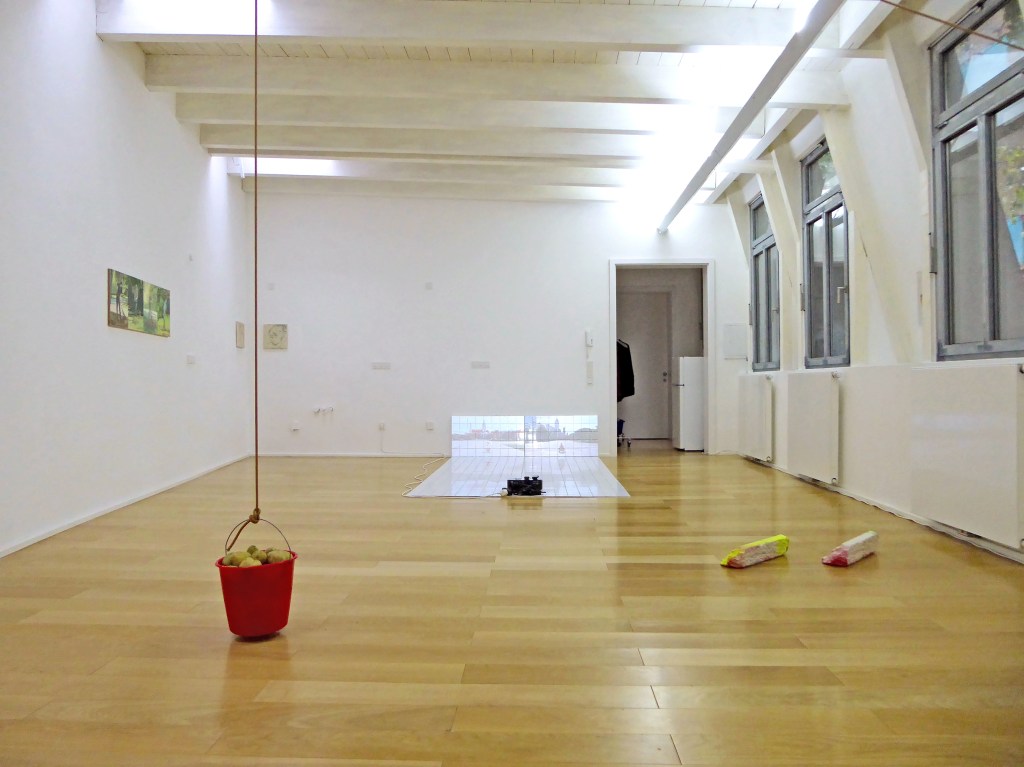
‘On Repeat’ exhibition view, 2018
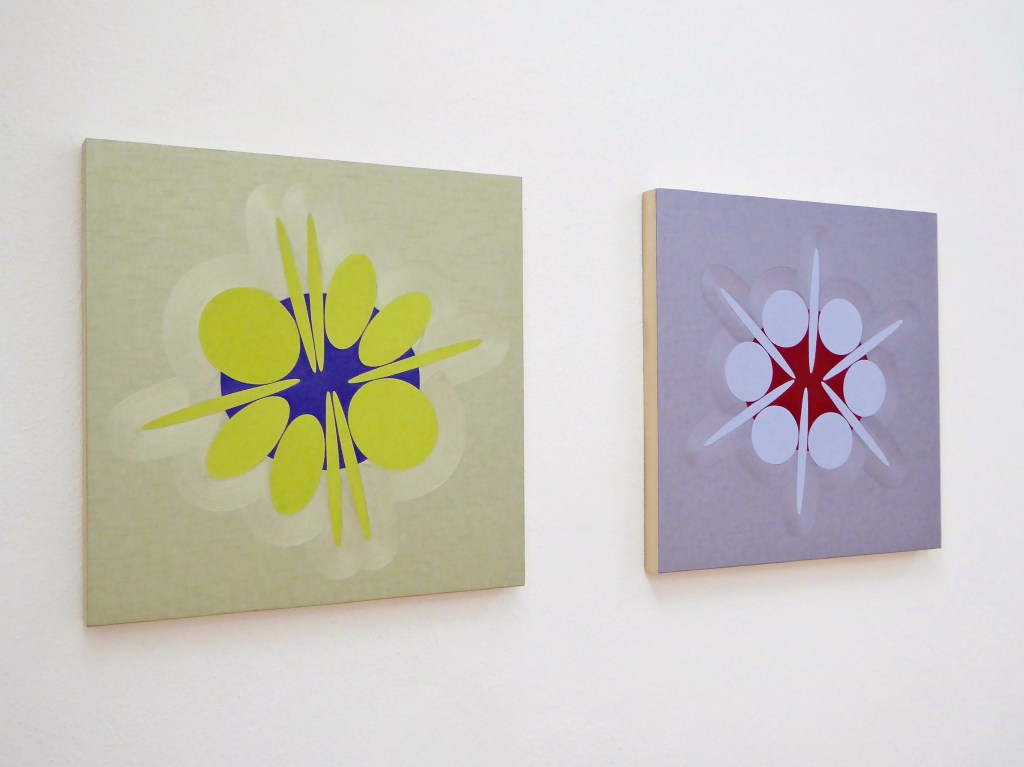
Jane Harris, Setting Out and Touching Light, 2018, oil on wooden panel, 50 x 50 cm
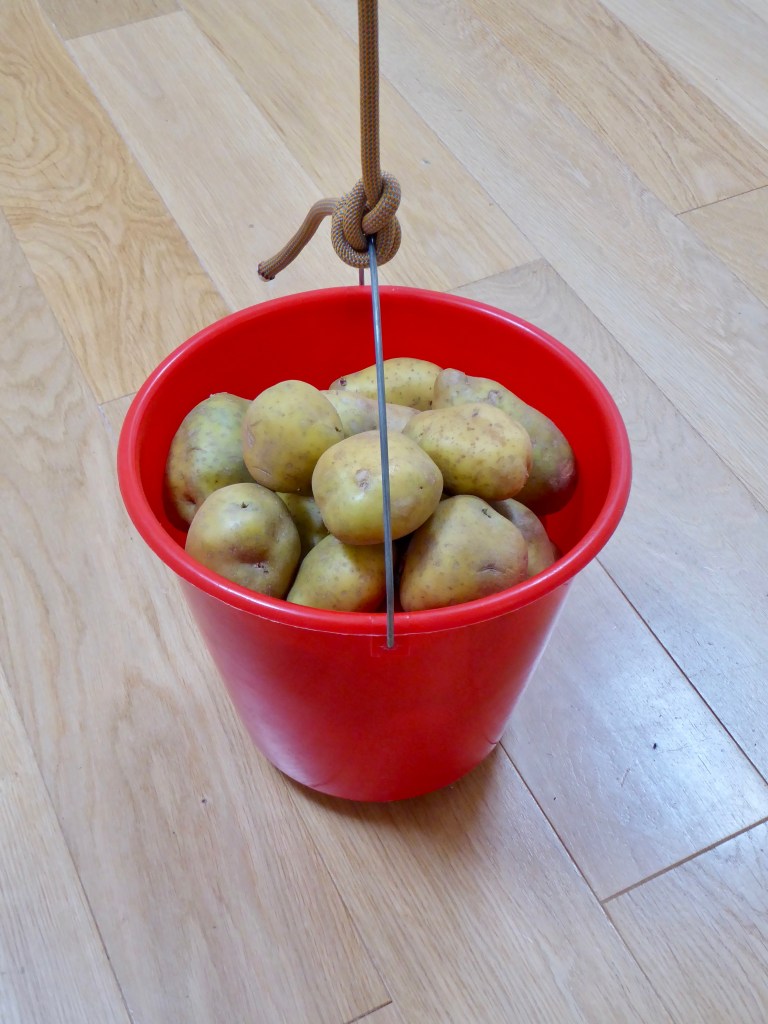
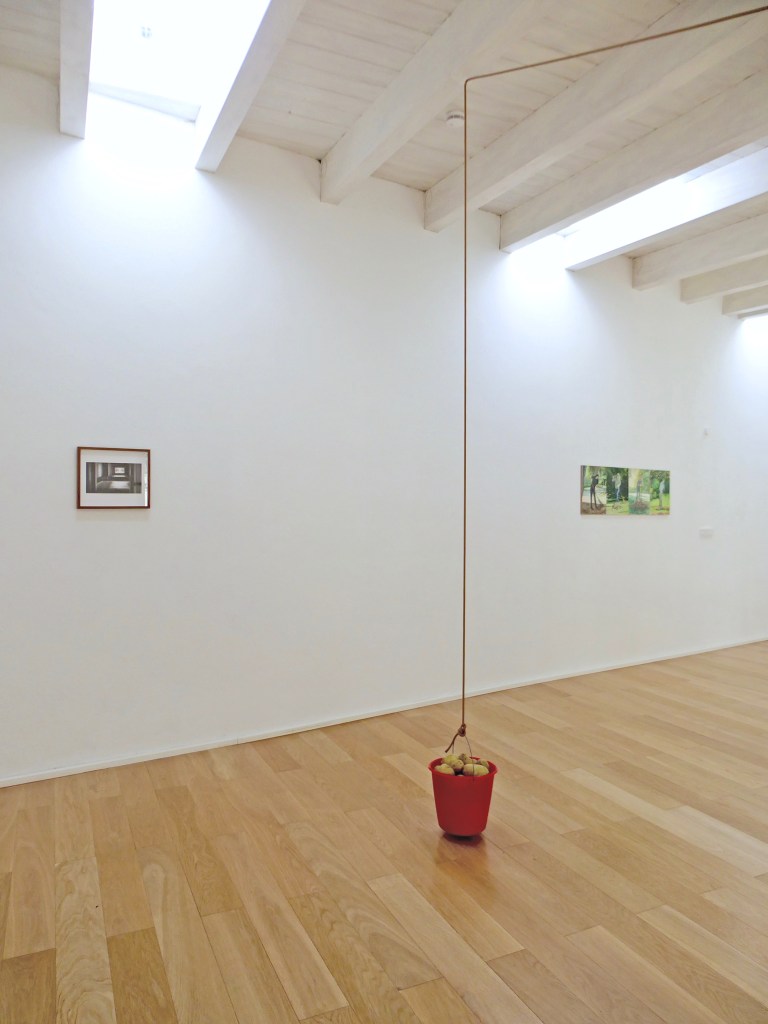
Alasdair Duncan, Magic Bucket, 2018, bucket, rope, potatoes, dimensions variable
‘On Repeat’ installation view, 2018 (Steffen Kern, Alasdair Duncan and Jonah Gebka)
Steffen Kern, o.T. (Aperture), 2018, Kohlestift on paper, 16x28cm
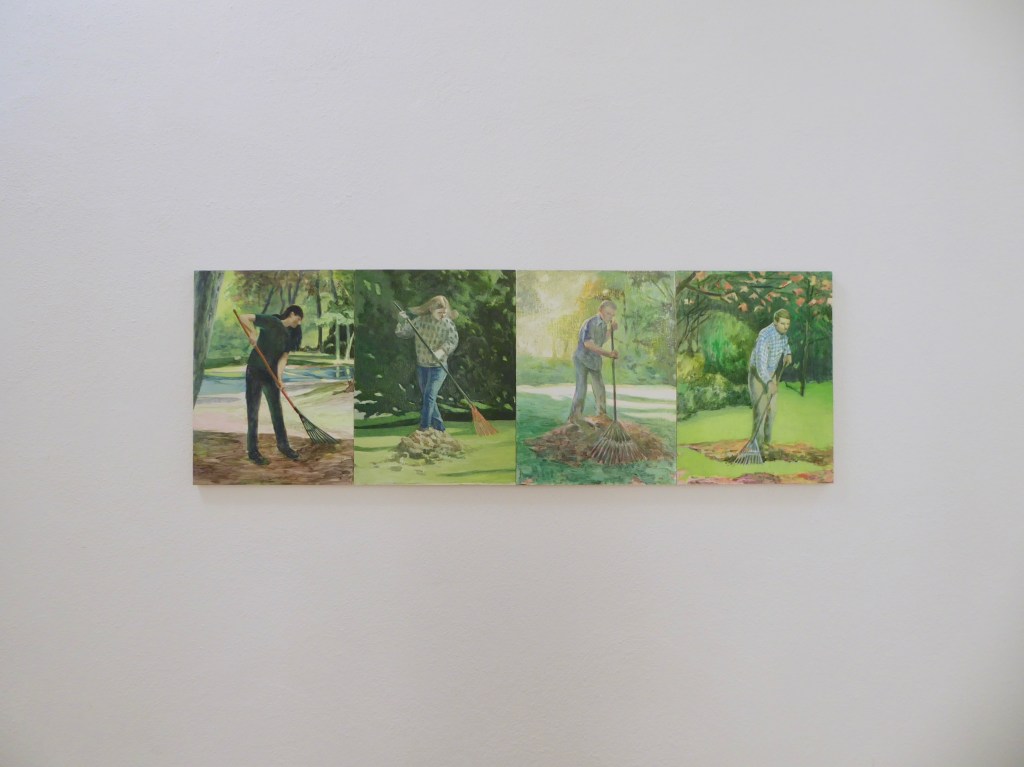
Jonah Gebka, Rechen (Engl. Title: Raking), 2018, oil on canvas and MDF, dimensions variable
Amanda Ure, Painting 111 and 112, 2018, oil on canvas, 30 x 30 cm
‘On Repeat’ exhibition view, 2018
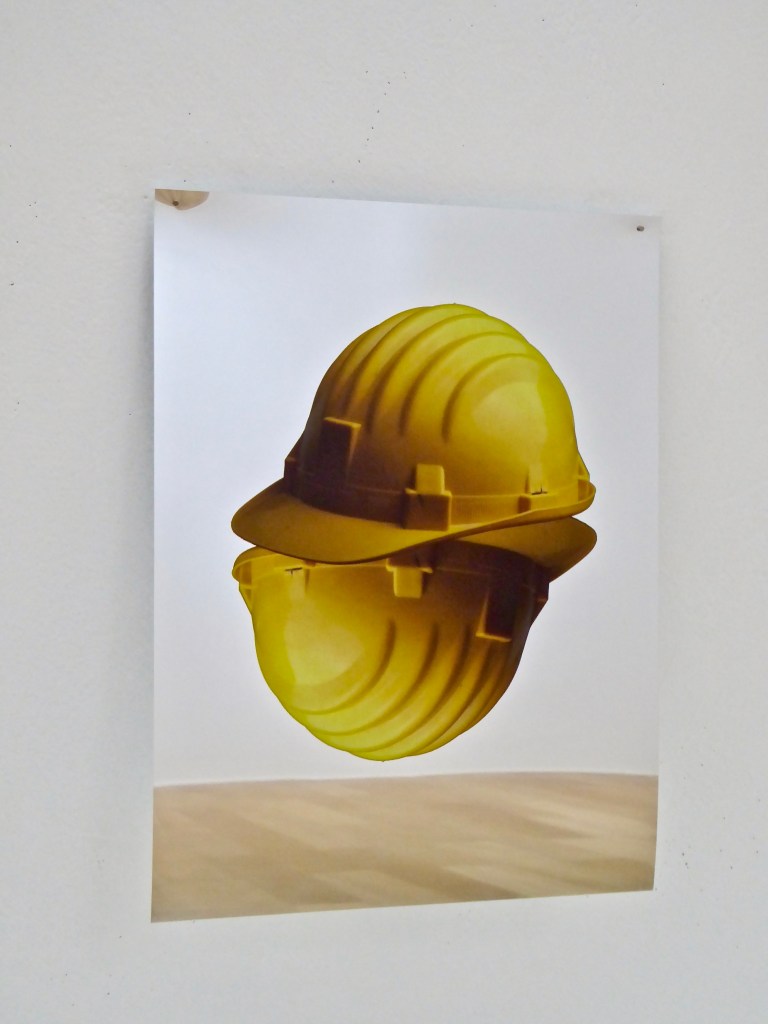
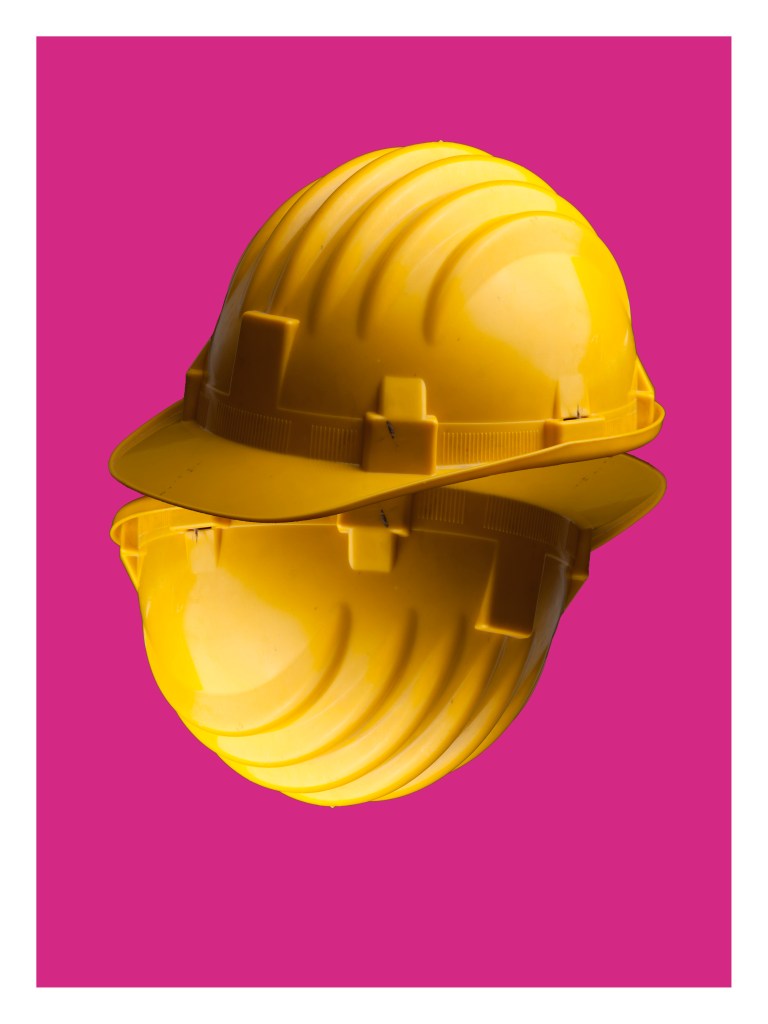
Jenny Dunseath, Hard Hard Hat Hat, 2018, digital print on silver film
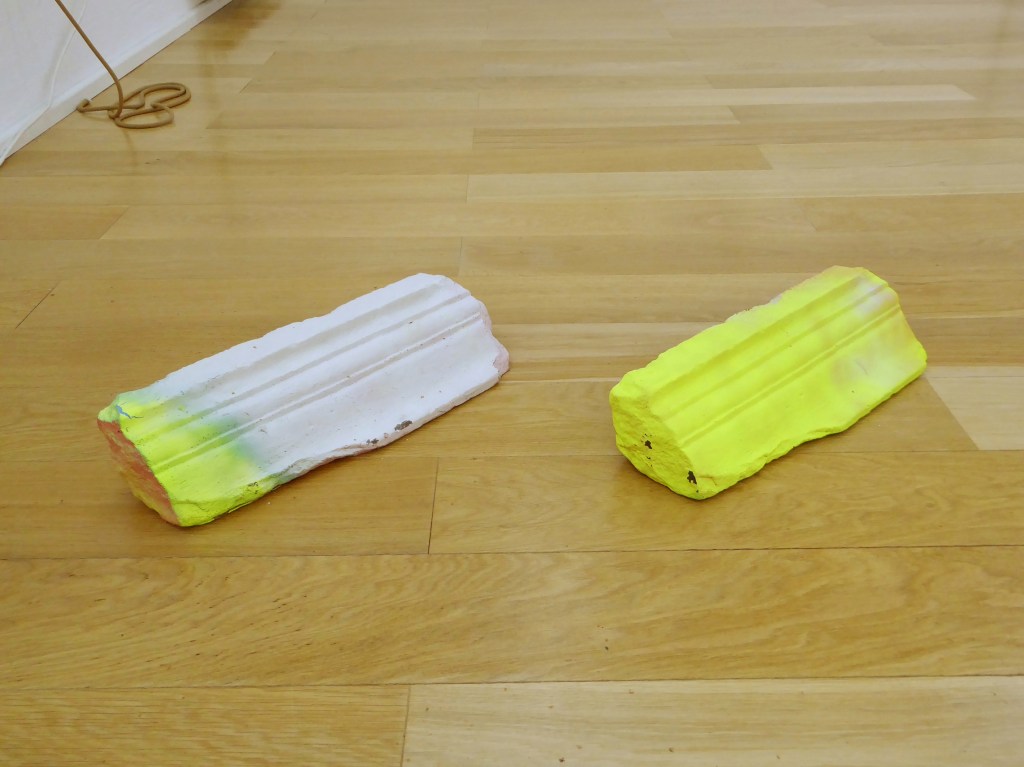
Claudio Matthias Bertolini, Montsalvar 2 & 3, 2017, spray paint on wax, dimensions variable
‘On Repeat’ is GiG Munich’s latest exhibition, featuring work by Alasdair Duncan, Jenny Dunseath, Jonah Gebka, Jane Harris, Melina Hennicker, Steffen Kern, Claudio Matthias Bertolini, Michael Schmidt, Amanda Ure, Magdalena Wisniowska.
The starting point for this show was the paper, ‘Genius and Genesis’ first presented by Magdalena Wisniowska at the 2017 Deleuze and Artistic Research Conference at the Orpheus Institute, Ghent.
As part of her investigation of the concept of originality, she argues that the process of repetition has an original because genetic component. This is not the repetition of the same as found in Walter Benjamin’s work on mechanical reproduction or Sigmund Freud’s discussion of trauma. Rather, it refers to our impulse to repeat, to try, to do something again and again, without thought of an outcome. Repetition in this spirit of Nietzsche and Deleuze, would be an affirmation of difference.
Artists in the exhibition use repetition in their work, not simply as a mechanical device (although this feature is present in Gebka’s or Kern’s investigations of the image in its relation to photography) but as a creative because productive gesture. For Alastair Duncan the act of repeating is miraculous; for Jenny Dunseath, absurd; for Jane Harris and Amanda Ure, the beginning of a long meditative process. In their video, Melina Hennicker and Michael Schmidt demonstrate that it has no boundaries, however much we wish to contain it. It often combined with a destructive quality as demonstrated in work by Claudio Matthias Bertolini. All in order to strip back and begin afresh.
Alasdair Duncan, Jenny Dunseath, Jonah Gebka, Jane Harris, Melina Hennicker, Steffen Kern, Claudio Matthias Bertolini, Michael Schmidt, Amanda Ure, Magdalena Wisniowska

Repetition. Not opposed to originality. Not the repetition of the same. But a call to productivity. To discovery and experimentation. To repeat is to start again, over and over. It is to affirm the unexpected and the new.
26.05 – 13.07.2018
peaches N cream, 2018, installation view
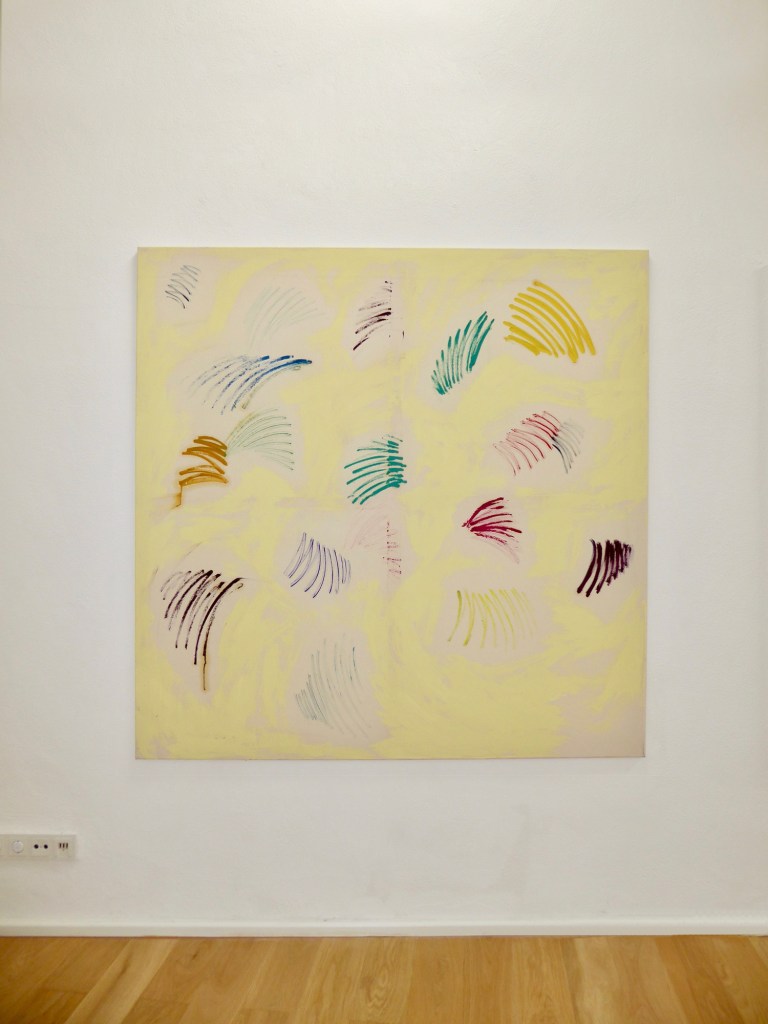
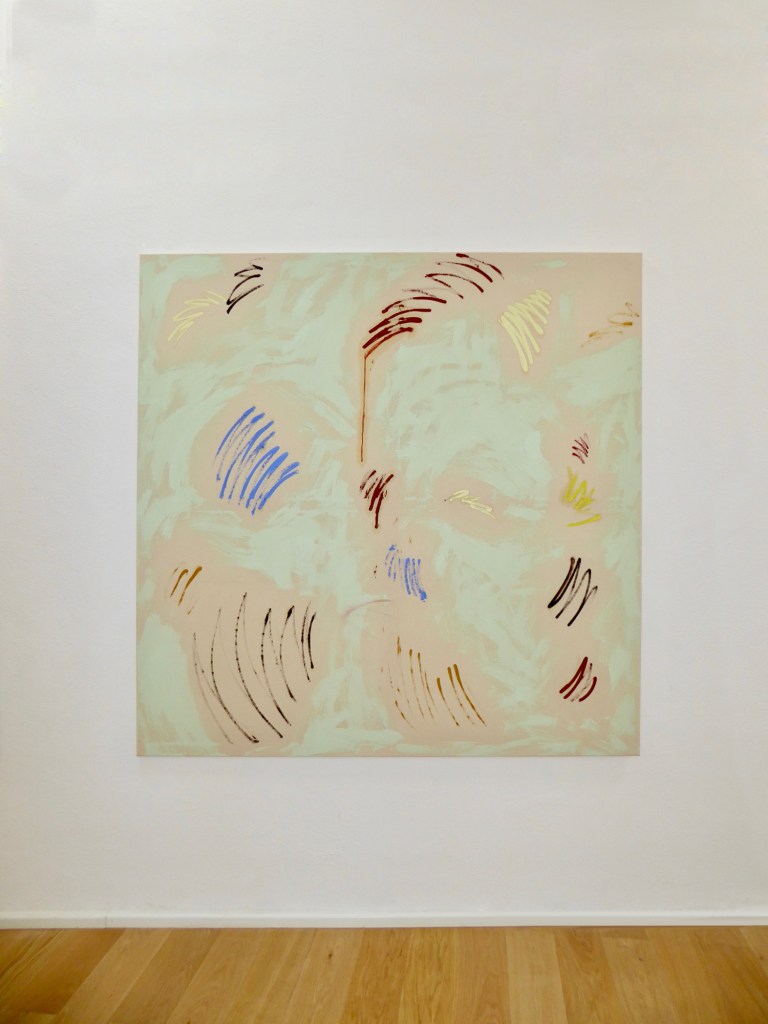
o.T. 2018, oil and acrylic on canvas, 160 x 160 cm
o.T. (series of watercolours on paper) 2017-8, watercolour on paper 32 x 24 cm
o.T. 2018, oil and acrylic on canvas, 35 x 35 cm
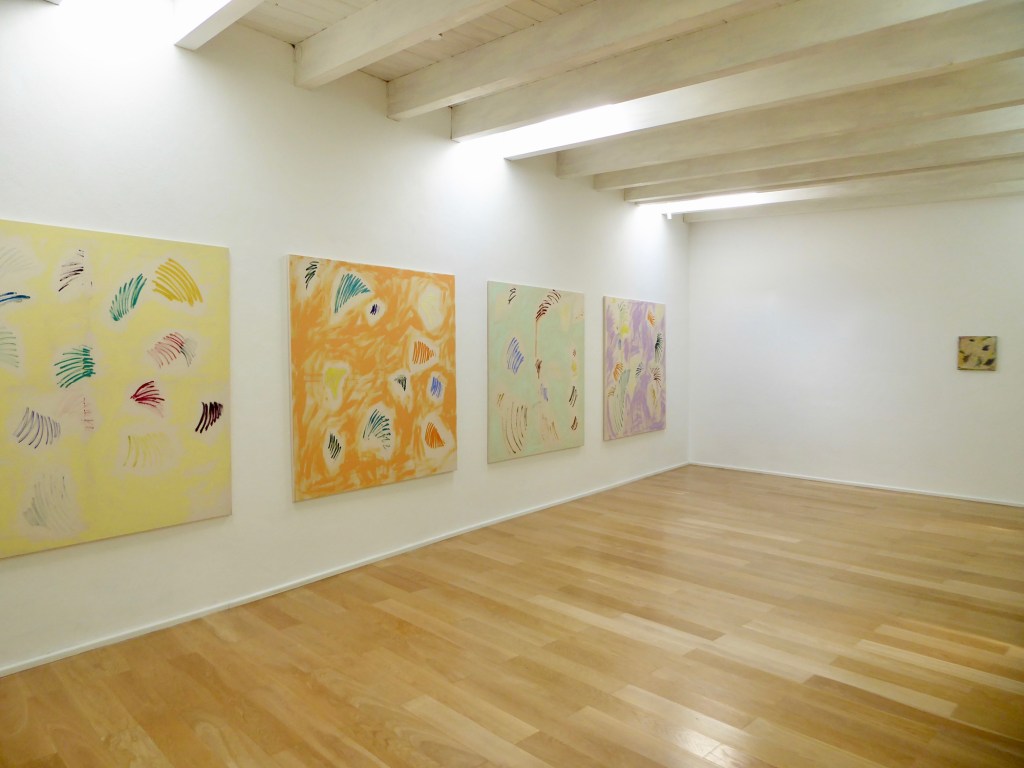
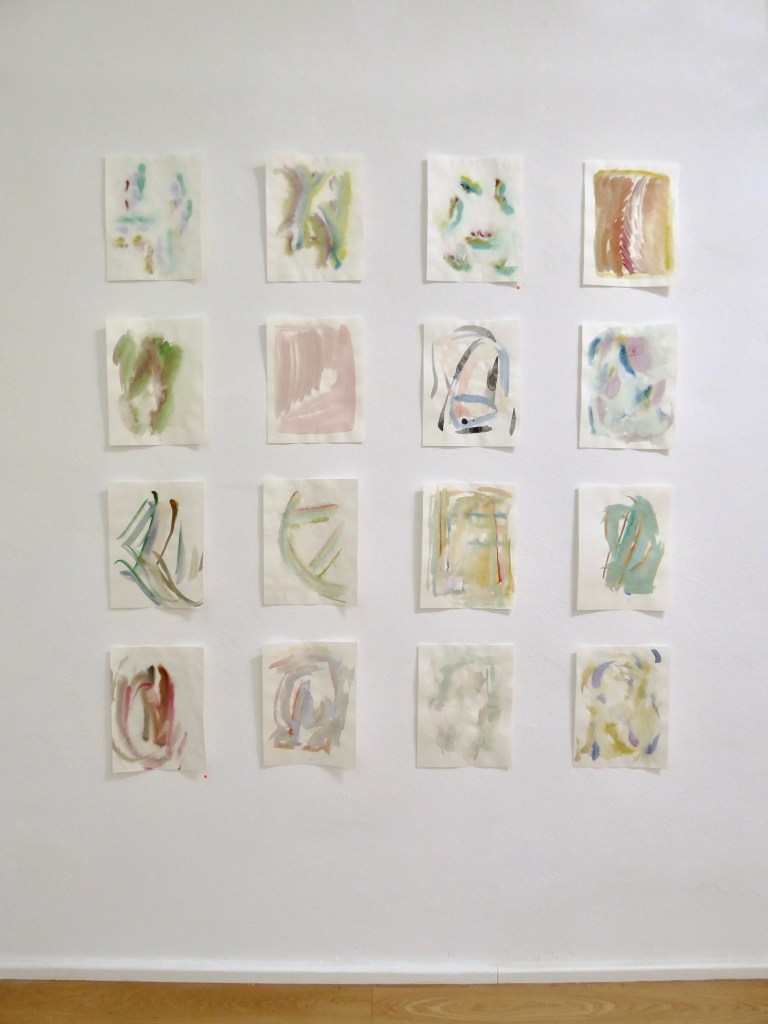
Stefanie Ullmann’s paintings have always been minimal. Even at their most overworked, there was never much to see in or on her small to medium sized canvases. A rather distressed looking surface perhaps, a few meandering brushstrokes, some lines or a couple of smudges. Muted colours. For this exhibition, she has made four larger canvases, brighter and larger than her previous work perhaps, but equally paired down, consisting of a few random marks on pastel coloured ground. A quiet ‘no’ cries out from each individual frame, which is a distant echo of Minimalism’s earlier, much more stark and vehement ‘no’ to values associated with Abstract Expressionism: transcendence, heroism, anguish, ego and preciousness. If Robert Morris used a chainsaw to slice out his rejection of anything that might distract the viewer from the here and now, Ullmann uses the slightest of gestures to question what is the ‘just enough’ for a painting. A canvas for instance, would seem about right, but brushes are something that could easily be dispensed with. Much of the painting at the exhibition is made directly by squeezing a tube of paint onto unprimed canvas. One squeeze is sufficient for one mark.
Similarly to other minimalist artists, Ullmann directs her ‘no’ against artistic intentionality, the external motivation of a rational type, an idea existing prior to the making of the work which nevertheless dictates its final form and meaning from within. This is why there are no vestiges of illusion in her paintings and no gestures towards representation, and why, unlike many of her contemporaries she does not work between abstraction and figuration. Instead she utilises strategies that do away with intentionality altogether: by reducing the number of elements in her paintings, by rejecting the hierarchies between the component parts, sometimes by painting with her eyes closed and leaving things unfinished. And yet she never quite resorts to the complete impersonalisation of many anti-authorial practices. The personal remains important, her way of navigating what is deliberate and what is not.
The deliberate and the accidental – as with minimalism what we see is what we get. Here it is a number of marks on a peach and cream background. But this does not cause us to turn away from the canvas to investigate the work’s surroundings and their function within a larger space. The work does not depend on the moving spectator’s visual trajectory in that way. It is not, in Michael Fried’s sense of the term, theatrical, analogous to an actor producing effects on us the audience in real time. The here and now of Ullmann’s paintings always draws us closer. There may be little present in the work, but what is there draws us in, before saying stop, it is enough, now you can go no further. What is there keeps us hovering at the surface of painting, neither allowing us, as a beholder to forget ourselves by entering a state of transcendence nor to move away to engage with the work’s surroundings. With her work, we are always caught between one pole and the other. Between presentness and presence lies their state of grace.
Magdalena Wisniowska 2018
26.05 – 13.07.2018

Vernissage: Freitag 25. Mai, 18 – 21 Uhr
Ausstellungsdauer: 26. Mai – 13. Juli 2018
Öffnungszeiten: Montag – Donnerstag, 15 – 18 Uhr
Bitte nach Vereinbarung unter contact@gig-munich.com
GiG Munich is pleased to present the new solo exhibition by Munich artist, Stefanie Ullmann, ‘peaches N cream.’
For the exhibition the artist has produced a new body of work,a series of large-scale paintings and smaller watercolours that wear their bright, pastel colours lightly.
Always a thoughtful and reflective painter, Ullmann has long pursued her unique kind of minimalism, one that slowly alerts us to the most minute of painterly gestures, meditating on the difference between the accidental and the deliberate. A certain roughness of texture perhaps, a brushstroke carelessly meandering across the raw canvas, a hint of colour, a smudge. In the past she achieved this through overworking her canvases, often painting and repainting the same distressed surface. For the exhibition she changed approach, to bring in a new lightness of touch. In an intellectual climate where it is more common to think the supplement or indeed, excess, she makes paintings according to the dictum of the ‘not too much / just enough.’
29.03 – 11.05.2018


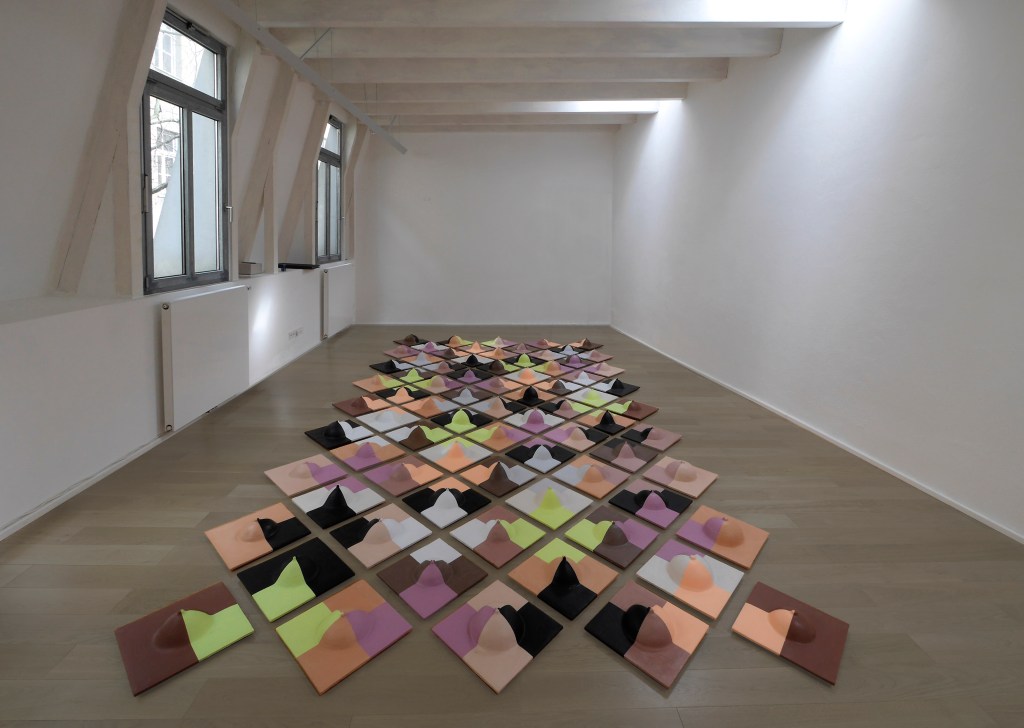
GiG Munich is excited to present Angelina, the solo exhibition by German video artist and sculptor, Susanne Wagner.
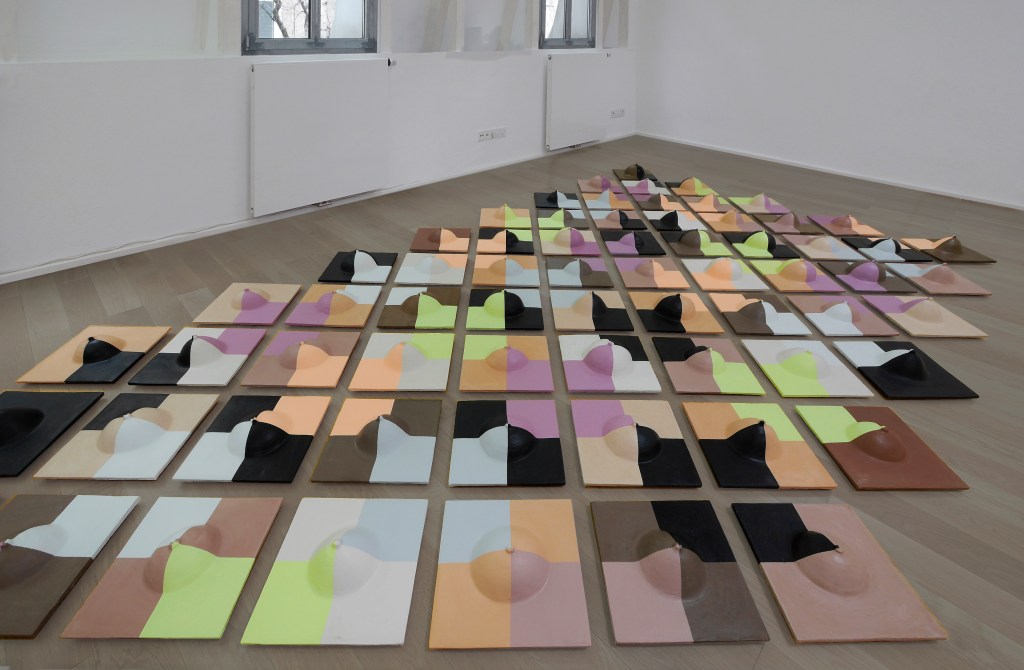
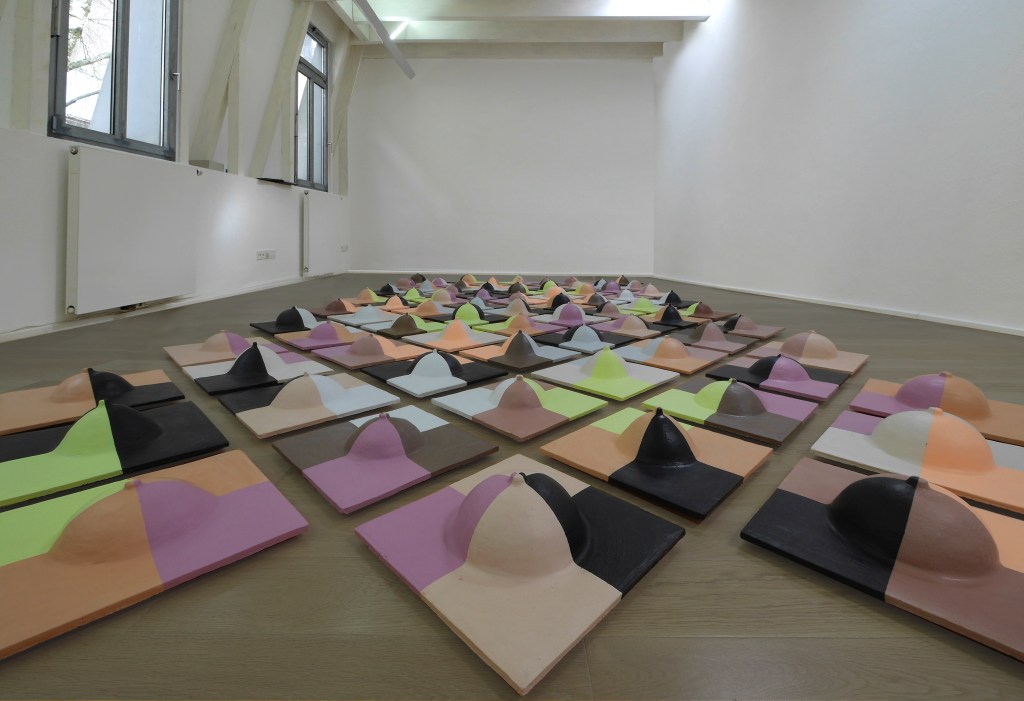
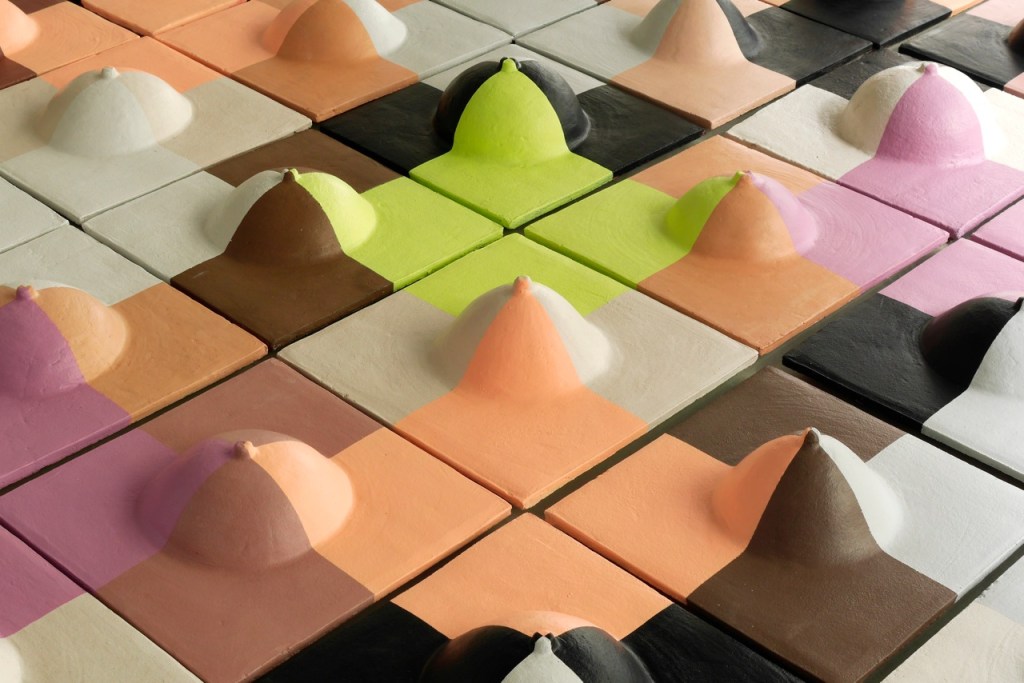
For the exhibition Wagner has produced a new body of work, a large-scale, site-specific floor installation consisting of seventy seven almost identical square ceramic tiles, each 40 x 40 cm individual tile topped by a slightly large than life dome of the female breast. These tiles are arranged in the exact centre of the room in a diagonal grid-like fashion, four or five tiles across, seventeen tiles deep. They are also painted to emphasise this diagonal pattern, again with each tile divided into quarters, or four squares, all in bright, non-primary colours. To stand at the doorway and to look down at the work is to see a pleasing check-board pattern of squares and undulating lines, salmon pinks, lemon yellows and different shades of brown moving across the room.
The arrangement recalls postmodern critiques of originality, best articulated by Rosalind Krauss in her 1986 essay, ‘Originality of the Avant-garde.’ As she argued, any work that makes use of the grid, cannot lay claim to originality, because the grid is a visual device that can only bear repeating. The same way there is no original and unique grid, there is no unique and original art object. Instead, Krauss rewrites the art object as text, whose meaning is determined by the relation it has with other texts. As a text the work of art has no point of origin and no essence; it is only something that can be endlessly reconfigured. In the case of Wagner’s floor piece, even though each tile is handmade and therefore has unique quality, none can claim to be the one original tile, more meaningful than the other.
But what makes Wagner’s work so exciting is that this repetition pertaining to postmodernism’s discussions of originality is complicated by another kind of repetition arising from a very different kind of discourse. For readers of Judith Butler, it has a performative aspect that addresses the ways in which the categories of gender are constructed in a heterosexual normative society. In this way, it is also very timely, considering that in our current era of ♯MeToo activism, many of the norms consolidating sexual and gender hierarchy are being questioned. It comes down to Wagner’s use of the breast. The female breast is a primary sexual characteristic but it also functions as a signifier of gender. Real women have breasts – and much of the uproar surrounding Angelina Jolie’s mastectomy had to do with our identification of her as the well-endowed Laura Croft, video game sex symbol supreme. By isolating, enlarging and repeating the form of the female breast Wagner demonstrates that gender is not a given fact. It is neither an expression of some internal essence, nor is it an objective ideal to which we may aspire to. Gender is something we perform, meaning it is brought about through certain acts on our part. And these are repetitive and often mundane, so much so, that they give gender the illusion of a stable identity. The gender identity we take for granted – with all the notions of ‘real womanhood’ that this assumes – are revealed to be nothing more than a re-enactment of a set of meanings already socially and culturally established.
What this means in turn is that the same acts, which give the illusion of stable identity are also the ones that reveal it to be illusory at the moment repetition fails. Wagner’s work alerts us to the fact that the same process of repetition, which constructs the gender categories binding us, could also be the key to their undoing.
Magdalena Wisniowska 2018

Eröffnung: Mittwoch 28. März, 18- 21 Uhr
Ausstellungsdauer: 29. März – 11. Mai 2018
Öffnungszeiten: Montag – Donnerstag, 15 – 18 Uhr
Bitte nach Vereinbarung unter contact@gig-munich.com
GiG Munich is excited to present the new, site-specific floor installation “Angelina” by German artist, Susanne Wagner.
Best known for her video work, Wagner’s current practice has shifted towards sculpture and now involves the use of ceramics in the production of large-scale modular pieces, often juxtaposed with representations of the female body. While the new work addresses themes of repetition and originality, it also complicates the postmodernist narrative by showing how repetition participates in the cultural construction of sex, gender and the body as ‘original’ because ‘natural’ foundations of identity.
With their upward facing breasts, the repeated floor elements of “Angelina” aim (quite literally) to bring to relief the power structures responsible for our assumptions about gender, in an up-to-date tabloid context of Angelina Jolie’s mastectomy, Emma Watson’s feminism-lite and ♯MeToo Twitter activism.
Robin Mason, Constellation : Konstellation, 2018, installation view. Image courtesy of Johannes Wende.
Robin Mason, Over the Border, 2017, velvet robe, acrylic on wood, 38 x 300 cm
Robin Mason, Collection, 2018, acrylic on paper, approx. 650 x 320 cm
Robin Mason, Threshold, 2017, acrylic on paper, 175 x 240 cm (detail)
Robin Mason, Threshold, 2017, acrylic on paper, 175 x 240 cm
Robin Mason, Black Forest Lake, 2017, acrylic on paper, four wineglasses, 65 x 42 x 15 cm
Robin Mason, After Elsenheimer, 2018, acrylic on wood, acrylic on paper mirror, 40 x 30 cm and Constellation, 2017, acrylic on wood, 30 cm in diameter
Robin Mason, Constellation, 2017, acrylic on wood, 30 cm in diameter