Maria VMier

Vier

12.10 – 23.11.2019


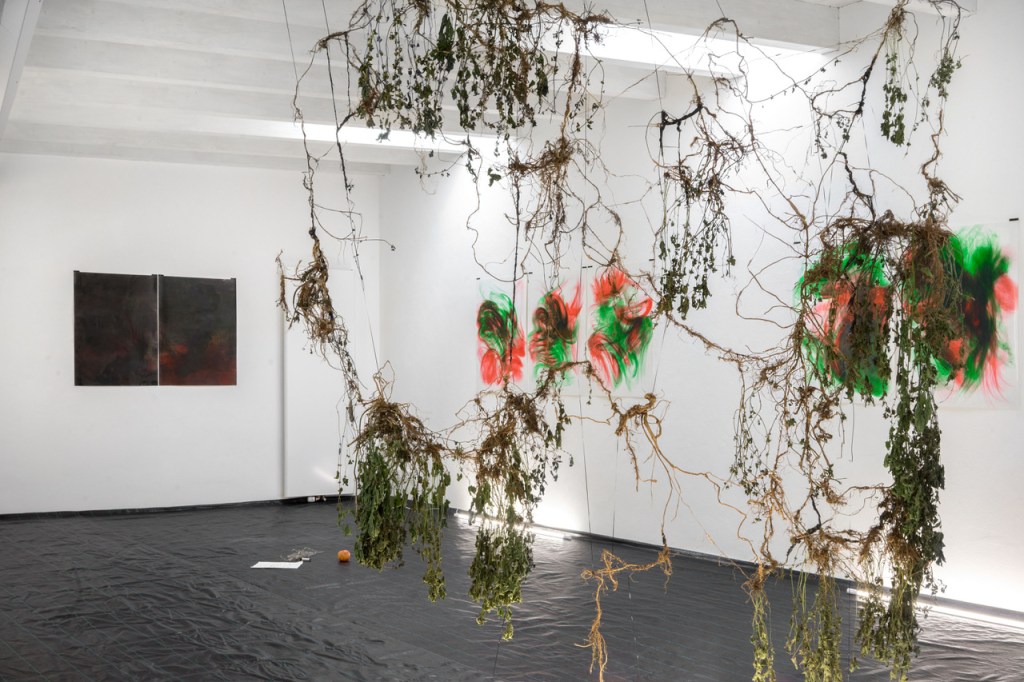
sVrg1-5_DSC0813Vier, 2019, installation view


3_DSC0275Vier, 2019, installation view


4_DSC0620Vier, 2019, installation view


rg1-3_DSC0639Vier, 2019, installation view


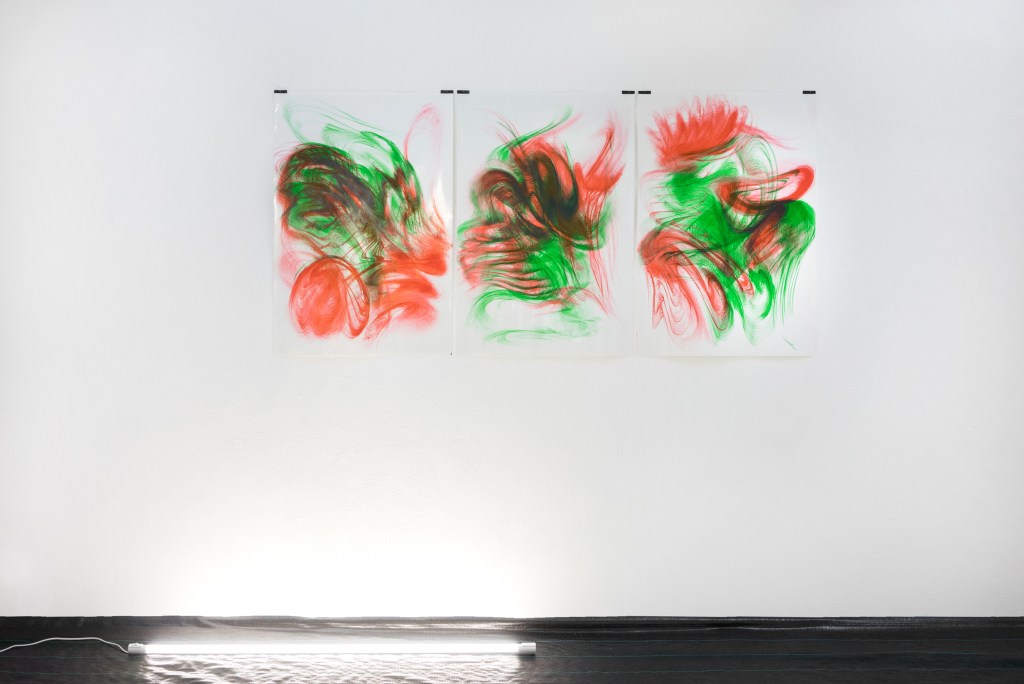
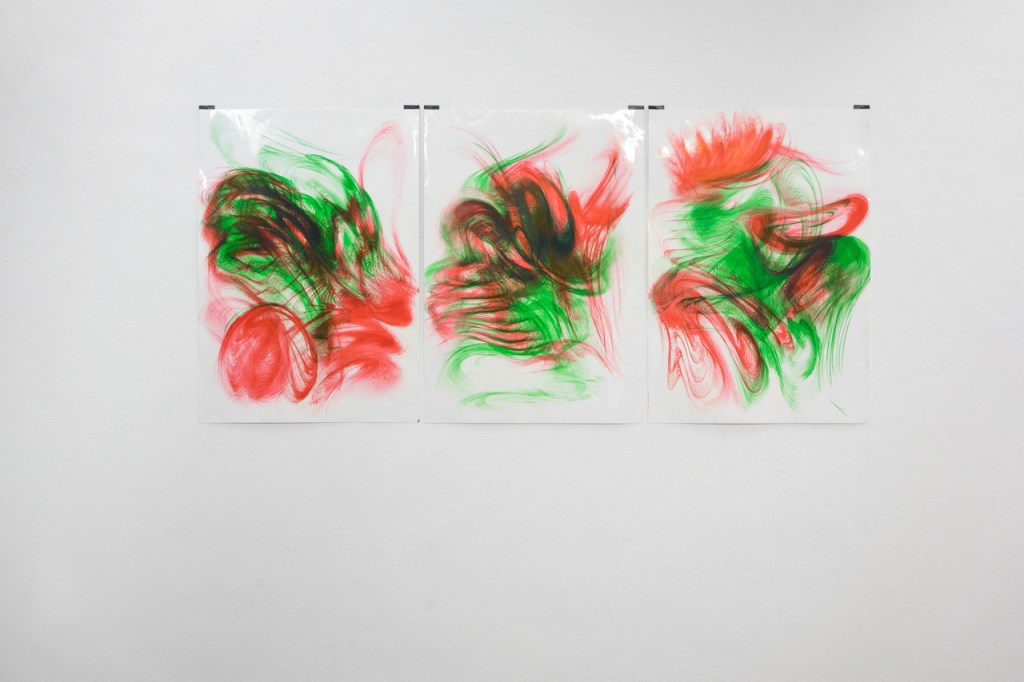
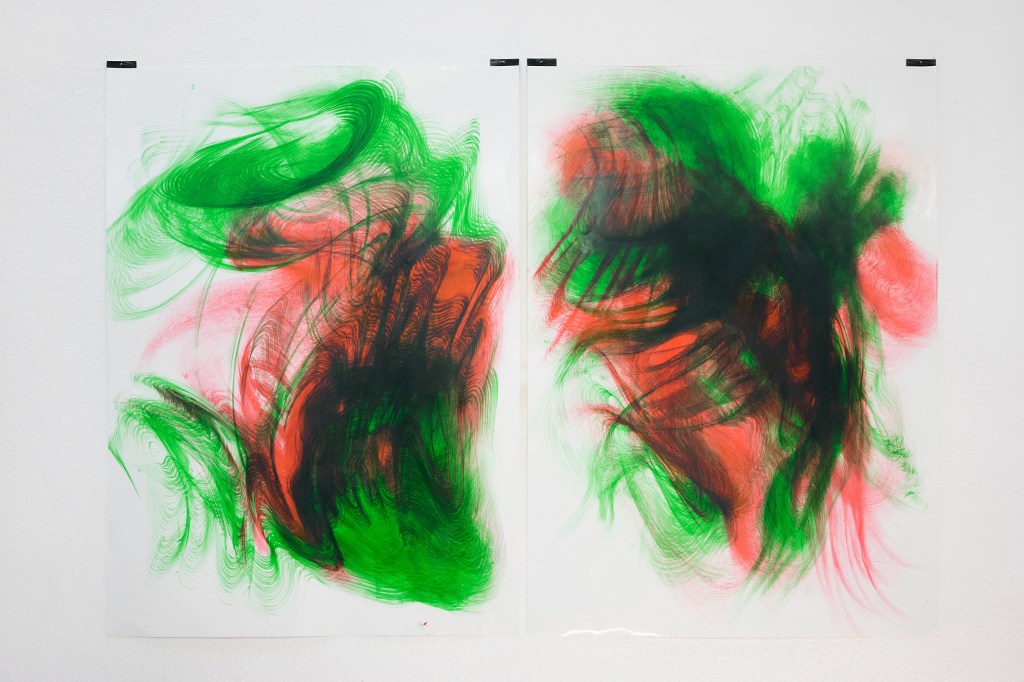
rg3_DSC0702o. T. [ scarlet red and sap green ], 2019, Indian ink on chromolux, 70 x 100 cm
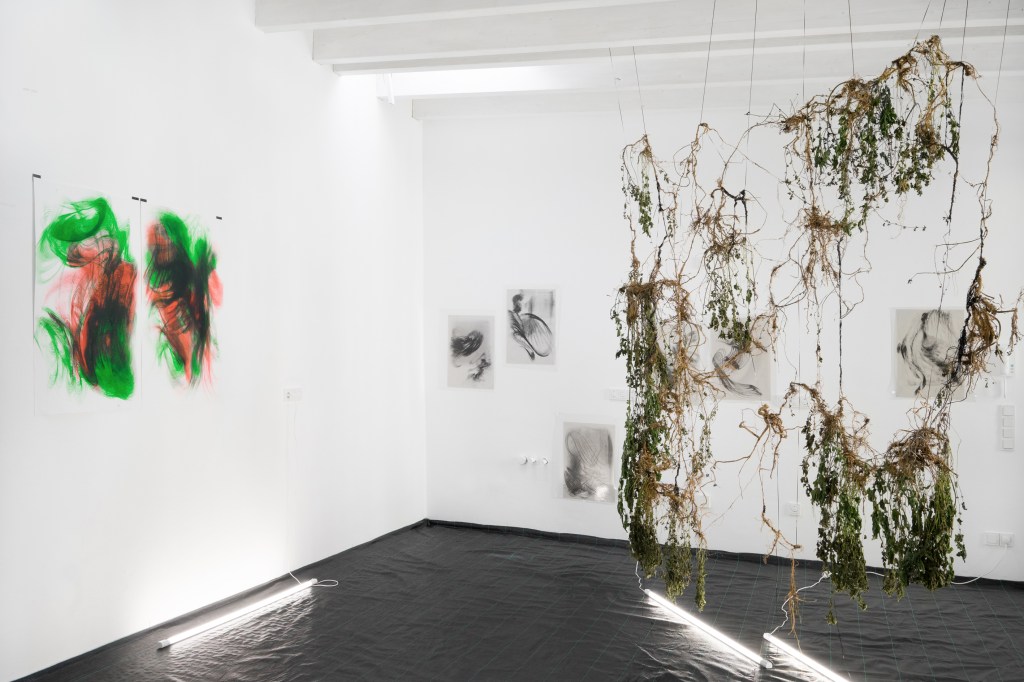
 

12_DSC0475Vier, 2019, installation view


9_DSC0629o. T. [ scarlet red and sap green ], 2019, Indian ink on chromolux, 70 x 100 cm


22_DSC0406Vier, 2019, installation view


13_DSC0395o.  T. , 2019, Stinging nettles,  black plastic, dimensions variable, detail


15_DSC0480o.  T. , 2019, Stinging nettles,  black plastic, dimensions variable, detail


20_DSC0482 o.  T. , 2019, Stinging nettles,  black plastic, dimensions variable, detail


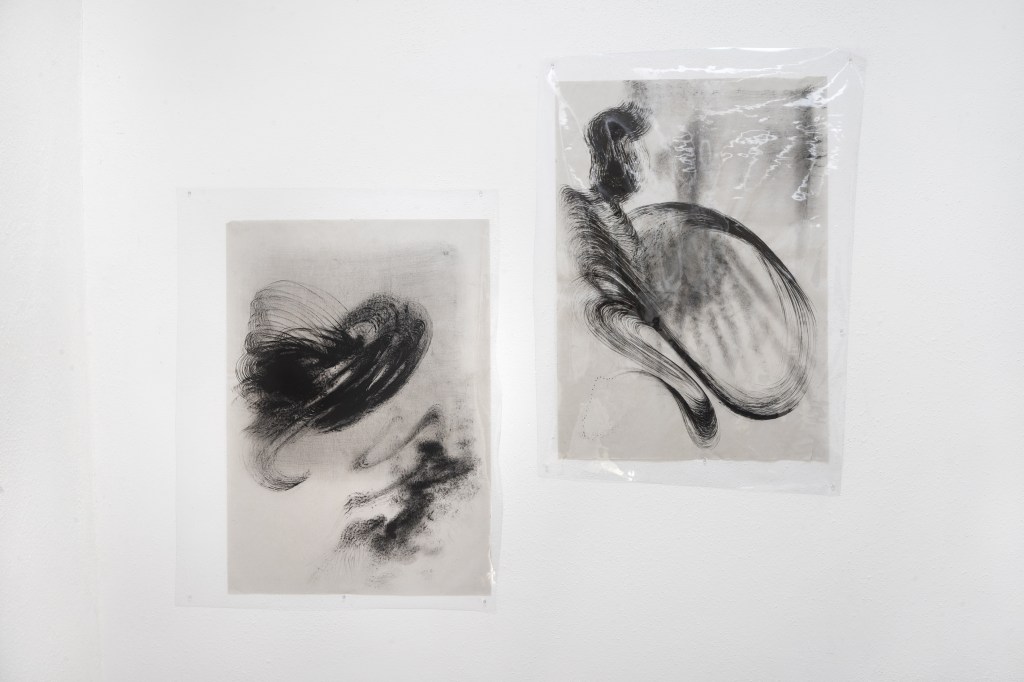
23_DSC0752o. T. [black ], 2019, Indian ink on newsprint, 42 x 60 cm
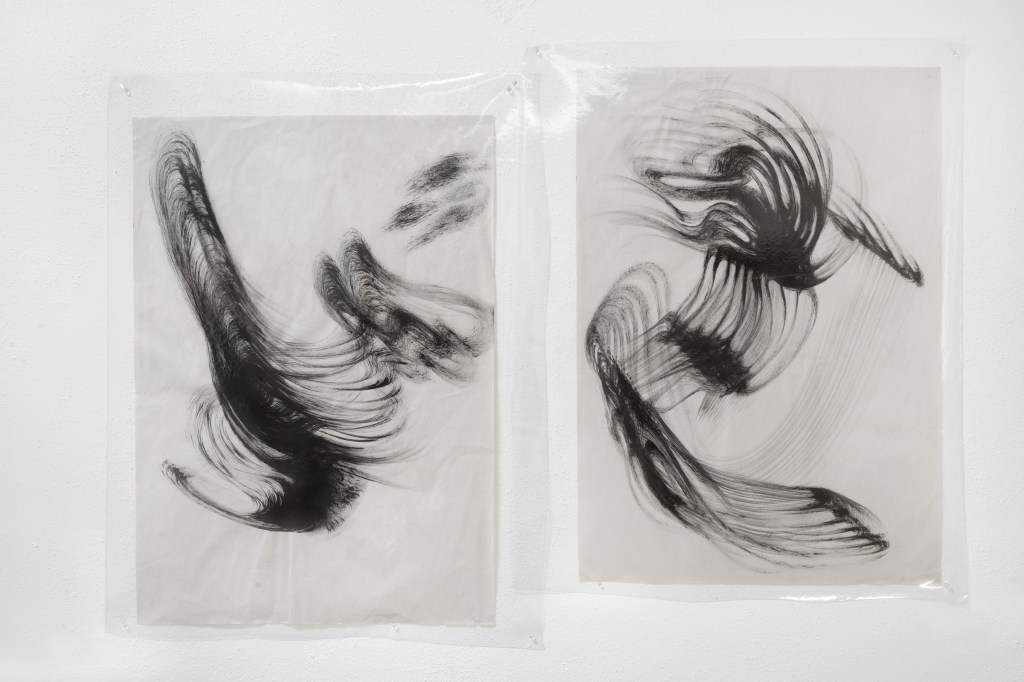
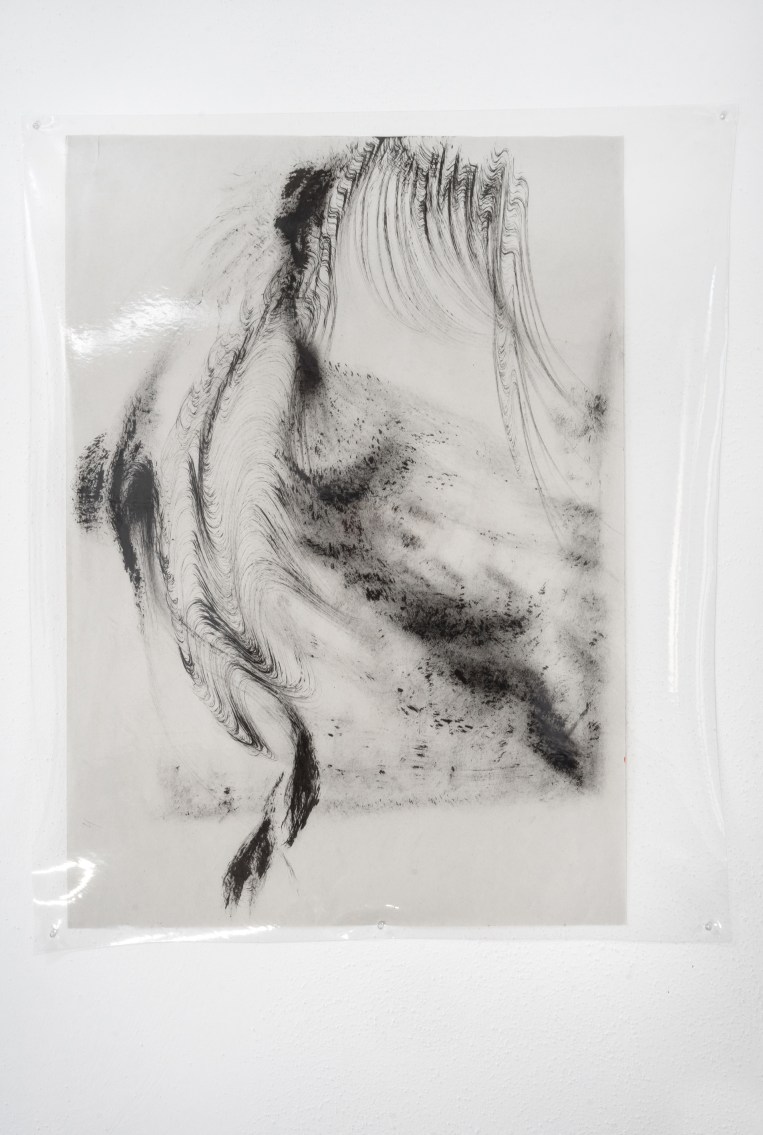
 

26_DSC0755o. T. [black ], 2019, Indian ink on newsprint, 42 x 60 cm
 

28_DSC0780o. T. [black ], 2019, Indian ink on newsprint, 42 x 60 cm


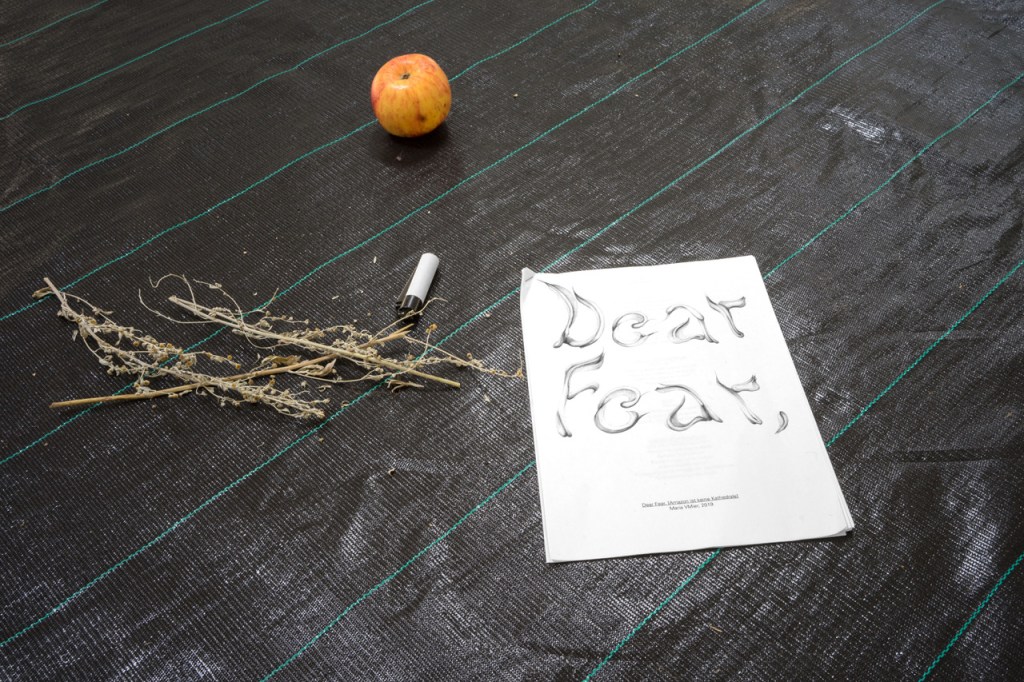
pd_DSC0816Dear Fear, 2019, reading performance


When Adorno was writing his Aesthetic Theory in the 50s and 60s, he could still make the claim, now by all accounts obsolete, that the experience of art is akin to the experience of natural beauty.  “Authentic artworks,” he writes, “hold fast to the idea of a reconciliation with nature by making themselves completely a second nature.” Although already wary of man’s subjugation of nature,  Adorno still believed it was possible to find beauty, if not in nature, then in art that we experience as if it was nature. He would argue we find certain objects in nature beautiful because these present themselves in such a way that allow us to do so.  Artworks are like a second nature because they also allow us to find beauty in them. Genius is nothing more than the creative principle by which this second nature can be produced.

Postmodern and especially feminist critique put this association of natural beauty with the beauty of art into question. While there might be objects that seem to engender claims of beauty, these are by large culturally determined by race, gender or class. Genius is not an innate principle but a historical concept, very much misogynistic in origin, that by definition excludes women from the production of art. So what would it mean to address natural beauty in art now? How can one as an artist approach the problem of nature?

These are some of the questions central to Maria VMier’s practice, and especially to the body of work she presents at GiG Munich, developed during her recent residency at a remote location in Uckermark, near Berlin. On the one hand, the reading she presents to us is a result of her research into the closely connected structures of patriarchy, capitalism and disenchanted nature, taking into account both feminist critique and postcolonial discourse. On site at Uckermack she would walk with her audience to various locations in the surrounding countryside to reflect on her relationship to nature while also referring to our current ecological crisis (the burning of the amazon, climate change denial and climate activism), the political consequences of capitalism’s belief in progress for postcolonial struggles in the global south and ecofeminist attempts to define the common as future sites of resistance. In her writing there is a Thoreau-like longing for a simpler existence within nature as well as the rejection of  hipster or even non-western spirituality, tainted as it is by the colonial representation of the other.

On the other hand her drawings are not so dissimilar to the paintings by Wols that Adorno was writing about more than 60 years ago. Black, scarlet and sap green ink on paper, meandering and interweaving brushstrokes – these formal elements recall the conventions of lyrical abstraction and in their modernism seem to pursue the image of a second nature. But the work also acknowledges that if this image is to be achieved at all it must be done knowingly, the exhibition constructed in such a way to expose the dialectics involved in all our dealings with nature. The meandering arabesques of VMiers large drawings are done on paper more suited to digital printouts than the handmade; the delicate smaller works are pinned like specimens behind plastic covers; the shamanistic frame of drying stinging nettles is set above a shimmering floor of the same plastic sheeting that is used to kill weeds. VMier’s drawings pursue a second nature almost stubbornly, aware of all the historical, political and personal difficulties involved. 

Magdalena Wisniowska 2019

Justina Becker

24.05 – 12.07.2019


P1030657Justina Becker, 2019, installation view


justina28Justina Becker, 2019, installation view


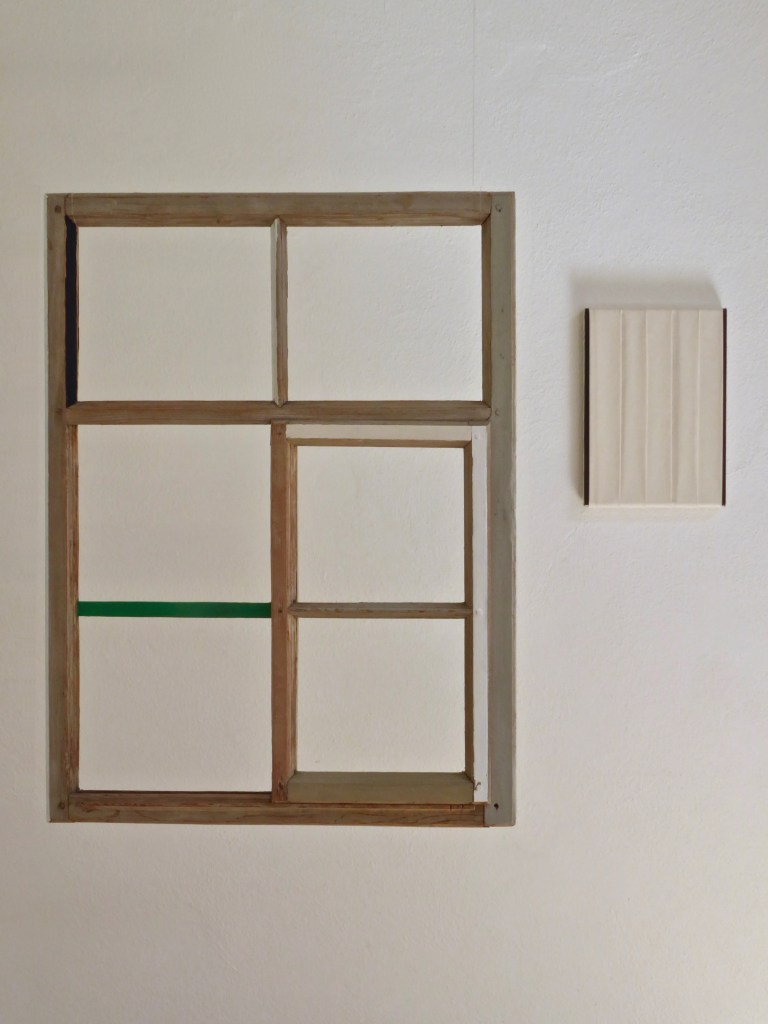
P1030722Justina Becker, untitled, 2019, antique wooden windowframe and egg tempera, dimensions variable


Justina14Justina Becker, 2019, installation view
justina26Justina Becker, 2019, installation view


P1030736Justina Becker, 2019, installation view


P1030735Justina Becker, 2019, installation view


Justina12Justina Becker, 2019, installation view


P1030700
Justina Becker, 2019, installation view


P1030699Justina Becker, o.T., 2015, egg tempera and canvas strips, 20 x 32  cm
P1030716Justina Becker, o.T., 2015, egg tempera on canvas, 20 x 32 cm


P1030719Justina Becker, o. T., 2015, egg tempera on canvas,  20 x 32 cm


P1030686Justina Becker, 2019, installation view


Justina3Justina Becker, 2019, installation view (nighttime)


Justina4Justina Becker, 2019, installation view (nighttime)


Justina2Justina Becker, 2019, installation view (nighttime)
 

All things have a strangeness to them for those who care to look. Their foreignness has been long recognised, whether this takes the form of the thing-in-itself, never to be experienced or trauma, first defined as that which acts like a foreign body in the mind.  We notice the strangeness of objects for instance, when blunt or broken they stop being useful and they turn away from us and each other.  Justina Becker pays close attention to things in their strangeness. The objects she incorporates in her practice are always things that she finds close by, in her house or in the small town where she lives, and almost always, these things have been abandoned, damaged in some regard, without a use. The objects have a history to them – even the viewer not privileged enough to know more of their background, the wheres and hows they came about, can recognise the signs of their previous use. They retain a sense of having lived their own life, among other people and other objects. 

Having studied painting to graduate with Klasse Hildebrand,  Justina Becker approaches her objects with the eye of a painter. Her older work was concerned with the material qualities of painting. How the canvas goes around the stretcher would be important or the way that the canvas keys fit tightly into the corner of a frame.  A shift in her practice occurred when she discovered the readymade and began to use things that previously belonged to someone else. Initially she would wrap these objects in various ways. Some would be covered in a layer of light, sheer fabric almost like a shroud, others would be tightly wound with brightly coloured woollen thread. This protective gesture had a double meaning. On the one hand, it would be a way of hiding the object, obscuring its material qualities and past histories. On the other hand, the object would never be completely covered and through the various gaps and imperfections, its material history would become even more apparent. 

The current exhibition at GiG, shows two of Justina Becker’s older paintings together with a new body of work. One seems at first a straightforwardly abstract, but gives the illusion of a painting shrunk and stretched, the other, consisting of strips of canvas wrapped tightly like a bandage around a stretcher, utilises this double gesture of hiding and revealing. They provide a kind of framework for the new work, a complex installation of hanging window frames, made specifically for the exhibition room at GiG. The wooden windows frames are old, perhaps antique, but with none of the antique’s preciousness. They have been removed and replaced with something better and less rickety, glass taken out, the wood still having some kind of value, even if just as kindling for the fire. These frames have been partially painted by the artist in sympathetic colours and rehanged in the space no longer as windows, or even as architectural elements that would divide the room, but simply for themselves, in their best light. Justina Becker’s work takes on here an almost theatrical element, but the stage she sets is curiously not for us, the viewer, awaiting some kind of grand spectacle. The room in its theatricality is now left for the objects to be in.

Magdalena Wisniowska 2019

Susanne Wagner

Angelina

29.03 – 11.05.2018

Angelina 1-2

Susanne Wagner, Angelina, 2018, installation view. Photo courtesy Susanne Wagner.


Angelina 2

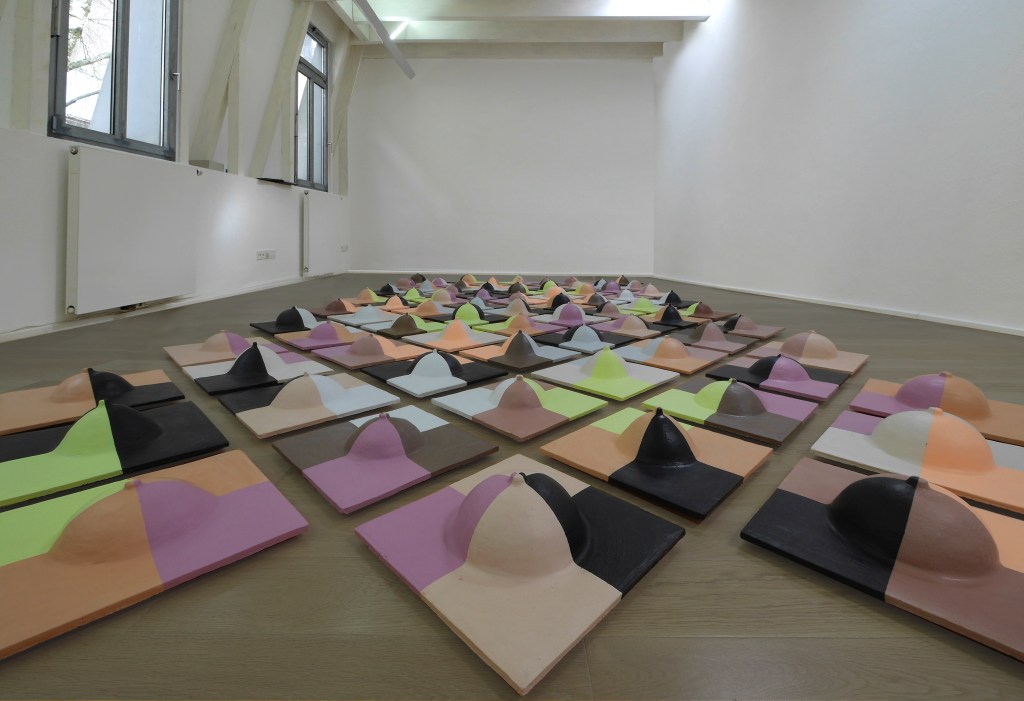
Susanne Wagner, Angelina, 2018, 77 x 40 x 40 cm, painted ceramic. Photo courtesy Susanne Wagner.


Angelina 3
Susanne Wagner, Angelina, 2018, 77 x 40 x 40 cm, painted ceramic. Photo courtesy Susanne Wagner.


Angelina 4

Susanne Wagner, Angelina, 2018, 77 x 40 x 40 cm, painted ceramic. Photo courtesy Susanne Wagner.


Angelina 5

Susanne Wagner, Angelina, 2018, 77 x 40 x 40 cm, painted ceramic. Photo courtesy Susanne Wagner.


GiG Munich is excited to present Angelina, the solo exhibition by German video artist and sculptor, Susanne Wagner.

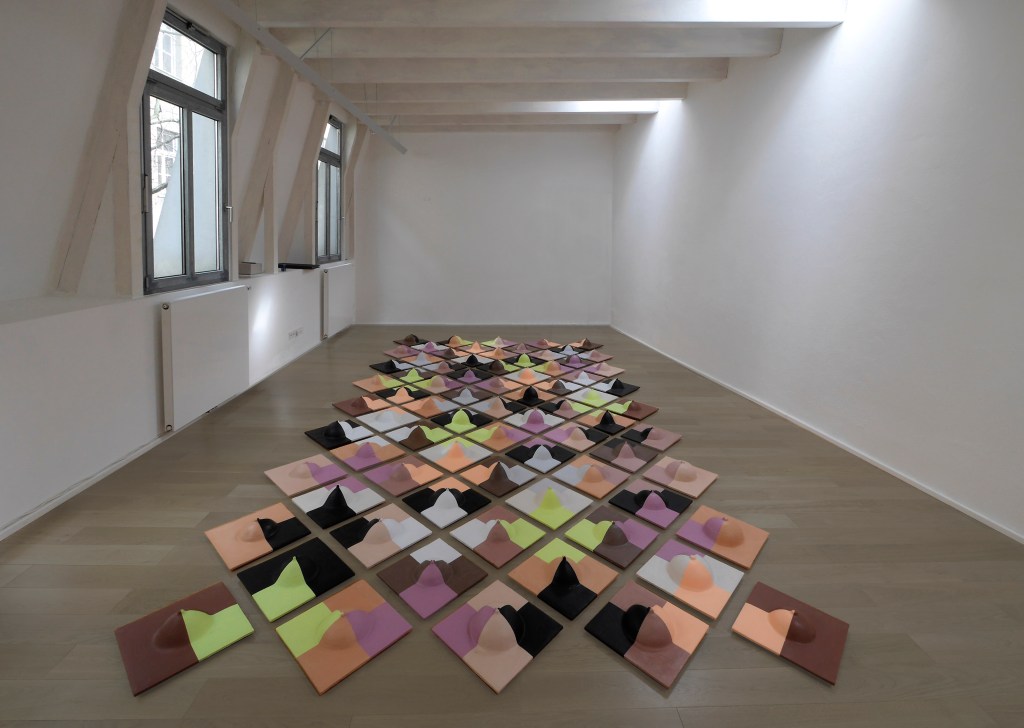
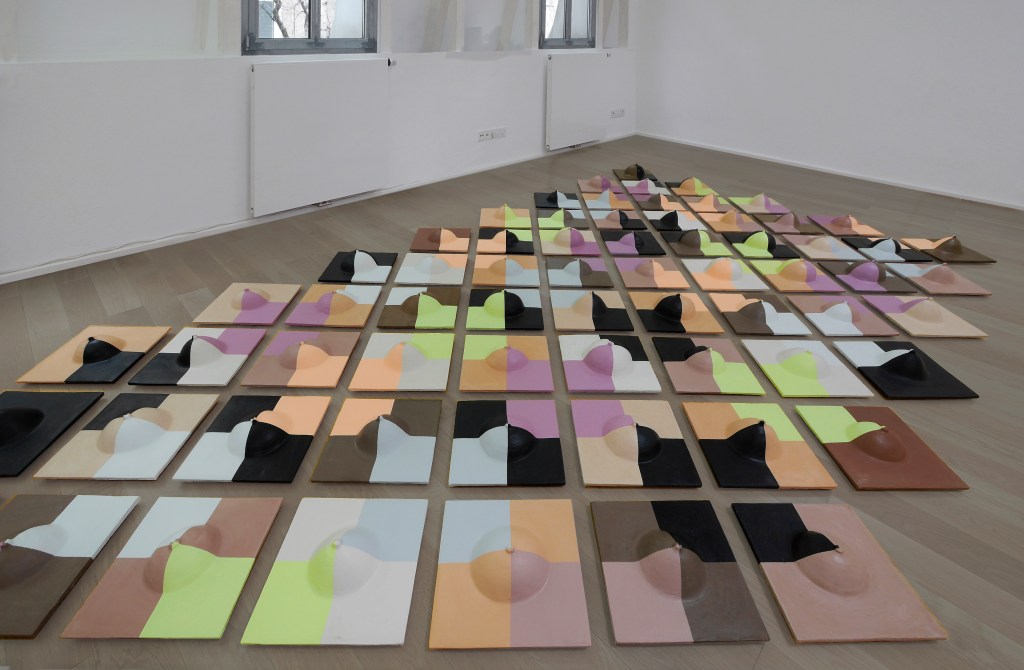
For the exhibition Wagner has produced a new body of work, a large-scale, site-specific floor installation consisting of seventy seven almost identical square ceramic tiles, each 40 x 40 cm individual tile topped by a slightly large than life dome of the female breast. These tiles are arranged in the exact centre of the room in a diagonal grid-like fashion, four or five tiles across, seventeen tiles deep. They are also painted to emphasise this diagonal pattern, again with each tile divided into quarters, or four squares, all in bright, non-primary colours. To stand at the doorway and to look down at the work is to see a pleasing check-board pattern of squares and undulating lines, salmon pinks, lemon yellows and different shades of brown moving across the room.

The arrangement recalls postmodern critiques of originality, best articulated by Rosalind Krauss in her 1986 essay, ‘Originality of the Avant-garde.’ As she argued, any work that makes use of the grid, cannot lay claim to originality, because the grid is a visual device that can only bear repeating. The same way there is no original and unique grid, there is no unique and original art object. Instead, Krauss rewrites the art object as text, whose meaning is determined by the relation it has with other texts. As a text the work of art has no point of origin and no essence; it is only something that can be endlessly reconfigured. In the case of Wagner’s floor piece, even though each tile is handmade and therefore has unique quality, none can claim to be the one original tile, more meaningful than the other.

But what makes Wagner’s work so exciting is that this repetition pertaining to postmodernism’s discussions of originality is complicated by another kind of repetition arising from a very different kind of discourse. For readers of Judith Butler, it has a performative aspect that addresses the ways in which the categories of gender are constructed in a heterosexual normative society. In this way, it is also very timely, considering that in our current era of ♯MeToo activism, many of the norms consolidating sexual and gender hierarchy are being questioned.  It comes down to Wagner’s use of the breast. The female breast is a primary sexual characteristic but it also functions as a signifier of gender. Real women have breasts – and much of the uproar surrounding Angelina Jolie’s mastectomy had to do with our identification of her as the well-endowed Laura Croft, video game sex symbol supreme.  By isolating, enlarging and repeating the form of the female breast Wagner demonstrates that gender is not a given fact. It is neither an expression of some internal essence, nor is it an objective ideal to which we may aspire to. Gender is something we perform, meaning it is brought about through certain acts on our part. And these are repetitive and often mundane, so much so, that they give gender the illusion of a stable identity. The gender identity we take for granted – with all the notions of ‘real womanhood’ that this assumes – are revealed to be nothing more than a re-enactment of a set of meanings already socially and culturally established.

What this means in turn is that the same acts, which give the illusion of stable identity are also the ones that reveal it to be illusory at the moment repetition fails.  Wagner’s work alerts us to the fact that the same process of repetition, which constructs the gender categories binding us, could also be the key to their undoing.

Magdalena Wisniowska 2018