Anna Łuczak, Sophie Schmidt
14.12.2024-2.02.2025









A person has died.
Andrea Éva Győri is dead.
These two statements are not the same, though they might seem very similar. When I say, E. is dead, I think of her and how she was, someone I never met but heard so much about: the tone of her voice, her laugh, her enthusiasm and strong personality. She is someone with a consciousness, a memory, a personal identity. But when I say, a person has died, I mean something different. The logic is different because it is impersonal. It has nothing to do with E. and yet everything to do with her. A person is singular – the one – yet not particular. I cannot say anything specific about a person. A person is dead is an indefinite statement, because a person is a life, and life is indefinite, singular, impersonal.
How can I describe a life? Without talking about E. who lived? Deleuze was right, this requires an empiricism, an empirical kind of thinking, an almost scientific kind of rigour. I keep making lists:
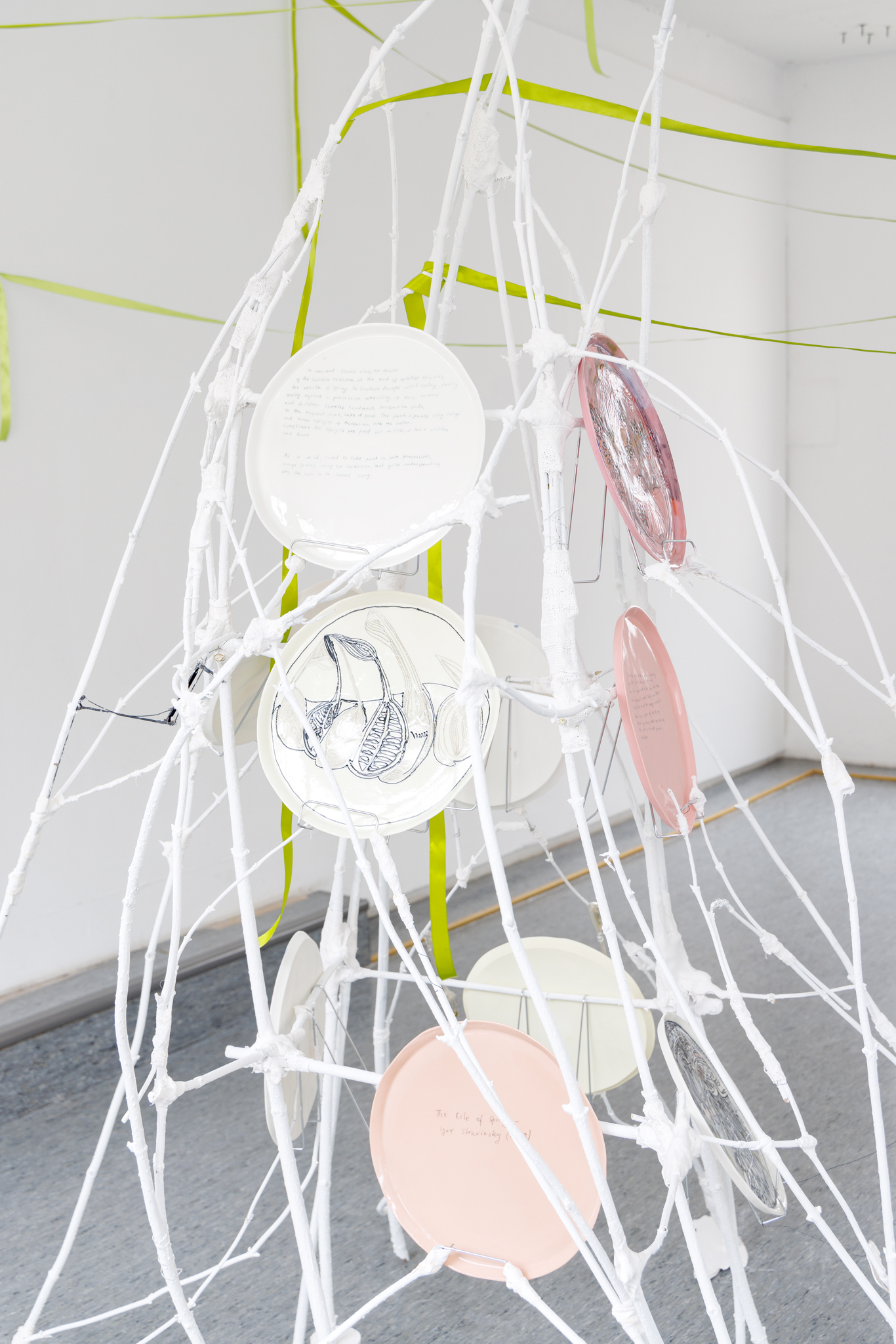
- There is the Marzanna, an effigy out of twigs and straw that Polish children drown in a nearby river as spring approaches.
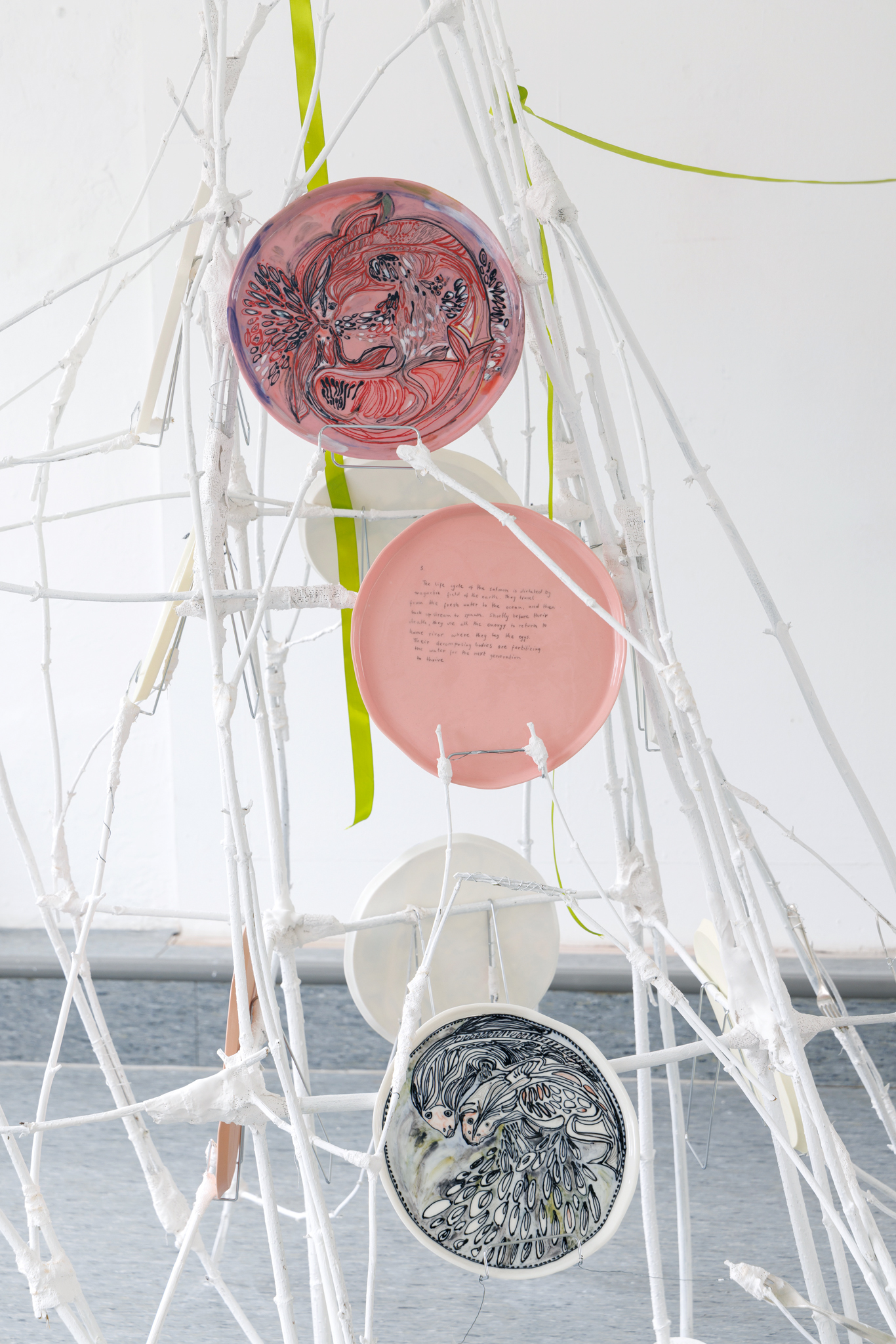
- There is the life cycle of the salmon, swimming upstream and spawning, then dying and their bodies fertilising the river.
- Did you know that skeletal muscle stem cells continue living up to 17 days after all other cells have died?
- That scene in Dicken’s novel, “Our Mutual Friend,” when the Rogue lays dying in Miss Abbey’s first-floor bedroom. While he barely breaths everyone tries to help, but as soon as his eyelid trembles, his nose twitches, the doctor and the four men grow distant and caution returns.
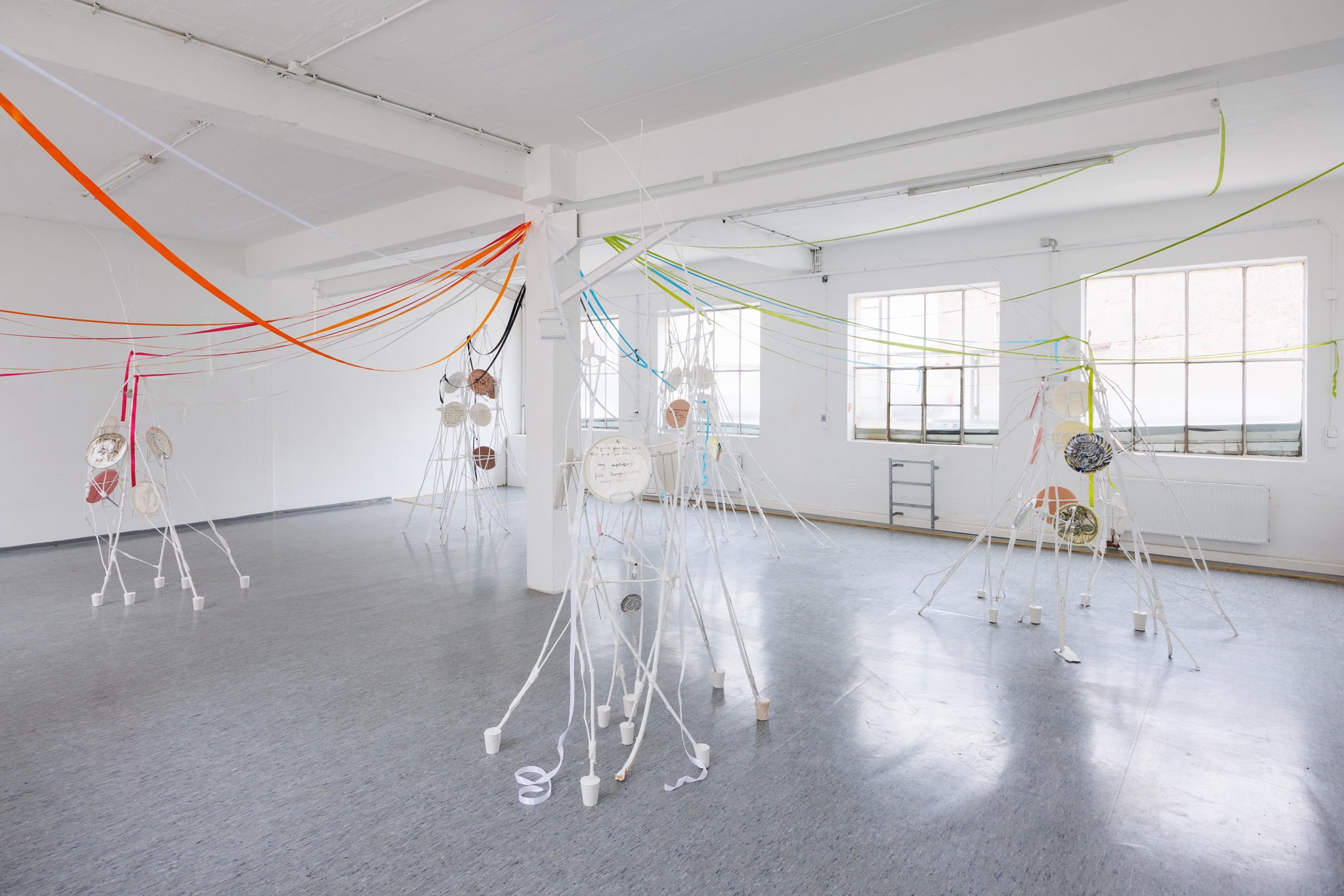
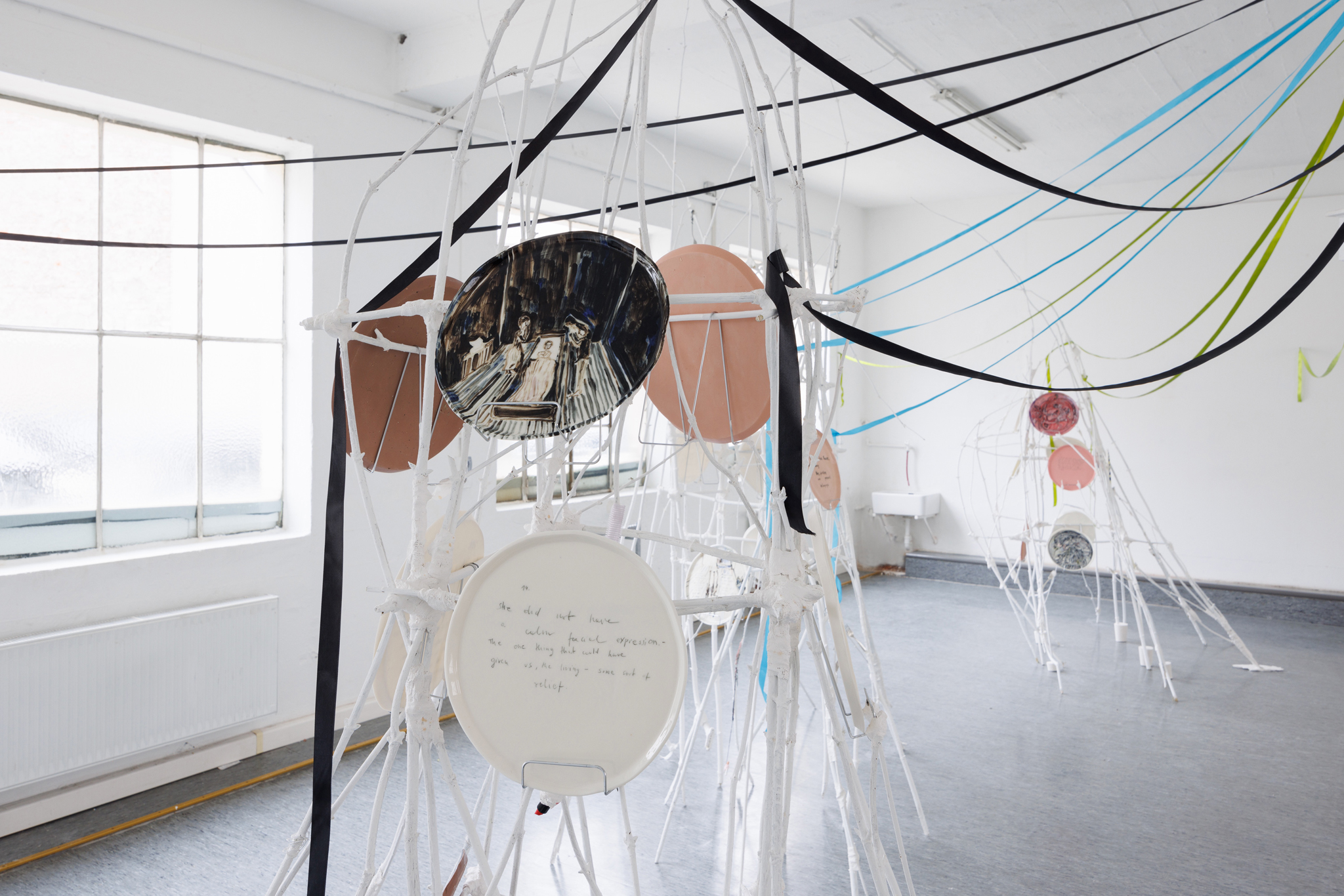
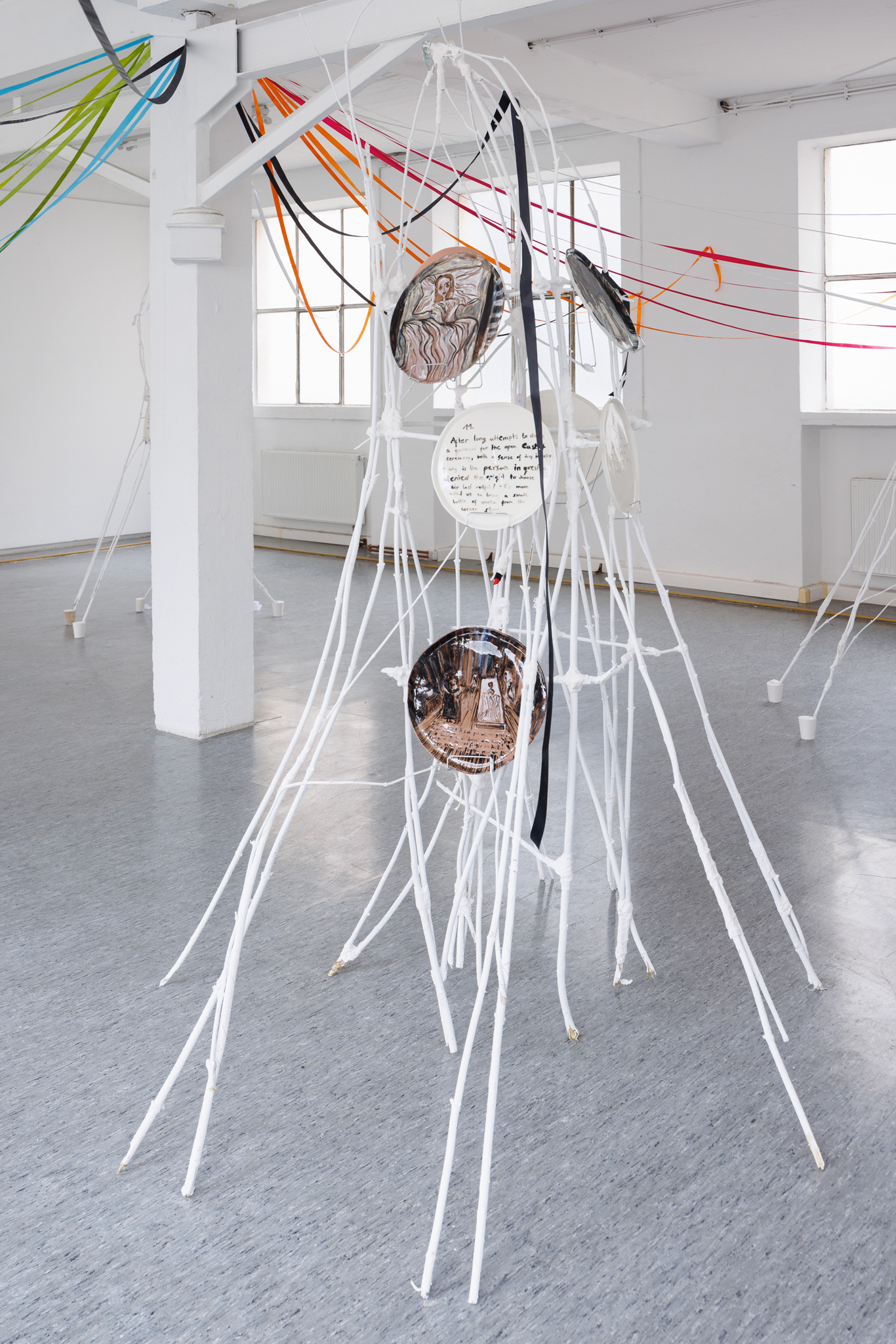
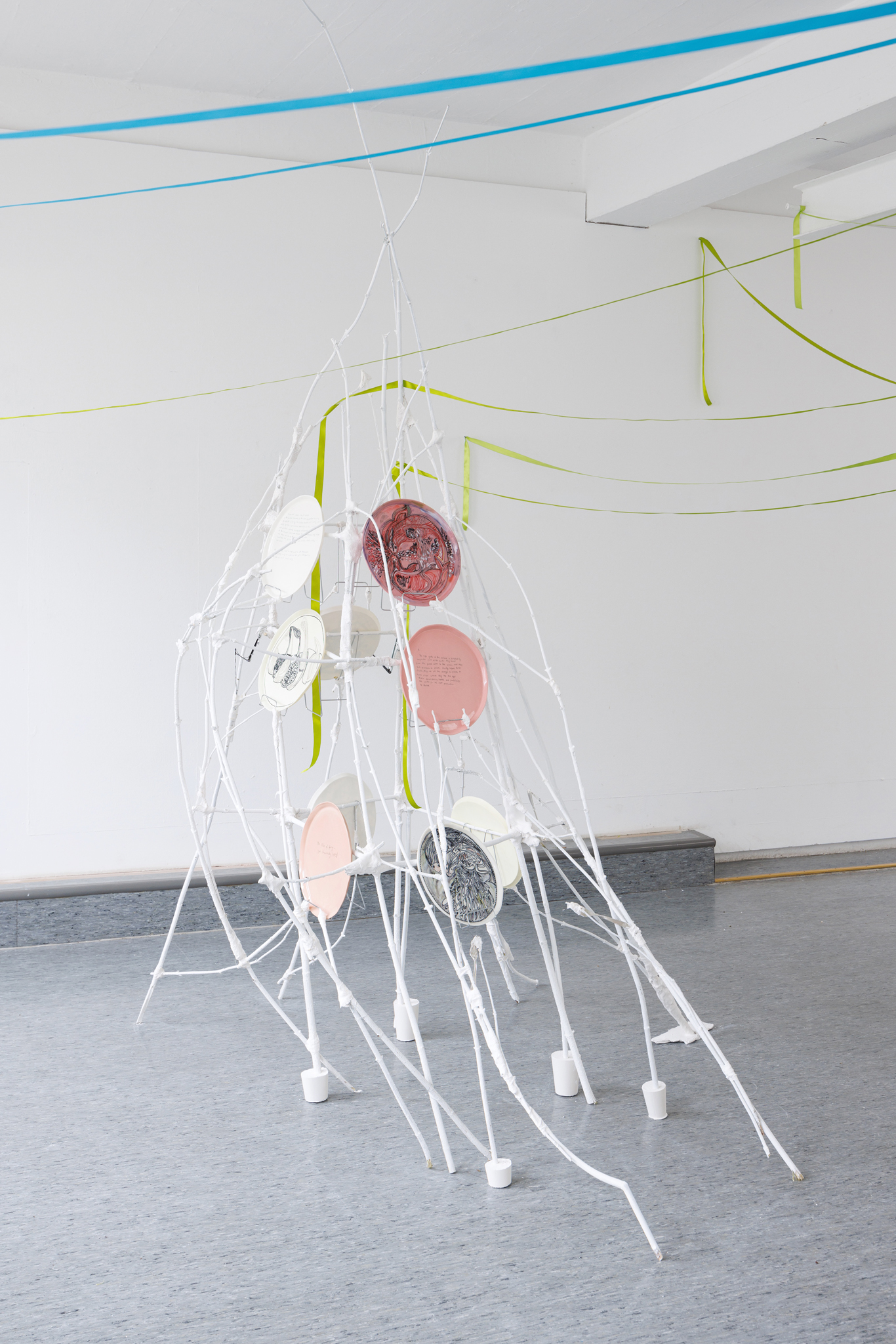
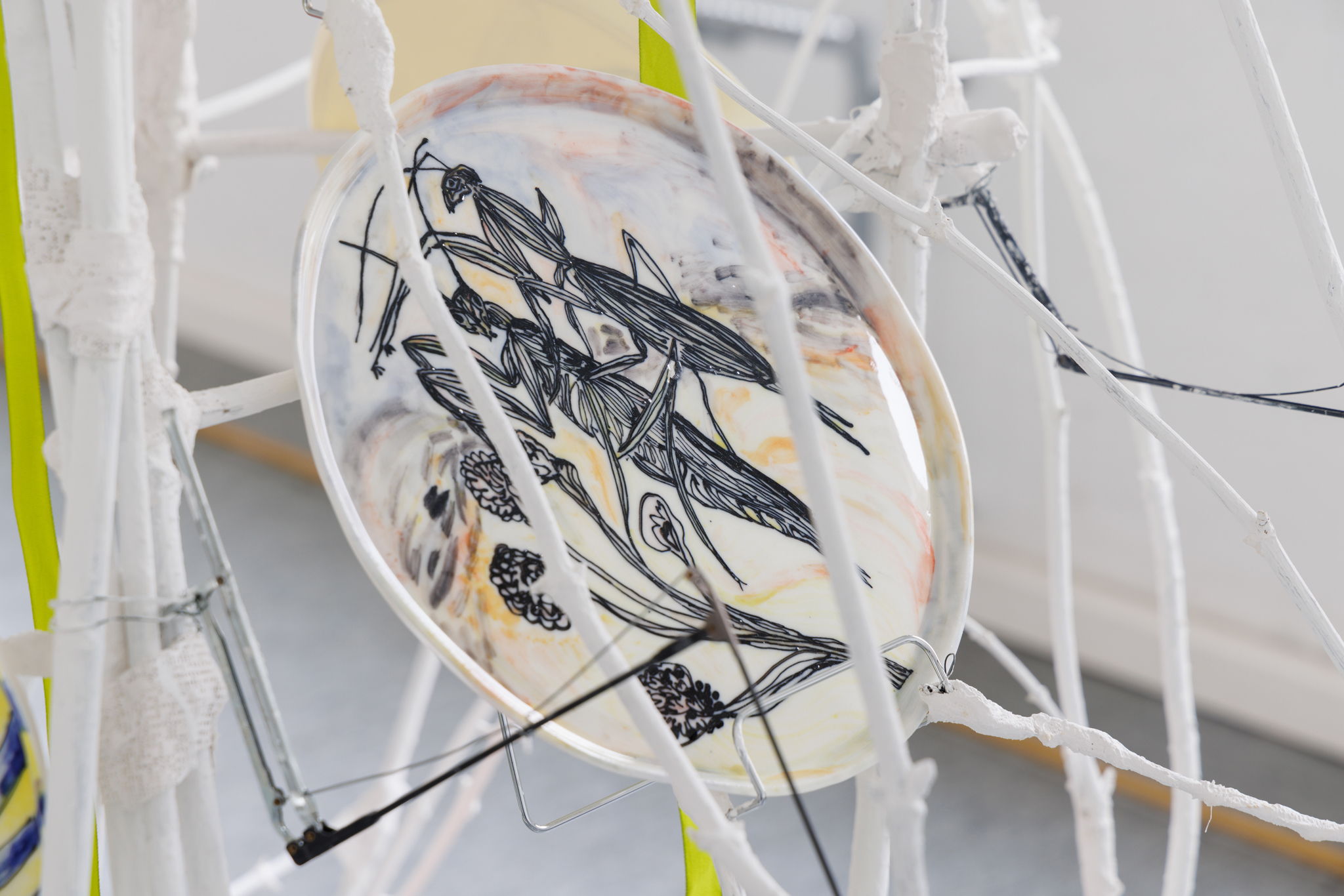
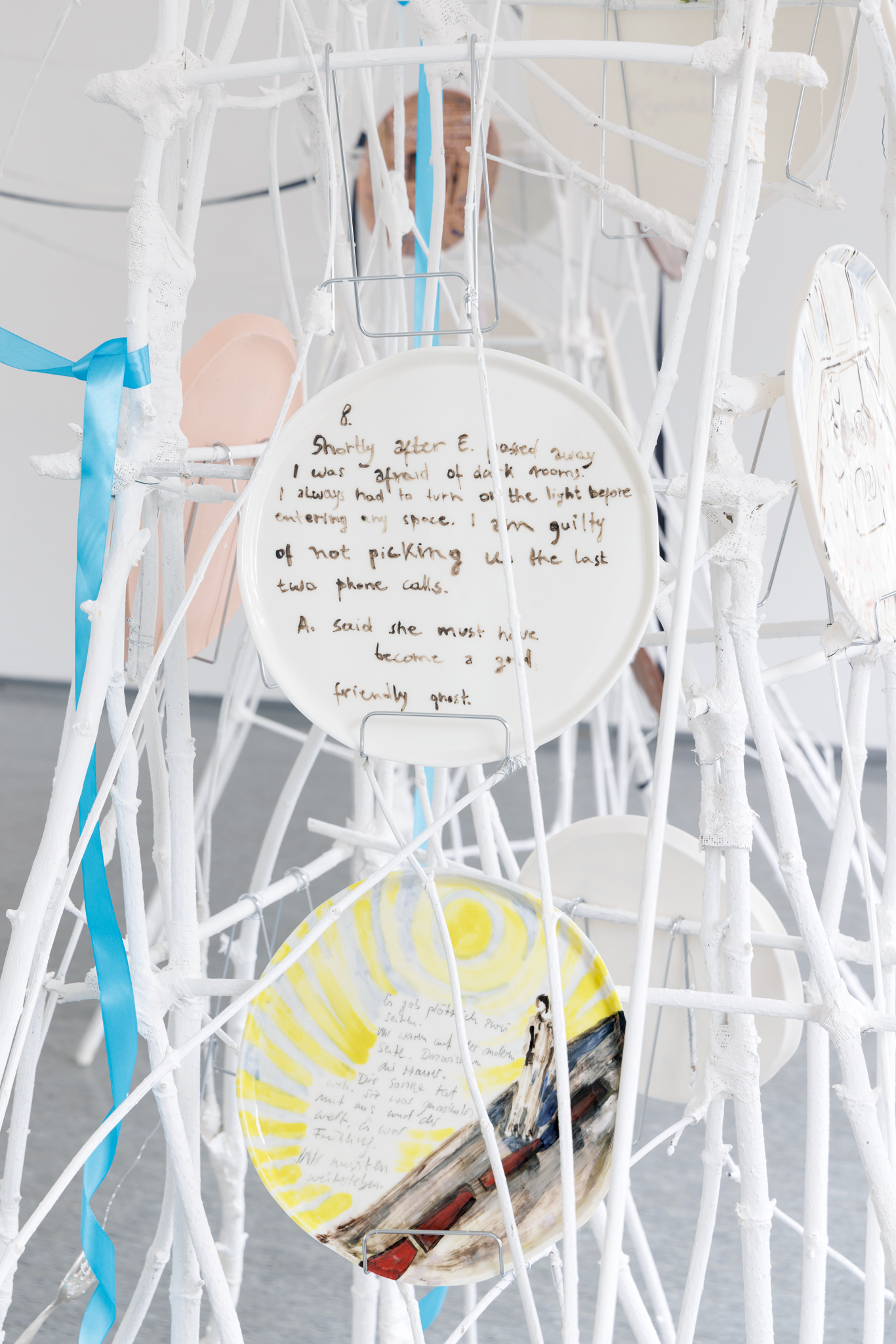
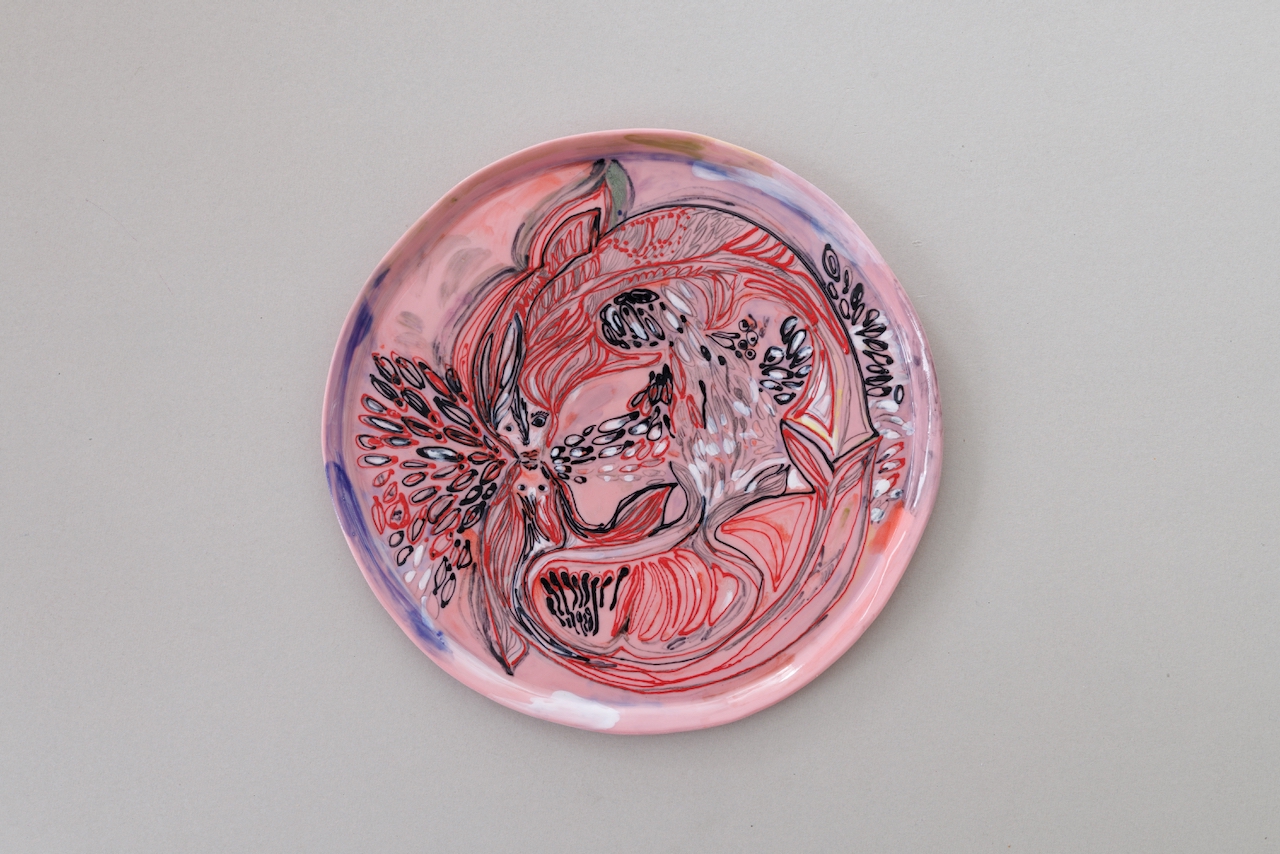
Anna Łuczak and Sophie Schmidt made a series of porcelain plates together, as individual responses to E.’s passing. Anna made the plates and wrote the texts, Sophie painted images:
- There is the day of E.’s diagnosis. The breast cancer.
- There is the day at the crematorium.
- And the time just after, laying on the floor.
- There is salmon spawning, seeds germinating.
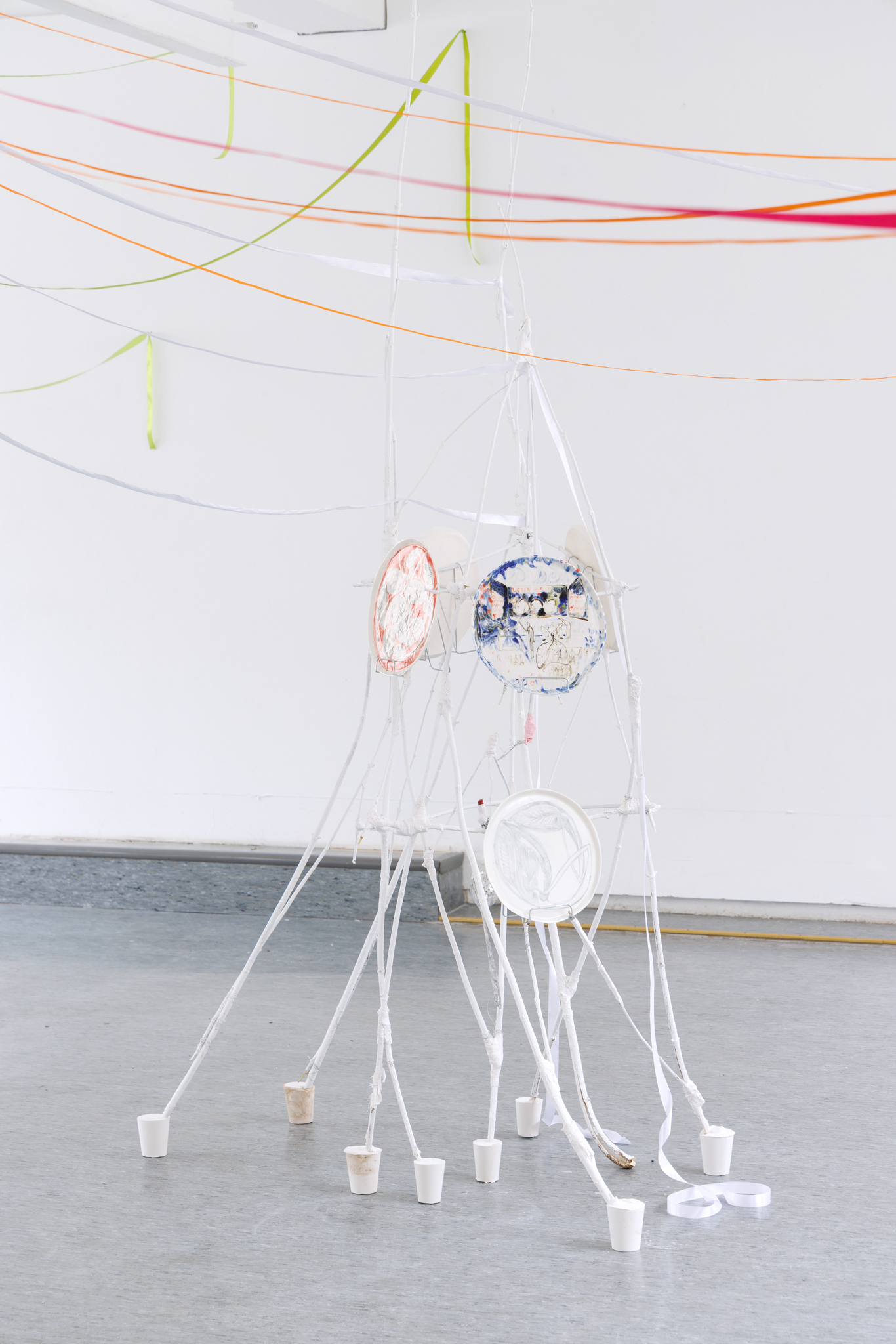
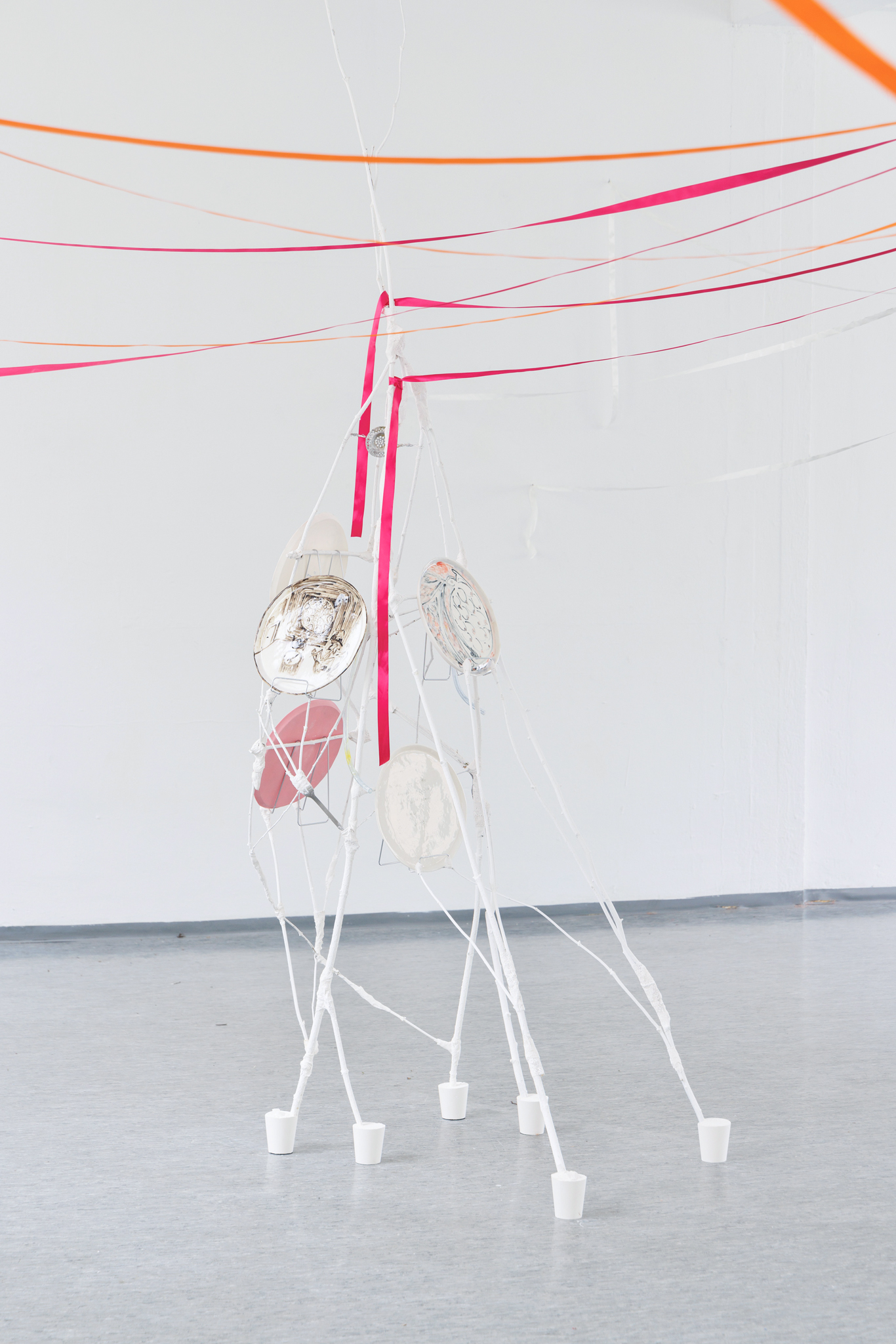
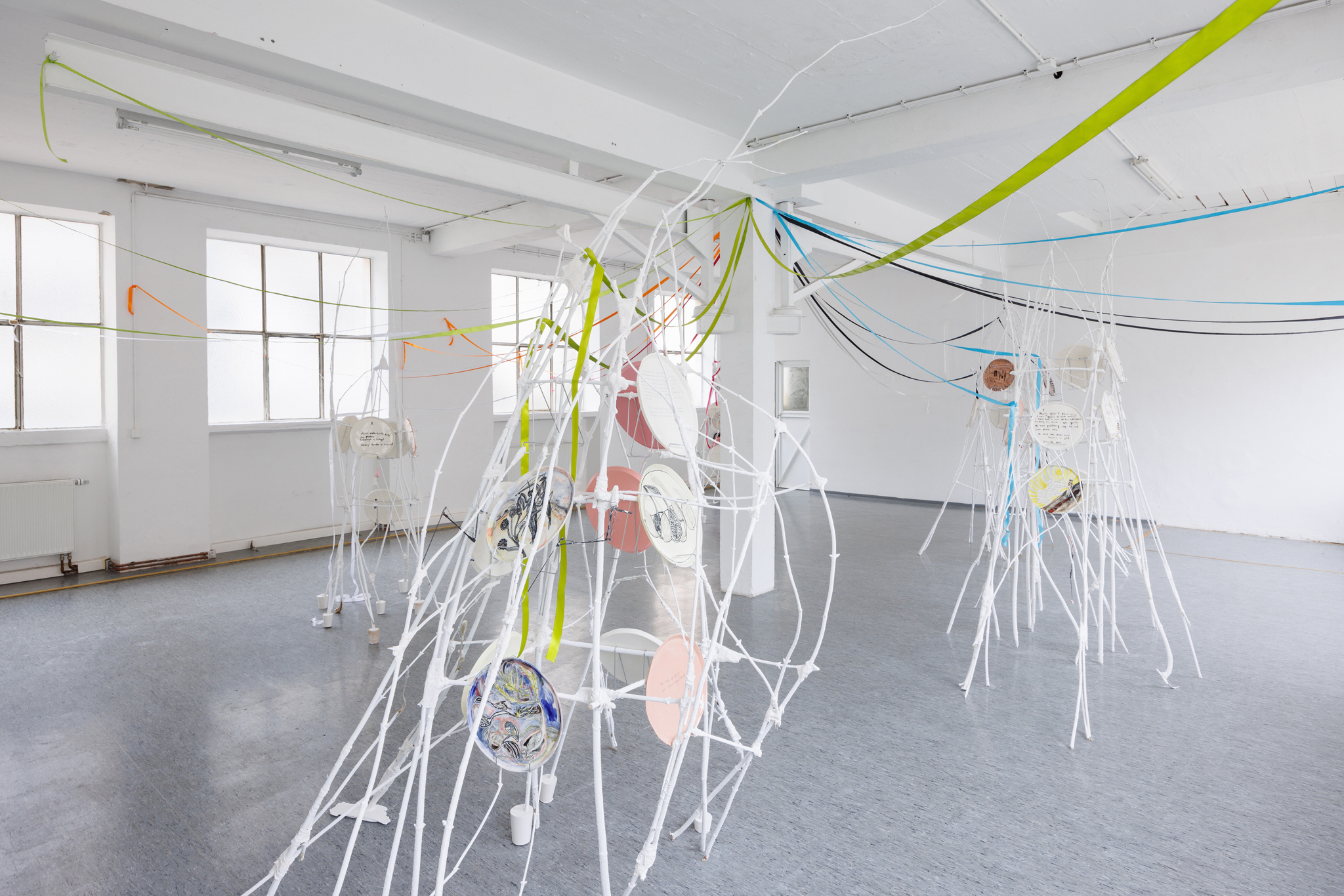
The plates refer to the domestic language of the vanitas. We eat on them with fork and knife, we wash them and we put them away. The colourful ribbons belong to the “kapliczka,” the wayside shrine found on nearly every road in Poland, equally catholic and pagan. Sophie Schmidt’s wooden structures hold everything together ever so precariously, extensions of the body, with the body’s fragility, strength and breakability.
Eine Person ist gestorben.
Andrea Éva Győri ist tot.
Diese beiden Aussagen sind nicht identisch, obwohl sie sehr ähnlich erscheinen mögen. Wenn ich sage: „E. ist tot“, denke ich an sie und an die Person, die sie war, obwohl ich sie nie persönlich kennengelernt, dafür aber viel über sie gehört habe: vom Klang ihrer Stimme, ihrem Lachen, ihrer Begeisterung und starken Persönlichkeit. Sie ist jemand mit Bewusstsein, Erinnerung und einer persönlichen Identität. Aber wenn ich sage, „eine Person ist gestorben“, meine ich etwas anderes. Die Logik ist eine andere, weil sie unpersönlich ist. Es hat nichts und alles mit ihr zu tun.
Eine Person ist einzigartig – genau die eine – und doch nicht besonders. Ich kann nichts Spezifisches über eine Person sagen. „Eine Person ist tot“ ist eine unbestimmte Aussage, denn eine Person ist ein Leben, und Leben ist unbestimmt, singulär, unpersönlich.
Wie kann ich ein Leben beschreiben? Ohne über E. zu sprechen, die gelebt hat? Deleuze hatte Recht, dies erfordert Empirie, eine empirische Art des Denkens, eine nahezu wissenschaftliche Gründlichkeit. Ich mache immer weitere Listen:
- Da ist die Marzanna, eine Puppe aus Zweigen und Stroh, die von polnischen Kindern in einem
nahegelegenen Fluss ertränkt wird, wenn der Frühling naht. - Da ist der Lebenszyklus der Lachse, die stromaufwärts schwimmen und laichen, dann sterben und mit
ihren Körpern den Fluss befruchten. - Wussten Sie schon, dass die Stammzellen der Skelettmuskeln bis zu siebzehn Tage weiterleben, nachdem
alle anderen Zellen bereits abgestorben sind? - Diese Szene in Dickens’ Roman „Unser gemeinsamer Freund“, als der Schurke sterbend im Schlafzimmer von Miss Abbey im ersten Stock liegt. Während er kaum noch atmet, versuchen alle zu helfen, aber sobald sein Augenlid zittert, seine Nase zuckt, werden der Arzt und die vier Männer misstrauisch und zurückhaltend.
Anna Łuczak und Sophie Schmidt haben als individuelle Reaktionen auf E.s Tod gemeinsam eine Serie von Porzellantellern entworfen. Anna schrieb Texte, Sophie malte Bilder:
- Da ist der Tag von E’s Diagnose. Der Brustkrebs.
- Da ist der Tag im Krematorium.
- Und kurz danach, als wir auf dem Boden lagen.
Der Lachs laicht, die Samen keimen.
Die Teller verweisen auf die häusliche Sprache der Vanitas. Wir essen auf ihnen mit Gabel und Messer, wir waschen sie ab und wir räumen sie weg. Die bunten Bänder gehören zu den „kapliczka“, den Bildstöcken, die man in Polen an fast jeder Straße findet, gleichermaßen katholisch wie heidnisch. Sophie Schmidts Holzkonstruktionen halten alles auf äußerst fragile Weise zusammen, sie sind Verlängerungen des Körpers, mit seiner Zerbrechlichkeit, Stärke und Brüchigkeit.
Magdalena Wiśniowska 2024
 GiG
GiG 